
So you’re ready to give red light therapy a go. You like the idea of better energy, improved recovery, deeper sleep, healthier skin, and maybe even less inflammation. But you don’t want to drop $4,000–$5,000 on a full-body panel.
The challenge is this: once you start looking, you quickly realize there are dozens of tabletop panels under $500. They all look similar. They all promise “clinically proven wavelengths.” And they all claim impressive power output.
Sorting through that takes hours.
After years of testing red light therapy devices — not just reading spec sheets, but actually measuring irradiance with a spectrometer, checking EMF levels, and using these panels consistently myself — I’ve narrowed it down to three standout tabletop options at or below $500.
Today, we’re breaking down:
- Hooga
- Mito Red Light
- Rouge
I’ll explain who each panel is for, where they shine, and which one I think delivers the best overall value.
What We’re Actually Trying to Achieve
Before comparing models, it’s important to clarify the goal.
We’re not looking for a device to treat one specific injury. We’re aiming for general health optimization — something that can support energy, recovery, sleep, skin health, and overall wellness.
With a $500 budget, we’re realistically looking at a tabletop panel in the range of 50–100 LEDs. These won’t treat your entire body in one session like a large full-body panel would. But here’s the key point: You don’t need a $5,000 panel to get results.
A quality tabletop panel delivers the same therapeutic wavelengths and similar energy output as a larger device. The difference is coverage area. You simply reposition it during your session. Yes, that costs you a bit more time. But the light entering your cells is the same.
So what really matters when choosing between them?
What Matters When Evaluating a Panel
Wavelengths
Red light therapy works because specific wavelengths penetrate tissue and stimulate mitochondrial activity.
The two foundational wavelengths are:
- 660 nm (visible red)
- 850 nm (near infrared, invisible to the eye)
Many modern panels now include additional wavelengths such as 630, 810, 830, and even 1060 nm.
More wavelengths can mean more tissue depth targeting and potentially broader biological effects. Is more always better? Not necessarily. But if two similarly priced panels exist and one offers eight wavelengths while another offers only two, that variety is worth considering.
Power Output
Measured in milliwatts per square centimeter (mW/cm²), this tells us how much energy is actually reaching the body.
Higher power output can allow for deeper penetration and shorter treatment times.
Manufacturer claims tend to be… optimistic. That’s why I measure these myself using a spectrometer. Real-world output matters far more than marketing numbers.
Features and Usability
This is often overlooked. Does it have:
- A built-in timer?
- Independent wavelength control?
- Preset programs?
- App or remote functionality?
These things don’t change the biology — but they absolutely affect consistency. And consistency determines results.
Build Quality and Warranty
A longer warranty usually reflects a company’s confidence in their product. If you’re investing several hundred dollars, you want something that lasts.
Total Cost
Sticker price isn’t everything. Shipping and taxes — especially internationally — can significantly change the final number.
With that framework in mind, let’s walk through the three contenders from lowest price to highest.
Entry-Level Simplicity: Hooga HG300 Pro
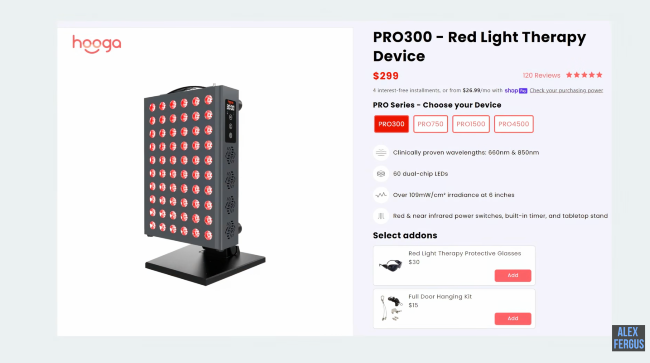
If your budget is firmly capped at $300, this is where you start.
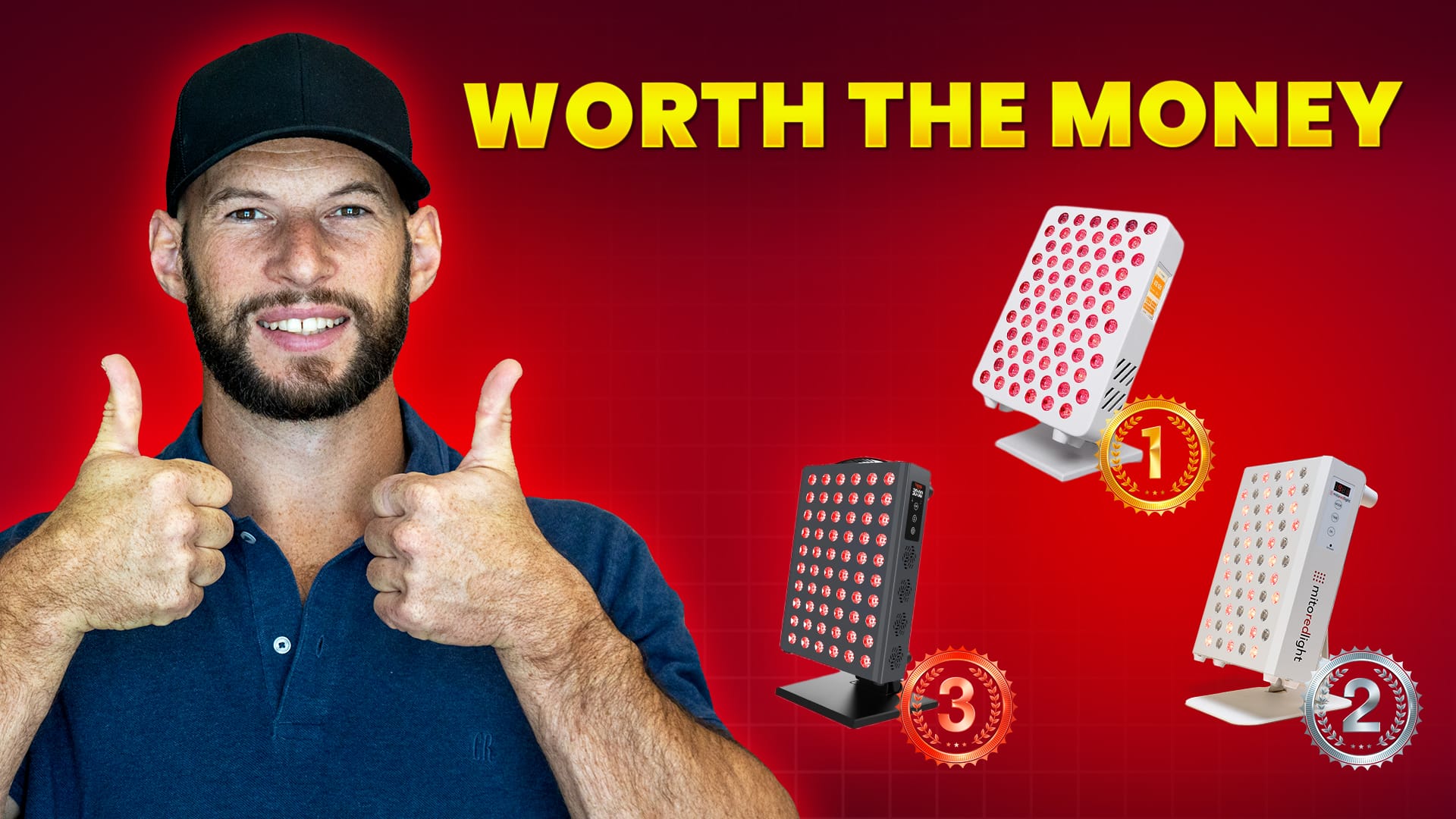
The Hooga 300 Pro sits right at that $300 mark with free US shipping. It includes 60 dual-chip LEDs emitting 660 nm red and 850 nm near infrared. The two most established therapeutic wavelengths.
This is a straightforward, no-frills panel. You’re not getting extra wavelengths. You’re not getting advanced controls. You’re not getting extended warranty coverage, it comes with a 3-year warranty.
But what you are getting is legitimate therapeutic light at an ultra-accessible price point.
If $300 is your absolute ceiling, this is a solid entry into red light therapy. You’ll still stimulate mitochondrial activity. You’ll still deliver energy into your tissues. You’ll still see benefits with consistent use. It’s basic but it works.
If you’re after more flexibility and more features, though, the next step up becomes very compelling.
The Sweet Spot for Most People: MitoPRO 300 by Mito Red Light
At roughly $370 after discount, the Mito Red MitoPro 300 panel represents a noticeable upgrade without a huge jump in price.
It also includes 60 dual-chip LEDs, but instead of two wavelengths, you get four: 630 nm, 660 nm, 830 nm and 850 nm
That added 830 nm near infrared is particularly interesting. If I had to choose between 830 and 850 nm alone, I’d probably lean toward 830, though that’s a deeper discussion for another day.
More wavelengths mean broader therapeutic coverage. But the improvements aren’t just in the spectrum.
This panel includes:
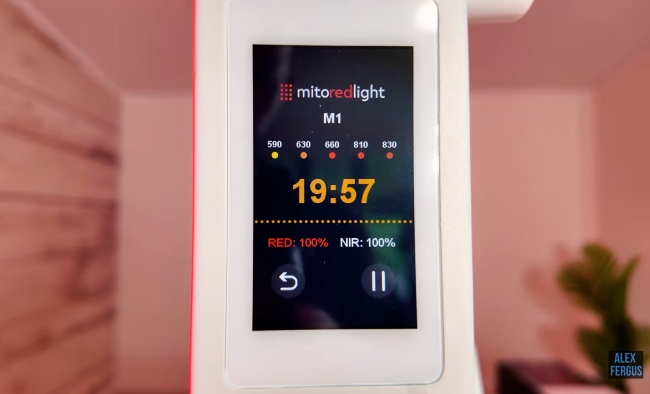
- An LCD control panel
- Built-in timer with automatic shutoff
- Independent red and near-infrared control
- Included stand
- 3-year warranty
For about $70 more than the Hooga (for US customers), you get more wavelengths, more control, better usability, and an extra year of warranty.
For most people in the US, this strikes the best balance between price and performance.
International buyers should note shipping can add around $80 depending on location, which may shift the value equation slightly.
The Premium Pick: Rouge Tabletop G4
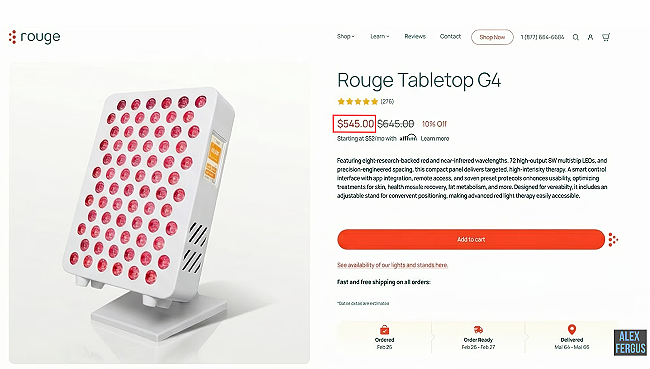
Now we step slightly above the $500 line — roughly $540.
But here’s why I’m including it. The Rouge Tabletop G4 is built for someone who wants the most advanced technology in this size category and is willing to stretch their budget to get it.
This panel features eight wavelengths: 630, 650, 660, 670, 810, 830, 850 and 1060 nm
That’s four red wavelengths for skin-level benefits and four near-infrared wavelengths for deeper tissue penetration, double what the MitoPRO offers.It also includes 72 five-watt multi-chip LEDs, which 12 more than the MitoPRO 300.
I’ve tested panels in the G4 series extensively. I personally use the larger G4 Ultimate model. The technology, wavelength configuration, and build quality are consistent across the series. This is a serious piece of equipment.
Feature-wise, it’s comprehensive:
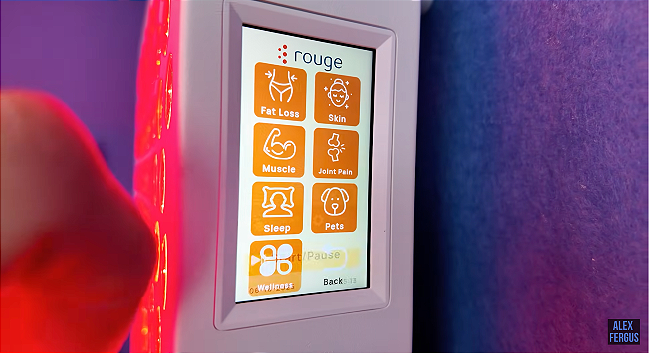
- Intuitive touchscreen
- Seven preset modes (wellness, skincare, sleep, muscle recovery, fat loss, joint pain, pets)
- Adjustable dimming for each wavelength independently
- Pulsing capability
- Bluetooth app control
- Digital timer with alarm
- Wireless connectivity to link additional G4 panels
You are absolutely paying for those extra features and expanded spectrum. If your budget is tight, this may not be realistic. But if you can stretch to that $540 mark, you’re getting meaningful upgrades in wavelength variety, LED count, usability, and expansion potential.
So Which One Should You Choose?
Let’s simplify it.
If your budget is firmly locked at $300, go with the Hooga HG300 Pro. It’s simple, foundational, and gets the job done.
If you want better features, more wavelengths, and a longer warranty without jumping dramatically in price, the MitoPRO 300 is probably the smartest move for most people.
But if you want the most advanced technology in this tabletop size — maximum wavelength diversity, advanced controls, app integration, pulsing, and future expandability — and you can stretch slightly above $500, then the Rouge Tabletop G4 would be my top recommendation.
At the end of the day, all three deliver therapeutic red and near-infrared light.
The difference comes down to how much flexibility, control, and future-proofing you want — and how much you’re willing to invest to get it.
Links for Products
⭐ If you want the Hooga device, click the following link: https://aferg.co/hooga-rlt.
⭐ For A Mito Red panel, use the following link for a discount: https://aferg.co/7d221.
⭐ For a Rogue use this link https://aferg.co/rougecare - code ALEX saves
Have You Seen These Reviews
🔴 Red Light Therapy Mask Comparing Test: 25 Masks Ranked And Reviewed
🔴 Rouge Red Light Therapy Review: Is It Worth the Investment?
🔴 MitoGlow LED Mask Review: The Best Red Light Therapy Mask I've Ever Tested
🔴 The Biggest Red Light Buying Regret (And How to Avoid It)
Found This Interesting? Look At These Articles
🔴 Is Red Light Therapy Safe for Your Eyes?
🔴 Celebrities Using Red Light Therapy: 7 Epic Examples 2026
🔴 The Red Light Therapy Facial Fat Loss Link: Myth Or Reality?
🔴 Does Red Light Therapy Help Scars? The Science
Alex's Bio
Alex Fergus wrote this blog post. Alex is an ISSN Sports Nutrition Specialist, Fitness Professional, and certified Superhuman Coach who continues to expand his knowledge base and help people worldwide with their health and wellness. Alex is recognized as the National Record Holder in Powerlifting and Indoor Rowing and has earned the title of the Australian National Natural Bodybuilding Champion. Having worked as a health coach and personal trainer for over a decade, Alex now researches all things health and wellness and shares his findings on this blog.
Frequently Asked Questions
What is red light therapy?
Red light therapy uses red and near-infrared wavelengths of light to support normal cellular energy and recovery. It’s often referred to as photobiomodulation (PBM). If you're comparing devices and brands, you can check the discounts page for current deals and recommendations.
How does red light therapy work?
Red and near-infrared light can be absorbed by mitochondria in cells, which may help support ATP production and normal cellular repair processes.
What wavelengths are used in red light therapy?
Most red light therapy devices use wavelengths roughly between 630 nm and 880 nm. Common wavelengths include 630 nm, 660 nm, 810 nm, 830 nm, and 850 nm.
What’s the best red light therapy panel?
The best red light therapy panel depends on coverage needs, power output, wavelengths, and budget. Before buying, it's smart to check the discounts page to compare brands and deals.
Red light panel vs mask: which should I choose?
Red light panels usually provide broader coverage and higher power output, while masks are designed primarily for facial skin treatments.
What does low EMF mean for red light therapy devices?
Low EMF refers to lower electromagnetic field emissions around a device. Some buyers prioritize this feature when comparing devices.
How long should a red light therapy session last?
Many users begin with sessions of around 5–10 minutes per treatment area and adjust based on device power and distance.
How often should you use red light therapy?
Common routines range from 3–5 sessions per week depending on the goal and device strength.
Is red light therapy safe?
Most consumer red light therapy devices are considered safe when used according to manufacturer guidelines.
Who is Alex Fergus?
Alex Fergus is the founder of Light Therapy Insiders and reviews red light therapy devices with a focus on practical buying factors.
Where can I find red light therapy discount codes?
You can check the discounts page to see the latest red light therapy discount codes and deals.
Do red light therapy discount codes expire?
Yes. Most brands rotate discount codes during promotions and seasonal sales. If a code stops working, it's best to check the discounts page for the latest offers.