
Could you effectively increase coverage by reflecting light back onto your body? Could you treat your front and back simultaneously by standing between a panel and a mirror? Or do mirrors simply scatter and weaken the light to the point where it’s negligible?
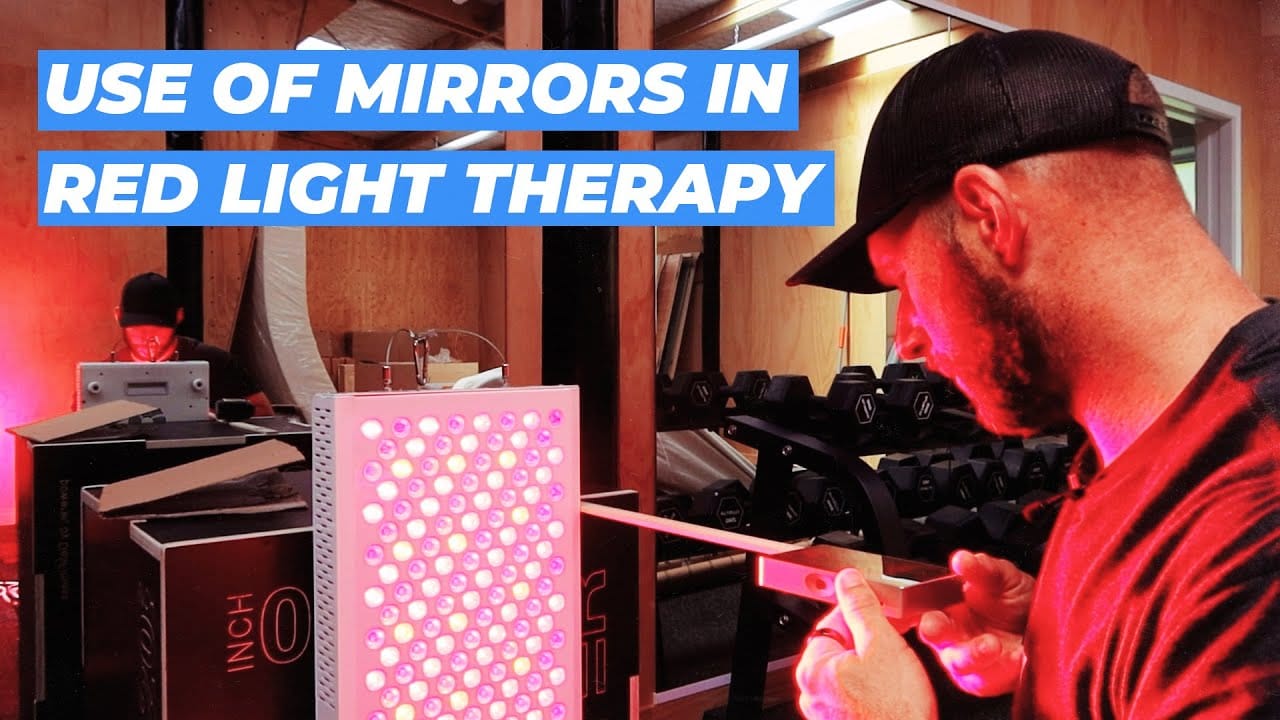
This is one of those ideas that sounds plausible in theory, but until you actually measure it, you’re just guessing. So in this experiment, I set up a real-world test using a full-size red light therapy panel and a wall-length mirror to finally see what actually happens when therapeutic light reflects.
The Experiment Setup
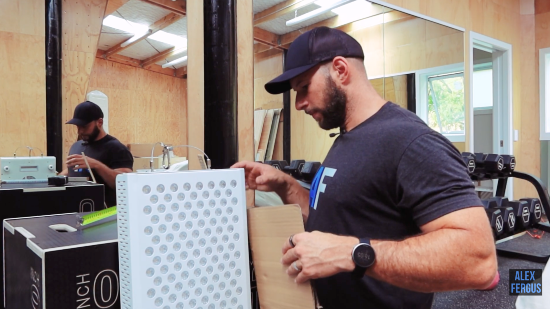
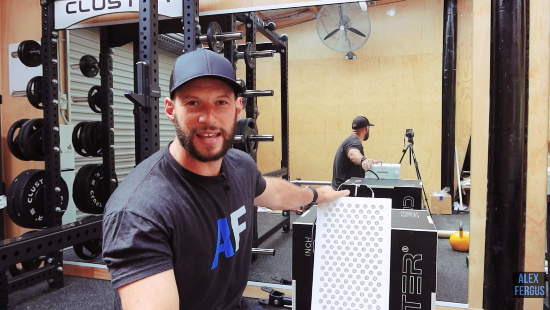
For this test, I used a BioMax 900 (Gen 2) panel positioned in my gym space, directly facing a large mirror wall. To measure the reflected light, I used a spectrometer capable of detecting both red and near-infrared wavelengths and reporting irradiance values.
The goal was straightforward: compare how much light is detected in three different situations:
- Behind or beside the panel with no mirror influence (baseline)
- Light reflected off the mirror at a distance
- Direct panel output at equivalent travel distance
The key question was whether reflected light maintains meaningful irradiance or drops off so much that it becomes practically useless.
Baseline: Light Detected Without the Mirror
The first step was to measure any stray light reaching the sensor when positioned behind and slightly to the side of the panel — effectively out of the beam path.
Even here, the spectrometer detected a tiny red and near-infrared signal, with a peak around 765 µW. That’s extremely small, but interestingly, it confirmed that a little light does leak or scatter from the panel housing — possibly from vents or internal reflections — even when you’re not in front of it.
With the LEDs switched off, that signal disappeared entirely, confirming the reading was genuinely from the panel.
So the baseline takeaway: without direct exposure or reflection, you receive almost no meaningful irradiance
First Mirror Test: Does Light Reflect at All?
Next, I positioned the panel facing the mirror and placed the spectrometer to detect the reflected beam path.
Immediately, a clear red and near-infrared peak appeared in the readings. The mirror was unquestionably reflecting therapeutic wavelengths back into the room.
The reflected peak measured roughly 6 mW/cm² at a total travel distance of just under a meter.
To put that in perspective, the BioMax 900 can produce around 80+ mW/cm² at 6 inches in direct exposure. So the mirror-reflected value was far lower — but importantly, not zero.
So yes — mirrors do reflect usable red and near-infrared light. But the next question was more important: how does that compare to direct exposure at the same distance?
Controlled Comparison: Direct vs Reflected at Equal Distance
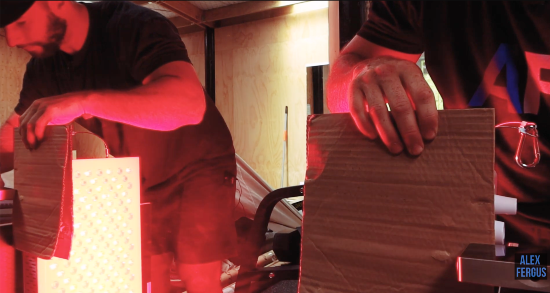
To make a proper comparison, I set up a more controlled distance test.
First, I measured the panel output at 40 cm directly in front of the device. The spectrometer consistently showed around 60 mW/cm² (varying roughly 58–62).
Then I moved the panel to sit 20 cm in front of the mirror and measured the reflected light, with a total travel distance of 40 cm (20 cm to the mirror + 20 cm back).
This gave a direct vs reflected comparison at an identical path length. The reflected reading? It was 8–9 mW/cm².
So at equal distance, the mirror reflection delivered roughly one-seventh of the direct irradiance. That’s a substantial drop — but still far from negligible.
Beam Spread Discovery: Why the Mirror Looked Weaker
At first glance, the reflected value seemed dramatically lower than the earlier 60 mW/cm² reading. But there was a critical realization during testing.
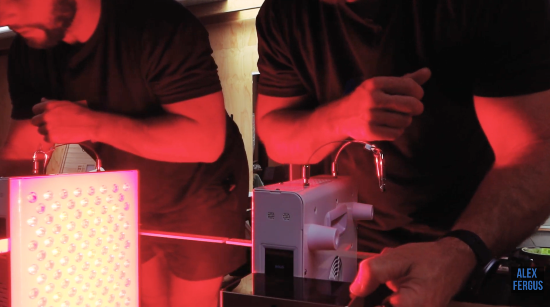
The direct measurement was taken directly in front of the panel beam. The reflected measurement was taken off to the side (because you physically can’t place the meter between the panel and the mirror).
So I repeated the direct measurement at 40 cm — but off-axis to the side, matching the reflected geometry. The result was 9 mW/cm². Essentially identical to the mirror reading.
This revealed something fascinating about the BioMax beam profile:
At a distance of 40 cm, the light is still quite narrow. Irradiance drops sharply when you move laterally away from the centerline — even without a mirror involved.
In other words, the mirror wasn’t dramatically weakening the light. The geometry of the beam was.
What This Means in Practice
From this experiment, several practical conclusions emerge.
Mirrors Do Reflect Therapeutic Wavelengths
Red and near-infrared light clearly bounces off mirrors and remains detectable at meaningful irradiance levels.
Reflected Irradiance Is Lower Than Direct
Even at equal travel distance, the reflected exposure measured about 8–9 mW/cm², compared with ~60 mW/cm² directly in front of the panel. So you lose a significant portion of intensity.
Positioning Matters Just as Much as With the Panel
The biggest insight was geometric: reflected light behaves like direct light in terms of beam spread.
If you want meaningful exposure from a mirror reflection, you must stand directly in the reflection path — just as you would stand directly in front of the panel beam.
Standing off-axis dramatically reduces irradiance in both cases.
Can Mirrors Increase Coverage or Treat Both Sides?
This is where things get nuanced.
Yes, you can use mirrors to redirect red light therapy. For example, you could angle a mirror behind you to bounce light onto the back of your body while facing the panel.
But the same rule applies: You need to be directly in the reflected beam path. If you’re offset or angled incorrectly, irradiance drops quickly.
So while mirrors can extend coverage directionally, they don’t magically amplify or spread light evenly around you.
Key Takeaways
Mirrors don’t boost irradiance — but they don’t destroy it either. They redirect it, and the resulting exposure can still be biologically meaningful if you’re positioned correctly.
Reflected light intensity is lower than direct exposure, but not trivial. In this test, reflected irradiance at equal path length was roughly comparable to being off-axis from the panel itself.
The most important takeaway is geometric: reflected red light behaves like direct beam light. Alignment with the beam path — not simply proximity — determines how much irradiance you receive.
Where This Leaves the Mirror Idea
So the long-standing idea of using mirrors with red light therapy devices isn’t entirely misguided — but it also isn’t a shortcut to higher exposure.
Mirrors can redirect therapeutic wavelengths and potentially help reach areas that would otherwise be missed. But they don’t amplify intensity, and proper positioning remains critical.
Like most things in light therapy, physics wins over theory.
If you’d like to see more experiments like this — testing angles, multiple mirrors, or real-world treatment setups — feel free to share ideas. There’s plenty more that could be explored here.
Items Mentioned
✅ You can buy a PlatinumLED BioMax 600 or 900 by using the following link for a discount: https://aferg.co/redled - discount code after you click the link.
Enjoyed This? You Might Like These!
🔴 Replacing Red Light: Does This Work?
🔴 Trained An AI On 7 Years Of Data: Meet Your Red Light Therapy Assistant
🔴 Sunlight Vs Red Light Therapy: Exciting Experiment!
🔴 Light Therapy Treatment Area + Beam Angle Confusion?
Found This Interesting? Look At These Articles:
🔴 Is Red Light Therapy Safe for Your Eyes?
🔴 Red Light Therapy Wavelengths Benefits: The Ultimate Guide
🔴 The Remarkable Role Of Light Therapy In Periodontal Care
🔴 Red Light Therapy For Neuropathy: The Promising Science
Alex's Bio
Alex Fergus wrote this blog post. Alex is an ISSN Sports Nutrition Specialist, Fitness Professional, and certified Superhuman Coach who continues to expand his knowledge base and help people worldwide with their health and wellness. Alex is recognized as the National Record Holder in Powerlifting and Indoor Rowing and has earned the title of the Australian National Natural Bodybuilding Champion. Having worked as a health coach and personal trainer for over a decade, Alex now researches all things health and wellness and shares his findings on this blog.