
How deep does red light therapy actually penetrate — and are we all underdosing? In this episode, I’m joined by Tom Kerber from SunPowerLED, a veteran electronics designer with decades of experience in high-power LED systems and photobiomodulation.
We break down the real-world physics of wavelength, power density, treatment area, and heat — and why many “rules” around dosing may be based on laser research that doesn’t translate well to LEDs. If you’ve ever wondered whether 660 vs 810 vs 1050 nm truly matters (and why bigger treatment areas often drive better results), this is the deep technical dive you’ve been waiting for.
Show Notes
In this technical episode of the Light Therapy Insiders Podcast, I interview Tom Kerber, founder of SunPowerLED, about the most misunderstood topic in photobiomodulation: dosing and penetration.
Tom shares his decades of experimentation, including tissue-penetration tests using stacked pork tissue, comparisons between lasers and LEDs, and the reasons the treatment area can significantly affect the amount of light reaching deeper structures. We also discuss thermal safety, near-infrared versus far-infrared penetration, and why higher doses may still be safe with LEDs when heat is adequately managed.
Key Topics
- Tom’s background in high-power electronics + photodynamic therapy shapes his approach to PBM dosing and penetration.
- Lasers travel straight in the air, but once they hit tissue, they scatter — penetration becomes a “bubble,” not a straight beam.
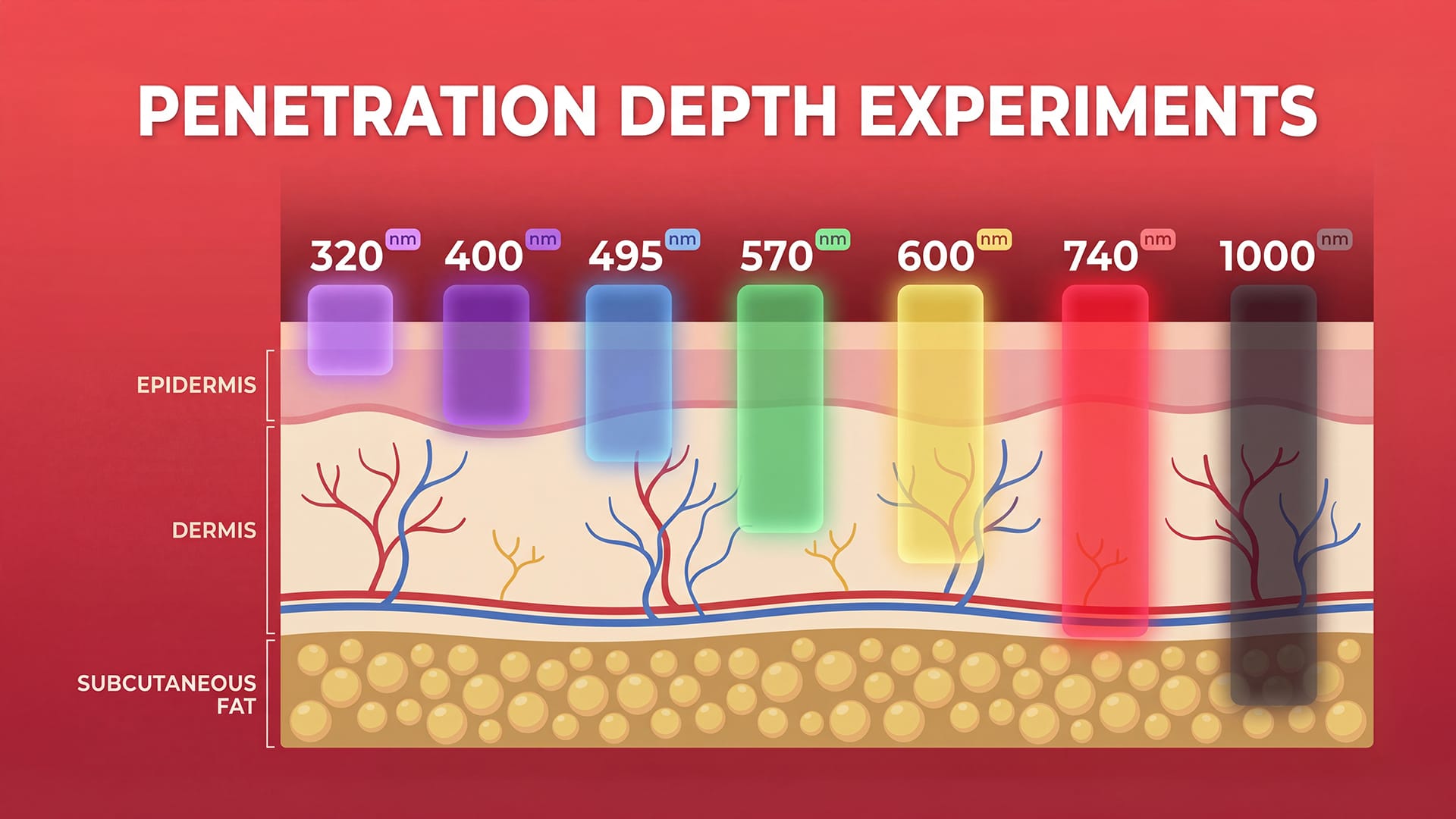
- Wavelength matters: green barely penetrates, red penetrates more, and near-infrared (810–1050 nm) penetrates deepest.
- Treatment area impacts depth: larger illuminated regions (at the same power density) can drive more light through tissue, up to a limit.
- Distance reduces deep benefits — standing far from a panel may help the skin, but deep tissue requires sufficient power density, area, and wavelength.
- Heat risk depends on wavelength, circulation, and skin tone — near-infrared spreads energy deeper and is often better tolerated.
- Near-infrared penetrates; far-infrared (>1350 nm) primarily heats the surface (still useful, but not deep penetration).
- LED dosing may plateau rather than decline — Tom argues that laser hot spots primarily drive the classic biphasic curve.
- Tom shares real-world examples (ribs, shoulder, lungs) where higher/longer LED exposure appeared to support recovery.
- A “4 J/cm² max” dosing limit can be misleading because many studies are from animal models and don’t scale well to human joints.
Resources Discussed
✨ Purchase the SunPowerLED devices, which are high-power PBM products designed for deeper penetration, using this link, https://aferg.co/sunpowerLED, and code ALEX5.
🎧 Prefer to Listen?
Find Alex Fergus – Light Therapy Insiders on your favorite platform: