Summary
Red light therapy (RLT) has become a full-blown TikTok aesthetic: glowing masks, “biohacking” language, and product links stacked like dominoes.
In a TikTok-only view of the trend (no external clinical validation), the “real” story is less about biology and more about platform dynamics: which hashtags aggregate attention, how creators manufacture credibility, and how TikTok Shop turns a wellness idea into a high-velocity shopping funnel. [1]
Today we explore red light therapy on TikTok in 2026, and what to be mindful of but also how to capitalize on opportunities:
A Few Patterns Dominate For Red Light Therapy On TikTok
First, the hashtag ecosystem is huge and messy. #redlighttherapy is framed as “Beauty & Personal Care” inside TikTok’s own Creative Center, with 14K posts in the last 30 days (US view in Creative Center) and 177K overall posts in that dashboard, plus closely related tags like #lighttherapy and #redlightmask. [2]
Yet hashtag “views” tallies circulating via TikTok-viewer indexing show a billion-plus view universe for #redlighttherapy and several billions for broader #redlight, which also captures unrelated “red light / green light” content—meaning the trend’s reach is both real and inflated by tag ambiguity. [3]
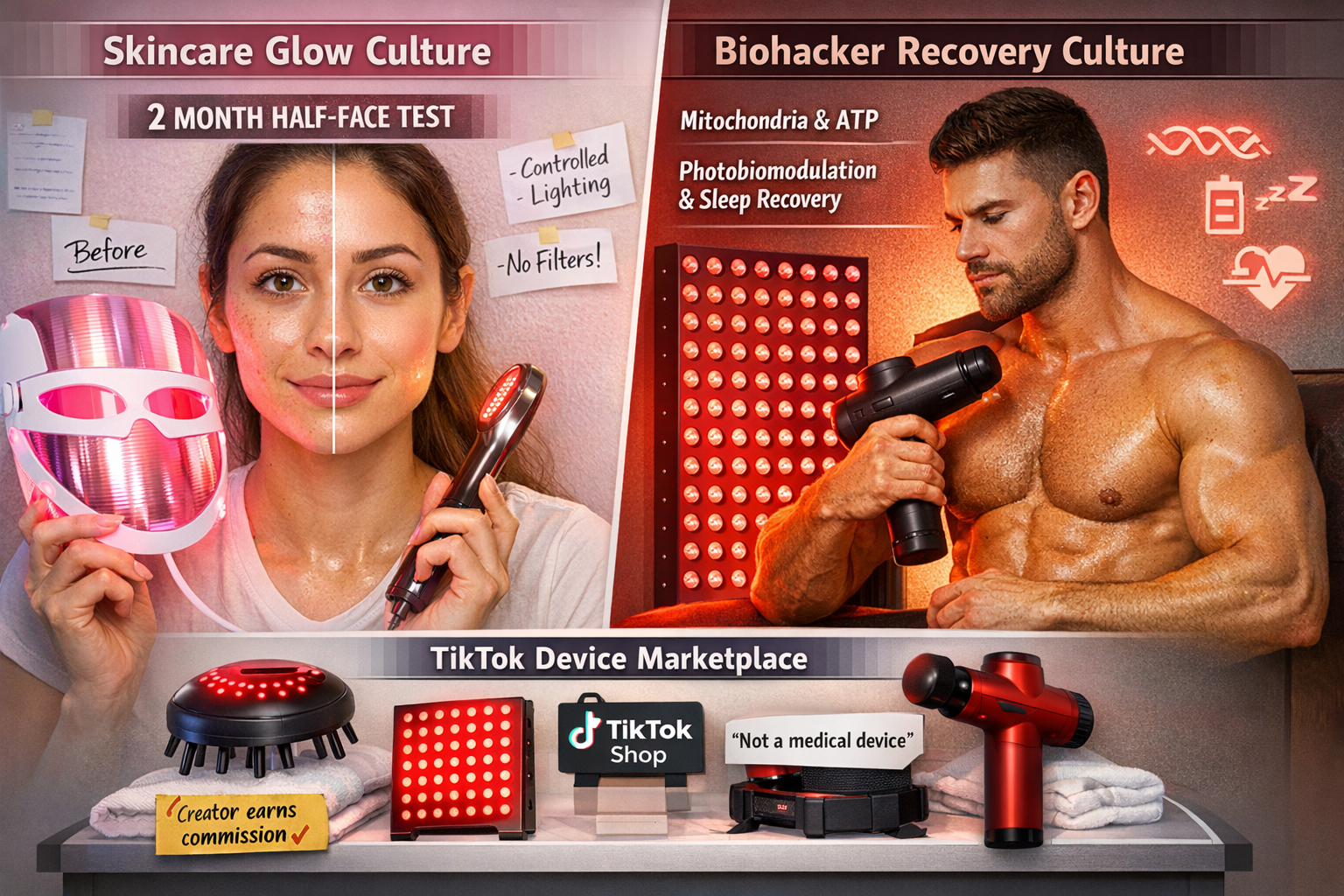
Second, the claim style splits into two cultures: Skincare glow culture (collagen, texture, breakouts, “anti-aging hack”) and biohacker recovery culture (mitochondria, ATP, “photobiomodulation,” athletic recovery, sleep). The strongest TikTok-native attempt at rigor often looks like self-experiment content—e.g., a dermatologist-style creator running a two-month “half-face” test and explicitly controlling lighting and filters. [4]
Third, the device landscape on TikTok is not just LED masks. It includes wands, scalp massagers, half-body panels, and even massage guns marketed as having “red light therapy.” TikTok Shop listings, creator affiliate labels (“Creator earns commission”), and even product disclaimers (“not a medical device”) are part of the reality consumers actually interact with. [5]
What’s “real,” in short: TikTok is excellent at turning a vaguely plausible-sounding wellness concept into a purchase-ready storyline—often faster than viewers can evaluate what they’re buying.
Want some good wand options? Check:
 Alex Fergus
This blog intentionally follows your revised requirement: TikTok content only—what’s posted, promoted, and sold on TikTok surfaces. It does not evaluate clinical efficacy, medical safety, or the scientific evidence base (even when creators claim it). When creators cite “studies” or “FDA” status, this article treats those as TikTok claims, not verified facts. [6]
Because direct crawling of some TikTok web pages can be restricted, the sampling used three TikTok-adjacent, content-preserving sources:
TikTok Creative Center (TikTok for Business) was used for hashtag-level analytics and related tags, since it is a public TikTok analytics surface. [7]
TikTok Shop product pages included device types, prices, ratings/sold counts where visible, affiliate labels (“Creator earns commission”), and on-page product disclaimers. [8]
A public TikTok viewer index (Urlebird) was used to systematically capture a content slice from hashtag feeds and to extract post-by-post engagement metrics (views, likes, comments, shares) along with captioned claims and promotional hooks (codes, “link in bio,” brand tags). Urlebird explicitly states it is not associated with TikTok and mirrors public TikTok content. [9]
The post sample emphasized high-engagement exemplars within the red-light therapy conversation, spanning skincare, hair, recovery/biohacking, and clinic/spa framing. Engagement metrics shown are as displayed at time of capture (Feb 2026) and are inherently fluid. [10]
TikTok’s Red Light Universe: Hashtags, Formats, And Recurring Storylines
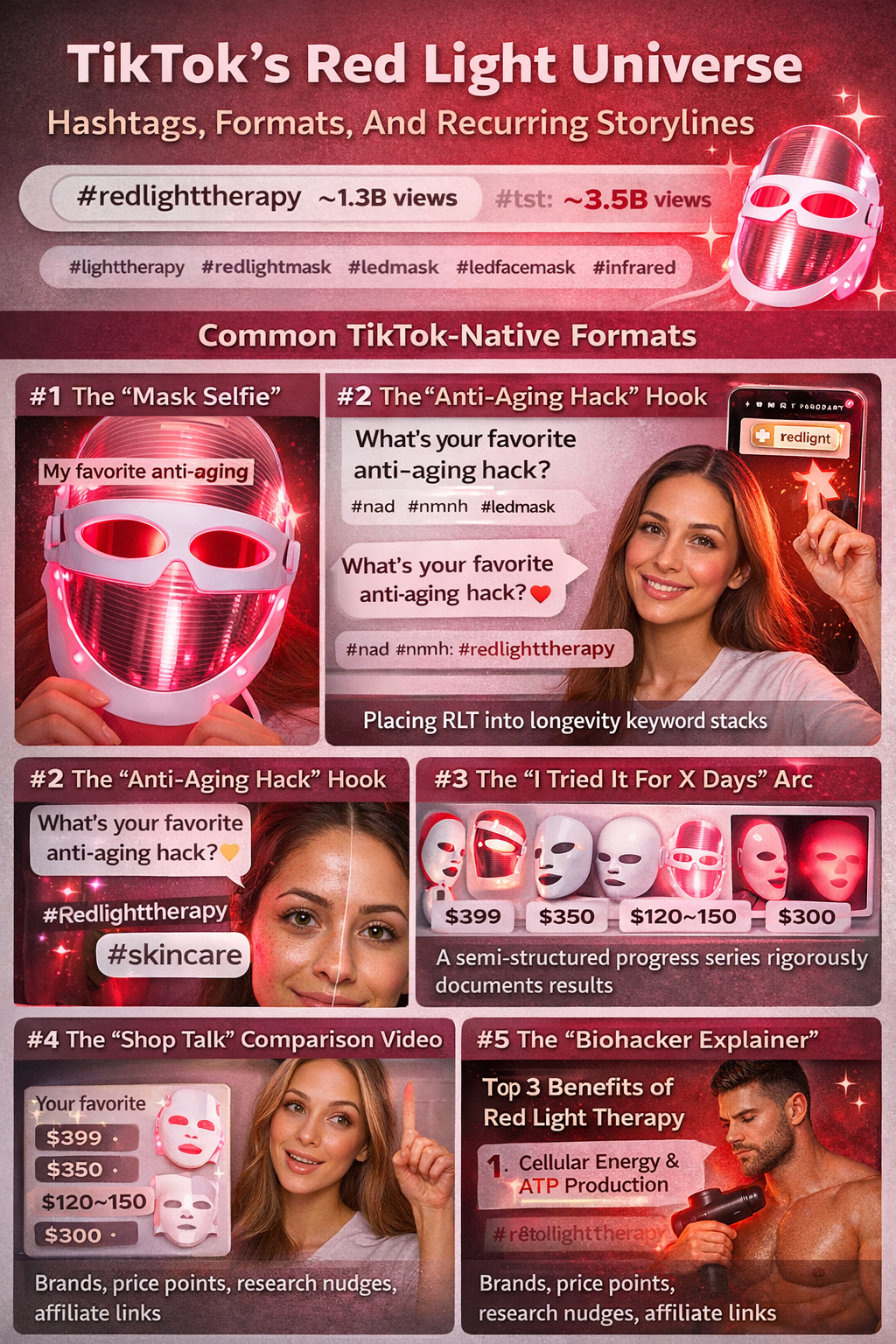
TikTok doesn’t present “red light therapy” as a niche. In TikTok’s Creative Center, #redlighttherapy is categorized under Beauty & Personal Care, with a recent posting cadence and a web of adjacent tags such as #lighttherapy, #redlightmask, #ledmask, #ledfacemask, and #infrared. [2]
On the viewer-index side, #redlighttherapy is shown as having ~1.3B views, while #redlight is shown around ~3.5B views—but #redlight also captures unrelated meme formats, so it’s a “big tent” tag by default. [3]
Across the sampled posts, the trend resolves into a handful of repeatable TikTok-native formats:
The “mask selfie” is the flagship: creators sit in a glowing LED face mask like it’s a wearable ring light, and the mask becomes a prop that signals “I’m doing futuristic skincare.” This is the visual grammar that makes the trend instantly legible—even muted, you know what the video is about.
The “anti-aging hack” hook is a close second. A creator asks a bait question (“What’s your favorite anti-aging hack?”) and then stacks trendy keywords (#nad, #nmnh, #redlighttherapy) to slot RLT into broader longevity content. [11]
The “I tried it for X days/weeks” arc is the retention engine. Some creators go beyond vibe marketing and attempt semi-structured documentation. The clearest example in the sample is a “half-face” experiment over two months, with the creator describing controlled final photos (dark room, centered ring light), “no filters,” and a request for viewers to vote which side looks better. [4]
The “shop talk” comparison video is increasingly common: creators name-check multiple brands and price points in one clip—positioning themselves as helpful curators while still moving viewers toward buying. In one example, a creator lists several well-known LED-mask brands and price points (e.g., “currently $350,” “$399,” “$120–150,” “$300”) and ends with “do your own research.” [12]
The “biohacker explainer” is the credibility play: words like “photobiomodulation,” “mitochondria,” and “ATP” appear as a vocabulary upgrade that implies science. [13] Often, this format is paired with affiliate codes and a device recommendation.
Finally, “RLT as an add-on feature” broadens the market: red light therapy becomes a bullet point attached to unrelated products—massage guns, saunas, and multi-function beauty devices—because “red light” as a phrase sells. [14]
The Device And Product Landscape TikTok Actually Sells
A useful way to understand TikTok RLT is simple: TikTok doesn’t just spread an idea; it sells hardware. TikTok Shop product pages don’t read like neutral catalogs—they read like persuasive landing pages, with ratings, “sold” counts, review photos, affiliate video grids, and sometimes explicit disclaimers. [21]
Curious about some of the products we recommend at Light Therapy Insiders, so that you ensure you actually buy quality and not hype? Check:
 Alex Fergus
 Bart Wolbers
The Hero Product: LED Face Masks
LED face masks dominate because they’re visually irresistible. The marketing language is consistent: “red light therapy,” “anti-aging,” “firming,” “glow,” and frequently a wink toward legitimacy with terms like “FDA cleared.” [22]
Here’s a representative TikTok Shop product image from an LED mask listing (TikTok Shop promotional image—not a screenshot): [23]
TikTok Shop product image: INIA GLOW Wireless LED face mask promo graphic (from TikTok Shop)
Want our opinion on that Inia mask? Check:
 Alex Fergus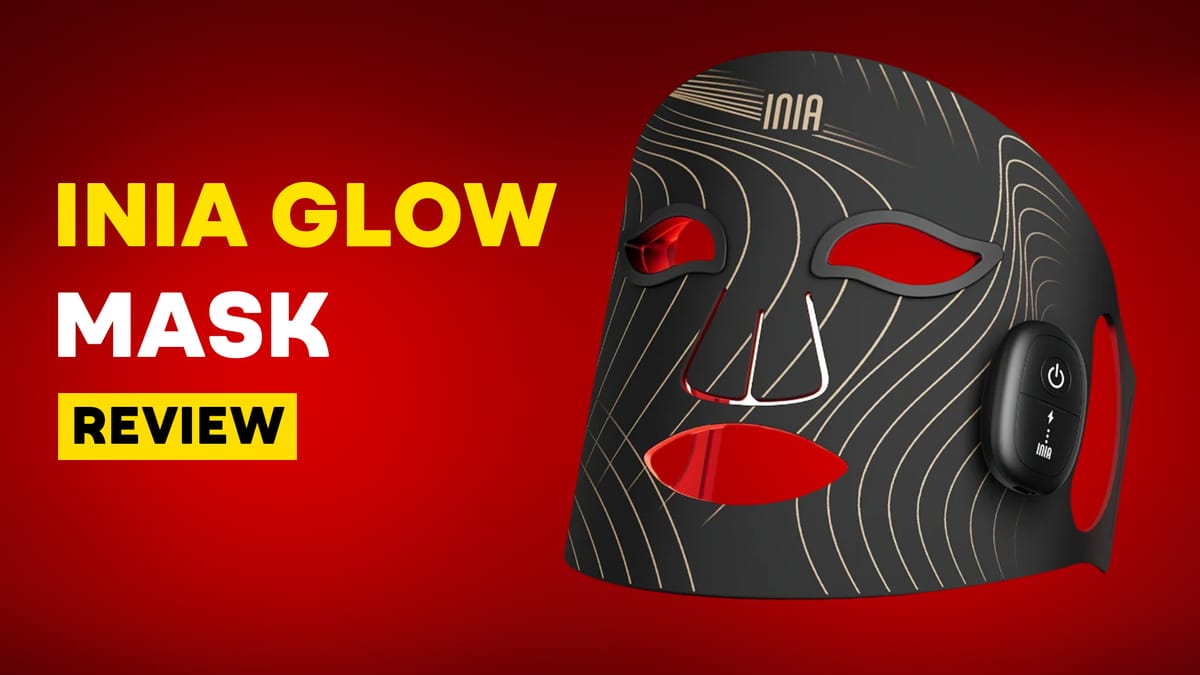
In this single image, you can see the classic TikTok RLT persuasion stack: a specific wavelength (“850nm NIR”), a “FDA cleared” badge motif, and convenience benefits (wireless; battery life). [24]
TikTok Shop also surfaces social proof at scale. For example, one INIA mask listing shows 22.0K sold and 928 global reviews alongside a rating displayed as 4.5, and a review excerpt where the buyer says “the fact that it’s FDA cleared had me sold.” [25] (Note: this is the reviewer’s wording on TikTok Shop, not a verification.)
And, if you are considering a mask, make sure to select the best:
 Alex Fergus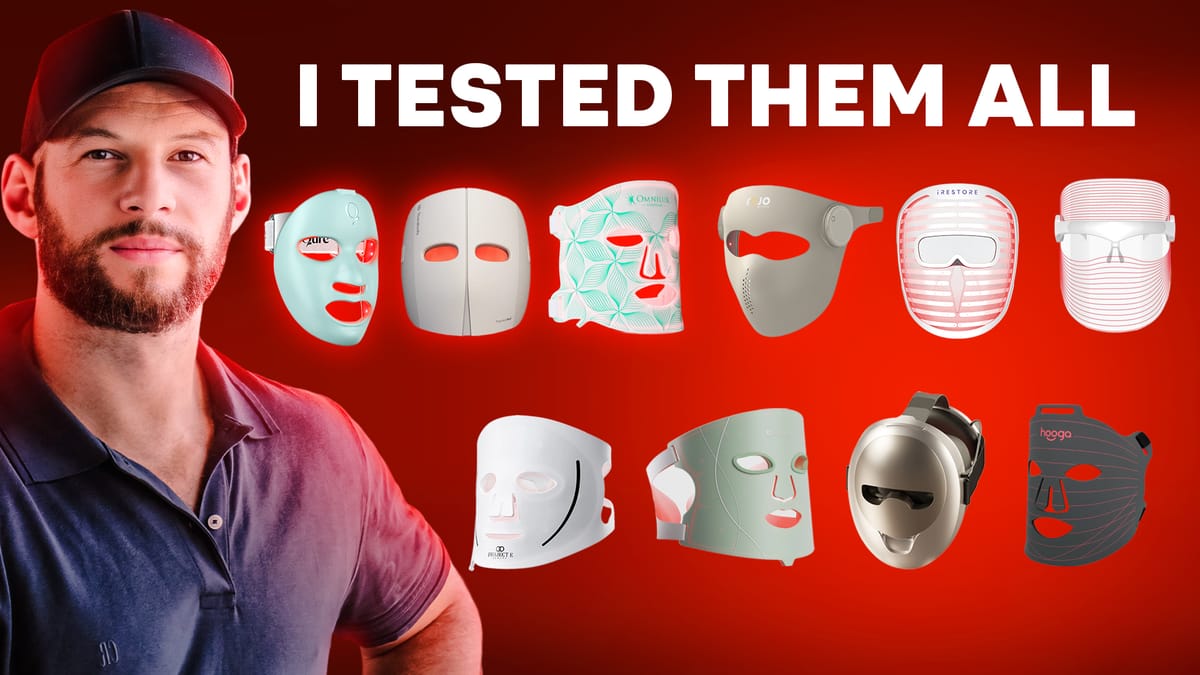
Beyond The Face: Neck/Chest Masks, Eye Tools, And Multi-Area kits
As soon as face masks become normal, TikTok expands the body map: neck/chest masks promise “lift & firm” timelines (“in 4 weeks”) and specific wavelengths like “850nm NIR.” [26]
Eye-area tools often emphasize speed and “results timelines.” For example, an INIA eye wand listing headline claims: “3 mins a day for fewer lines in 14 days & less puffiness in 21,” and uses “FDA-Cleared” wording in the listing text. [27]
Wands, Scalp massagers, And “Targeted” Devices
Wands are TikTok’s bridge between skincare and gadgets: they look like something you can use while watching Netflix, and they fit into a “routine” video without needing a dedicated session. A high-view example is a Solawave “Advanced Skincare Wand” post with hundreds of thousands of views, where the creator stacks a long list of #solawave and #redlighttherapy tags to make the device discoverable. [16]
Hair/scalp devices appear as a parallel mini-trend—positioned as “one thing that can help with hair growth,” often with a brand tag for the massager itself. [17]
Honestly, we've reviewed the Solawave Wand, and it's not that great of a product:
 Alex Fergus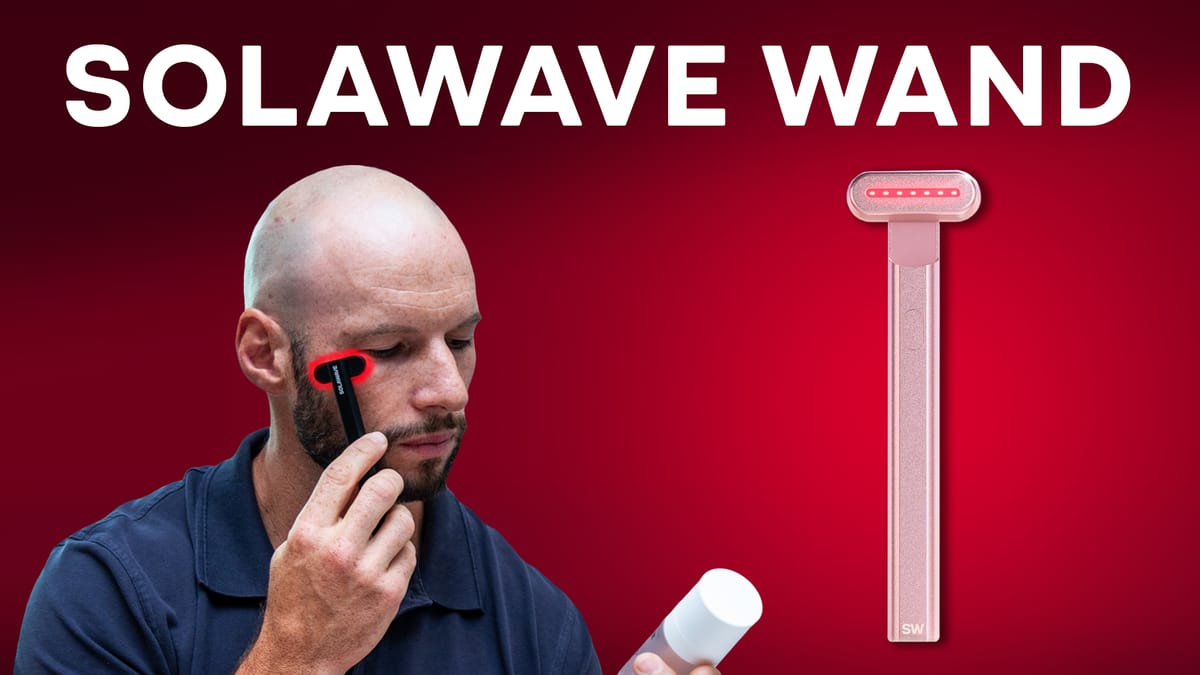
Panels, Saunas, And The “Biohacker Upgrades.”
The more performance-oriented side of TikTok leans into larger devices and more technical language. In one “biohacker explainer” post, the creator describes a half-body panel product and lists multiple wavelengths (630/660/850/940 nm), states a variety of benefits (skin tone/collagen/recovery/sleep), and includes an affiliate code. [13]
A related pattern: home sauna content where “red light and NIR therapy” becomes an added feature next to infrared heat and “compact profile,” again tied to off-platform review funnels (“full YouTube review in bio”). [28]
As a side note, panels arguably are still the best overall tool for red light therapy - and here are the best 2025-26 options:
 Alex Fergus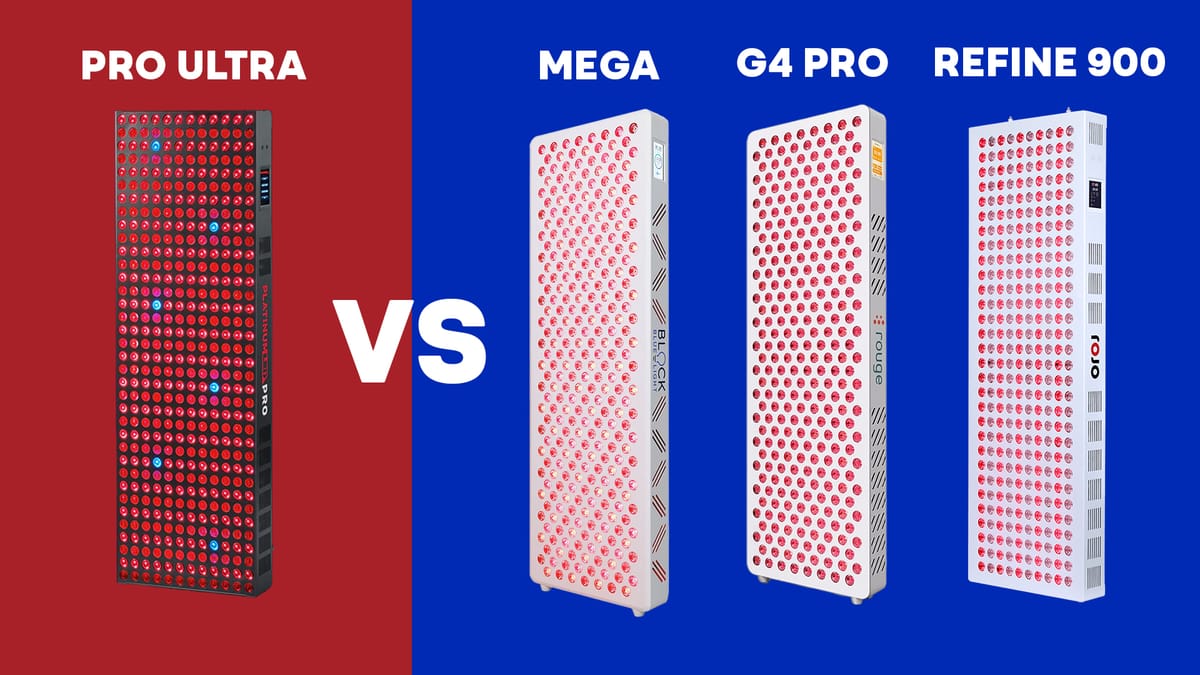
The Sneaky Category: “Red Light Therapy” As A Feature On Unrelated Products
One of the most revealing TikTok realities is how “red light therapy” gets attached to products that already sell for other reasons—like massage devices. A TikTok Shop massage gun listing includes “red light therapy” in the title and then includes a blunt disclaimer: “This product is intended for personal massage and relaxation use only. It is not a medical device…” [29]
That disclaimer is important not because it proves anything clinically—but because it shows how TikTok commerce navigates the boundary between “wellness gadget” and “medical claims.”
The Claims Map: What TikTok Says Red Light “Does”:
If you strip away the glow filter vibe, TikTok’s red light therapy claims cluster into a few predictable buckets. What changes is the presentation style—from casual “this is my best skincare thing” to science-coded “photobiomodulation, mitochondria, ATP.”
Here’s the map, based on recurring phrasing in the sampled posts and listings:
- Skin appearance upgrades: “anti-aging,” “boost collagen,” “improve texture,” “brighter/smoother/younger-looking skin,” “reduce breakouts.” These appear both in creator captions and in product marketing language. [40]
- Hair growth: framed as an actionable tip (“one thing that can help with hair growth”) attached to a specific device. [17]
- “Clinic-grade / FDA-cleared” legitimacy: used as a credibility shortcut, sometimes in creator captions (“FDA-cleared… clinic-grade”) and sometimes appearing in product imagery or reviews. [41]
- Biohacker recovery / inflammation language: creators describe deeper-penetrating near-infrared wavelengths and suggest benefits for muscles, joints, recovery, circulation, and sleep—often tied to panels and codes. [13]
- Short timelines: “14 days,” “21 days,” “4 weeks,” “2 months.” TikTok loves outcomes with a clock attached because it creates a bingeable “results” arc. [42]
The important “what’s real” point is that TikTok doesn’t just host these claims—it rewards them. A two-month half-face experiment becomes interactive (“Vote: side A or B?”), turning evaluation into engagement. [4] A discount code turns curiosity into conversion. [43]
What’s “real” On TikTok: Commerce Signals, Credibility Tricks, And Red Flags
When people ask “Is TikTok red light therapy real?”, they often mean “Does it work?” But on TikTok, the more immediate reality is: Is this content an ad? Is the creator incentivized? Is the claim being made responsibly—or just virally?
TikTok itself tells you a lot—if you know where to look.
The Platform’s Loudest Truth: Affiliate Monetization Is Baked In
On TikTok Shop listings, you repeatedly see labels like “Creator earns commission” attached to video tiles and creator lists. [45] That’s not a conspiracy; it’s a core mechanic. It means the same product can be pushed by dozens (or hundreds) of creators simultaneously, each competing to make the “best” hook.
You can literally watch the affiliate swarm in the interface: - A “live” style listing page surfaces multiple creators with counts beside them (the page shows creator names and the “Creator earns commission” label). [35]- A Ulike listing snippet similarly shows a long grid of affiliate creators tied to the same product. [46]- Even a massage gun page shows affiliate video tiles and “Creator earns commission,” alongside a strong product disclaimer. [29]
This matters because it explains why the trend feels omnipresent: it’s not only algorithmic; it’s systematically produced.
“Science Words” Often Function Like A Second Filter
“Photobiomodulation,” “mitochondria,” “ATP,” wavelength lists—these terms can be educational, but on TikTok they often behave like credibility cosmetics. You’ll see detailed wavelength breakdowns paired with strong benefit claims and an affiliate code in the same caption. [13]
A practical TikTok-native heuristic: when a caption reads like a mini whitepaper and ends with “use my code,” you’re reading marketing that has learned to cosplay as education. [13]
Before/After Content Is TikTok’s Persuasion Superpower—So Watch The Framing
TikTok’s most convincing “evidence” is often visual: glow-ups, texture shots, side-by-side comparisons. The strongest example in the sample is the half-face experiment where the creator explicitly describes controlling lighting and using no filters. [4]
But most content is not that controlled; it’s routine clips or vague “best thing I’ve done” testimonials. [47]
The Most Important Red Flag: Medical Claims With No Medical Framing
On the commerce side, you’ll sometimes see medical-adjacent promises tucked into product “benefits,” like a roller tool claiming it “Helps with Sinus Infection.” [39] Meanwhile, other products in adjacent categories include explicit disclaimers stating they are not medical devices and not intended to treat anything. [29]
TikTok-only takeaway: if a product is casually positioned as solving a condition (infection, disease, etc.) without serious context, that’s not “fear-mongering”—it’s simply recognizing that TikTok’s incentive structure rewards boldness.
Want A Legit 100% Science Backed Free Course On What's True And What Isn't On Red Light Therapy? Join Below:
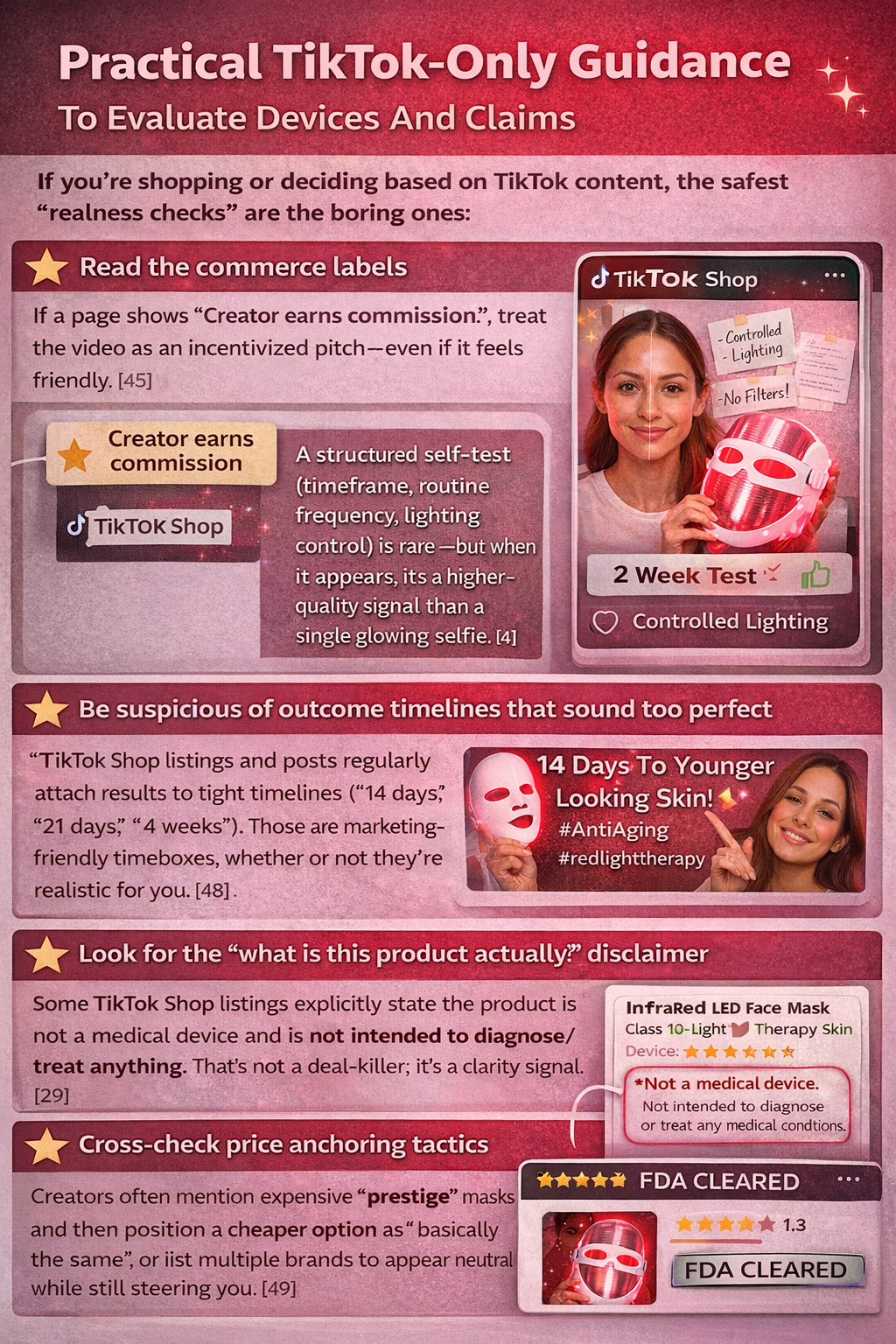
Practical TikTok-Only Guidance To Evaluate Devices And Claims
If you’re shopping or deciding based on TikTok content, the safest “realness checks” are the boring ones:
Read the commerce labels. If a page shows “Creator earns commission,” treat the video as an incentivized pitch—even if it feels friendly. [45]
Prefer posts that show method, not just outcome. A structured self-test (timeframe, routine frequency, lighting control) is rare—but when it appears, it’s a higher-quality signal than a single glowing selfie. [4]
Be suspicious of outcome timelines that sound too perfect. TikTok Shop listings and posts regularly attach results to tight timelines (“14 days,” “21 days,” “4 weeks”). Those are marketing-friendly timeboxes, whether or not they’re realistic for you. [48]
Look for the “what is this product actually?” disclaimer. Some TikTok Shop listings explicitly state the product is not a medical device and is not intended to diagnose/treat anything. That’s not a deal-killer; it’s a clarity signal. [29]
Cross-check price anchoring tactics. Creators often mention expensive “prestige” masks and then position a cheaper option as “basically the same,” or list multiple brands to appear neutral while still steering you. [49]
Treat “FDA-cleared” as a claim that needs context. On TikTok, “FDA cleared” appears as a caption hook (“FDA-cleared… clinic-grade”), as a badge-like visual, or inside customer reviews. [41] TikTok content frequently doesn’t explain what the term means—so don’t let it be the only reason you buy.
Closing Take
On TikTok, red light therapy isn’t a single trend—it’s a content economy. #redlighttherapy sits inside beauty culture, but it borrows the language of medicine, the aesthetics of sci‑fi skincare, and the infrastructure of TikTok Shop to become endlessly shoppable. [50]
What’s “real” is not that every claim is true. What’s real is the machine: viral formats (mask selfies), credibility theater (photobiomodulation vocabulary), and conversion hooks (“link in bio,” “use my code,” “creator earns commission”). [51]
If you treat TikTok as what it is—an entertainment-and-commerce platform that sometimes hosts good experimentation—you can watch the trend with clearer eyes than any LED mask could ever give you.
This article is written by our AI assistant Sally. Check the short bio of Sally below:
Found This Interesting? Look At These Resources:
- Welcome to the Light Therapy Course
- Best Red Light Panel 2025? BioMax Pro Ultra vs The Rivals
- Red Light Mask Buyer's Guide - Avoid These Mistakes!
- Light Therapy Insiders AI Bot That Answers All Your Questions
- Red Light Therapy Shopping Tool
Have You Seen These Reviews? Check:
🔴 Celebrities Using Red Light Therapy: 7 Epic Examples 2026
🔴 The Exciting New Red Light Devices and Innovations Coming in 2026
🔴 MitoGlow LED Mask Review: The Best Red Light Therapy Mask I've Ever Tested.
🔴 2026 Red Light Therapy Panels Revealed
🔴 Red Light Therapy Mask Comparing Test: 25 Masks Ranked And Reviewed
🔴 Rouge Red Light Therapy Review: Is It Worth the Investment?
🔴 Red Light Therapy Insiders Kineon: Move Plus 2.0, Heel Modular System And Sensor Roadmap
![[23]](https://p16-oec-general-useast8.ttcdn-us.com/tos-useast8-i-rt0ujvrtvp-tx2/83f3bb4c72974ed08b0bff2fe7e989d3~tplv-fhlh96nyum-resize-webp%3A800%3A800.webp?dr=12186&from=1826719393&idc=useast8&ps=933b5bde&shcp=e1be8f53&shp=6ce186a1&t=555f072d)