

Red light therapy panels often carry names like BioMax 900, Mito Pro 1500 or Optics 210. Those numbers feel meaningful, like a shorthand for power or effectiveness. They are meaningful—but not in the way most people assume. Understanding what those numbers actually represent, why companies use them, and what truly matters when choosing a panel will save time, money and disappointment.
What those model numbers really are
In many cases the number attached to a panel is the product of a simple calculation: the number of LEDs multiplied by the nominal wattage per LED. For example, a panel listed as a "900" might have 300 LEDs rated at 3 watts each (300 × 3 = 900). A "1500" could be 300 LEDs rated at 5 watts (300 × 5 = 1500). Simple, neat and easy to print on a product sticker.
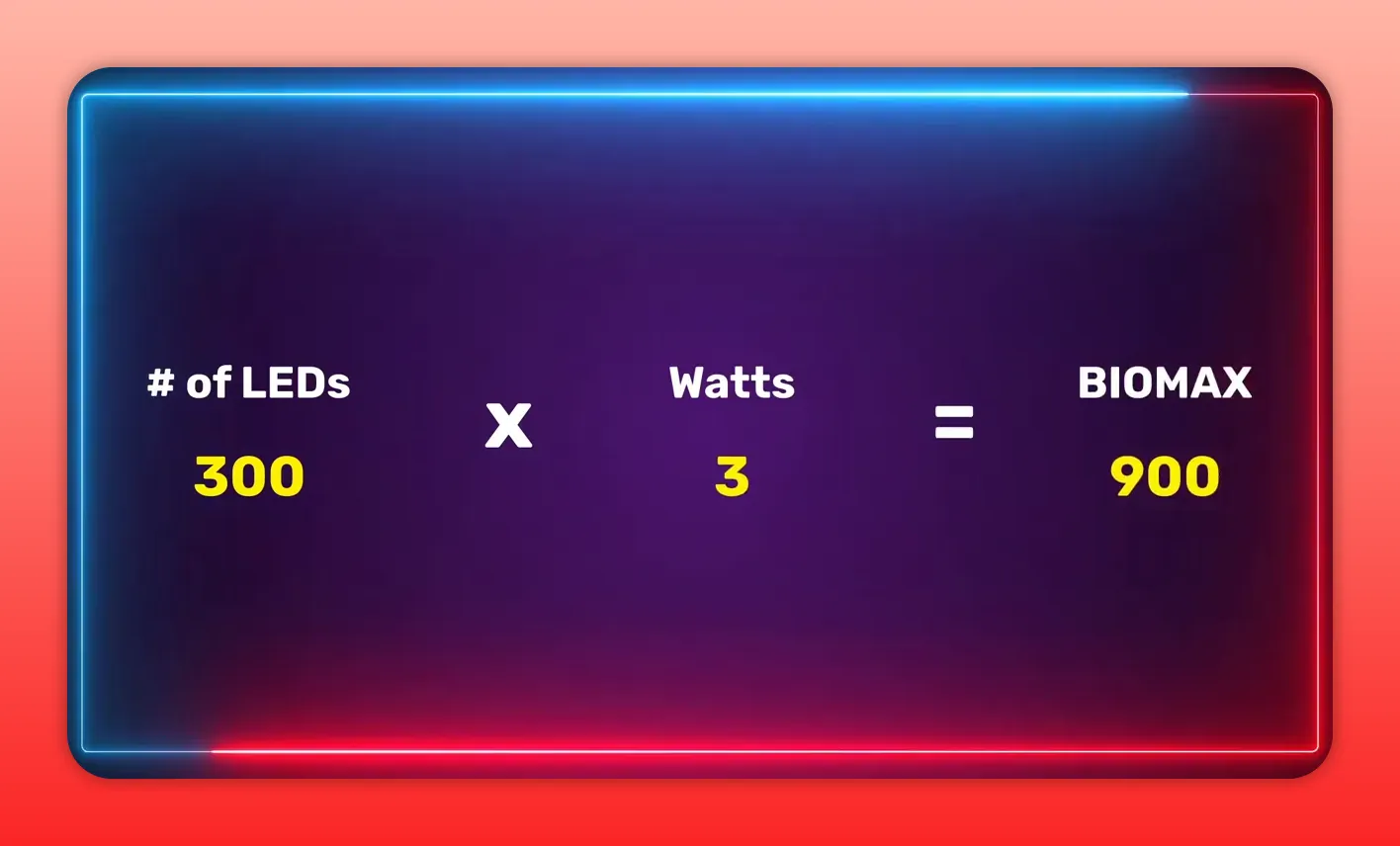
That explains why you see ranges such as 300, 600, 900, 1500, 3000 across brands. Some makers use LED count times LED wattage as their naming convention. Others do something different. Some brands name products by LED count only, while others use descriptive names like Mini, Go, Light, Mid or Max. The end result is a jumble of model numbers that look comparable but frequently are not.
Why Companies Use These Numbers
There are two straightforward reasons:
- Perception — higher numbers sound and look better. A "1500" sounds more impressive than a "100", and customers often use those numbers to understand where a panel sits in a product line.
- On-paper wattage — the number does loosely represent a calculated wattage figure. A 1500 on paper sounds like more power than a 300 and can be useful for marketing and quick comparisons inside a single brand.
Both reasons serve marketing goals, but neither ensures a panel will deliver superior therapeutic outcomes.
Why Are Those Numbers Misleading
Those model numbers create three common misunderstandings.
1. They are not a measure of actual light output
LED wattage stamped on paper does not directly equal the light a device emits at therapeutic wavelengths. Everything from LED binning, lensing, driver efficiency and heat management changes actual light output. In practice, a panel that uses "3 W" LEDs can produce similar or even higher irradiance than a panel that uses "5 W" LEDs. Real-world radiance does the heavy lifting, not nominal LED wattage.
2. They are not the electrical power draw from the wall
People sometimes assume that the number corresponds to how many watts the panel draws from the mains. It does not. Measured power draw for popular panels often sits far below or above the product number.
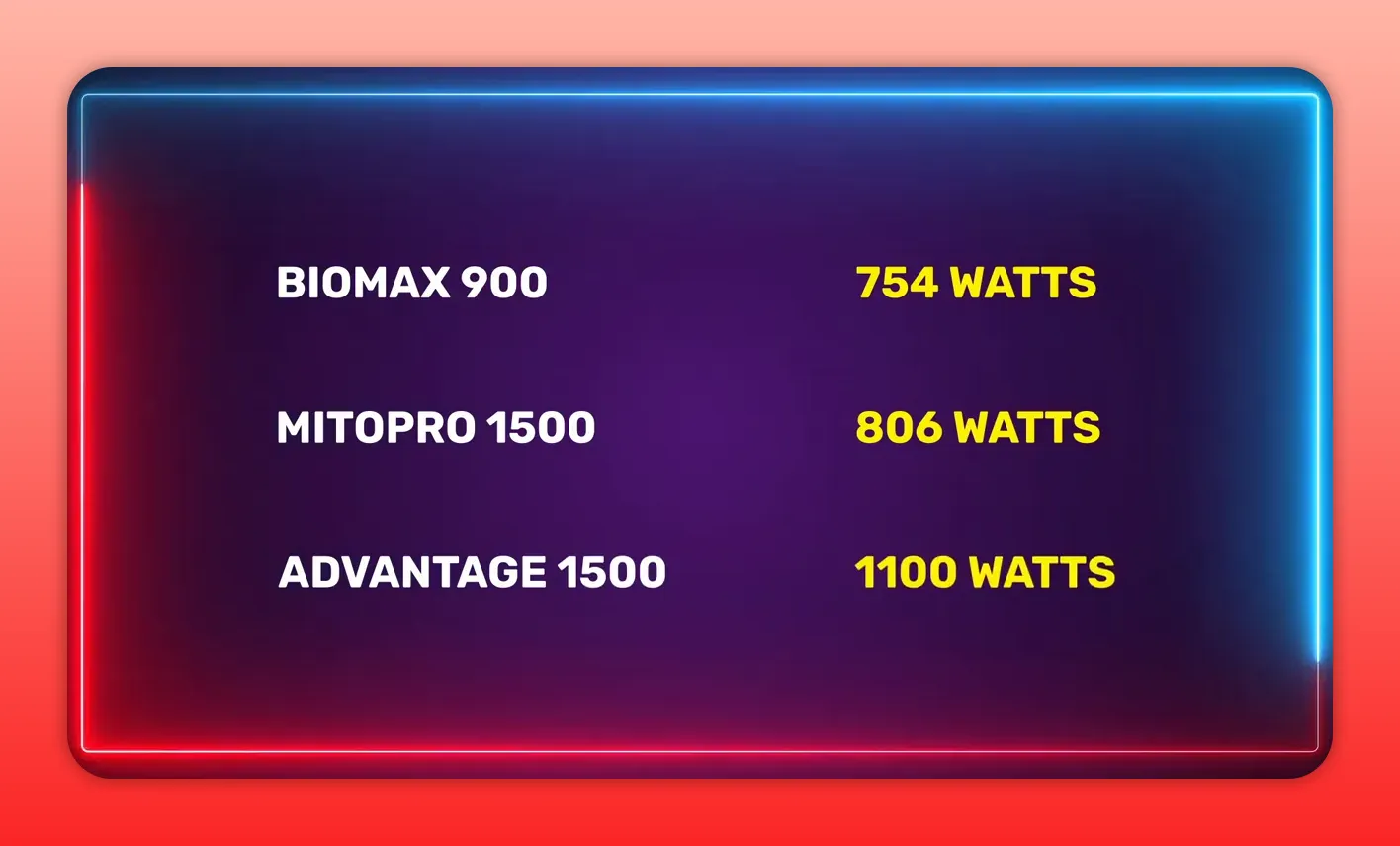
Examples from measured devices:
- The BioMax 900 (300 LEDs) measured around 754 watts draw.
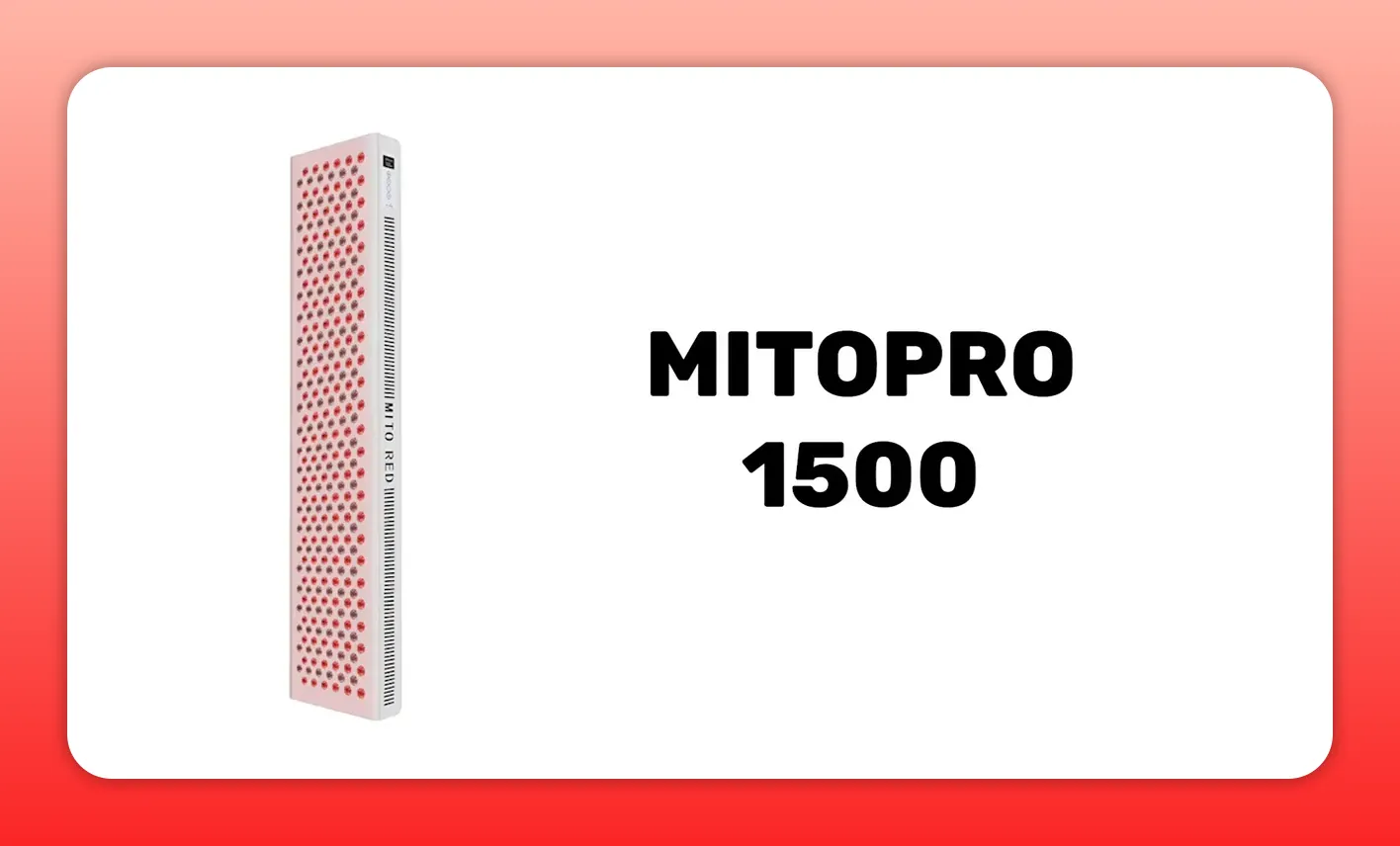
- The Mito Pro 1500 (300 LEDs) measured about 806 watts draw.
- The Red Light Rising Advantage 1500 (500 LEDs) drew roughly 1100 watts, yet was the least powerful in that group by measured irradiance.
These examples show the disconnect: model numbers, LED ratings and wall draw can all differ significantly from raw therapeutic output.
 Alex Fergus
3. Companies do not standardise naming
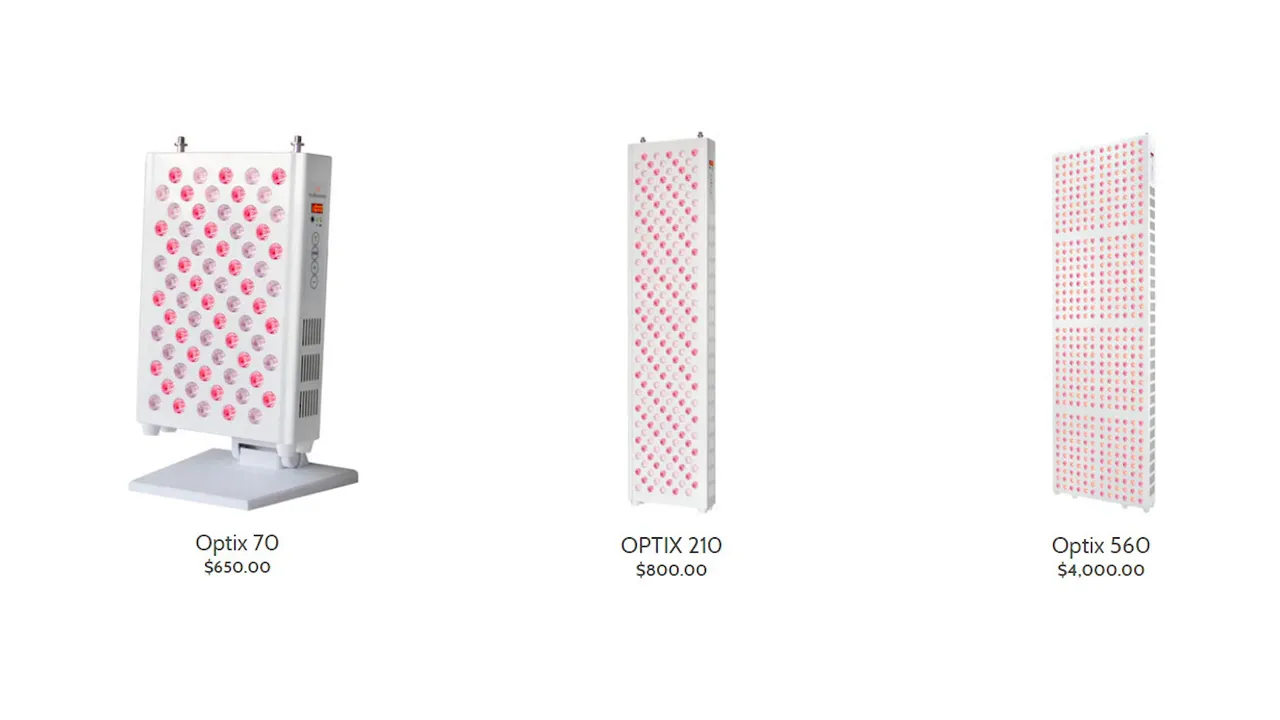
Some brands use LED-count-based names, some use LED-count times LED-wattage, some use arbitrary model codes or names. For instance, a Solbasium Optix 210 may align closely with a Mito Pro 1500 in terms of LED count or physical size, even though their labels follow different logic. Comparing numbers across brands without checking specifications is like comparing apples to oranges.
What actually matters for therapeutic value
If numbers like 900 or 1500 are unreliable guides, what should you look for? The three technical measures that matter most are:
- Irradiance (also called irradiance intensity) — measured in milliwatts per square centimetre (mW/cm²). This tells you how much light energy hits the target area. Higher irradiance means shorter treatment times for the same total dose.
- Wavelengths — therapeutic red and near-infrared wavelengths typically cluster around 630–660 nm, 810–850 nm and sometimes 940 nm. Effective panels deliver strong output at clinically useful wavelengths.
- Treatment area and evenness — how large an area a panel covers and how uniformly it distributes light. A high irradiance concentrated in a tiny patch is less useful than a slightly lower irradiance spread evenly across the full target area.
Secondary but still important factors include build quality, heat dissipation, lensing and manufacturer transparency about measurements. Panels with good cooling maintain LED performance and longevity; cheap panels can lose output as they heat up.
How to read real specs: a practical guide
When comparing panels, use this step-by-step checklist to focus on meaningful data rather than model numbers.
Step 1: Look for irradiance maps or spot measurements
Manufacturers should provide measured irradiance at a specified distance, usually 6, 12, 18 or 24 inches. Prefer maps that show how intensity varies across the treatment surface rather than a single peak number. Ask what distance the measurement was taken at and whether it represents the centre, an average or a hotspot.
Step 2: Check the wavelengths and spectral distribution
Good panels list their dominant wavelengths. Ideal therapeutic panels usually provide strong emission at around 660 nm and 830–850 nm. Beware of vague claims like "full spectrum" without numbers.
Step 3: Confirm the active treatment area
Understand how much of your body you can treat at once. A small panel that requires many passes to treat the same area as a large panel is not economical in the long run—even if it carries a big model number.
Step 4: Inspect the actual power draw and heat management
A measured wall draw can help you understand efficiency. Panels with similar measured irradiance but lower electrical draw are usually more efficient. Also check for active cooling or adequate heatsinking. LED efficiency drops as temperature rises.
Step 5: Read independent tests
Third-party or independent testing is invaluable. Look for reviewers who measure irradiance with calibrated meters and show real measurement data rather than relying on manufacturer claims.
A shopping checklist you can print
- Irradiance values at standard distances and ideally an irradiance map.
- Wavelengths listed (ideally 660 nm and 830–850 nm for combined red and NIR therapy).
- Treatment area dimensions and how even the light is across that area.
- Measured power draw or efficiency indicators.
- Build quality details: cooling, driver type, lensing and warranty.
- Independent test data or verified measurements from a trusted reviewer.
Common misconceptions debunked
Myth: Higher model numbers always mean a more powerful device.
Reality: A model number often reflects a product code, LED count times rated LED wattage, or other naming logic. It does not reliably indicate therapeutic output.
Myth: LED wattage equals output.
Reality: Nominal LED wattage is only one piece of the puzzle. Two panels using 3 W and 5 W LEDs can produce similar irradiance depending on LED quality, optics, thermal design and electrical driving. Always check measured irradiance.
Myth: Wall power draw equals therapeutic power.
Reality: Wall power draw can be useful for efficiency comparisons, but it still does not tell you where the energy is going. Poorly designed units can waste power as heat. Good design converts more electrical energy into useful light at therapeutic wavelengths.
Examples to illustrate the confusion
Consider two panels that both use 300 LEDs. One uses 5 W LEDs and gets labelled as a "1500". The other uses 3 W LEDs and is called a "900". You might assume the 1500 is significantly more powerful. In practice, measured irradiance at typical treatment distances can be very close between them because LED quality and optics vary. Worse, another company might call a panel "Optix 210" referring only to LED count, adding another layer of confusion.
The bottom line: names and numbers are product codes and marketing shorthand rather than consistent engineering measures.
How this influences treatment time and results
Treatment dose in red light therapy is usually given in joules per square centimetre (J/cm²). Dose equals irradiance (mW/cm²) multiplied by time (seconds), divided by 1000. If you know the irradiance at the treatment distance, you can calculate how long to stay in front of the panel to achieve a desired dose.
Higher irradiance reduces treatment time. That is why irradiance maps are so important: they show how quickly you will reach a therapeutic dose across the whole surface being treated. A panel with a misleading model number might require far longer sessions than another less flashy panel that actually emits more useful light.
Practical buying scenarios
If you want a full-body experience
Prioritise a large treatment area and good irradiance across that whole area. A single 1500-numbered unit that produces moderate irradiance over a good area may be better than two smaller high-numbered units that leave gaps and hotspots.
If you want an inexpensive starter unit
Target panels with transparent irradiance claims and tested wavelengths. Small panels are fine for trying the modality, but avoid judging by model numbers—some small 300-numbered panels outperform larger numbered competitors in real output.
If you want clinical or professional results
Insist on independent measurements, professional-grade build quality, and manufacturer data showing irradiance at multiple distances and across the surface. Warranty and cooling become more important as frequency of use increases.
Quick formulas and conversions
Two simple calculations help estimate dose and time:
- Dose (J/cm²) = (Irradiance in mW/cm² × time in seconds) / 1000
- Time (seconds) = (Desired dose in J/cm² × 1000) / Irradiance in mW/cm²
Example: If your target dose is 10 J/cm² and irradiance at your distance is 50 mW/cm², time = (10 × 1000) / 50 = 200 seconds, or about 3 minutes 20 seconds.
Final thoughts and a straightforward rule
Don't get caught up in the numbers.
Model numbers are marketing shorthand at best and product codes at worst. What matters is how much useful light reaches the area you want to treat and how long it takes to deliver a therapeutic dose. Use irradiance, wavelength and treatment area as your primary comparison points. Seek independent measurements and prioritise good design features like cooling and even light distribution.
Ready-to-use comparison checklist
- Ask for irradiance maps at usable distances (6–24 inches).
- Verify wavelengths supplied and whether they cover both red and near-infrared bands.
- Check active treatment area dimensions and the evenness of output.
- Look for measured wall draw to judge efficiency but treat it as secondary.
- Search for independent third-party testing or validated reviewer data.
- Confirm warranty, build quality and cooling strategy.
Stick to that checklist and the model numbers will stop being a distraction. It will become much easier to pick a panel that fits your goals and budget.
Questions people often ask
Can I use a smaller panel multiple times to get the same effect as a big one?
Yes, but it takes longer overall and is less convenient. Multiple passes increase total session time and can create inconsistent dosing across the body. For full-body therapy, a larger panel with good irradiance is typically more efficient.
Are more LEDs always better?
Not necessarily. LED count contributes to coverage, but the key is how those LEDs are driven, cooled and optically arranged. A high LED count with poor optics or thermal design can underperform compared to a lower count with good engineering.
Is wavelength more important than irradiance?
Both matter. If a panel emits at the right wavelengths but has very low irradiance, treatment times become impractical. Conversely, great irradiance at non-therapeutic wavelengths is of limited benefit. Seek a balance: the correct therapeutic wavelengths delivered at usable irradiance across a meaningful treatment area.
Closing
Model numbers like 300, 900 or 1500 are a starting point, not a conclusion. They can hint at LED count or a calculated number, but they do not replace meaningful specifications. Focus on measured irradiance, wavelength, treatment area and independent testing. Those will tell you what you really need to know.
Use the checklist, demand transparent data and choose panels based on performance rather than product codes. That way, the time and money invested will translate into reliable and repeatable therapeutic results.
Found This Interesting? Look At These Articles
🔴 The Red Light Therapy Facial Fat Loss Link: Myth Or Reality?
🔴 Does Red Light Therapy Help Scars? The Science
🔴 Red Light Therapy For Skin: Beauty Benefits, Potential Complications, And More
🔴 Psoriasis With Red Light Therapy: Potential Game-Changer?
Have You Seen These Reviews
🔴 Rouge G4 Pro Review: Most Advanced Red Light Panel Yet?
🔴 Best Red Light Panel Yet? Block Blue Light Mega Review
🔴 $800 Red Light Mask Has Lasers… But Why?
🔴 Omnilux Contour Mask Review: Still Worth It in 2025?
Alex's Bio
Alex Fergus wrote this blog post. Alex is an ISSN Sports Nutrition Specialist, Fitness Professional, and certified Superhuman Coach who continues to expand his knowledge base and help people worldwide with their health and wellness. Alex is recognized as the National Record Holder in Powerlifting and Indoor Rowing and has earned the title of the Australian National Natural Bodybuilding Champion. Having worked as a health coach and personal trainer for over a decade, Alex now researches all things health and wellness and shares his findings on this blog.