
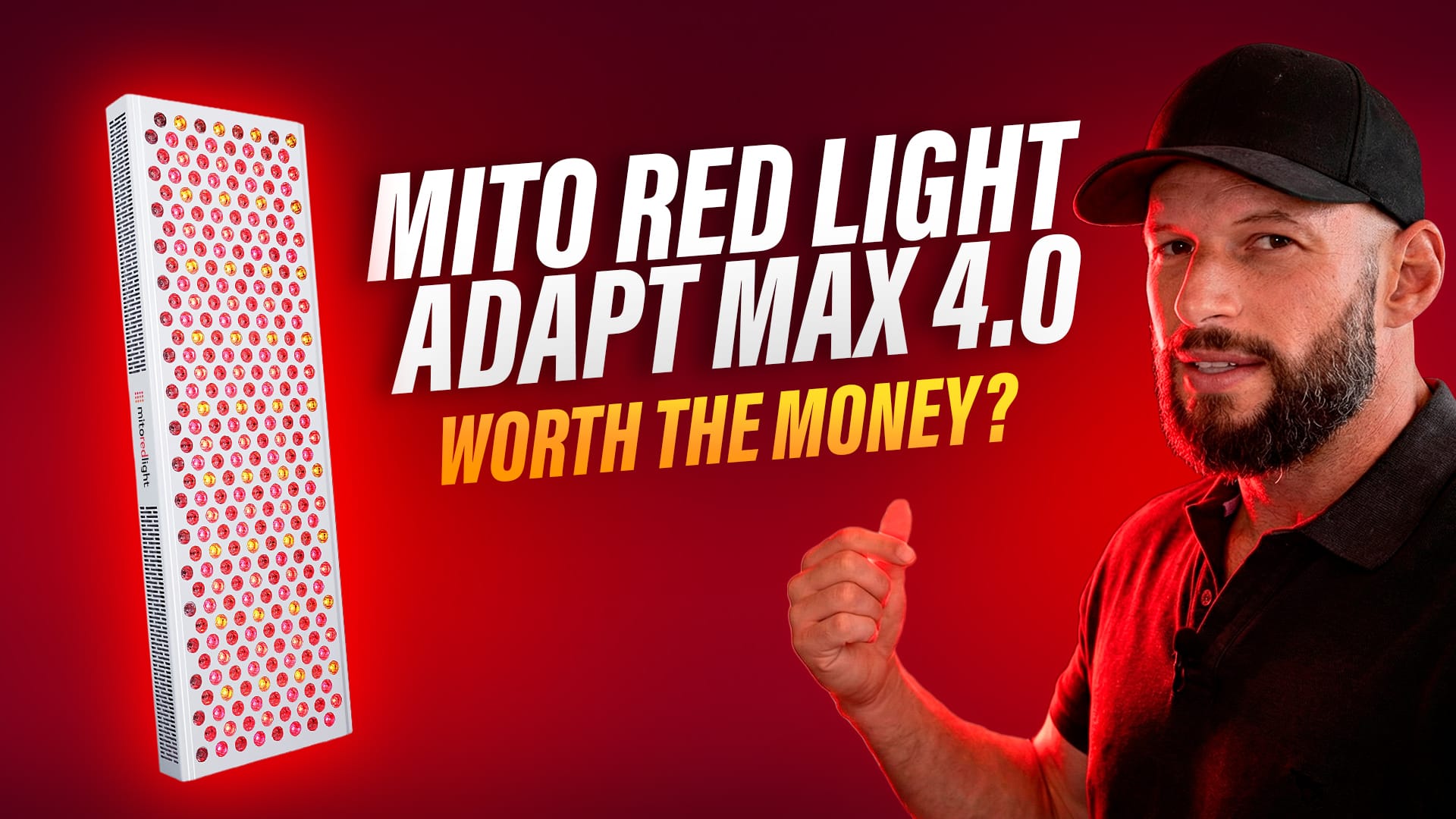
The Mito Red Light Adapt 4.0 Max is the company’s latest-generation red light therapy panel. This is the Max model in the Adapt lineup, representing a notable shift in direction for Mito Red Light—particularly in wavelength selection and built-in software features.
At first glance, the Adapt 4.0 appears to be another wall-mounted panel update. But once you dig into the details, it becomes clear that Mito Red is trying to differentiate this model in ways we don’t commonly see, including the use of eight distinct wavelengths, one of which is rarely included in consumer red light therapy panels.
Let’s walk through what this panel offers, how it performs in real-world testing, and who it may—or may not—be right for.
Where the Adapt 4.0 Fits in the Mito Red Light Lineup
Mito Red Light’s panel lineup has become increasingly complex over the years, and the introduction of the Adapt series doesn’t necessarily make things clearer.
To quickly put it into context:
- The MitoPro + uses four wavelengths
- The MitoPro X increases that to six wavelengths
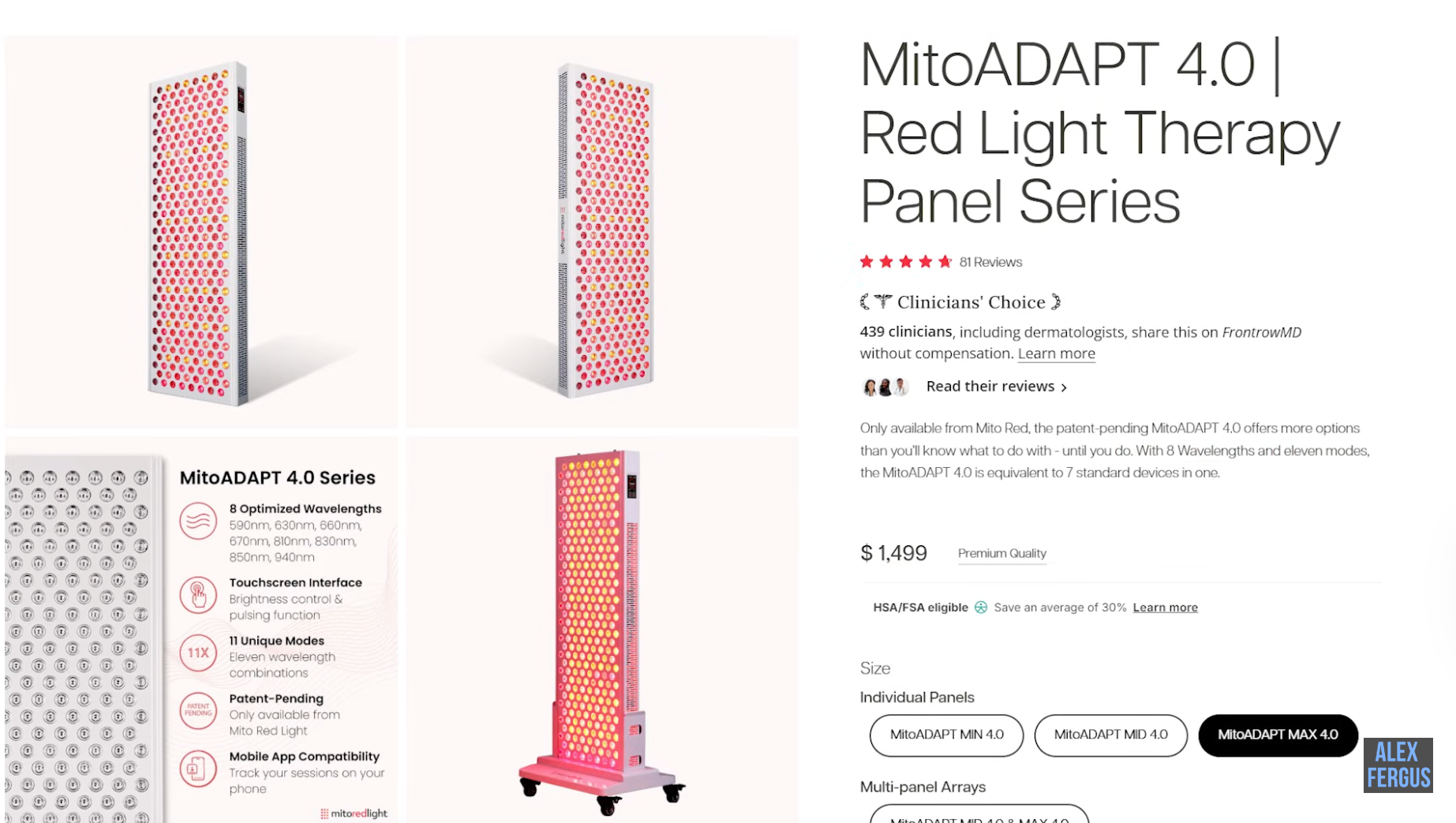
- The MitoAdapt 4.0 pushes things further with eight wavelengths
So yes, you are getting more wavelengths with the Adapt—but that’s not the only change. This panel also introduces 11 pre-built smart modes, limited pulsing functionality, and a revised internal LED configuration.
All of this is powered by 288 dual-chip LEDs, housed in a panel 36 inches tall, 12 inches wide around 25 pounds.
Eight Wavelengths: An Ambitious Design Choice
The headline feature of the Mito Red Light Adapt 4.0 Max is its eight-wavelength configuration. Even by today’s standards, that’s an unusually high number.
When panels like the BioMax first launched with seven wavelengths, it was considered a major step forward. In practice, though, most panels still concentrate most of their output at just one or two primary wavelengths.
What makes the Adapt 4.0 different is that the output is spread evenly across all eight wavelengths, rather than heavily favoring a small subset.
Those wavelengths are:
- 590 nm (amber)
- 630 nm (red)
- 660 nm (red)
- 670 nm (red)
- 810 nm (near-infrared)
- 830 nm (near-infrared)
- 850 nm; (near-infrared)
- 940 nm (near-infrared)
The inclusion of 590nm amber already sets this panel apart from most competitors. The real outlier, however, is 940nm near-infrared. This wavelength is not commonly found in consumer panels. It has appeared in a handful of niche products before, but it remains far from standard.
There is some research on 940nm, but it’s limited. It’s not a wavelength most manufacturers would prioritize when designing a panel strictly based on established clinical evidence. Whether Mito Red included it to expand therapeutic options or simply to stand out in a crowded market is open to interpretation.
What makes this especially interesting is that Mito Red already differentiates itself through amber light. Adding 940 nm feels less like refinement and more like experimentation.
Spectrometer Testing: Do the Claims Hold Up?
Spectrometer testing confirmed multiple distinct wavelength peaks; the panel is genuinely emitting all eight wavelengths.
Most of the measured peaks aligned well with the claimed specifications. There was, however, one notable exception: the amber wavelength.
The panel is advertised as using 590nm amber, but the measured peak was 599 nm. Typically, a variance of about ±5 nm is acceptable. In this case, the difference is closer to 10 nm.
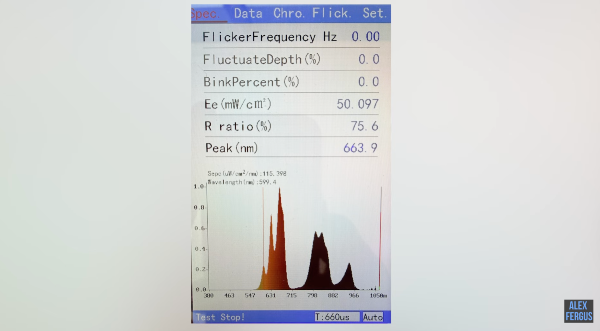
This isn’t a major functional issue, but it does matter if you’re buying this panel specifically for true 590 nm amber. What you’re actually getting is closer to 600 nm, which leans more toward red than amber.
That doesn’t make the panel ineffective—but it is something buyers should be aware of.
Power Output and Performance in Context
In terms of measured output, the Adapt 4.0 delivered:
- Peak irradiance: 74 mW/cm²
- Average irradiance (9-point test): 58 mW/cm²
- Total therapeutic output: 133 watts
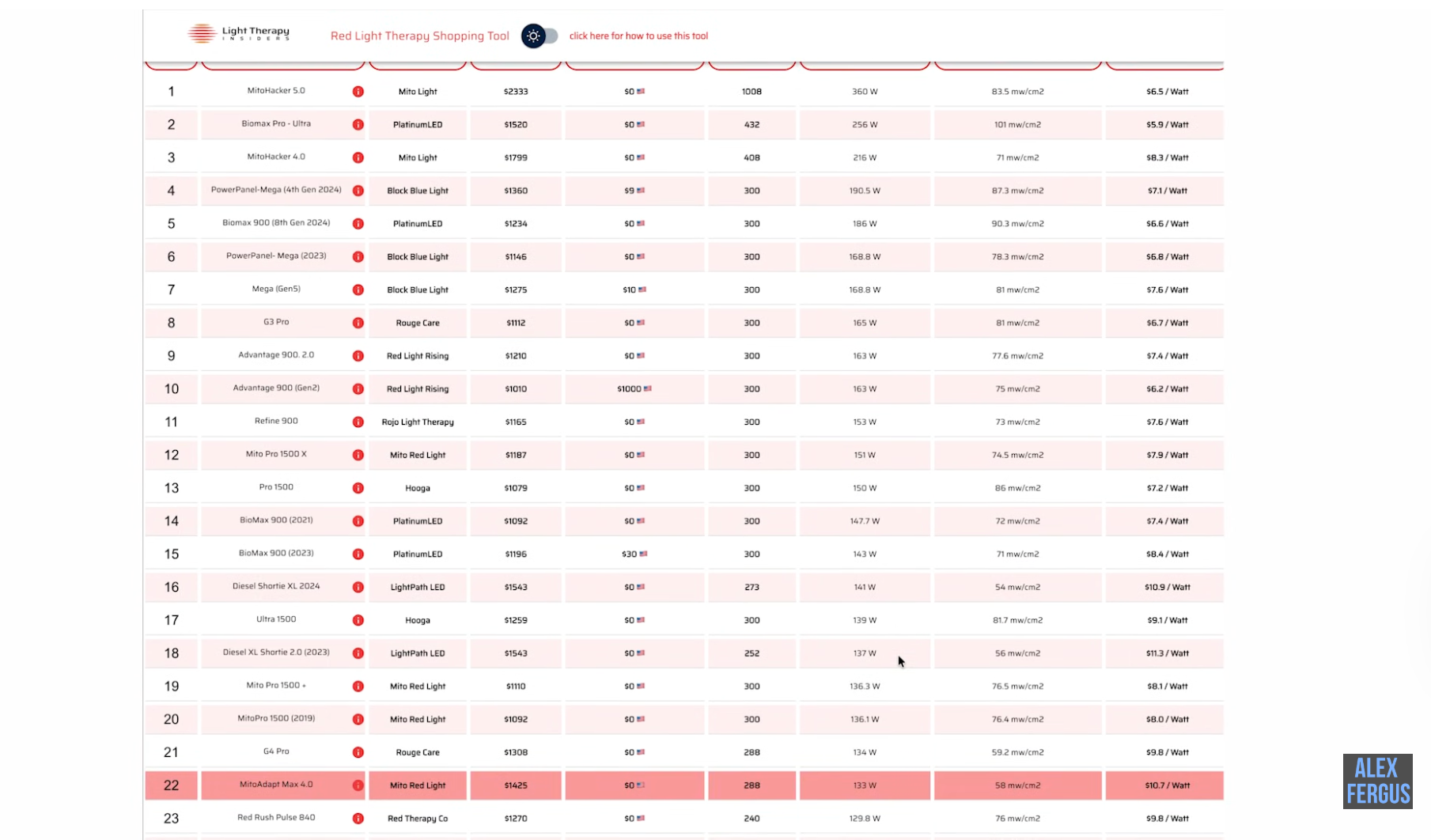
Let's compare it with my shopping tool database; this places the Adapt firmly in the middle of the pack—and closer to the lower end than the top.
Sorted by total power output, it ranks around 22nd. By average irradiance, it drops further to around 31st. That doesn’t mean it won’t work. It will absolutely deliver therapeutic light. But it’s clearly not a high-output panel.
For perspective, panels like the BioMax deliver nearly double the total output at similar—or sometimes lower—price points.
Price, Shipping, and Value
The Mito Red Light Adapt 4.0 Max retails for $1,499 and is discounted to $1,425 when purchased through my link: https://aferg.co/7d221. Discount automatically applied at checkout.
Shipping within the United States is free. International shipping, however, is extremely expensive. Quotes to locations like New Zealand and the UK came in at $400 or more, which makes this panel a tough sell outside the U.S.
Smart Modes, Controls, and Usability
The panel includes 11 built-in modes, but these modes are far less intuitive than what we typically see.
Rather than clearly labeled presets like “recovery” or “skin,” most modes simply indicate which wavelengths are active. There are no meaningful labels on the panel itself, no ability to save custom presets, and no clear guidance built directly into the interface.
Some modes are described as “skin” or “collagen” on the website, but those labels don’t appear on the device. This creates unnecessary confusion and forces users to reference the manual or website.
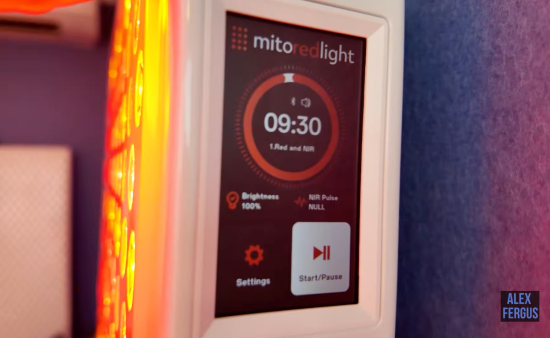
The touchscreen is high-resolution and looks great, but it’s quite small. With brightness controls, timers, pulsing options, and multiple modes all packed in, the interface can feel cramped—especially if you’re frequently adjusting settings.
There is a companion phone app, which is honestly the better way to control this panel.
Stands, Warranty, and Build Quality
No stand is included with the panel. Optional stand pricing is roughly:
- Vertical or horizontal stand: around $300
- Floor stand: around $150
Warranty coverage is three years, along with a 60-day return period. That’s reasonable, though not best-in-class, as several competitors now offer four- or five-year warranties.
Build quality is solid, the manual is well done, and Mito Red Light has a long-standing reputation for good customer support.
Pros and Cons
Pros
The Mito Red Light Adapt 4.0 Max stands out primarily for its eight-wavelength configuration, which remains rare in the panel market. Output is distributed across all wavelengths rather than concentrated in one or two, which will appeal to users who value spectral variety over raw power.
The inclusion of amber light remains a differentiator for Mito Red Light. While the measured peak is closer to 600 nm than the advertised 590 nm, amber-range light is still uncommon in full-size panels and may be desirable for some users.
The panel also includes 940nm near-infrared, a wavelength that is rarely found in consumer red light therapy panels. While not essential for most users, it does offer an option that very few competing panels provide.
Build quality is solid, the touchscreen is high-resolution, and the manual is well put together. Mito Red Light remains a reputable company with consistent product quality, good customer support, a 60-day return period, and a three-year warranty.
Cons
The amber wavelength discrepancy is a drawback, particularly for buyers specifically seeking true 590 nm output. At this price point, tighter wavelength accuracy would be expected.
Overall power output is relatively low compared to similarly priced panels, which hurts the value proposition. While the panel will deliver therapeutic light, it is underpowered relative to many alternatives in the same price range.
The user interface, despite its visual polish, is cramped. Managing modes, timers, brightness, and pulsing directly on the panel can be frustrating, making the phone app almost necessary.
There is no individual wavelength control, limiting customization compared to newer competing panels. Stand options are limited and not included, adding to the overall cost.
Finally, international shipping costs are very high, making this panel difficult to justify for buyers outside the United States.
Better Alternatives to Consider
If power and value are higher priorities, panels like the PlatinumLED BioMax Pro series offer significantly more output at a more competitive price. While they use fewer wavelengths, the core wavelengths are where the majority of the therapeutic benefit comes from, and the added power gives you more flexibility.
The Rouge G4 lineup is another strong alternative. These panels also offer eight wavelengths, but with a blend that is arguably more practical. They lack amber and blue but include 1064nm near-infrared, offer more intuitive smart modes, and deliver better overall value.
If you were buying today and weighing features, performance, and price together, the G4 would be the more compelling option for most people.
Items Mentioned
⭐ Mito Red Light Adapt or any items, use https://aferg.co/7d221 for 5% off sitewide . Code will auto-generate once you click the link.
⭐ For a PlatinumLED BioMax, use https://aferg.co/redled for 5% off. Code will generate once you click the link.
⭐ For A Rouge Panel, Use discount code ALEX at https://aferg.co/rougecare for 5% off
Found This Interesting? Look At These Articles:
♦️ Light Therapy EXPLAINED: Basic Terms Guide!!!
♦️ Red Light Therapy Help Scars? The Science
♦️ You Need To Know About Tinnitus & Red Light Therapy
♦️ Light Therapy For Migraines 101: Why The Research Is Super Promising!
My Latest Reviews
♦️ How to Find YOUR Best Red Light Therapy Mask
♦️ Rouge Red Light Therapy Review: Is It Worth the Investment?
♦️ Better Than Red Light Therapy Masks? My Top Picks
♦️ Red Light Therapy Mask Comparing Test: 25 Masks Ranked And Reviewed
Alex's Bio
Alex Fergus wrote this blog post. Alex is an ISSN Sports Nutrition Specialist, Fitness Professional, and certified Superhuman Coach who continues to expand his knowledge base and help people worldwide with their health and wellness. Alex is recognized as the National Record Holder in Powerlifting and Indoor Rowing and has earned the title of the Australian National Natural Bodybuilding Champion. Having worked as a health coach and personal trainer for over a decade, Alex now researches all things health and wellness and shares his findings on this blog.
Frequently Asked Questions
What is red light therapy?
Red light therapy uses red and near-infrared wavelengths of light to support normal cellular energy and recovery. It’s often referred to as photobiomodulation (PBM). If you're comparing devices and brands, you can check the discounts page for current deals and recommendations.
How does red light therapy work?
Red and near-infrared light can be absorbed by mitochondria in cells, which may help support ATP production and normal cellular repair processes.
What wavelengths are used in red light therapy?
Most red light therapy devices use wavelengths roughly between 630 nm and 880 nm. Common wavelengths include 630 nm, 660 nm, 810 nm, 830 nm, and 850 nm.
What’s the best red light therapy panel?
The best red light therapy panel depends on coverage needs, power output, wavelengths, and budget. Before buying, it's smart to check the discounts page to compare brands and deals.
Red light panel vs mask: which should I choose?
Red light panels usually provide broader coverage and higher power output, while masks are designed primarily for facial skin treatments.
What does low EMF mean for red light therapy devices?
Low EMF refers to lower electromagnetic field emissions around a device. Some buyers prioritize this feature when comparing devices.
How long should a red light therapy session last?
Many users begin with sessions of around 5–10 minutes per treatment area and adjust based on device power and distance.
How often should you use red light therapy?
Common routines range from 3–5 sessions per week depending on the goal and device strength.
Is red light therapy safe?
Most consumer red light therapy devices are considered safe when used according to manufacturer guidelines.
Who is Alex Fergus?
Alex Fergus is the founder of Light Therapy Insiders and reviews red light therapy devices with a focus on practical buying factors.
Where can I find red light therapy discount codes?
You can check the discounts page to see the latest red light therapy discount codes and deals.
Do red light therapy discount codes expire?
Yes. Most brands rotate discount codes during promotions and seasonal sales. If a code stops working, it's best to check the discounts page for the latest offers.