
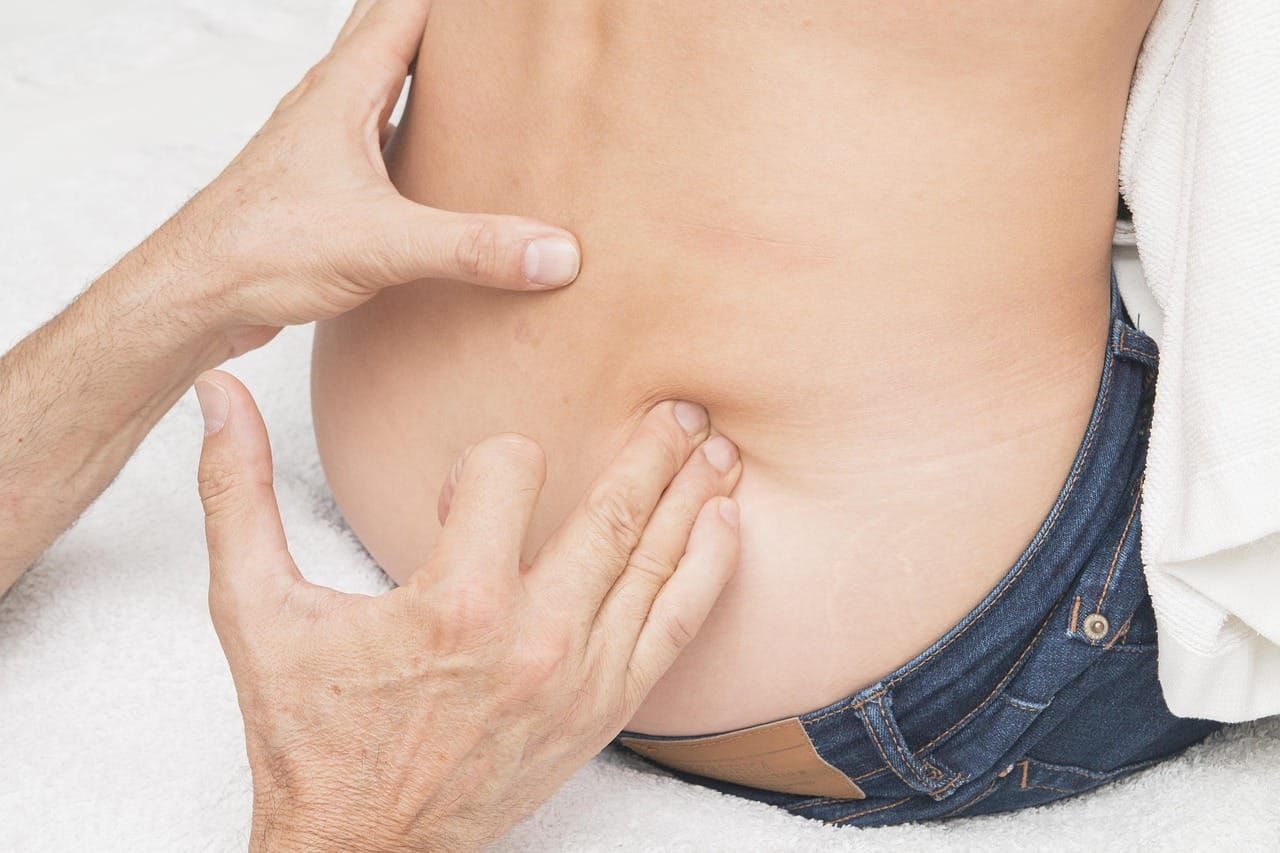
I've extensively talked about red light therapy for back and neck pain before. Sciatica is a very specific type of back pain. And fortunately, there are quite a few studies on sciatica and red light therapy as well.
Just imagine:
Getting a sharp, shooting, burning sensation down the leg. At best, you've got some discomfort. At worst, you've got relentless crippling pain. You may be unable to sit down well and may need to stay moving.
I've seen patients with sciatica as a physical therapist. And, no, it's not fun! Sciatica doesn't just mean pain, it also means that daily life's activities are strongly impeded. An inability to play with your kids, having to move very carefully throughout the day in order not to trigger the joints or the pain, not being able to sit for long periods of time, and maybe not even being able to work!
Not good!
Fortunately, red light therapy may be a great aid. No, red light therapy won't magically cure the entire condition and make you live happily ever after. But what red light therapy will do is make your pain, activities, and life slightly easier!
I consider questions such as:
- Is red light therapy good for sciatica?
- Does red light therapy work for sciatica?
- How to use red light therapy for sciatica?
I explore that dynamic in this article. If you just want to understand the basics of red light therapy for sciatica, read my summary below. If you want to understand my whole argument with all its details, read the entire article!
Easy peasy...
Here we go. Let's make life a little bit more normal again:
Sciatica affects 40% of humans in their lifetime. So if it's not you, it's someone you know. The pain originates from the sciatic nerves, which moves from the back into your legs. Sometimes, the leg pain can be more intense than that in the back.
Common symptoms you can experience are radiating leg pain, numbness, tingling, muscle weakness, and pain worsened by movement or pressure. Causes range from disc herniation and spinal stenosis (deformations of the spine) to nerve impingement in the buttocks. Diagnosis often involves symptom review and physical tests like the straight leg raise, with imaging (MRI/CT) used for persistent cases.
I've seen many sciatica patients as a physical therapist and the solution isn't always easy. Medication is often used and physical therapy doesn't have a great track record in the science. The same is true for surgery. Hence, you and I need new solutions!
That's where red light therapy comes in as a supportive treatment. Human studies, where light is applied to the lower spine and adjacent areas, have a decent track record right now, from all the existing studies I've analyzed. Studies show reductions in pain and disability using varying wavelengths and dosages, with some outperforming traditional therapies like TENS. For the best results, combine red light therapy with movement and physical therapy.
My recommendation is to start red light therapy slowly at the lower back and nerve area, and build up from there. Monitor your response during that process.
If you need an introduction to what these terms mean, check the following resources:
- What Is Red Light Therapy?
- Red Light Therapy Explained: Basic Terms Guide
- Start Here - Light Therapy 101 & Buyers Guide
- Red Light Therapy Dosing Chart: The Raw Data From Hundreds Of Studies
- Red Light Therapy Dosing: Why It's Complicated!
- Red Light Therapy Wavelengths Benefits: The Ultimate Guide
- How Often Should You Use Red Light Therapy Explained
These resources should give you a basic understanding of how red light therapy works, and the discussions around it!
The image at the start of this article is AI-generated, though!
In Search Of Non-Invasive Relief: Why Sciatica Matters
Let's look at a few reviews on sciatica. Reviews integrate previous (high-quality) publications on a given topic.
Sciatica: Primary Causes
In sciatica, as the name already implies, the sciatic nerve is affected. You can see that nerve running from the spinal cord in the lower back down into the legs:
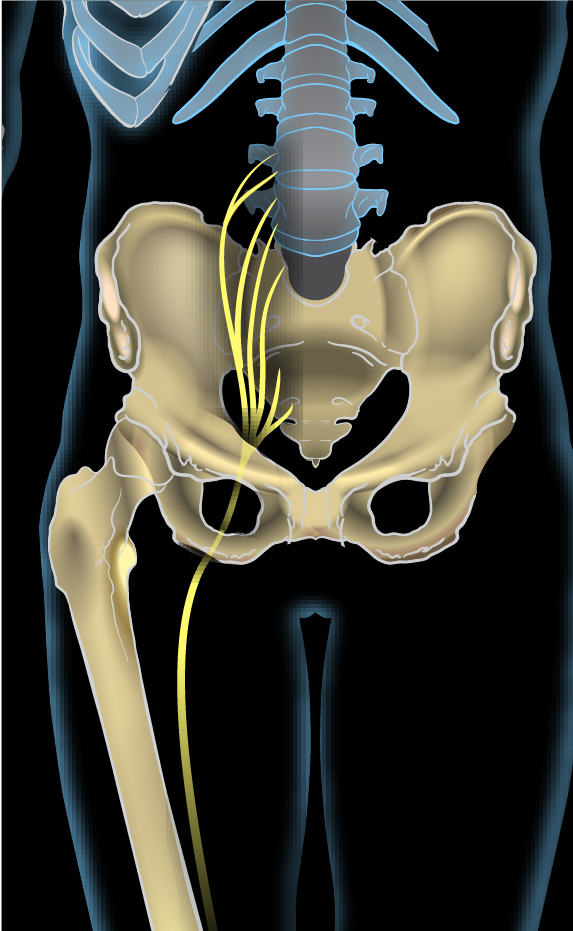
So, when I told you that I saw patients as a physical therapist who couldn't sit down, now you can understand the reason. Sitting increases the compression on that nerve, when then triggers problems down the nerve. Many times, people will actually have more symptoms in the area down the nerve than in the back itself.
Here's what a very recent review states about the condition:
"Sciatica represents a debilitating condition characterized by pain or paresthesias within the sciatic nerve distribution or an associated lumbosacral nerve root. A prevalent misconception often mislabeles any low back pain or radicular leg pain as sciatica. Sciatica entails pain directly resulting from sciatic nerve or root pathology. Comprising nerve roots from L4 to S3, the sciatic nerve, with a diameter of up to 2 cm, stands as the body's largest nerve. Pain associated with sciatica is exacerbated by lumbar spine flexion, twisting, bending, or coughing." (1)
The sciatic nerve provides sensation and the ability to move to the inner part and back of the upper leg, and then the lower legs (1). Inflammation is the main issue with sciatica, which is a key pointer for the argument I'm going to make later (1).
(Red light therapy strongly influences inflammation!)
Inflammation can exist in around the sciatic nerve all by itself and therefore cause symptoms. But inflammation can also exist because there's a herniated disc that's compressing the nerve, and thereby causing problems. Other reasons exist as well, such as spinal deformation ("stenosis"), trauma, impingment of the sciatic nerve further down the road in the buttocks, and degenerative disc disease.
Below, you can see how the condition originates in a disc herniation example. Somewhere, in the lower spine, there needs to be impingement or compression on the sciatic nerve:
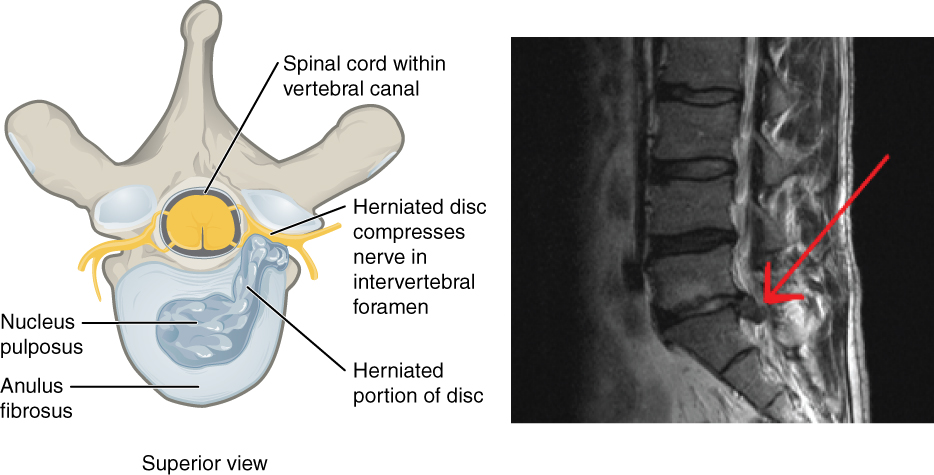
Usually, only one leg is affected.
Sciatica Demographics
Now here's the kicker: about 10 - 40% of people will experience sciatica in their lifetimes (2). And, yearly, the number is 1 - 5% of people (2). There's often no easy solution though - even if you've got sciatica long-term, surgery won't fix the issue in most cases, at least not long-term (3; 4).
In many studies, conservative treatment even outperforms surgery in the long run (4). My general recommendation as a physical therapist in the past is to really do your research well before getting back surgery, in general.
Sciatica Symptoms
So what will you feel when affected by sciatica? I've already mentioned the inability to sit down - because that compresses the disc or presses down on the nerve even more here are other symptoms:
- Radiating leg pain (often in just one leg because of the nature of the condition)
- Pain originating from the lower back or buttocks
- Numbness or tingling (paresthesia) in the leg or foot - this is because the nerve is affected!
- Muscle weakness in the affected leg - also because of the nerve once again!
- Pain aggravated by some movements, coughing, or sneezing. Coughing or sneezing increases the pressure on the spine or discs, thereby the pressure on the nerve.
Sciatica Diagnosis
The condition can be challenging to diagnose, however, as there are numerous moving parts in the spine (2; 5; 6; 7). In general, though, you simply listen to the symptoms of the patient. There, you can identify the neurological symptoms.
As a physical therapist, you'd do some testing, such as "straight leg raise", whereby a patient raises their leg while laying on their back, with assistant of the physical therapist. This test often provokes the pain, if there is sciatica.
I'll come back to that "straight leg raise" test later - as it's a main outcome in many red light therapy studies...
In terms of neurology, the symptoms that I've described in the previous section can be tested for.If symptoms persist long-term and aren't fixable, then MRI and CT scans are necessary in mainstream medicine. MRIs and CTs can be great for identifying the options you've got!
Sciatica Treatment Options
So there are loads and loads of different sciatica treatment options. I'll start with the most obvious choices and work my way down to the more invasive ones (2; 8; 9; 10; 11; 12; 13).
Conservative treatment - it's best to start here:
- Rest and activity changes (don't do the stuff that makes your sciatica worse!)
- NSAIDs such as ibuprofen
- Physical therapy, such as core stabilization and McKenzie exercises (based on extending the spine, that will often make issues better, especially if you sit a lot!). Massages are also super frequently done in physical therapy but I don't support that fully because it makes you depend on the physical therapist for treatment.
- Heat/ice therapy
- Manual therapy: a specializion on physical therapy, which includes spinal manipulation.
- Education, with reassurance and informing patients about the prognosis. If you just got sciatica the first week, for instance, you should be worried because it often resolves itself!
Medications:
The following medications are often used. Keep in mind, these don't fix the underlying issue:
- Corticosteroids ("cortisol" - for inflammation and more! )
- Muscle relaxants
- Opioids: These are riskier because of addiction issues - we all know the history there!
Yes, these tend to help but not long-term. Corticosteroids can even break down tissue long-term, even though it may give you great pain relief!
Surgery:
- Selective nerve root blocks, whereby you block part of the nerve so it doesn't give symptoms anymore
- Symptoms persist for more than 6–12 weeks - despite conservative treatment
- Severe neurological symptoms that prevent you from functioning normally. Some people cannot move their feet normally anymore, for instance, if the impingement on the nerve is too strong.
- Cauda equina syndrome (surgical emergency)
Here, the disc or parts of the bony areas in the spine can be removed, or the spine can be fused. This all depends on the diagnosis!
The bottom line? There are tons and tons of sciatica treatment options. But none of these is bulletproof! Do keep in mind that for most people, sciatica resolves all by itself. So in my opinion it's best to focus on the conservative treatment first, as well as potentially some medication where necessary.
I'm not against medication here. Sometimes you need medication in the short-run, such as to get through nasty pain or to be able to sleep at all. There's no black and white answer here and I don't think you should feel guilty or ashamed for using medication!
How Red Light Therapy Interacts With Nerves And Tissues
I've written quite a lot about red light therapy for back and neck pain on the one hand, and topics related to nerve health, such as neuropathy, on the other hand. As always, you can insert the "standard list" of the "red light therapy effects", mechanisms, basic physiological consequences, that is found everywhere on the internet (14; 15; 16; 17; 18; 19; 20). These are:
- Greater energy production due to increases in "ATP" or "Adenosine Triphosphate". ATP is generally accepted as the main energy currency of the cell - so the more ATP you have, the more "fuel" the cell can burn, metaphorically speaking!
- Lower inflammation and oxidative stress. Some inflammation and oxidative stress are good, at the right time. But most people - especially with age - have excessive inflammation and oxidative stress. Oxidative stress is a natural byproduct of energy production, for instance, but at excess levels it's harmful. Pro-inflammatory messenger compounds ("cytokines") such as interleukin-6 and TNF-alpha are impeded, while anti-inflammatory ones such as Interleukin-10 are upregulated.
- Boosts the regeneration of the nervous system. A few different mechanisms exist here, such as "Brain-Derived Neurotrophic Factor" (BDNF) that increases repair and regeneration of the nervous system. There's also increased sprouting of nerve endings ("axons") and the white matter of the nervous system ("myelin") is repaired. That myelin plays a major role in MS, which red light therapy is also very helpful with!
- Has general pain-killing effects, especially at higher doses. This is why red light therapy has an effect on fibromyalgia, for instance, or knee pain, and even injection pain at the dentist's office. This effect is reached through several mechanisms, such as sodium/calciums that are involved with pain transmission, and certain compounds such as "substance P" and calcitonin gene-related peptide that lower pain - no need to remember these names!
With the spine, in particular, there are a few mechanims that I've also talked about in other articles:
- Treating the muscles next to the spine: These muscles commonly have tension and pain if you're under stress, for instance. An example here are tight neck muscles around the spine when you're under lots of stress or have poor posture.
- The joints around the spine are affected as well, lowering pain.
- Intervertebral discs may have their degeneration slowed. These discs is what cause lots of sciatica in the first place.
- Affecting the peripheral nervous system. By treating the nerves around the lumbar and sacral spine (such as the L3, L4, L5, S1 areas), the sensory and motor function is directly affected, also further down the road. In my light therapy and gut health article, for instance, I talk about how applying light therapy to the lower and middle spine likely helps gut issues!
So there's that!
Let's now look at the specific studies red light therapy for sciatica pain and other outcome studies:
From Chronic Pain To Cellular Repair: The Role of Red Light Therapy For Sciatica
In the medical literature, "sciatica" is a form of "radiculopathy" - or pathology of the "radix" (Latin for "root") of the nerve. That root of the nerve is placed in the spine. Hence, you're looking for studies on light therapy studies on lower back pain with radiculopathy.
Vladimir Heiskanen's Excel sheet that showcases 8,000+ light therapy studies is an excellent source for these studies, if you search for "radiculopathy" (21). Credit where credit is due!
So let's consider the question of "does red light therapy help nerve pain?", in the area of sciatica:
- First there's a 1,064 nm study with light, where the control group received "TENS" - electrostimulation for lowering pain (22). Here's the description of the researchers:
"Group 1 (n:27) received 10 sessions of a combination of hot pack, TENS, US and exercise, and Group 2 (n:27) received hot pack, HILT and exercise." (22).
- "HILT" here means "High Intensity Laser Therapy". The TENS application worked better than the light therapy in this study. Pain, however, decreased very much in both groups. You can see the results in the picture below (23):
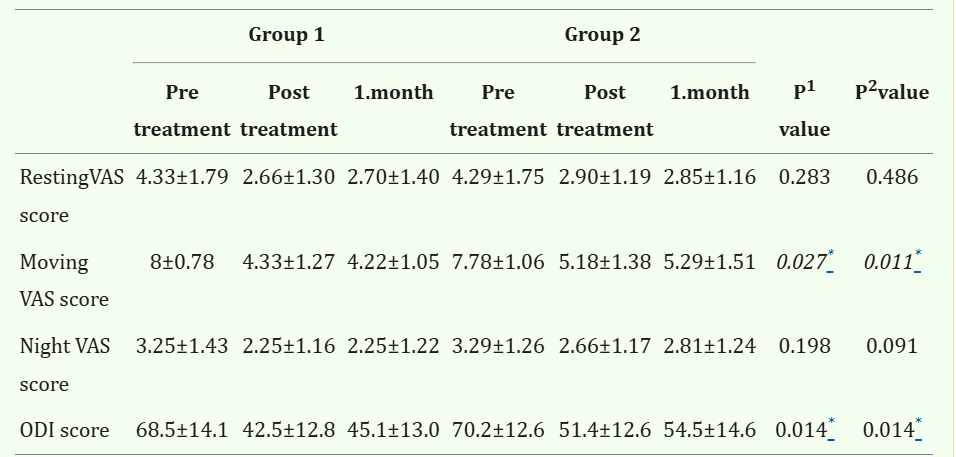
- Pain levels in both groups, using the VAS scale which measures pain on a scale from 0 - 10, was reduced by about 30%. The dose in this study was super high, though - researchers write here that:
"The second group had high intensity laser device (BTL 6000) used after 20 minutes hot pack application for five days per week over two weeks for a total of 10 sessions of high intensity laser treatment. The device was set to 25 Hz frequency, 10 watt power with 12 j/cm2 dosage to the lumbar region over 25 cm2 area for four minutes biostimulation mode, followed by continuous mode for 6 minutes with 7 watt power and 120 j/cm2 dosage." (23)
- Moving on to the second study used five weekly treatments for two weeks at 904 nm with 3,000 Hz pulsing (24). There were three treatment groups but only the doses differed (0.4J, 4J, and 16J). All groups had great outcomes in pain as measured by the VAS scale, but the third gropu had the best improvements in functional capacity.
- Thirdly, there's another study with a highly complex setup once again (25). Here, NSAID medication (anti-inflammatory) and light therapy, NSAID and sham light therapy, and NSAIDs only. There were five weekly treatments for three weeks. All groups improved pain and function significantly in their pain, disability, and quality of life, but the light therapy group did best! The wavelength used was 904 nm, at 5,000 Hz pulsing and 3 J/cm2 per treatment point.
- By the way, some neck pain radiculopathy studies also show good outcomes (26; 27). I just want to include that data as a point of reference becuase it strengthens the case!
- Then, another study comparing light therapy to TENS (28). Both worked but light therapy worked better for lowering the neuropathic pain and the pain in the leg. Light therapy was applied at a 4 J/cm2 dose at 850 nm at each treatment point at the point at which the nerve most easily compresses.
- A lower quality study with 830 nm does show that it works for pain intensity, range of motion, and functional capacity (29).
- Another 830 nm study at 3 J/cm2 has better outcomes with the light therapy and physical therapy combination than just light therapy alone (30). Pain, disability, functional ability, and range of motion all improved more in the light therapy group.
- In a last study there were three separate groups: a 904 nm laser, placebo, and 940 LED (31). Here's the treatment protocol for the light therapy:
"laser wavelength 904 ± 10 nm, average power 0.038 ± 20 % W, irradiated area 0.16 cm(2), energy per point 4 J, and treatment time per point 104 s; LED wavelength 945 ± 15 nm, power 0.1 W, irradiated area 1.0cm(2), energy per point 4 J, and treatment time per point 40 s." (31).
- So, the treatment area was generally very small! All participants - who have disc herniaations in the spine - also did some exercises. The LED group had the best outcomes for pain, gait quality, disability, and function!
And that's it. All the studies on red light therapy for sciatica that have currently been published.
I wish there were more studies on topics such as:
- Red light therapy for piriformis syndrome
- Red light therapy for pinched nerve
- Red light therapy for spinal stenosis
But these don't exist currently - not at the very specific level. So I'll be watching out for these in the future!
Best Red Light Therapy For Sciatica Devices
If you want easy treatment, it suffices to just use a handheld red light therapy panel in this case, and apply it to both the lower back and glute region. Here's where Alex reviews different handheld devices:
Alternatively, a tabletop panel likely hits a bigger area. With a bigger area, you can treat a larger portion of the spine at one, including all the nerve endings, such as L1 - S1:
And, while slightly more expensive, the best option right here is likely the Chroma Ironforge, if you're able to reach behind your back with one arm and treat the lower back and glute area:
Hope that helps!
Real Stories Of Sciatica Relief Through Red Light Therapy?
So we've had quite a few people resolve their sciatica or get huge relief from it in our Facebook group. In that group, you can't just talk about your personal experience but also ask questions about how to best treat your sciatica, or adjust your treatment based on personal circumstances:
In the top-right of the group, there's a search function that allows you to type in "sciatica":
Just click on the focus glass, and you'll find many different answers of different people, such as:
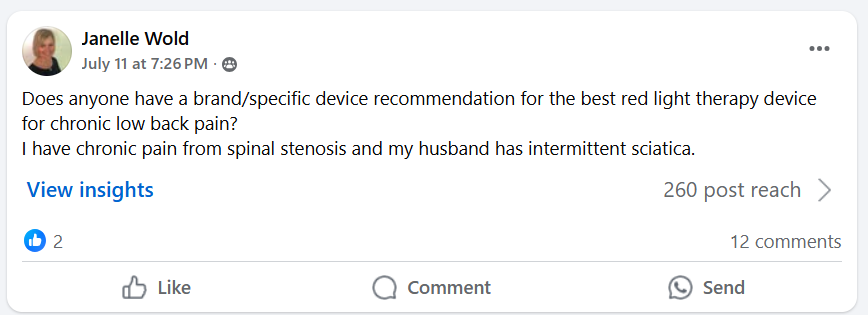
And:
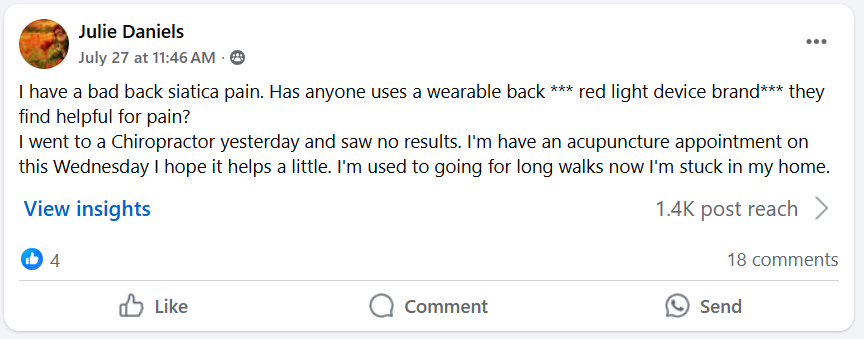
So, I recomend joining us there, if you don't know how to properly treat your sciatica with red light therapy:
What to Know Before Starting Red Light Therapy For Sciatica
Proper dosing by starting slowly is the most important pointer for starting your sessions. Many people who enter this space think that more is better, but that's often not the case.
Instead, you'll want to go really slow at the beginning and monitor your response. Then, you can increase the dose (treatment time) in the next session or even next week. It's important to monitor your response during the red light therapy session, directly afterward, and also the next few days. If you've got a good response, take note, and potentially increase the dose. I've written very extensively about dosing in the past, and you can check the articles here:
- Red Light Therapy Dosing Chart: The Raw Data From Hundreds Of Studies
- Red Light Therapy Dosing: Why It's Complicated!
- Red Light Therapy: What’s The Ideal Distance from Skin?
I know it may seem intimidating at first - the quantity of information. But nevertheless, the more you read up on those topics, the better you can understand the dynamic there!
Want More Red Light Deep Dives, Including Red Light Therapy For Back And Neck Pain? Join My Advanced Science Course:
Join my 100% free advanced science light therapy course above, where I take deep dives into many different topics, such as mechanisms, neurology (Alzheimer's, Parkinson's, etc), exercise recovery, skin beauty & rejuvenation, and much more. Here's what you can expect:
- My latest take on using light therapy for Alzheimer's, Parkinson's, and other neurodegenerative diseases, updated late 2025.
- Countering joint problems and lowering pain by 20-40%, such as osteoarthritis
- The best light therapy routines to optimize sleep quality and gym performance, leading to significant boosts in these areas.
- Current 2025-26 updates on using red light therapy for skin rejuvenation, and which wavelengths, power outputs, devices, and routines I recommend there.
- More oral health episodes, with the science on dentin hypersensitivity, injection pain, and periodontal health, broken down on camera.
- All of this info based on peer reviewed reviews, or human RCT studies ideally, broken down by me on camera.
Some of the topics are only published in that course, such as UV light risks and benefits, addiction, anxiety, depression, and more. So join HERE!
Red Light Therapy & Other Alternative Treatments: Is There A Synergy?
Yes, there's a synergy! As always, I very much recommend viewing red light therapy as a tool in the toolbox, not the only tool you use! I'll briefly go over a few great options here, regarding what other strategies you can use.
I won't consider surgery here - that's something between your doctor and you. However, I only recommend surgery if all options are exhausted and if you're very thouroughly done your research on the risk:reward ratio of doing that surgery! People don't always end up in a better place after surgery, especially long-term, so be pretty skeptical there!
Let's check a few options from the research of the last 5 years:
- Physical therapy may not have a perfect track record here (32). A review looking at 18 earlier studies finds the results inconsistent (32). And yet, as you probably know, many people use physical therapy as a first line of treatment for sciatica! The same is even true for manual therapy, such as chiropractic manipulations (33).
- NSAID drugs have a similar outcome (34). There's no improvement over alternative medication, although, medication will help you with short-term painkilling. Just don't rely on painkilling medication forever!
- What's great is that acupuncture does help with relief, apparently (35). There's a whopping 17/100 reduction in pain on the VAS scale, which measures pain from 1-100.
- Cognitive behavioral therapy, which is a psychotherapy which helps you deal with the interaction of thoughts/emotion, rational choices, and behavior, also helps (36).
- Steroid injections in the back also help, at least, in the short term (37).
- Staying active remains the cornerstone of treating sciatica well. So overall, there's no single best solution. Acupuncture and red light therapy, with movement, and strategically implemented medications, is likely best here!
Finally, let's conclude:
Conclusion: Red Light Therapy Is One More Tool In The Sciatica Toolbox!
So yeah, what can I say? Currect red light therapy research on this topic is quite promising. But it's not convincing enough yet for universal recommendation as we need more studies on this topic.
I am very excited, however, with the existing studies. And given the very low cost of a small red light therapy device, and the control that gives you, I'm pretty comfortable recommending this treatment for almost anyone with sciatica right now.
So if I had this condition, I'd 100% use it - hopefully together with acupuncture, movement, and, painkillers here and there when needed!
This is a post by Bart Wolbers of Light Therapy Insiders. Bart finished degrees in Physical Therapy (B), Philosophy (BA and MA), Philosophy of Science and Technology (MS - with distinction), and Clinical Health Science (MS), has had training in functional medicine, and is currently chief science writer.
Found This Interesting? Then You Might Like:
- Discount Codes, Deals & Recommendations - Red Light Therapy
- 36 Powerful Red Light Therapy Benefits
- Is Red Light Therapy Science-Based? An Introduction
- Red Light Therapy For Upgrading Your Brain Health
- Red Light Therapy For Depression: A Potential Solution
- Red Light Therapy For Weight Loss: The Science Of Supercharging Fat Loss
- HigherDOSE Sauna Blanket Review: Game-Changing Budget Home Sauna?