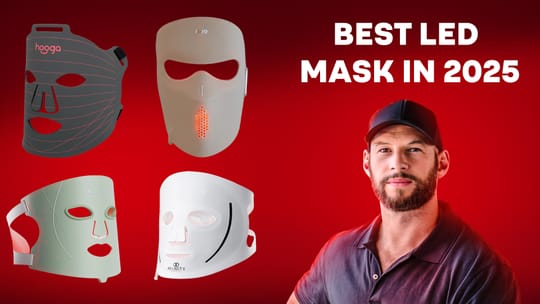

Red light therapy masks have exploded in popularity, promising smoother skin, fewer wrinkles, clearer complexions, and spa-level results from the comfort of your couch. But as the market grows, so does the noise. Scroll through Google, and you’ll find dozens of “best LED mask” lists — many filled with glowing praise, impressive LED counts, and bold claims about NASA technology.
The problem? Most comparisons barely scratch the surface of what actually determines whether a mask works. Not all reviews are created equal. Some reviews rely heavily on brand marketing and subjective impressions, while others dig deeper into the science of wavelengths, dosing, coverage, and real-world usability.
In this article, we break down the good, the bad, and the ugly of red light therapy mask comparisons — so you can tell the difference between hype and genuinely helpful guidance.
Foundational Principles: What To Look For In A Red Light Therapy Mask
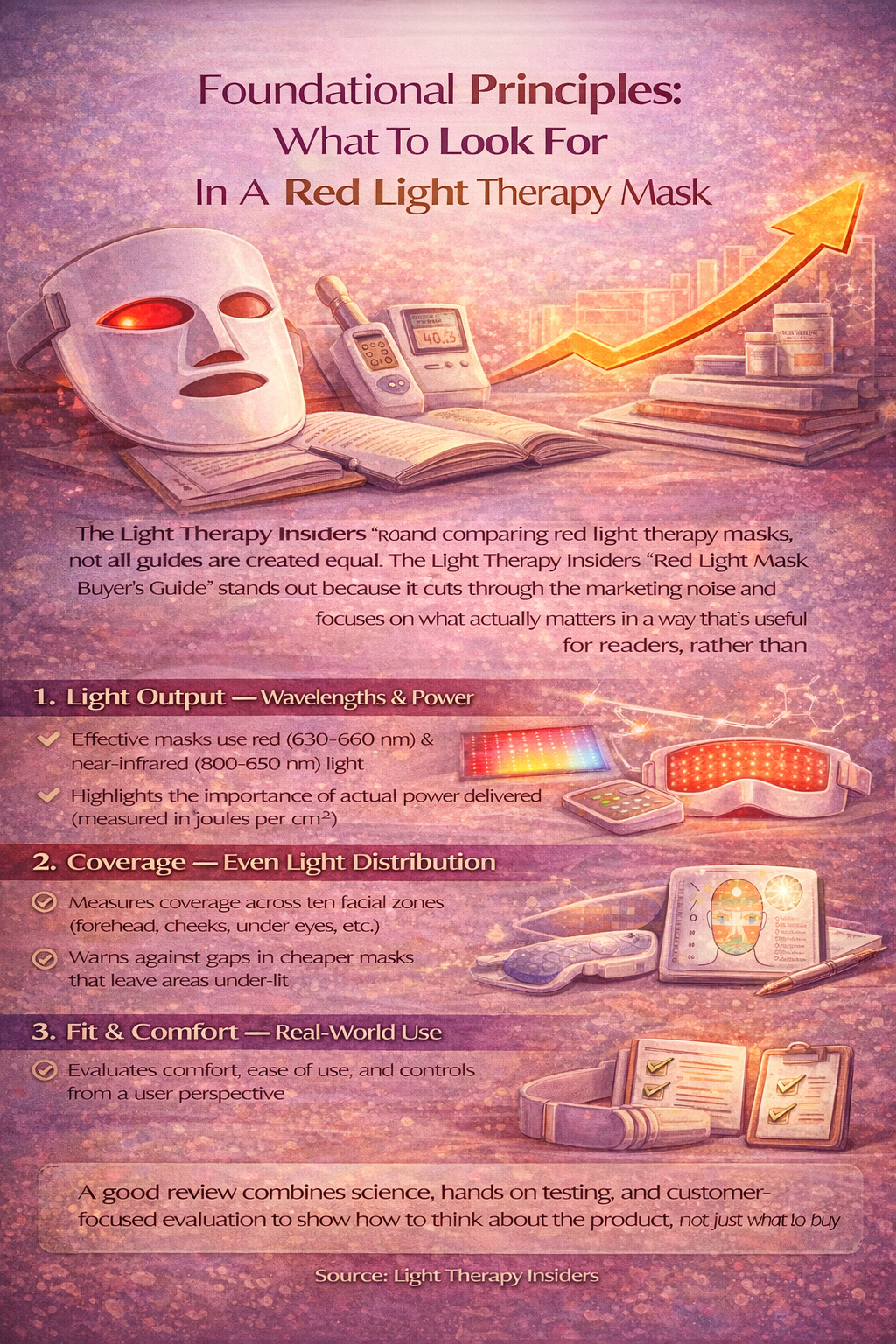
When it comes to reviewing and comparing red light therapy masks, not all guides are created equal. The Light Therapy Insiders “Red Light Mask Buyer’s Guide” stands out because it cuts through the marketing noise and focuses on what actually matters in a way that’s useful for readers, rather than regurgitating specs or hype plucked from press releases.
The author begins by acknowledging a crowded market full of flashy claims—“NASA-based” technology, rainbow LEDs, and promises to erase wrinkles with minimal effort. Rather than repeating these selling points, the guide leans on real experience and data-driven insights: the author has personally tested and compared over 20 different masks, used professional light-measurement tools, and drawn on clinical research to identify what features actually move the needle.
At its core, the article distills mask evaluation into four key pillars:
1. Light Output — Wavelengths & Power
A great review doesn’t just list wavelengths—it explains why they matter. According to the guide, red light around 630–660 nm and near-infrared around 800–850 nm are the only wavelengths with strong evidence for skin benefits like collagen stimulation, inflammation reduction, and cellular energy boosts. Anything else—colors like pink or purple—are often marketing fluff masquerading as features. It also emphasizes the importance of actual power delivered (measured in joules per cm²) rather than just LED counts, because many companies omit or misreport these numbers.
2. Coverage — Even Light Distribution
Good comparisons go beyond raw LED counts to evaluate how those LEDs are placed on the mask. The guide measures coverage across ten facial zones (forehead, cheeks, under eyes, etc.), noting that high LED counts mean little if key areas are under-lit. Many cheaper masks fail here, leaving gaps in treatment that real comparisons should reveal.
3. Fit & Comfort — Real-World Use
A mask might have excellent specs, but if it’s uncomfortable or awkward to wear, users won’t stick with it. What makes a review credible is user-focused insight on comfort, ease of use, controls, and how those affect actual adoption—insights that specs alone can’t capture.
4. Price & Peace of Mind
Finally, the guide highlights value beyond price tags: long return windows, reputable brands, warranties, and realistic expectations. Good comparisons weigh not just cost, but overall risk and reward for the reader.
What makes this buyer’s guide good—and what others often fail at—is that it combines science, hands-on testing, and customer-centric evaluation rather than simply replicating manufacturer claims. It teaches readers how to think about the product, not just what to buy.
Want more info on what to look out for in a red light therapy mask? Check:
 Alex Fergus
The Gold Standard Of Red Light Therapy Mask Reviews: Alex Fergus' Comparison Of 25 Masks
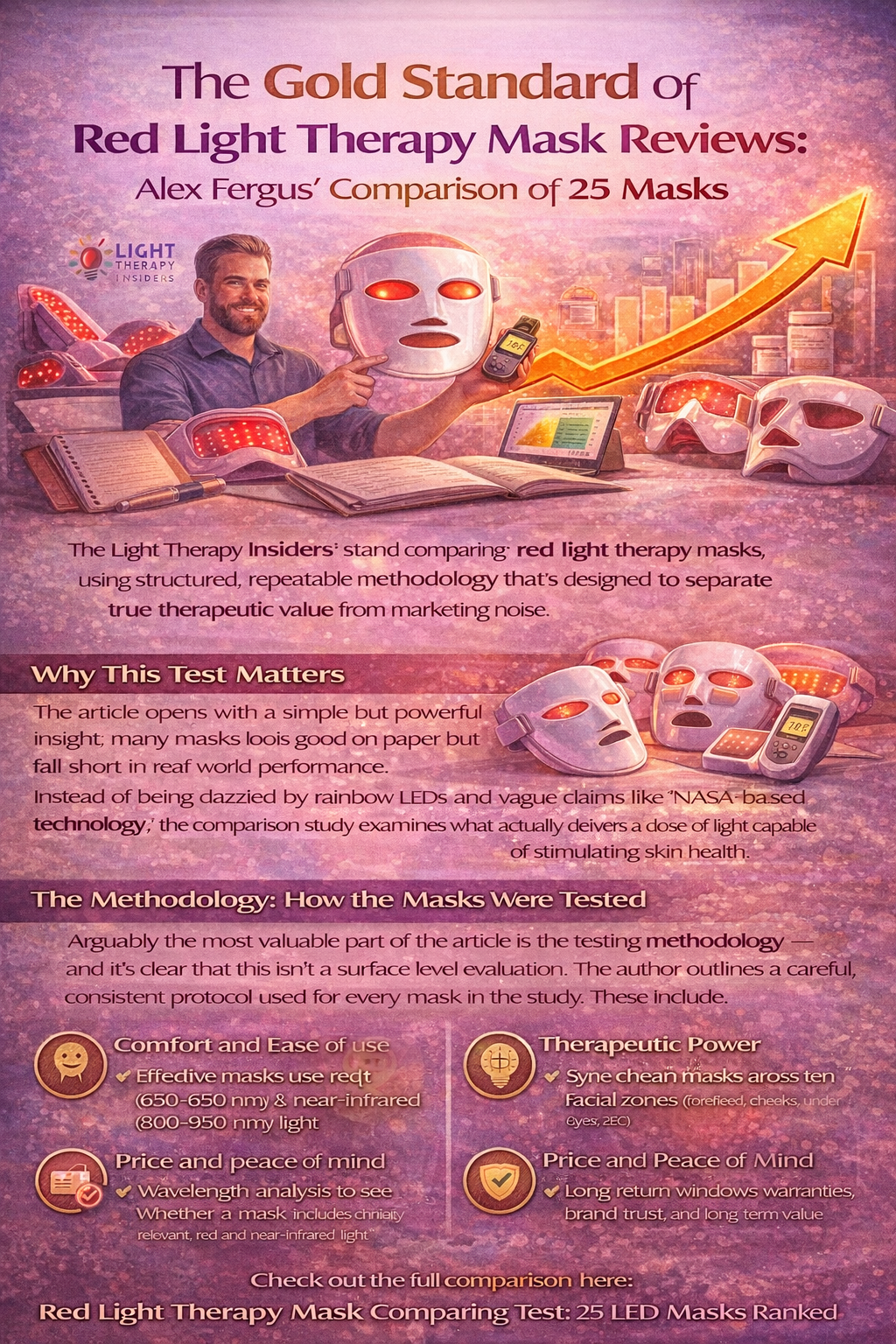
In a marketplace crowded with glowing promises and flashy specs, Light Therapy Insiders delivers one of the most rigorous and enlightening comparisons of red light therapy masks available online. Rather than simply rehashing manufacturer claims, this comparison test evaluates 25 different LED masks using a structured, repeatable methodology that’s designed to separate true therapeutic value from marketing noise.
Why This Test Matters
The article opens with a simple but powerful insight: many masks look good on paper but fall short in real-world performance. Instead of being dazzled by rainbow LEDs and vague claims like “NASA-based technology,” the comparison study examines what actually delivers a dose of light capable of stimulating skin health benefits — and what doesn’t.
To do this, Alex Fergus breaks testing into four practical categories that reflect what real consumers care about:
- Comfort and ease of use
- Therapeutic power
- Coverage quality
- Price and peace of mind
Each category contains measurable criteria rather than vague impressions, giving readers actionable insights instead of just star ratings.
The Methodology: How the Masks Were Tested
Arguably the most valuable part of the article is the testing methodology — and it’s clear that this isn’t a surface-level evaluation. The author outlines a careful, consistent protocol used for every mask in the study. These include:
• Fit and comfort over repeated sessions, assessing how likely a mask is to be worn consistently.
• Operational simplicity, including controller design, battery placement, and ease of travel.
• Wavelength analysis to see whether a mask includes clinically relevant red and near-infrared light.
• Delivered fluence, measured with a spectrometer across multiple facial zones and averaged over default session times.
• LED quantity and distribution to map coverage across key areas like under the eyes, nose bridge, chin, and cheeks.
• Warranty and return policy to judge risk and peace of mind for buyers.
What sets this comparison apart is the emphasis on measured light energy (fluence) rather than just counting LEDs or reciting wavelengths. Using a handheld spectrometer, the reviewer takes multiple readings from different spots on each mask, then compares the delivered energy (in joules per cm²) against established “therapeutic windows” for skin regeneration. By doing this, the study accounts not just for raw output but for real-world efficacy.
What the Data Reveals
From these measurements and practical tests, patterns emerge: many inexpensive masks either lack near-infrared light entirely or emit intensity levels far below what studies suggest is effective. Conversely, well-designed masks achieve a sweet spot of fluence (roughly 4–15 J/cm²), hitting both therapeutic thresholds and comfortable wearability.
Coverage mapping — another standout part of the methodology — shows that LED count alone doesn’t guarantee even light distribution. Masks with hundreds of diodes can still leave gaps under the eyes or around the nose if the placement isn’t thoughtful; the article tracks coverage across ten facial zones to highlight these differences.
Beyond Just Rankings
What makes this piece especially useful for readers isn’t just the final ranking, but the way transparent methods illuminate why some masks excel and others fall short. By grounding conclusions in measurable criteria — and explaining why those criteria matter — the comparison helps buyers evaluate future devices themselves, rather than relying on advertising claims.
In essence, this test turns what could be a superficial product roundup into a data-informed guide that educates as much as it advises — a valuable model for anyone trying to create meaningful reviews in the age of “LED splash” marketing.
Want the full comparison? Check Alex's comparison of 25 different masks here:
 Alex Fergus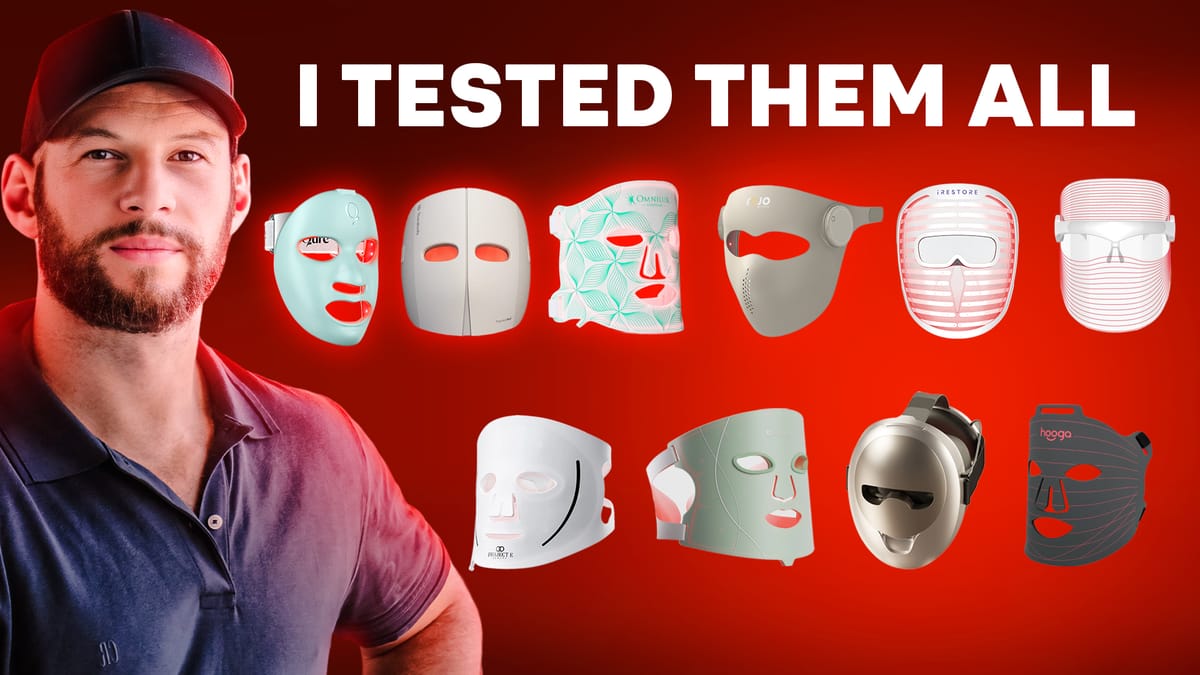
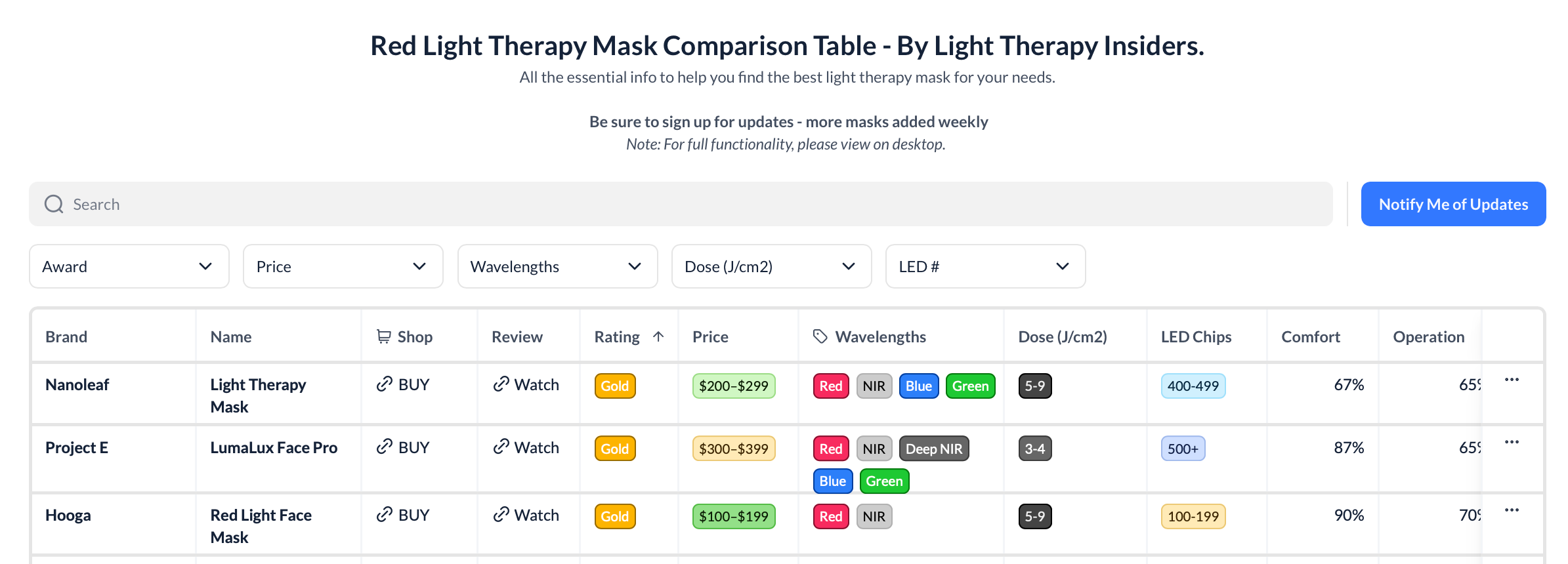
☝️ Use my Mask Comparison Table ☝
Access all my data on each mask
Compare different masks side by side
Search by price, wavelengths, and more
Links to my reviews and discount codes
Taking A Step Back: Why Dosing Is Important For Red Light Therapy Masks
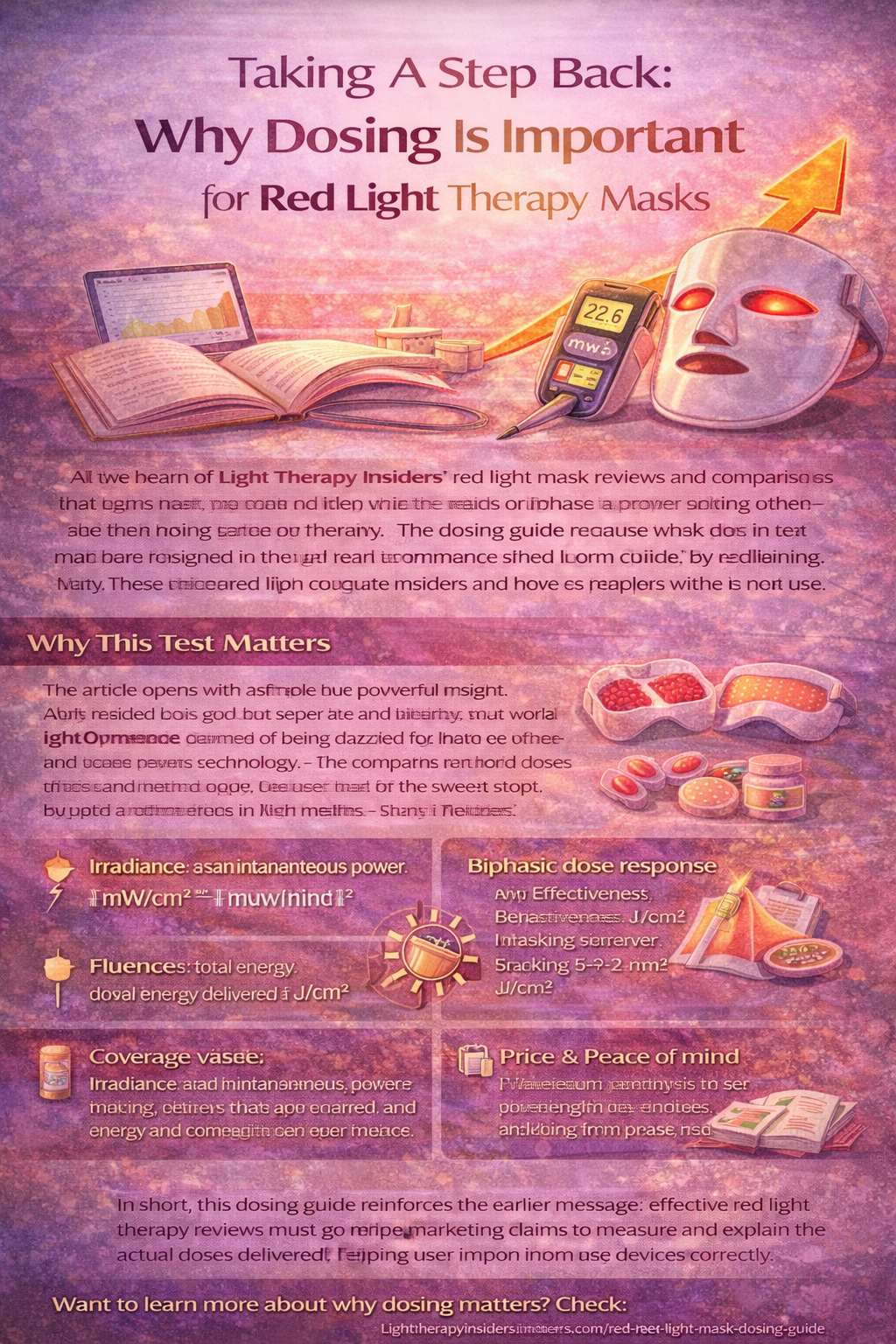
At the heart of Light Therapy Insiders’ red light mask reviews and comparisons lies a core truth: you can’t judge a device’s value without understanding dose — the actual energy your skin receives. The dosing guide builds on the rigorous testing methodology used in the 25-mask comparison and buyer’s guide by explaining why those measured light outputs matter, and how to interpret them in real use.
Rather than relying on superficial specs or LED counts, the dosing article breaks down irradiance (instantaneous power) and fluence (total energy delivered over time), showing how both influence whether a mask produces real biological effects like collagen stimulation and anti-inflammatory responses. The author highlights the biphasic dose response — meaning too little light does nothing, and too much can be ineffective or irritating — and identifies a practical “sweet spot” of about 5–9 J/cm² per session for skin-beauty goals, with a broader useful range of roughly 3–14 J/cm².
This dosing perspective is essential context for interpreting the comparison test’s fluence measurements. A mask that looks powerful on paper may deliver only fractions of a joule in practice and thus fail to stimulate cells, while another with high irradiance might overshoot unless you adjust session time.
In short, this dosing guide reinforces the earlier message: effective red light therapy reviews must go beyond marketing claims to measure and explain the actual doses delivered, helping users make informed choices and use their devices correctly.
Want to learn more about why dosing matters? Check:
 Alex Fergus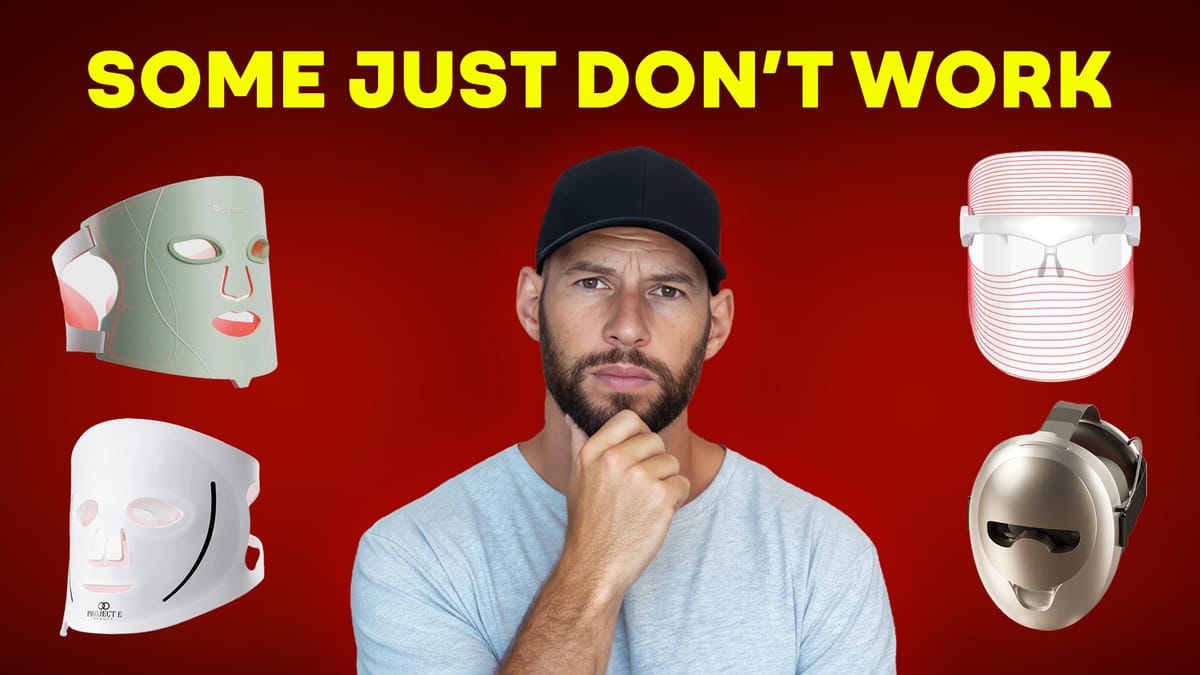
First Example: Glamour.com's Mask Comparison - Why The Methodology Is Flawed
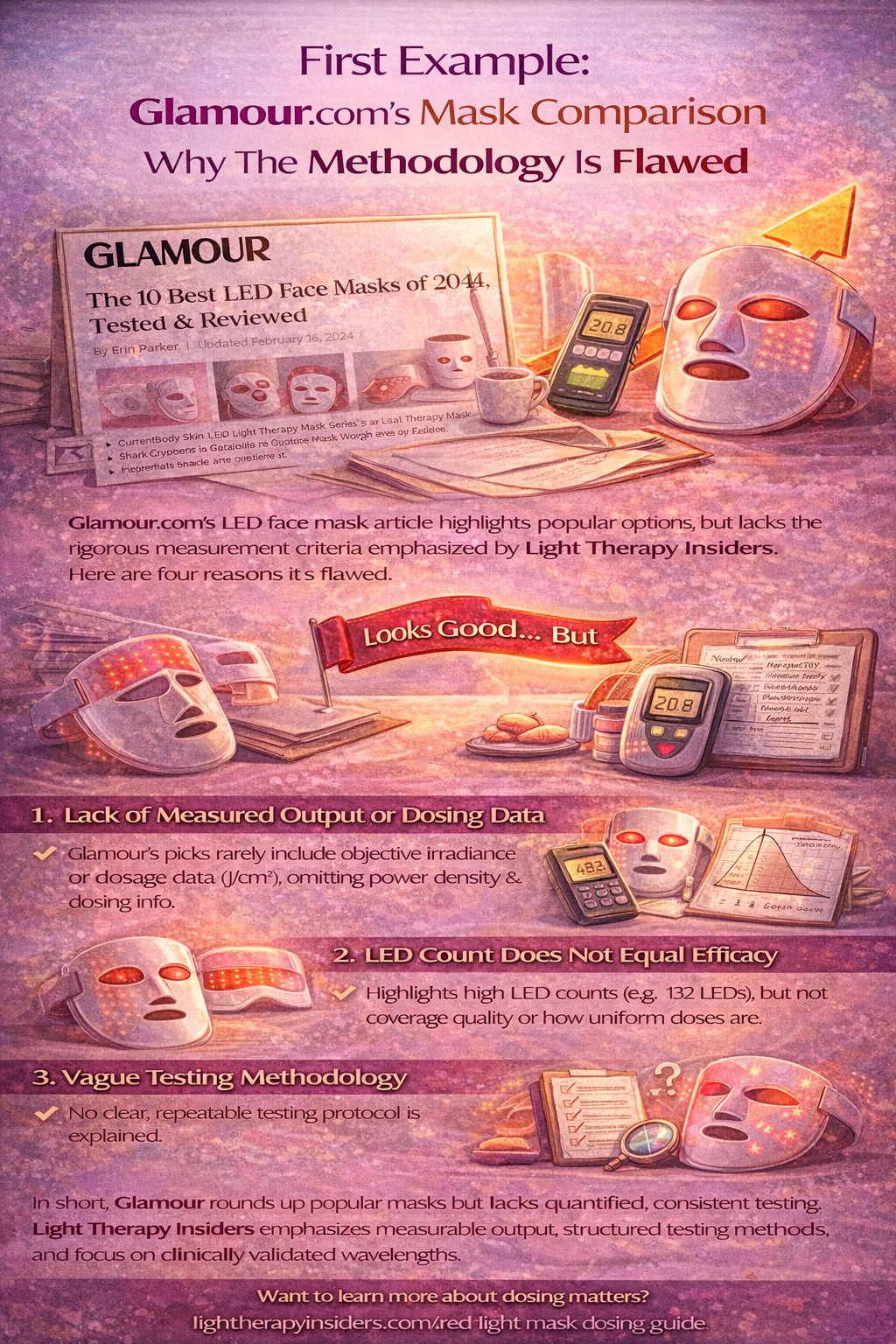
Glamour’s “Best LED Face Masks” article rounds up a curated list of top LED and red-light therapy face masks based on editor testing, dermatologist recommendations, hands-on use, and user experience.
The article highlights devices like the CurrentBody Skin LED Light Therapy Mask Series 2, Shark CryoGlow, Omnilux Contour Face, Dr. Dennis Gross SpectraLite FaceWare Pro, HigherDose Red-Light Face Mask, and Theraface Mask Glo, among others, presenting them as standout picks for concerns ranging from anti-aging and acne to comfort and innovative features. Each mask entry includes subjective pros and cons, basic specs (like number of LEDs and wavelengths), user impressions on fit and comfort, and some input from dermatologists on how light therapy can support collagen and skin health.
What the article gets right: It provides a wide range of devices across budgets and skin concerns, ties some picks to expert voices, and acknowledges that consistent use over weeks is key to seeing results — advice aligned with dermatological guidance on LED therapy. It also references things like FDA clearance and different light modes, which are meaningful considerations for consumers comparing products.
However, when evaluated through the Light Therapy Insiders lens — which emphasizes rigorous measurement and dosing fundamentals — the article’s methodology shows several weaknesses:
1. Lack of Measured Output or Dosing Data
Unlike Light Therapy Insiders’ testing, which uses spectrometer readings to quantify irradiance and fluence (J/cm²) across facial zones, the Glamour piece rarely, if ever, includes measured light output, power density, or real dosing information. Without these, it’s impossible to judge whether a mask delivers a therapeutically effective dose — the key determinant of real biological impact.
2. LED Count Does Not Equal Efficacy
The article sometimes highlights LED counts (e.g., 132 or 480 LEDs), a common but misleading metric. As Light Therapy Insiders shows, positioning and effective coverage matter more than raw LED numbers; many devices with high LED counts still deliver poor irradiance or leave zones under-treated. Glamour doesn’t systematically assess coverage distribution across facial zones, leaving readers without insight into how uniformly a mask treats the face.
3. Vague Testing Methodology
While the editors describe what they liked or disliked, there’s no transparent, repeatable protocol for their tests (e.g., how many sessions per device, how improvements were measured, whether controlled conditions were used). This contrasts with Light Therapy Insiders’ structured approach, which includes consistent measurement tools and quantified criteria.
4. Mixed Light Modalities Without Scientific Rationale
The Glamour article lists multi-wavelength masks (including blue or purple LEDs) without clearly explaining which wavelengths have clinical backing and which are more speculative. Light Therapy Insiders emphasizes red and near-infrared (630–660 nm & 800–850 nm) as evidence-based for cellular benefits; other colors often lack similar support.
In summary, Glamour’s article is a useful consumer guide for broad product awareness and user-centered impressions, but from a methodological perspective — especially when judged against the rigor in Light Therapy Insiders — it lacks objective measurement, dose quantification, and consistent testing protocols. Readers should enjoy the editorial insights but supplement them with hard data and dosing context before making purchase decisions.
Want Help Choosing a Red Light Mask? We built our Red Light Mask Guide. An interactive tool that compares the top masks side by side.
Example Two: Fortune Magazine's Suboptimal Attempt At A Mask Comparison
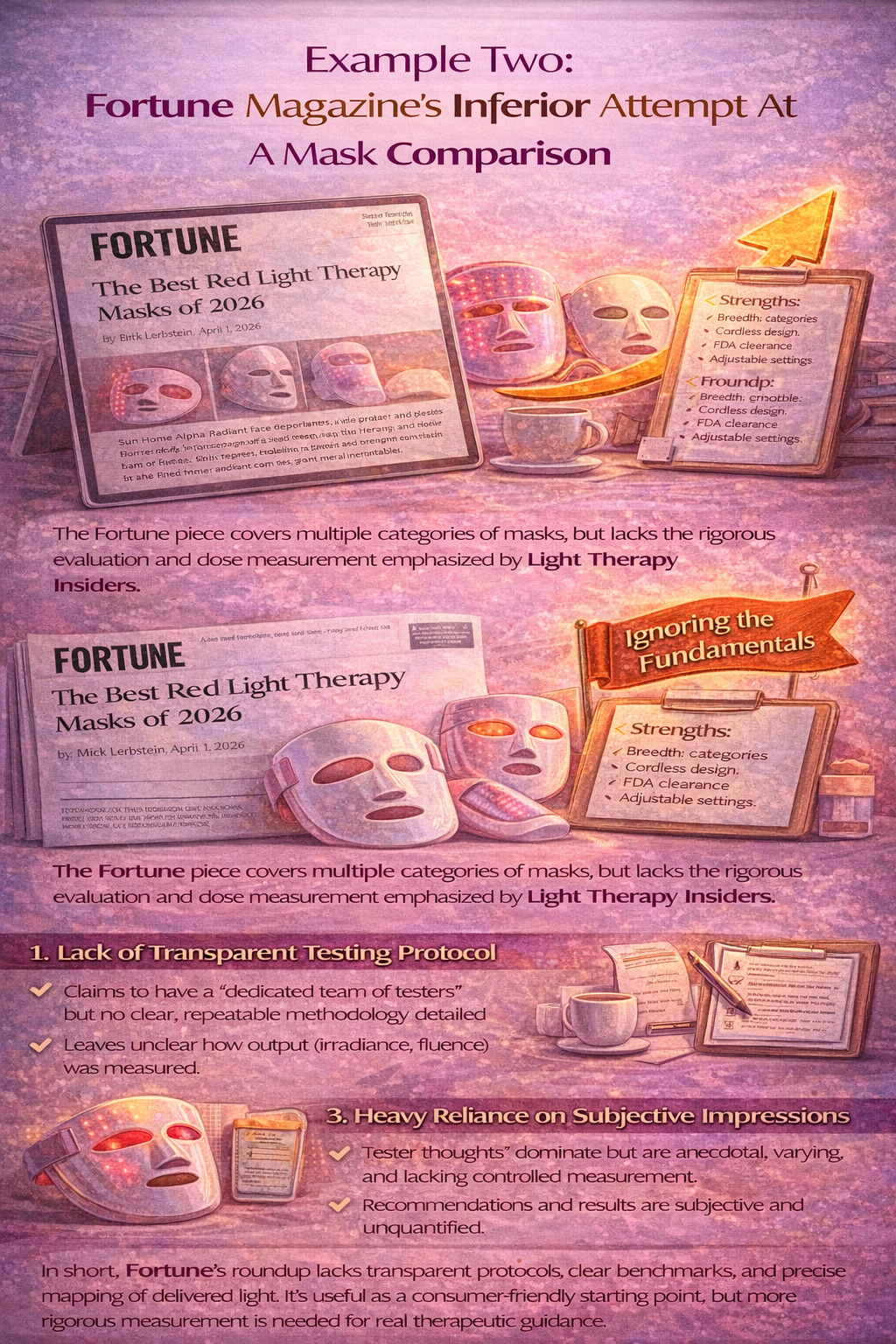
Fortune’s “The Best Red Light Therapy Masks of 2026” is a comprehensive, consumer-focused roundup of standout red light therapy masks, aimed at helping readers choose devices that balance science-backed performance, comfort, and user experience.
The article highlights several top picks — including the Sun Home Sauna Radiant Face Mask as the overall best, HigherDOSE for acne, iRestore Illumina for combined red/blue light therapy, and RevitaGlow for affordability — and provides specs like wavelengths, treatment modes, and design features. It also includes short user impressions and pros/cons for each device, along with a note reminding readers that visible results usually take weeks or months of consistent use.
A notable strength of the Fortune piece is its breadth: it covers multiple categories of devices and touches on practical concerns like cordless design, FDA clearance, and adjustable settings. For example, the Sun Home Sauna Radiant Face Mask is praised for its clear irradiance specs (30–55 mW/cm²) and multiple clinical wavelengths that align with evidence-based ranges for skin benefits, pointing toward a more educated assessment than many fluffier “best of” lists.
However, when evaluated through the Light Therapy Insiders testing philosophy — which emphasizes objective measurement of dose (fluence and irradiance), coverage, and repeatable methodology — several methodological weaknesses become apparent:
1. Lack of Transparent Testing Protocol
While Fortune claims a “dedicated team of testers,” there is no clearly documented, repeatable methodology. There are no details about how irradiance or fluence were measured, what tools (e.g., spectrometers) were used, or whether measurements were taken at consistent distances and across multiple facial zones — all practices that Light Therapy Insiders considers essential for valid comparisons.
2. Undefined Evaluation Criteria
The article lists features like wavelengths and modes, but it doesn’t explain why certain thresholds matter (e.g., what irradiance levels are considered clinically effective) or how devices perform relative to those benchmarks. In contrast, Light Therapy Insiders explicitly connects wavelengths (roughly 630–660 nm red and 800–850 nm near-infrared) and fluence targets to clinical evidence, helping readers understand which specifications are meaningful.
3. Heavy Reliance on Subjective Impressions
Fortune includes personal tester thoughts about comfort and early results, but these are anecdotal and not quantified. There’s no indication of controlled use duration across testers, nor standardized before/after measurement criteria — issues that can skew conclusions, especially when results are gradual and subtle.
4. Missing Coverage Mapping and Dosing Insight
Although the article reports wavelengths, it doesn’t assess coverage distribution (i.e., how uniformly light reaches all key facial regions) or actual delivered dose (J/cm²) — metrics that Light Therapy Insiders argues are critical for predicting efficacy. Without these, recommendations risk being speculative rather than evidence-anchored.
In summary, Fortune’s roundup is a useful, accessible starting point for consumers interested in LED masks, offering thoughtful category distinctions and helpful product context.
But from a methodological standpoint, its lack of transparent, objective testing protocols, precise dosing data, and systematic measurement limits its ability to definitively guide readers toward the most therapeutically effective devices. Readers should enjoy the editorial insights but seek out hard data — ideally from sources using rigorous measurement, like Light Therapy Insiders — before committing to a purchase.
Third Example: Wired's Red Light Therapy Mask Reviews/Comparisons - A Little Better But Still Flawed!
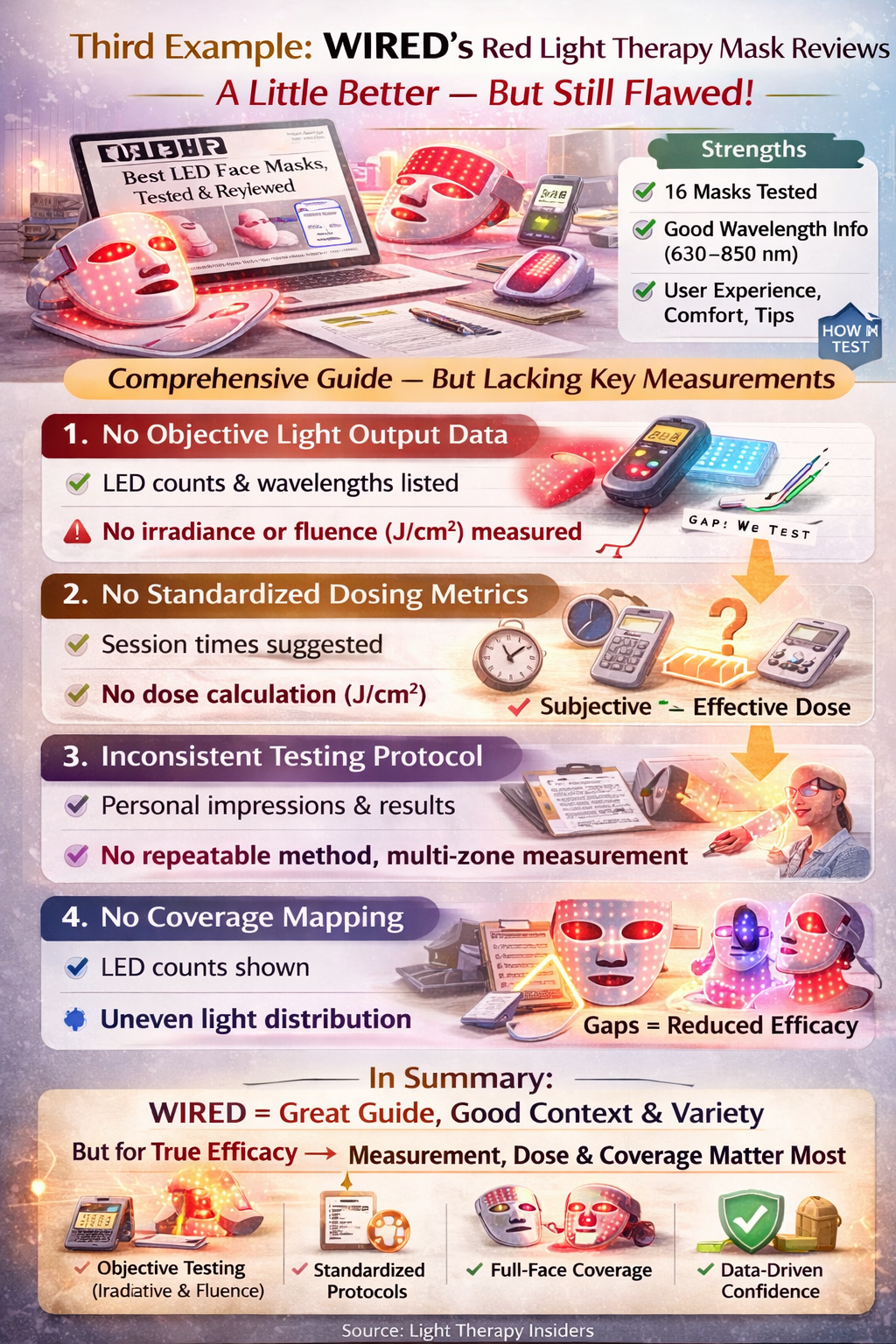
WIRED’s article on LED/red-light face masks is a relatively in-depth consumer guide that evaluates about 16 popular devices across skin-care goals, comfort, and ease of use, based on weeks of hands-on testing and dermatologist input.
The article highlights top picks like the CurrentBody LED Face Mask Series 2, iRestore Illumina, Shark CryoGlow, Dr. Dennis Gross SpectraLite FaceWare Pro, and even handheld options like the Solawave Radiant Renewal Wand — organized by use cases such as general anti-aging, combination treatments, cooling technology, and spot treatment.
The guide also includes background sections explaining how red/near-infrared light works, what wavelengths are considered effective, recommended usage routines, and an FAQ on what consumers should know before buying. (
WIRED’s strength is its wide coverage — it doesn’t just list products but attempts to educate readers on relevant wavelength science, recommended session times, treatment goals, and user experience factors like comfort, control systems, and daily routines. It also includes a “How We Test” section, which implies that devices were actually used over time rather than evaluated solely on specs. ([turn0search0])
However, methodologically, the article falls short in several ways when compared to the more scientific and measurement-driven testing approach used by Light Therapy Insiders:
1. Lack of Objective Light Output Measurement
WIRED does cite wavelengths and LED counts, but it does not include measured irradiance or delivered fluence (J/cm²) for devices. Specifying nanometers alone doesn’t assure therapeutic effectiveness; real power levels and dose are crucial to determine whether enough light energy actually reaches skin cells — something Light Therapy Insiders emphasizes as fundamental for efficacy.
2. No Standardized Dosing Metrics
While WIRED discusses recommended session lengths, it doesn’t tie these to specific dose calculations based on device output (e.g., how many joules per area are delivered). Without this, recommended usage remains subjective rather than evidence-anchored — a key gap illuminated in the Light Therapy Insiders dosing guide.
3. Inconsistent Evaluation Criteria Across Devices
Some entries include personal impressions on visible results or comfort, but WIRED doesn’t document a repeatable testing protocol (e.g., consistent distance from the skin, standard multi-zone measurements, or blinded assessment). Results like “subtle improvements” or “noticeable reduction in inflammation” are anecdotal and tied to individual experiences rather than quantified comparisons.
4. Device Coverage and Uniformity Not Systematically Assessed
The article mentions LED counts and wavelengths, but, like many lifestyle roundups, it lacks coverage mapping — a systematic check of how evenly light reaches all critical facial zones. High LED counts are often highlighted without evaluating whether those lights produce meaningful output across the face — a distinction Light Therapy Insiders considers essential.
In summary, WIRED’s piece is one of the more comprehensive mainstream guides you’ll find, offering good context, product variety, and user-focused commentary. But from a methodological perspective, it stops short of the objective, measurement-based testing and dosing analysis that would give readers true confidence in which devices actually deliver effective therapeutic light — a gap that more technically rigorous reviews like Light Therapy Insiders strive to fill.
Conclusion: Always Opt For Quality And Actual Testing Of Products!
In a market flooded with flashy claims and superficial specs, understanding what truly matters in red light therapy masks has never been more important. As this article has shown, the difference between a mask that might look impressive and one that actually delivers results lies not in marketing buzzwords or LED counts, but in measurable performance, effective dosing, and thoughtful design.
A rigorous comparison — grounded in scientific principles like appropriate wavelengths, real delivered fluence, even coverage across the face, and a repeatable testing protocol — separates meaningful devices from overhyped ones.
The most effective masks hit a therapeutic “sweet spot,” delivering sufficient energy (fluence) within practical session times and ensuring light reaches all key facial zones. Conversely, many low-budget units and even some premium-looking options fail to provide enough therapeutic dose, despite tall LED numbers or trendy colors. Emphasizing comfort, warranty terms, and real user experience is also crucial, because a mask that sits unused does no one any good.
Ultimately, informed comparisons empower consumers to choose devices based on evidence and actual performance, not superficial specs — helping them get real value and better long-term skin outcomes from their red light therapy investments.
This article is written by our AI assistant Sally. Check the short bio of Sally below:
Found This Interesting? Look At These Articles
🔴 The Red Light Therapy Facial Fat Loss Link: Myth Or Reality?
🔴 Combating Psoriasis With Red Light Therapy: Potential Game-Changer?
🔴 Red Light Therapy For Hair Growth: Worth The Hype!
🔴 Gut Health & Red Light: A Surprising Connection
Have You Seen These Reviews
🔴 Rouge G4 Pro Review: Most Advanced Red Light Panel Yet?
🔴 Best Red Light Panel Yet? Block Blue Light Mega Review
🔴 Lasers vs LEDs: Exposed — What Really Works for Your Skin
🔴 Maysama Prana LED Mask Review: Too Powerful?!