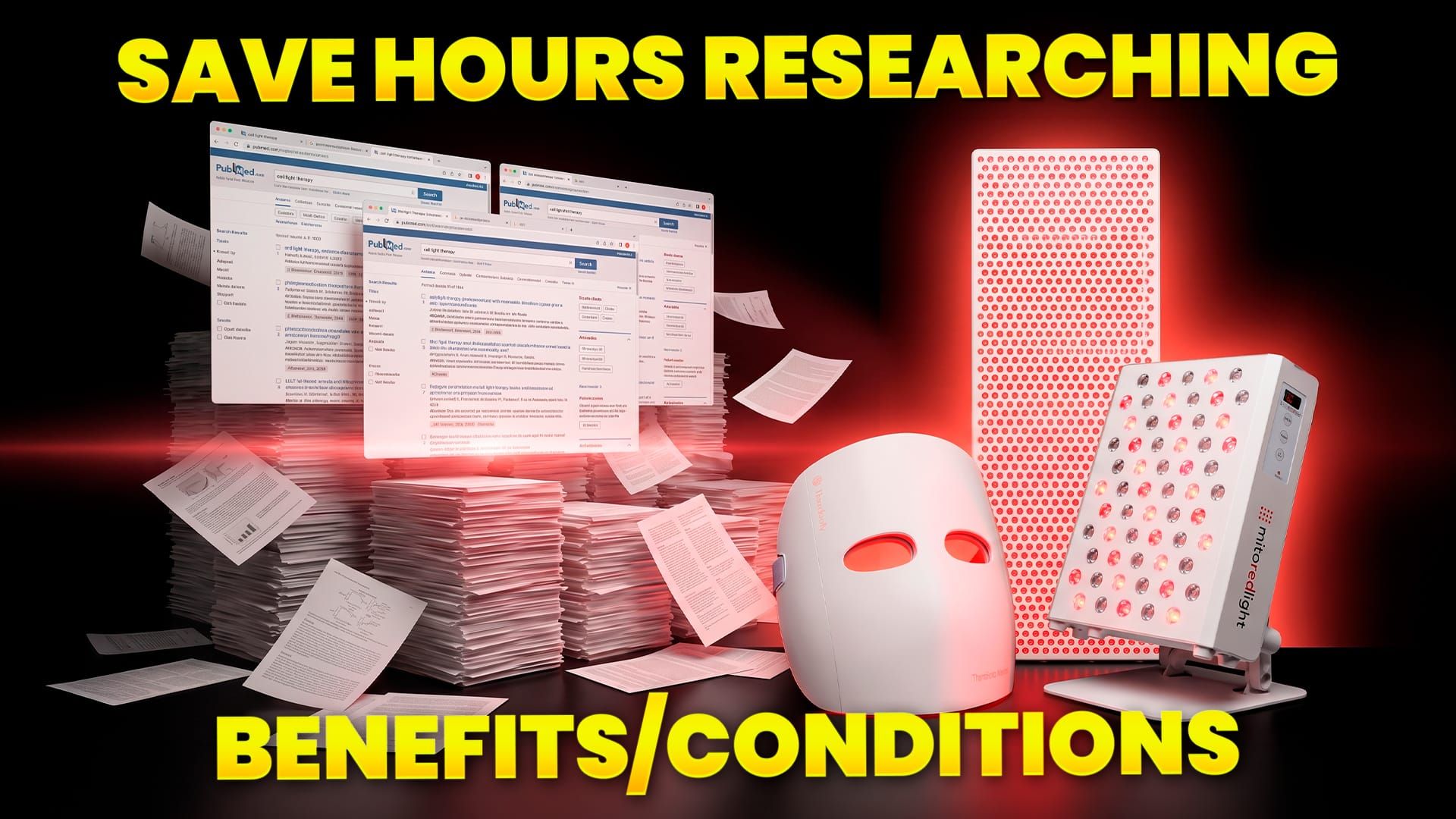
There are now nearly 10,000 studies related to photobiomodulation and red light therapy—but what does that enormous body of research actually tell us?
In this episode, we sit down with Vladimir Heiskanen, creator of one of the most comprehensive photobiomodulation research databases available. Vladimir has spent roughly a decade collecting and organizing PBM research, making it far easier to explore studies by condition, wavelength, treatment parameters, study type, and more.
We discuss where the evidence for red light therapy is strongest, where it is still lacking, and why having thousands of studies doesn't necessarily mean we have thousands of high-quality studies.
Vladimir also explains some of the biggest challenges facing PBM research, including inconsistent treatment parameters, poor reporting, the limitations of animal studies, and the need for better randomized human trials.
We also get into red light therapy safety, negative findings, the importance of dosing, whether the time of day could influence results, and how artificial intelligence could eventually change the way we search and analyze PBM research.
Show Notes
Vladimir Heiskanen's interest in photobiomodulation began long before red light therapy became as widely known as it is today. After discovering research on red and near-infrared light, he began digging into the scientific literature and eventually created a database to organize what was becoming an enormous body of evidence.
Today, that database contains nearly 10,000 studies.
Rather than simply providing study titles like a traditional scientific search engine, Vladimir's database organizes research by topic and includes information such as publication year, country, study methodology, human or animal research, wavelengths, treatment parameters, and other useful details when available.
In our conversation, Vladimir explains why this broader view of the research is so valuable. While the sheer volume of PBM research is impressive, the quality and usefulness of those studies vary considerably.
We explore areas where clinical evidence appears strongest, including certain pain conditions and oral mucositis associated with cancer treatment, as well as areas with promising but less established research, including Alzheimer's disease, diabetic foot ulcers, and age-related macular degeneration.
One of the biggest challenges is the enormous variation between PBM studies. Researchers may use completely different wavelengths, irradiance levels, doses, treatment frequencies, beam sizes, and treatment areas. That makes it difficult to compare studies—or determine exactly why one trial produces positive results while another does not.
Vladimir also discusses another major issue: research quality. Some studies fail to report important treatment parameters, while others have methodological problems that limit how useful their findings are. This becomes particularly important when trying to move photobiomodulation from experimental research into mainstream clinical treatment guidelines.
We also look at the limitations of animal research. Although animal and laboratory studies can provide valuable information, successful results in animals don't necessarily translate to humans. Vladimir argues that the PBM field ultimately needs more high-quality, randomized human trials with adequate sample sizes, good reporting, proper controls, and clearly documented treatment protocols.
Another fascinating question is whether factors we're barely considering today—such as the time of day a treatment is performed—could influence PBM outcomes. Early research raises interesting questions, but Vladimir explains why there simply isn't enough evidence yet to draw firm conclusions.
Toward the end of the conversation, we turn to safety. Serious negative effects appear uncommon in the research Vladimir has reviewed, although high doses can cause problems in certain contexts. We also discuss the complicated question of PBM and cancer, where animal research has produced mixed findings.
Finally, Vladimir shares some of the research he would most like to see conducted, including better replication studies involving hypothyroidism, Alzheimer's disease, and other promising applications.
And after spending a decade manually organizing thousands of scientific papers, he considers another fascinating question: Could AI eventually make a database like his unnecessary—or could AI instead become the tool that helps take it to the next level?
Episode Highlights
The PBM database reaches nearly 10,000 studies
Vladimir explains how a project that began in 2016 has grown alongside the rapidly expanding field of photobiomodulation research.
Where is the strongest evidence for red light therapy?
We look at the difference between biological mechanisms, animal research, and actual clinical evidence—and the areas where human research is becoming more convincing.
Why 10,000 studies don't necessarily mean 10,000 good studies
Poor methodology, missing treatment parameters, inadequate reporting, and bias can dramatically reduce the usefulness of published research.
The problem with PBM dosing and study comparisons
Wavelength, irradiance, fluence, treatment frequency, beam size, and treatment area can all differ from one study to another, making seemingly similar trials surprisingly difficult to compare.
Do we need fewer animal studies and more human trials?
Animal research doesn't always translate successfully to humans. Vladimir explains why well-designed randomized human trials are critical if PBM is going to influence medical treatment guidelines.
Could the time of day change your results?
Morning versus evening PBM is an intriguing area of research, but we may still be missing important variables that affect treatment outcomes.
What does the research say about red light therapy safety?
Negative effects appear relatively uncommon, but dose matters, and certain applications—including treatment around cancerous tissue—raise questions that still need better answers.
The PBM studies Vladimir wants to see next
Hypothyroidism, Alzheimer's disease, diabetic foot ulcers, and better replication of promising findings are among the areas where stronger clinical trials could have a major impact.
Could AI replace the PBM database?
With AI becoming increasingly capable of searching and analyzing scientific literature, Vladimir discusses what the future may hold for the database he has spent a decade building.
Closing
Nearly 10,000 studies sounds like an overwhelming amount of evidence—and in some ways, it is. But this conversation highlights why the number of studies alone doesn't tell the whole story.
Photobiomodulation research is growing incredibly quickly, but better methodology, standardized reporting, stronger human trials, and replication of promising results will be critical to understanding where red light therapy truly works and how it should be used.
Vladimir's database provides a remarkable way to see that research landscape in one place—and after a decade of work, it also offers a unique perspective on just how far the field has come and how much there still is to learn.
Here are the resources we discuss in the video:
⭐ Vladimir Heiskanen’s Database: https://aferg.co/lllt-studies
⭐ Ray Peat's website: https://raypeat.com/
⭐ Gelatin, stress, longevity: https://raypeat.com/articles/articles/gelatin.shtml
⭐ Systematic Reviews: Systematic Review or Meta-Analysis?: https://library.hmsom.edu/SystematicReviews/SR_MA
⭐ Human Charger: https://humancharger.com/
⭐ Mitochondrial mechanisms of photobiomodulation: https://pubmed.ncbi.nlm.nih.gov/20374017/
⭐ Photobiomodulation enhancement of cell proliferation https://www.sciencedirect.com/science/article/abs/pii/S1011134419301885
⭐ 1064 Benefits: https://www.lighttherapyinsiders.com/1064nm-wavelength-health-benefits/
⭐ Photobiomodulation: lasers vs. light-emitting diodes?https://pubmed.ncbi.nlm.nih.gov/30044464/
⭐ World Federation For Laser Dentistry; https://www.lighttherapyinsiders.com/wfdl-2024-review/
⭐ Analysis of animal-to-human translation: https://journals.plos.org/plosbiology/article?id=10.1371/journal.pbio.3002667
⭐ Risk of bias: why measure it, and how?: https://pmc.ncbi.nlm.nih.gov/articles/PMC8807607/
⭐ Trends and predictors of biomedical research quality, 1990–2015: https://bmjopen.bmj.com/content/9/9/e030342
⭐ Red Light Therapy For Thyroid Health: https://www.lighttherapyinsiders.com/red-light-therapy-for-thyroid-health-the-incredible-science/
⭐ A clinical trial testing the efficacy of PDT in preventing amputation: https://www.sciencedirect.com/science/article/abs/pii/S157210001400057X
🎧 Prefer to Listen?
Find Alex Fergus – Light Therapy Insiders on your favorite platform: