
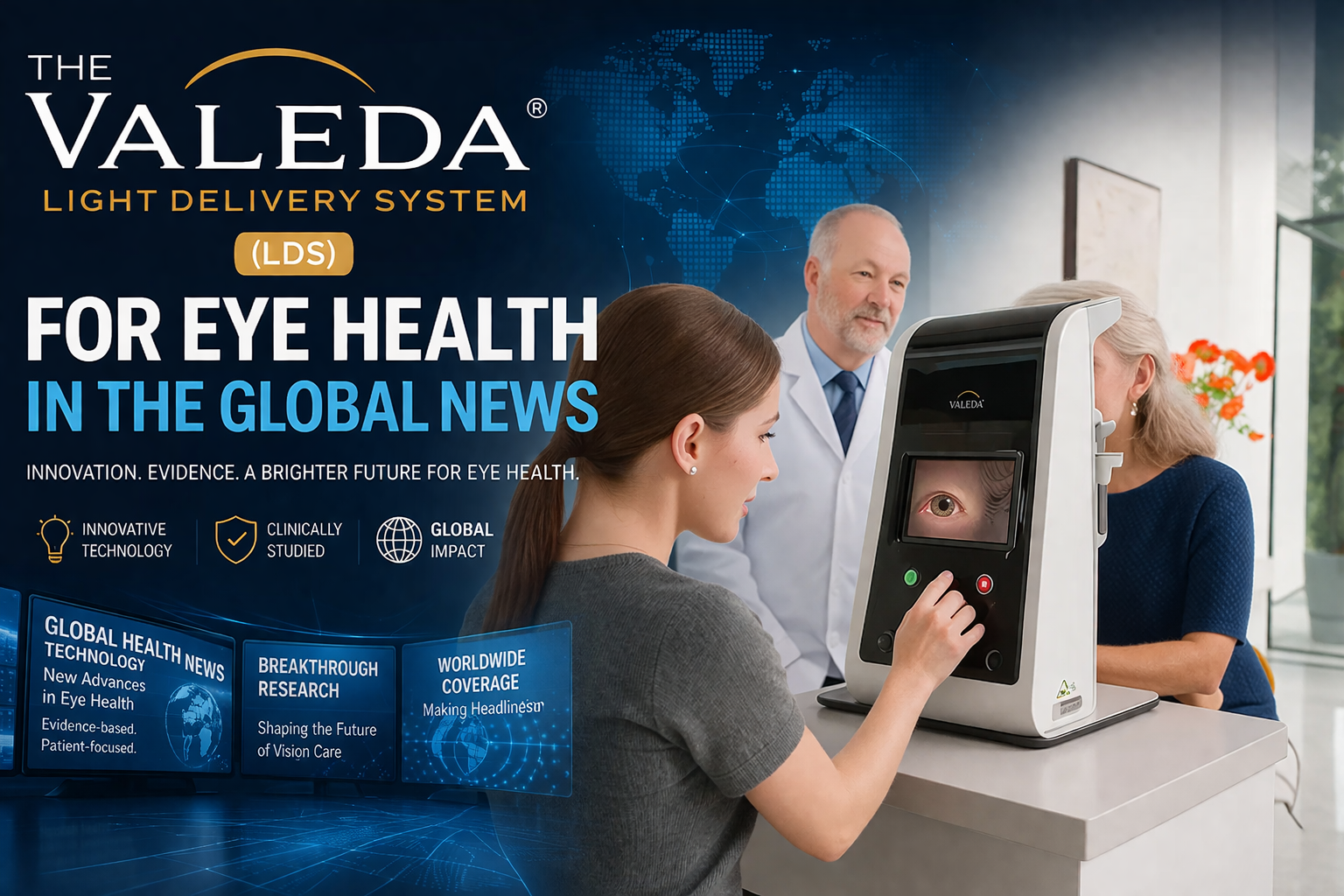
The Valeda Light Delivery System (LDS) has rapidly moved from clinical innovation to a major news story in the eye-care world, signaling a shift in how dry age-related macular degeneration (AMD) may be treated.
Traditionally, dry AMD has had limited options beyond monitoring, lifestyle changes, and nutritional support. However, Valeda’s photobiomodulation (PBM) technology — delivering multi-wavelength, non-invasive light therapy — is now being highlighted in medical press and industry coverage for its potential to improve vision where few therapies existed before.
In November 2024, the system became the first FDA-authorized treatment shown to improve visual acuity in dry AMD patients, a watershed moment for a condition long defined by its lack of effective early interventions.
Since then, extended clinical trial results and Alcon’s acquisition of LumiThera have kept Valeda in the headlines, sparking discussion among clinicians, patients, and researchers about its real-world impact and future potential.
Background: Light Therapy For Eye Health
We've covered the topic of (red) light therapy for eye health super extensively in the past. Here's that background:
 Bart Wolbers
 Bart Wolbers
 Bart Wolbers
Read these articles above if you want a real detailed science breakdown on the topic of light therapy for eye health.
But, the space is evolving rapidly and some of the benchmark devices in the space have huge news:
LumiThera, Inc. With The Valeda Light Delivery System (LDS) Purchased

Alcon has officially completed its acquisition of ophthalmic medical device company LumiThera, Inc., following an earlier announcement of its intent to buy the company. The deal brings LumiThera’s flagship photobiomodulation (PBM) technology—the Valeda Light Delivery System (LDS)—into Alcon’s retina portfolio, reinforcing its position beyond surgical solutions and into clinic-based treatments.
The Valeda LDS is a noninvasive, in-office PBM device that uses multi-wavelength light delivered through LEDs to treat early and intermediate dry age-related macular degeneration (AMD). It is notable for being the first technology shown to provide meaningful visual improvement—about one line on a standard eye chart—after two years of treatment in clinical trials, a significant milestone for a condition that traditionally has had few effective early interventions.
Although Alcon did not disclose financial terms in the article, the acquisition does not include two of LumiThera’s diagnostic products (AdaptDx Pro and NOVA/Diopsys). These will be spun off and returned to LumiThera shareholders, continuing to be marketed independently.
Alcon plans to expand the availability of Valeda beyond its current markets—including the United States, parts of Europe, and Latin America—into additional countries in 2026, although specific targets have yet to be announced. This acquisition complements other recent strategic moves by Alcon to broaden its ophthalmology offerings and address significant unmet needs in eye care, particularly in retinal disease treatment.
Overall, the purchase represents a key step in Alcon’s strategy to integrate innovative, non-surgical therapies into its broader vision care portfolio.
Our writer, Bart, actually based his eye health protocol, where you don't even need a Valeda device, on the Valeda research. Again, I recommend you check the full article on light therapy for eye health that contains a breakdown of all published studies up until 2024.
Background: LumiThera’s Valeda Extension Trial Shows Sustained Vision Gains in Dry AMD
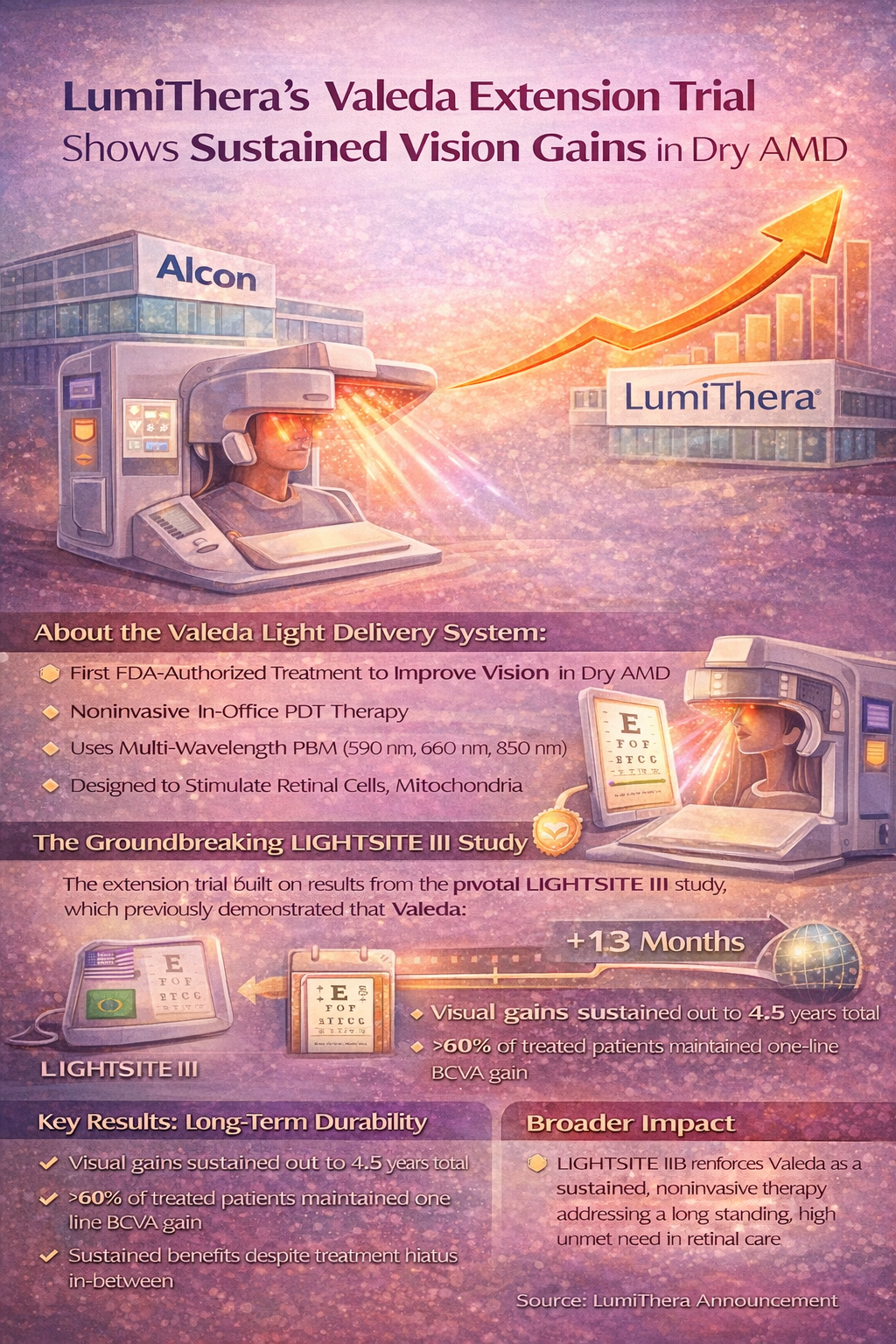
LumiThera has announced topline results from its LIGHTSITE IIIB extension trial, demonstrating sustained and extended vision improvements in patients with early to intermediate dry age-related macular degeneration (AMD) treated with its Valeda Light Delivery System (LDS). The findings were presented at the 2025 Association for Research in Vision and Ophthalmology (ARVO) annual meeting and further reinforce Valeda’s clinical value in a disease area with historically limited treatment options.
About the Valeda Light Delivery System
Valeda is a noninvasive photobiomodulation (PBM) therapy designed for in-office use. The system delivers multi-wavelength light (590 nm, 660 nm, and 850 nm) via LEDs to stimulate retinal cellular activity, improve mitochondrial function, and reduce inflammation. Treatments are brief and performed in a clinical setting.
In November 2024, Valeda became the first FDA-authorized treatment shown to improve vision in dry AMD patients, marking a major milestone in retinal care.
The Groundbreaking LIGHTSITE III Study
The extension trial builds on results from the pivotal LIGHTSITE III study, which previously demonstrated that Valeda:
- Produced an average gain of more than 5 letters in best-corrected visual acuity (BCVA) (approximately one line on an eye chart)
- Slowed disease progression in treated patients
- Maintained a strong safety profile over 24 months
These findings were significant because dry AMD has long lacked therapies capable of delivering meaningful visual improvement, especially in earlier stages of the disease.
LIGHTSITE IIIB Extension Trial Design
The LIGHTSITE IIIB trial was a prospective, open-label extension study involving patients who completed LIGHTSITE III. After a treatment-free interval of approximately 20 months, participants resumed Valeda therapy and were followed for an additional 13 months.
The goal was to evaluate whether vision improvements could be sustained or re-established over a longer timeframe.
Key Results: Long-Term Durability
The extension data suggest that:
- Vision gains were sustained out to 4.5 years total follow-up
- More than 60% of patients treated across both studies maintained a clinically meaningful improvement of at least one line of vision
- Visual benefits persisted despite the treatment hiatus between study phases
These findings indicate that photobiomodulation therapy may offer durable functional benefits when administered periodically.
Safety and Clinical Implications
Investigators highlighted Valeda’s excellent safety profile, consistent with earlier studies. No new safety concerns emerged in the extension phase.
Clinicians presenting the data emphasized the potential importance of early and sustained intervention, suggesting that initiating PBM therapy in earlier stages of dry AMD may yield the most favorable long-term outcomes.
LumiThera’s leadership stated that the results support the idea that Valeda may help alter the trajectory of vision loss, rather than simply slowing decline.
Broader Impact
Dry AMD remains a leading cause of central vision loss in older adults worldwide, with limited treatment options for early and intermediate stages. The LIGHTSITE IIIB extension results strengthen the case for Valeda as a clinically meaningful, noninvasive therapy that provides sustained visual improvement over multiple years.
Overall, the data expand confidence in Valeda’s long-term durability and reinforce its role in addressing a significant unmet need in retinal care.
Adding A Scientific Perspective to the Valeda Story

Recent coverage of the Valeda Light Delivery System (LDS) highlights several important milestones. To fully understand its significance, however, it helps to examine both the strengths of the data and the broader clinical and commercial context.
What the Clinical Data Gets Right
Valeda represents a meaningful development in the treatment of early and intermediate dry age-related macular degeneration (AMD). Its FDA authorization in November 2024 marked the first time a device demonstrated improvement in visual acuity in this patient population. In the pivotal LIGHTSITE III trial, patients treated with photobiomodulation (PBM) therapy gained on average approximately five letters in best-corrected visual acuity (BCVA) — about one line on a standard eye chart — compared to sham-treated controls.
The subsequent LIGHTSITE IIIB extension study suggested that these visual benefits may be sustained over multiple years with periodic retreatment. For a condition historically managed with monitoring and nutritional supplementation rather than vision-improving therapies, these findings represent genuine progress.
Interpreting the Results with Appropriate Nuance
At the same time, it is important to contextualize the magnitude of effect. A five-letter gain, while statistically significant, is generally considered a modest clinical improvement. Not all patients respond equally, and subgroup variability remains an important factor in determining real-world impact.
Some secondary endpoints, including certain anatomical progression measures, have shown mixed or evolving results. As with many emerging therapies, longer-term and larger-scale studies — particularly independent and real-world data — will further clarify durability, optimal treatment intervals, and patient selection criteria.
PBM as a therapeutic category is also relatively new in ophthalmology. The biological rationale — supporting mitochondrial function, reducing oxidative stress, and modulating inflammation — is plausible and supported by preclinical research. However, broader adoption across the retina community typically depends on accumulating confirmatory data and continued peer-reviewed validation.
The Significance of the Alcon Acquisition
Alcon’s acquisition of LumiThera adds a strategic dimension to the Valeda narrative. The purchase signals confidence from one of the largest ophthalmic companies in the world and provides the infrastructure necessary for broader commercialization. Alcon’s established retina relationships, distribution network, and reimbursement expertise may accelerate global expansion.
That said, acquisition alone does not guarantee widespread adoption. Integration into retina practice workflows, physician education, reimbursement clarity, and continued evidence generation will all play decisive roles in determining long-term success. Commercial scale and clinical validation must progress together.
A Balanced Outlook
Valeda occupies a promising position at the intersection of innovation and unmet need in dry AMD. The existing trial data support its role as a meaningful new option, particularly in earlier stages of disease. At the same time, measured interpretation of the evidence and continued scientific scrutiny are appropriate as the field gains more experience.
With further research, transparent reporting, and real-world validation, Valeda’s long-term place within retinal care will become increasingly clear.
Conclusion: Red Light Therapy For Eye Health Has A Bright Future Ahead!
The media attention surrounding the Valeda Light Delivery System underscores a pivotal evolution in dry AMD care and the broader field of light-based therapies. What began as promising clinical data has translated into regulatory authorization, extended study outcomes, and industry recognition — including Alcon’s strategic acquisition of LumiThera.
These developments not only validate the clinical promise of photobiomodulation but also signal growing confidence in PBM as a viable, non-invasive treatment modality that addresses the critical unmet need for early intervention in dry AMD.
While questions remain about long-term adoption, access, and comparative effectiveness in diverse patient populations, the sustained vision benefits seen in extended trials and the expanding availability of the technology highlight Valeda’s potential to change treatment paradigms.
For patients, clinicians, and the eye-health community, the ongoing news coverage reflects both the excitement and the pragmatic considerations of integrating novel therapies into practice. As the conversation continues, Valeda’s journey from research to headlines offers a case study in how light therapy innovations can redefine expectations — and, importantly, improve outcomes — for conditions once considered untreatable.
Want To Understand The Light Therapy Science Better? A Health Science (MS) Graduate Breaks It All Down Here:

Join Bart's 100% free advanced science light therapy course above, where he takes deep dives into topics such as mechanisms, neurology (Alzheimer's, Parkinson's, etc), exercise recovery, skin beauty & rejuvenation, and much more. Join HERE!
You may also want to consider the following articles on eye health:
 Bart Wolbers
 Bart Wolbers
This article is written by our AI assistant Sally. Check the short bio of Sally below:
Found This Interesting? Look At These Resources:
🔴Red Light Therapy For Eye Health: The Very Impressive Science
🔴 Is Red Light Therapy Safe for Your Eyes?
🔴 2026 Red Light Therapy Panels Revealed
🔴 Welcome to the Light Therapy Course - Science-Backed On Many Topics
🔴 Red Light Mask Buyer's Guide - Avoid These Mistakes!
🔴 Light Therapy Insiders AI Bot That Answers All Your Questions
🔴 Red Light Therapy Shopping Tool