
The bad news? Light therapy and carpal tunnel research is messy. You've got dozens of studies, wildly different protocols, and no universal answer.
So I dug through the latest reviews and nearly 50 photobiomodulation or "red light therapy" studies to find the patterns that actually matter. I'll tell you about the ideal wavelengths, dosing, frequency, treatment location, and also give you my top-3 devices based on the current research.
Let's go:
If you need an introduction to what these terms mean, check the following resources:
- What Is Red Light Therapy?
- Red Light Therapy Explained: Basic Terms Guide
- Start Here - Light Therapy 101 & Buyers Guide
- Red Light Therapy Dosing Chart: The Raw Data From Hundreds Of Studies
- Red Light Therapy Dosing: Why It's Complicated!
- Red Light Therapy Wavelengths Benefits: The Ultimate Guide
- How Often Should You Use Red Light Therapy Explained
These resources should give you a basic understanding of how red light therapy works, and the discussions around it!
Red Light Therapy For Carpal Tunnel Syndrome Summary
Carpal tunnel syndrome involves compression of the median nerve at the wrist, causing numbness, tingling, pain, weakness, and reduced grip strength.
Medical reviews that analyze and aggregate earlier evidence on a topic, show the best results with near-infrared (NIR) lasers, with wavelengths between 800 - 1,100 nm light. Treatment parameters are all over the place, however, so favoring one protocol over another isn't easy here.
The dose I recommend based on the research is 10-20 J/cm2, as a starting point. You can adjust from there based on trial and error. 2-5 weekly treatments is sufficient, and, ensure you continue for 4-8 weeks before changing things up.
The full article below contains my device recommendation!
Background: What Is Carpal Tunnel Syndrome?
Below, I'll cover the most recent medical reviews on carpal tunnel syndrome. I use these as there's tons of medical literature on this topic, and for the goal of this article, you just need to know the basics:
Carpal tunnel syndrome is a nerve entrapment disorder (1). This entrapment originates around the wrist, where nerves are impinged and then symptoms originate (1).
The risk for carpal tunnel syndrome is multi-factorial, so there's no single cause (1):
"Risk factors that contribute to the etiology of compression include female gender, obesity, work-related factors, and underlying medical conditions, such as hypothyroidism, pregnancy, and amyloidosis" (4)
Here's a well-written explanation of the origins of the condition, as well as its consequences:
"In carpal tunnel syndrome (CTS), the median nerve is compressed at the level of the carpal tunnel in the wrist. This entrapment manifests as unpleasant symptoms, such as burning, tingling, or numbness in the palm that extends to the fingers. As the disease progresses, afflicted individuals also report decreased grip strength accompanied by hand weakness and restricted movement" (2)
Technology usage, such as typing on a computer, and smartphones, have also dramatically increased the incidence of CTS (2). Apparantly, 3-6% of the human population is affected at any given moment of time (2).
Hence, a fix is necessary!
Here's a great description of carpal tunnel syndrome treatment, both surgical and non-surgical:
"A variety of treatment strategies are available, ranging from conservative measures, including splinting, corticosteroid therapy, manual therapy, acupuncture, and extracorporeal shock wave therapy, to surgical interventions aimed at decompression of the median nerve. While non-surgical methods provide meaningful relief in early or mild cases, surgery remains the gold standard in advanced or refractory disease. Minimally invasive approaches, including endoscopic and ultrasound-guided release, as well as the WALANT (Wide Awake Local Anesthesia No Tourniquet) technique for anesthesia, represent recent advances that improve recovery time, reduce complications, and enhance patient satisfaction." (3)
Surgery, here, to remove the entrapment of the median nerve, isn't always a solution here (1). Non-surgical options still have the preference here due to having lower long-term risk.
Of course, the condition has consequences. Loss of grip strength was mentioned earlier, which affects anything you do with your hands. Pain is an issue, as well as coordination, and all of the downstream problems. You can end up losing your work, for instance, and lose sleep at night.
Simply put, a new solution is necessary, as current treatment options aren't close to perfect (5; 6; 7; 8). The medical science on the topic, fortunately, is also quickly developing (5; 6; 7; 8).
So let's explore a, perhaps unkown, but promising alternative:
Red Light Therapy For Carpal Tunnel Science
So, a total of 48 light therapy and mostly red light therapy studies are available in the Database of Vladimir Heiskanen (9):
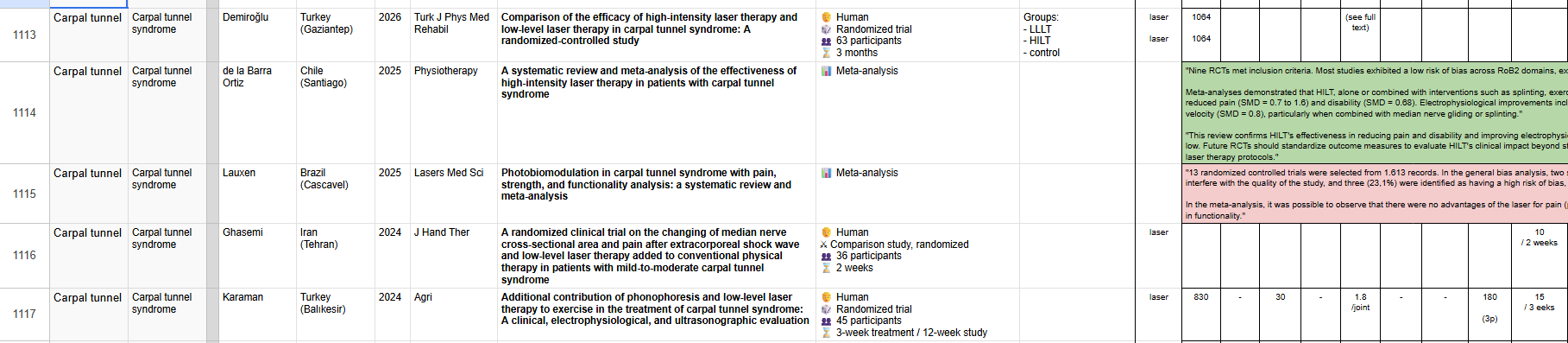
I'll limit myself to recent reviews, for understanding the science here. Fortunately, we have a few very recent reviews that analyze and integrate the publications of the last few years.
Light Therapy Reviews On Carpal Tunnel Syndrome
Let's start with a 2025 review that considers high intensity lasers for carpal tunnel syndrome (10). Here's the outcome of the study - don't worry I'll translate that to simple English soon:
"Meta-analyses demonstrated that [High Intensity Laser Therapy], alone or combined with interventions such as splinting, exercise, TENS, vitamin B supplements, or ergonomic modifications, significantly reduced pain (SMD = 0.7 to 1.6) and disability (SMD = 0.68). Electrophysiological improvements included enhanced distal motor latency (SMD = 0.98) and sensory conduction velocity (SMD = 0.8), particularly when combined with median nerve gliding or splinting." (10).
So, here, light therapy works if you combine it with other non-surgical methods, such as exercise, B vitamins, ergonomic adjustments of your workplace, etc.
And it's not just pain that decreases, also disability. Plus, the health of the nerve seems to improve due to better electrical conductivity.
Then, a second review from the same year, that's kind of lukewarm, in a sense positive but criticizing that the treatment parameters are all over the place (11).
Other reviews are from 2020 and earlier, and don't offer the info I want. So I decided to check the studies myself and observe the pattern:
My Take On The Light Therapy & Carpal Tunnel Syndrome Studies
So I checked Heiskanen's Database and made the following observations (9):
- Most studies use lasers and near-infrared (NIR), not red light. Mostly this is in the 800 - 1,100 nm range.
- Only a few studies use red light
- Reviews over the course of decades even, are mixed, as the first human studies already started in 1999
- Doses are almost always small, with a few exceptions, under 20 J/cm2
- Treatment occurs 2-5 times weekly, over the course of 1 month or less generally
- The reported treatment area is often very small, under 1 centimeter, which is less than 0.4 inches give or take
Is that outcome helpful? Absolutely. I'll explore the answer in the next section.
As a sidenote:
Going through the research, I even found a few of my old fellow students in the Netherlands who published an article on this topic, so shoutout to Thierry and Sven (12).
Moving on:
So, How To Use Red Light Therapy For Carpal Tunnel?
How to use red light therapy for carpal tunnel? Well, you'll want a NIR-dominant light, allowing you to deliver up to a 20 J/cm2 dose, 2-5 times weekly, at the impingement location.
Ideally, IMO, you'll either have a:
- Torch device, as it most closely resembles lasers
- A handheld panel, which offers a bigger treatment area, and slightly more red light, in many cases
- A travel or small device - the Chroma Ironforge is unparralelled here, especially because it has more NIR.
Which brings me to:
Best Red Light Therapy For Carpal Tunnel Syndrome Devices
So, here are the best red light therapy for carpal tunnel devices, ranking from best to less good:
- Any torch device, ideally one that's also high in NIR - check our deals page for the latest discounts. Examples here are the Chroma torch (code ALEX saves) with more NIR. The Hooga torch is also great
- Handheld devices - again, check the deals page with the most recent discounts. Any of the bigger/better brands will do, such as PlatinumLED, Mito Red, Mito Light, Block Blue Light, or Hooga.
- The Chroma Ironforge - because of the huge NIR emission, and its overall versatility. You'll only have to treat for 20-40 seconds with this device, at the location of the impingement in the wrist, to get to a 10-20 J/cm2 dose, per treatment.
Treat for at least 1 month, like in the studies, 2-5 weekly sessions.
Conclusion: The Future Is Bright!
So is red light therapy good for carpal tunnel? Likely, yeah. But there's still no one protocol to rule them all. And, much more here than on other topics, there's discussion about the best wavelengths, treatment frequency, application area, etc.
So I recommend taking the guidelines above as a starting point, but, adjusting from there. You can adjust based on trial and error, as long as you try a protocol for a while.
You can test treating the entire wist area with 30 J/cm2, for instance, for 8 weeks. Or, use 10 J/cm2 for 8 weeks, and observe how your body reacts. Decreasing symptoms of carpal tunnel syndrome during and after a session is a great hallmark for a sign that you've hit the sweet spot in terms of treatment.
This is a post by Bart Wolbers. Bart finished degrees in Physical Therapy (B), Philosophy (BA and MA), Philosophy of Science and Technology (MS - with distinction), and Clinical Health Science (MS), has had training in functional medicine, and is currently the head researcher at Lighttherapyinsiders.com
Other Resources I Recommend Checking:
🔴 Science Tool: Simplifying Routines, Benefits & Device Selection
🔴 Light Therapy Insiders Shopping Tool
🔴 Light Therapy Insiders Mask Shopping Tool
🔴 Light Therapy Advance Science Course Introduction
🔴 Signup To The Light Therapy Insiders 100%-Free Advanced Science Course
🔴 Light Therapy Insiders AI-Assistant Explained
🔴 All The Deals & Discounts Listed Alphabetically
🔴 Basics: What Is Red Light Therapy?
🔴 Basics: How To Use Red Light Therapy?
🔴 Basics: Red Light Therapy Buyer's Guide
🔴 Best Red Light Panel 2025? BioMax Pro Ultra vs The Rivals
🔴 The 3 Red Light Therapy Mechanisms You Should Know About
🔴 Red Light Therapy Wavelengths & Penetration Ultimate Guide