
Last updated: June 27 2026
In this article, I've covered the June 2026 science on red light therapy for hearing loss.
If you're short on time, check the summary below. If you want a full understanding of the topic, read my analysis of the current studies below.
Enjoy!
Red Light Therapy For Hearing Loss Summary:
For now, I recommend the LightpathLED torch (discount code ALEX saves here) with the "oral attachment" to directly treat the cochlear organ inside the ear and adjacent tissues. Side effects are infrequent here, but I recommend you monitor your results.
Overall, red light therapy for hearing loss is somewhat promising other hearing conditions and animal research. Hopefully, we see more human research emerge over the next few years to better understand what makes a treatment successful, as hearing loss affects 1 billion+ people.
Not all hearing loss may be fixable with light therapy and I mainly recommend using it as one therapy among many, for support, such as lowering inflammation and oxidative stress, and supporting blood flow and mitochondrial function.
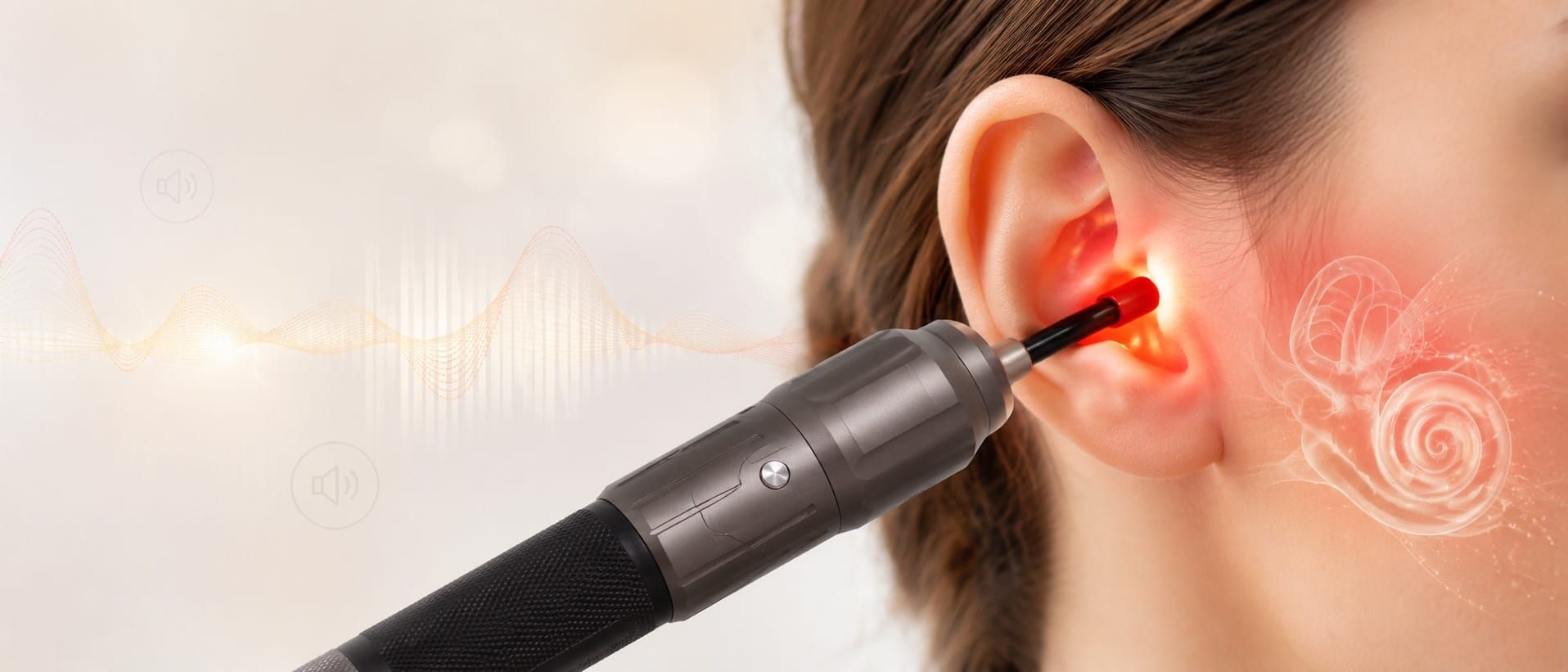
The header picture above is AI-generated though.
If you need an introduction to what these terms mean, check the following resources:
- What Is Red Light Therapy?
- Red Light Therapy Explained: Basic Terms Guide
- Start Here - Light Therapy 101 & Buyers Guide
- Red Light Therapy Dosing Chart: The Raw Data From Hundreds Of Studies
- Red Light Therapy Dosing: Why It's Complicated!
- Red Light Therapy Wavelengths Benefits: The Ultimate Guide
- How Often Should You Use Red Light Therapy Explained
These resources should give you a basic understanding of how red light therapy works, and the discussions around it!
Hearing Loss Introduction
If you're young like I am, hearing loss seems like a condition far from experience. However, as you age, the risk increases, and up to 25% of people over 60 are affected by some form of hearing loss (1).
In 2050, it's also projected that 10% of the world's population will have hearing loss (1). Other sources have much higher estimates, such as 1.5 billion people currently, which is around 20% (3).
The cause? Harvard Medical explains causes in simple terms:
"The cells that collect sound information from the environment and send it to the brain are called hair cells. We are born with about 11,000 hair cells in each ear, and they need to last. We experience the slow progression of hearing loss as these fragile cells die due to excessive noises, exposure to certain drugs, and aging. As hair cells die, nearby brain cells that once carried sound information to the audio processing part of the brain also expire." (2)
Different types of hearing loss exist, from very mild to severe (total deafness). And hearing loss doesn't just affect hearing; it has a widespread impact on your life, such as mental well-being, social dynamics, cognitive performance, and even neurodegenerative disease risk (4; 6). There's stigma, self-esteem issues, and potential threats of loneliness with haring loss (4).
Treatment is multifaceted, with hearing aids and ear canal treatments acting as primary treatments (5). Treatment at an early age is especially important, as it can significantly impact a child's development (5).
Lots of different causes of hearing loss exist (7; 8; 9; 10). Genetics play a role, excess noise often worsens hearing function, but also inflammation and loss of mitochondrial function affect the dynamic.
Let's consider how red light therapy for hearing loss can change the dynamic here:
Does Red Light Therapy Work For Hearing Loss?
So, simple question: "Does red light therapy work for hearing loss?" To answer that question, let's consider Vladimir Heiskanen's database - search for "Hearing" in the category column and then "Hearing loss" if you want to see the studies I'm citing (11):
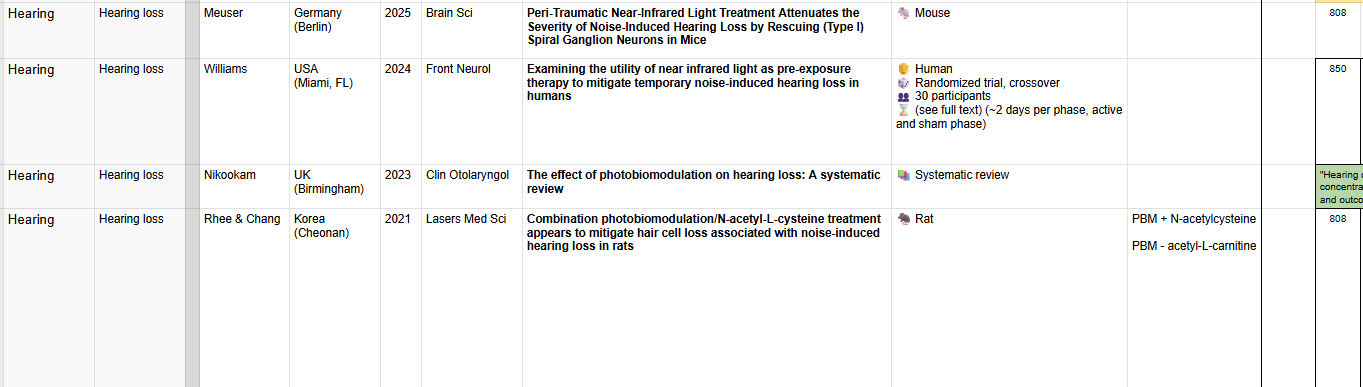
Right now, 14 studies are published on the topic of red light therapy for hearing loss. Among these are just two human studies, and two reviews (which aggregrate and integrate earlier evidence) (11).
Human Studies On Light Therapy For Hearing Loss
I'm only considering the reviews and human studies here:
- First, a 2024 study uses NIR at 850 nm to prevent noise-induced hearing loss in humans (12; 13). Here's the treatment protocol:
"Each earbud emitted 850 nm light at 58 mW/cm2 at 0.5 cm distance from the tympanic membrane, with an energy density of 3.3 J/cm2." (13)
- In that study, NIR wasn't protective against the temporary hearing loss induced by noise.
- Another 2013 study uses 532 nm green light and 635 nm red light in older adult humans (14). Here's the treatment protocol:
"The treatment group was given [red light therapy], which consisted of shining low-level lasers onto the outer ear, head, and neck. Each laser treatment lasted approximately five minutes. Three treatments were applied within the course of one week. " (14)
- No effect was found, though!
Reviews On Red Light Therapy For Hearing Loss
Now onto the two reviews on this topic:
- Here's the outcome of the first review, which claims
"The auditory cell protective effects of [red light therapy] could significantly enhance the performance of [Electronic Acoustic Stimulation (EAS), which is a hearing solution that combines a cochlear implant for high-pitched sounds and a hearing aid] in individuals with residual hearing. Further, postoperative [Cochlear Implant] is accompanied by an inflammatory response characterized by the upregulation of specific cytokines." (15; 16)
Well, so here there's a benefit for cochlear implant application, but not for hearing loss in general. Then there's a second review, which focuses on the animal study research and has a lot more positive outcomes than any of the studies I've considered so far:
"Efforts to use [red light therapy] to improve hearing have been ongoing for several decades. Initial in vitro studies using cell lines and ex vivo culture techniques have now been supplanted by in vivo studies in animals; [red light therapy] protects the sensory epithelium and triggers neural regeneration. Many reports have used [red light therapy] to treat tinnitus. In this brief review, we introduce [red light therapy] applications in hearing research, helpful protocols, and relevant background literature." (17)
The review also focuses heavily on tinnitus research (18). I've covered that tinnitus research in the past, and it's extremely promising, here:
 Bart Wolbers
So far, though, the review above doesn't include too much human research for regular hearing loss (non-tinnitus) (18). The research is positive though for protecting against stress-induced hearing loss (such as noise) in animal studies (18). You can see the ear canal treatment below, for instance:
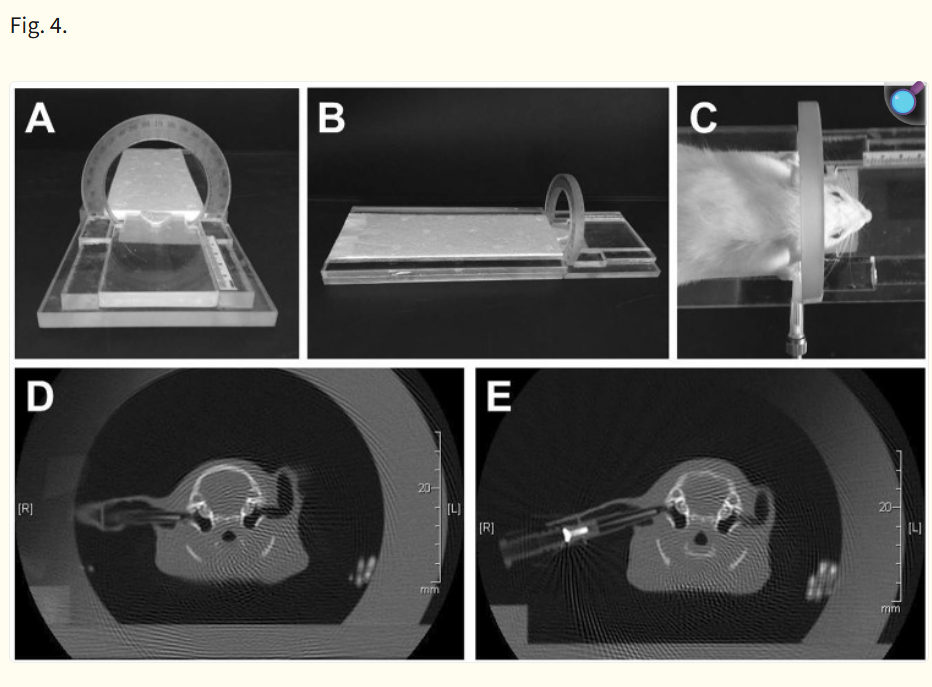
Other Studies/Research
Another review in a different category also concludes that red light therapy may be helpful for cochlear implants, improving their performance (19).
And there are two studies on Ménière's Disease (20; 21). In Ménière's Disease, there's periodic fluid buildup in the ear, which can cause tinnitus, vertigo, hearing loss, and a sensation of pressure inside the ear.
Both studies are very promising and seem to imply a reduction of the frequency and intensity of attacks in red light therapy for Ménière's Disease (20; 21). Ideally, again, we need far more research here.
Red Light Therapy For Hearing Loss Treatment Protocol
Right now, due to the absence of a lot of human evidence, but ample of available animal studies, I recommend treating very conservatively.
This conservative treatment protocol entails:
- A 2-4 J/cm2 dose, that I've also used in my tinnitus article.
- At the high end, you can work up to 10 J/cm2, but closely monitor your response. If you have headaches, worsening of symptoms, fatigue, etc, then the 10 J/cm2 dose may be too high.
- We're waiting here for a lot more research to show up on light therapy for hearing loss.
In my opinion, a variety of mechanisms exist, such as inflammation, oxidative stress, and loss of mitochondrial function. Which leads me to the next step:
Best Red Light Therapy For Hearing Loss Device
So what's the best red light therapy for hearing loss device?
Right now, I still recommend:
- LightpathLED Torch with oral tip, that can penetrate the ear canal (and is made for oral health primarily, at 100 mW/cm2, so you need 10 seconds to get a 1 J/cm2 dose. Code ALEX saves here.
- Block Blue Light Torch, although it's less applicable for the ear canal, you can still use it to shine light into the area. Click the link for a discount
- Chroma torch - code ALEX saves again. Once more, this torch is less suitable for shining light directly into the air canal, but it will still work. I still recommend the LightpathLED above as my first choice!
Keep in mind that you only need 20-40 seconds treatment time, per day, with the LightpathLED Torch above, for a 2-4 J/cm2 dose.
Conclusion: Waiting For More Research
Yes, the research is quite promising but also quite circumstantial right now. Animal studies on hearing loss are decent, the tinnitus research is decent, and we've got some research on cochlear implant functioning.
What's missing, though, is general human research on hearing loss. Hence, I've developed a very conservative protocol that should still deal with the underlying issues, such as inflammation, stress, and mitochondrial dysfunction, in relation to hearing loss.
Is it perfect?
No...
I'm still waiting for much more research to emerge in 2026 on this topic and will continue to update this article over time. Stay tuned!
This is a post by Bart Wolbers. Bart finished degrees in Physical Therapy (B), Philosophy (BA and MA), Philosophy of Science and Technology (MS - with distinction), and Clinical Health Science (MS), has had training in functional medicine, and is currently the head researcher at Lighttherapyinsiders.com
Other Resources I Recommend Checking:
🔴 Everything You Need To Know About Tinnitus & Red Light Therapy
🔴 Is Red Light Therapy Safe for Your Eyes?
🔴 Science Tool: Simplifying Routines, Benefits & Device Selection
🔴 Light Therapy Insiders Shopping Tool
🔴 Light Therapy Insiders Mask Shopping Tool
🔴 Light Therapy Advance Science Course Introduction
🔴 Signup To The Light Therapy Insiders 100%-Free Advanced Science Course
🔴 Light Therapy Insiders AI-Assistant Explained
🔴 All The Deals & Discounts Listed Alphabetically