
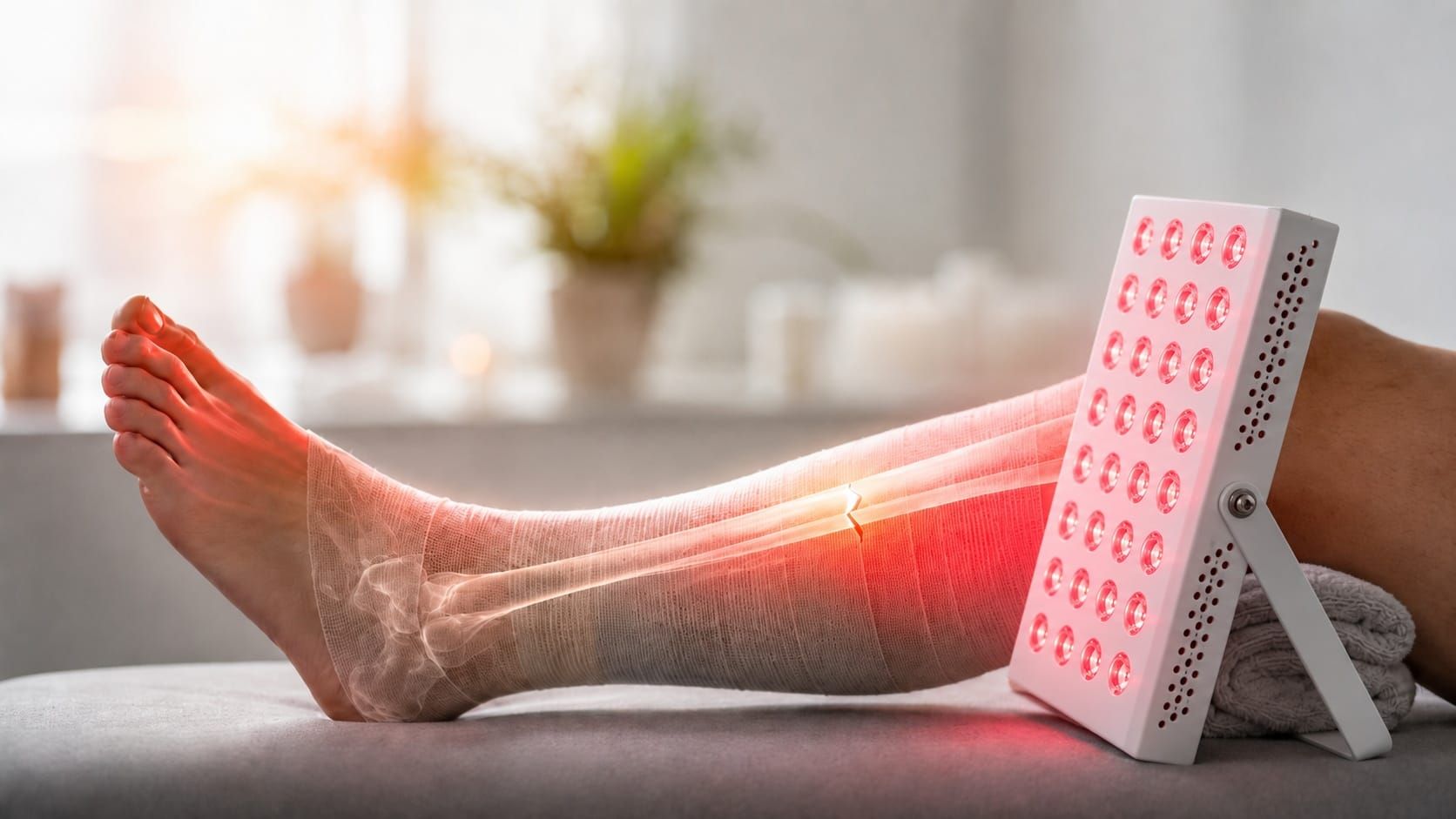
So what's up with red light therapy for bone fractures? Is there any evidence that if you have a broken bone, healing can be sped up with red light therapy?
Check out the surprising outcome in the summary below - with device recommendations. If you want to understand my full argument, read the entire blog post.
Red Light Therapy For Bone Fractures Summary
Bone healing is multifactorial - influenced by factors such as smoking, blood supply, medication use, etc - and red light therapy is mainly beneficial for pain in the current studies.
Near-infrared (NIR) light has superior evidence. More human reserach is needed though, and future studies may find protocols that do enhance bone healing. A dose of up to 15 J/cm2 dose is recommended for now, one study goes as high as 100 J/cm2.
Best devices:
1) Handheld panels - such as Rouge Nano (has NIR only mode) or Block Blue Light PowerPanel Portable. Both arguably have 50 - 75 mW/cm2 with the contact method (3-4 J/cm2). Others: Mito Light Bulb 5.0 for EU (NIR only option), Hooga HG24, etc
2) Chroma Ironforge - Use discount code ALEX - for 500 mW/cm2, and NIR predominance. So 30J/cm2 per minute, meaning you only need to treat for about 30 seconds for a fracture. I will say this device is better for bigger joints, such as (God forbid!) the hip or back!
3) Kineon MOVE+ - Use discount code AFERGUSMOVE - which is ideal if you cannot hold the device due to the location. This Kineon device can still easily be placed on a location by another person
4) Any Tabletop, Wall, or Body Panel that you can use near the fracture site, and it's OK to use both red and NIR as there's no evidence that red is harmful here, but also no evidence that red/NIR combined work better than NIR alone. It's just that there's more evidence on NIR which makes sense from a physiological/mechanistic perspective.
Background Info
The image on top is AI-generated, though!
If you need an introduction to what these terms mean, check the following resources:
- What Is Red Light Therapy?
- Red Light Therapy Explained: Basic Terms Guide
- Start Here - Light Therapy 101 & Buyers Guide
- Red Light Therapy Dosing Chart: The Raw Data From Hundreds Of Studies
- Red Light Therapy Dosing: Why It's Complicated!
- Red Light Therapy Wavelengths Benefits: The Ultimate Guide
- How Often Should You Use Red Light Therapy Explained
These resources should give you a basic understanding of how red light therapy works, and the discussions around it!
Fractures Basics
Let's briefly consider the status of the science on bone fractures in 2026. Loads of reviews which aggregate and analyze previous science have been published on this topic.
Here we can see, for instance, in a 2024 review, why light therapy may affect bone healing:
"Bone is classified into two main types based on microstructure: lamellar and woven bone, with lamellar bone being stronger and more durable. Factors such as inflammation, the periosteum, vascularity, and infection significantly impact healing outcomes. Moreover, fracture fixation is fundamental to optimal healing, guided by principles of anatomical reduction, stable fixation, blood supply preservation, and early mobilisation" (1),
As you likely know, inflammation, vascularity, and even infection risk, are affected by light therapy. Both fixation and controlled movement can speed up bone healing, in turn (1).
Some recent reviews showcase that healing speed can be enhanced with bone fractures. Here's an example:
"The most promising methods identified are the application of axial micromovement, electromagnetic stimulation with electromagnetic fields and direct electric currents, as well as the administration of growth factors and parathyroid hormone. Some interventions have been shown to reduce the healing time by up to 20 to 30%, potentially equivalent to several weeks." (2).
That dynamic is also the angle I'll soon take, considering the science on red light therapy for fractures. Obviously, not all trauma/fractures are the same, and the nature of the trauma determines prevention and healing (3). Bone healing can go wrong, and is determined by cellular components/dynamics (4).
Proper bone healing is not just a matter of bone/joint fixation, and then waiting. Here's what a 2023 review writes on the topic:
"Bone non-union occurs in 2–10% of all fractures. Although the cellular components of bone healing are partially understood, the mechanisms by which bone fails to heal are manifold and remain largely unexplored. Among the main risk factors for non-union are smoking, open fractures, and certain medications including NSAIDs." (5).
So yeah, bone healing at least in some part depends on your overall lifestyle. Fixing non-healing fractures can be complex and the solution is often multi-factorial (6; 7).
New tech such as AI seems to be able to help with this process (7). So let's consider the role of light therapy for bone fractures too, in this process:
Red Light Therapy For Bone Fractures
Vladimir Heiskanen's datasheet is my main source right now, for red light therapy for bone fractures (8). Under "Bone, Fractures", there are 16 different studies listed currently (8).
Quite a few of these are animal studies, which I'll ignore for now and focus on the human outcomes. Generally though, these animal studies have neutral/positive outcomes (9; 10; 11; 12). So that's all good.
Review Studies On Light Therapy For Fractures
First up, a 2026 review (13; 14). The full text is freely available here which is great (14).
Pain was the primary outcome of this review, and secondarily, functional outcomes and healing. On the first topic, 12 earlier studies were included, and on the secondary outcomes, 9 (14).
Here's the current conclusion:
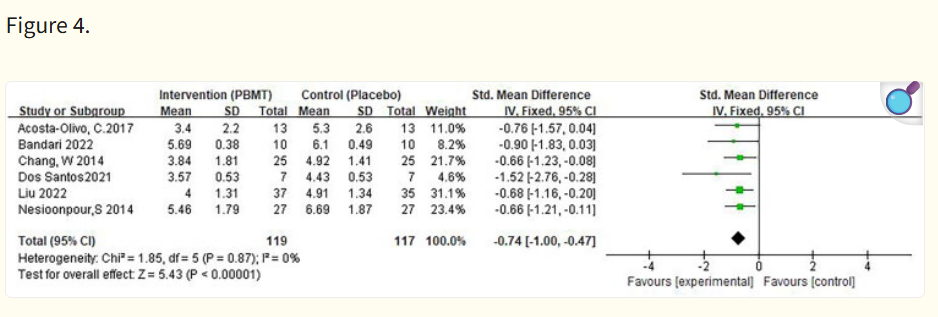
"[Red light therapy] appears to relieve short-term pain in fractures and improve grip strength in patients with upper limb fractures, but does not show significant long-term benefits." (14).
Figure 4 of their study showcases the outcomes in the pain outcome, and the benefit of light therapy over placebo:
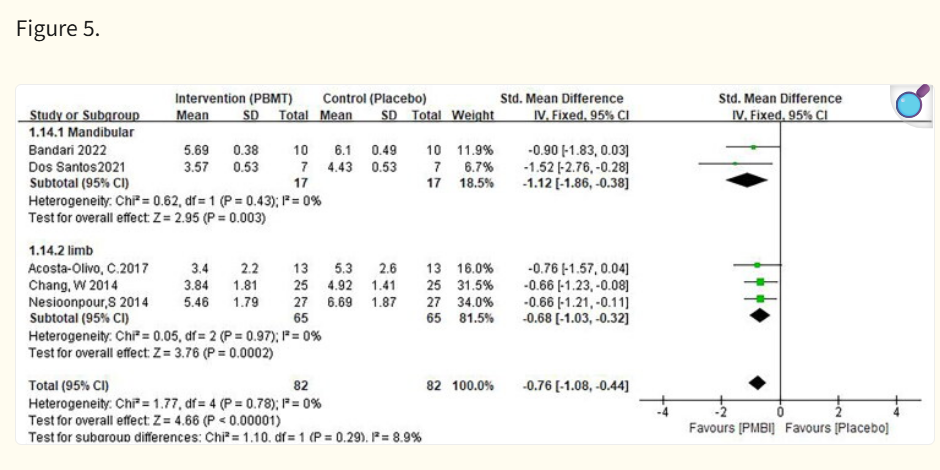
And then, Figure 5, shows the outcomes in different locations, such as the mandibular (lower jaw), and limbs:
The analysis of the researchers is quite complex. For instance, there's difference between irradiation sites, such as the acupuncture points, or the site of the fracture, in Figure 6:
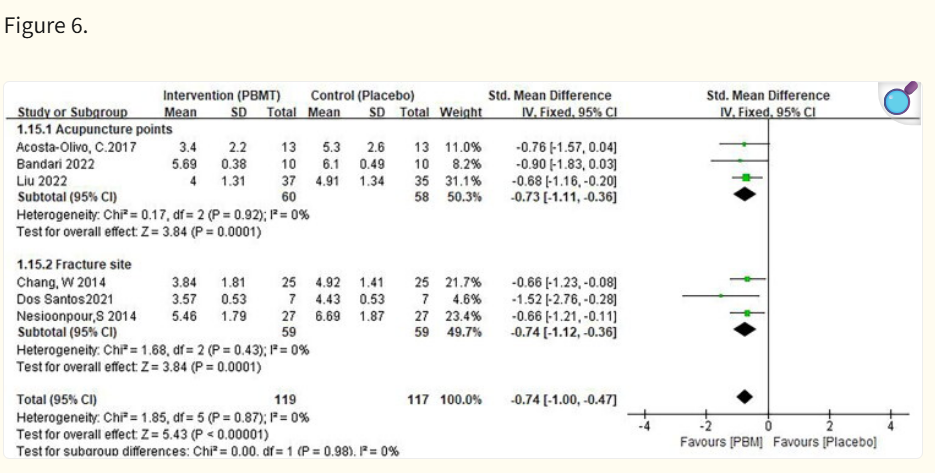
Figure 8 shows wavelength differences, for instance, and Figure 10-13 show pain/disability scores over time where there's no statistically significant difference (14).
All in all, though, here's the final outcome:
"The accumulated evidence of our study confirms and reinforces the previous findings that, compared with placebo or conventional treatment, [red light therapy] can reduce short-term postoperative pain in patients with fractures, with no evidence to support its long-term efficacy. We additionally found that PBM may promote grip strength recovery in patients with upper limb fractures, and mandibular functional rehabilitation remains controversial, but subgroup analyses showed no significant differences in pain relief between the two. In addition, the subgroup analysis also found that [red light therapy] therapy and laser acupuncture had similar analgesic effects. The wavelengths involved in the included studies did not differ in the efficacy of pain relief. There is no clear evidence that [red light therapy] can promote bone healing" (14).
So, lower pain but not quicker healing.
A second review looks at the published animal studies, and has a slightly different conclusion:
"Although [red light therapy] shows potential for enhancing fracture healing in animal models, meta-analysis showed that it has no effect on maximum force of fracture or Raman peaks of hydroxyapatite" (15).
So, quicker healing but not greater bone mineral density/adaptation to force, in plain English (15).
Another review, including both animal and human studies, from 2020, is more positive but states that more research is needed for optimal parameter selection (16).
Dosing Parameters For Fractures
Main near-infrared (NIR) is supported for fractures:
"Available evidence mainly supports the use of near-infrared light in fracture-related pain management." (14).
Then, on dose, the researchers state:
"Therefore, according to the method proposed by de Abreu et al. this study divided the energy density into three levels (0.1–5.0 J/cm2, 5.1–10.0 J/cm2, 10.1–15.0 J/cm2 and above) for subgroup analysis, representing low, medium and high doses, respectively. The results of the analysis showed that all dose groups showed a statistically significant pain relief effect." (14).
So, NIR predominance and a dose of up to 15 J/cm2 is recommended here. Some studies go higher than this, is noted by the researchers (14).
A wide array of dosing patterns seem to be helpful. And, because of the difficulty of irradiating the acupuressure points, I will recommend exposing the fracture site here, based on the most important review (14).
So the current status?
- Red light therapy for healing fractures? Not too much evidence here.
- But red light therapy for fracture pain? Damn yes!
Red Light Therapy For Bone Fractures Devices
So what are the best red light therapy for bone fractures devices? Here are the criteria:
- NIR predominance
- Local spot treatment option
- The ability to easily deliver a dose of up to 15 J/cm2 at the location
Best Devices For Fractures (Best at top - May 2026 update):
- Handheld panels - such as Rouge Nano (has NIR only mode) or Block Blue Light PowerPanel Portable. Both arguably have 50 - 75 mW/cm2 with the contact method (3-4 J/cm2). Others: Mito Light Bulb 5.0 for EU (NIR only option), Hooga HG24, etc
- Chroma Ironforge - Use discount code ALEX - for 500 mW/cm2, and NIR predominance. So 30J/cm2 per minute, meaning you only need to treat for about 30 seconds for a facture. I will say this device is better for bigger joints, such as (God forbid!) the hip or back, as it's easier to treat a bigger area with it.
- Kineon MOVE+ - Use discount code AFERGUSMOVE - which is ideal if you cannot hold the device due to the location. This Kineon device can still easily be placed on a location by another person
- Any Tabletop, Wall, or Body Panel that you can use near the fracture site, and it's OK to use both red and NIR as there's no evidence that red is harmful here, but also no evidence that red/NIR combined work better than NIR alone. It's just that there's more evidence on NIR which makes sense from a physiological/mechanistic perspective.
Conclusion: Keeping You Updated On The Red Light Therapy For Broken Bones Science
Yeah, I'll have to keep you updated in the coming year on the red light therapy for broken bones science.
For now, there's not much evidence that bone mineral density or healing speed is increased with light therapy. But reviews also mention that we may not have found the optimal treatment parameters yet (14).
And, while this is speculation, I'd like to see studies with a combination of movement and light therapy, or other strategies to increase recovery speed and light therapy, assuming here that light therapy allows for less pain and therefore impacts other variables as well.
For now, use NIR up to 15 J/cm2 (higher in some studies) around the facture location!
This is a post by Bart Wolbers. Bart finished degrees in Physical Therapy (B), Philosophy (BA and MA), Philosophy of Science and Technology (MS - with distinction), and Clinical Health Science (MS), has had training in functional medicine, and is currently the head researcher at Lighttherapyinsiders.com
Other Resources I Recommend Checking:
🔴 Science Tool: Simplifying Routines, Benefits & Device Selection
🔴 Light Therapy Insiders Shopping Tool
🔴 Light Therapy Insiders Mask Shopping Tool
🔴 Light Therapy Advance Science Course Introduction
🔴 Signup To The Light Therapy Insiders 100%-Free Advanced Science Course
🔴 Light Therapy Insiders AI-Assistant Explained
🔴 All The Deals & Discounts Listed Alphabetically
🔴 Basics: What Is Red Light Therapy?
🔴 Basics: How To Use Red Light Therapy?
🔴 Basics: Red Light Therapy Buyer's Guide
🔴 Best Red Light Panel 2025? BioMax Pro Ultra vs The Rivals
🔴 The 3 Red Light Therapy Mechanisms You Should Know About
🔴 Red Light Therapy Wavelengths & Penetration Ultimate Guide