

🏆 Quick Answer: What's the Best Red Light Therapy Panel of 2026?
Winner: PlatinumLED BioMax Pro Ultra
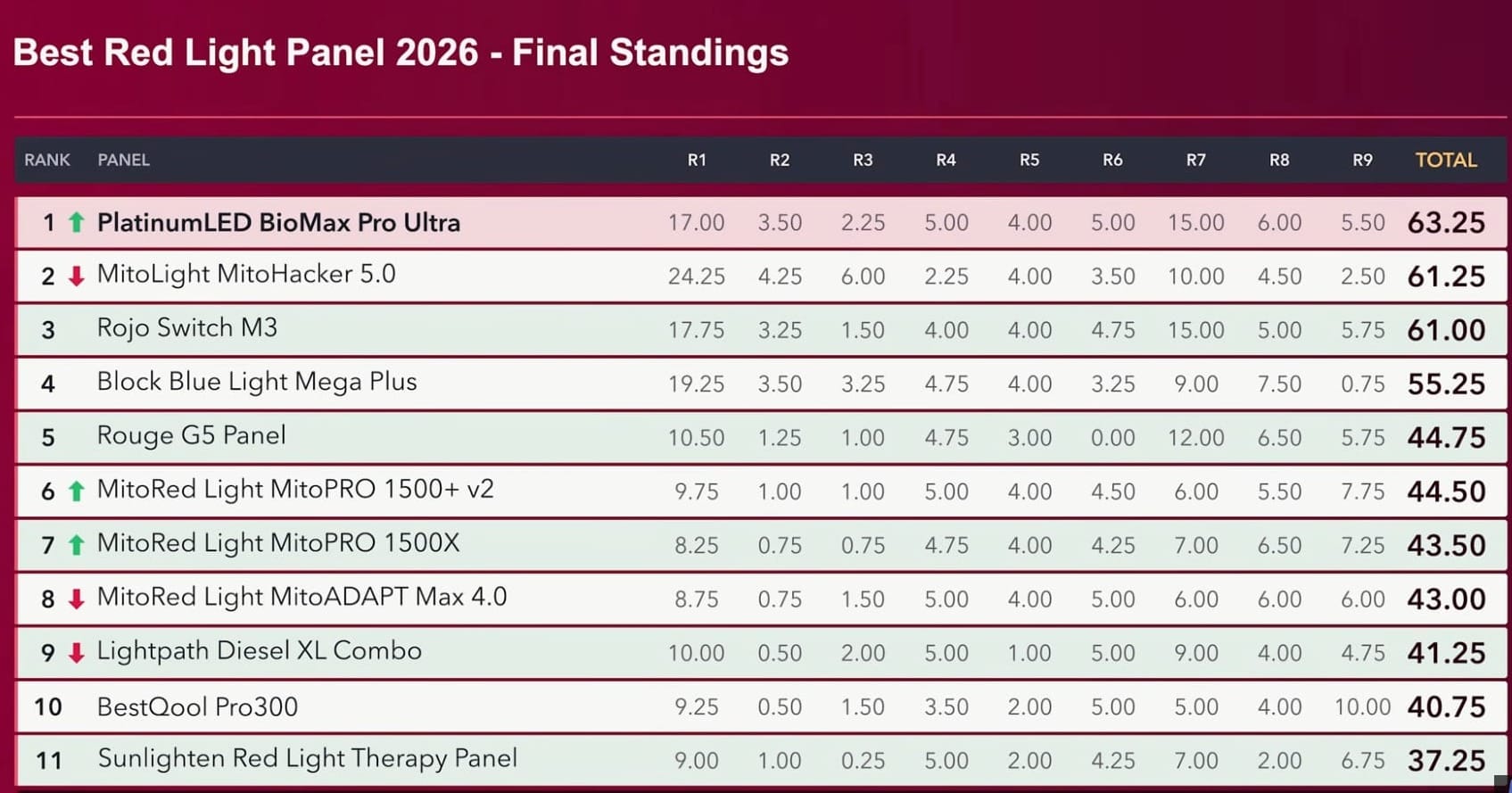
After nine rounds of independent testing involving 11 red light therapy panels, the PlatinumLED BioMax Pro Ultra took first place with 63.25 points. The MitoLight MitoHacker 5.0 finished second with 61.25 points, followed closely by the Rojo Switch M3 with 61 points.
🏆 Best Red Light Therapy Panels 2026 – Final Rankings
Here are the final standings after nine rounds of independent testing. Each panel was evaluated across multiple performance categories, with the highest total score determining the winner.
| Rank | Panel | Total Score |
|---|---|---|
| 🥇 1 | PlatinumLED BioMax Pro Ultra | 63.25 |
| 🥈 2 | MitoLight MitoHacker 5.0 | 61.25 |
| 🥉 3 | Rojo Switch M3 | 61.00 |
| 4 | Block Blue Light Mega Plus | 55.25 |
| 5 | Rouge G5 Panel | 44.75 |
| 6 | MitoRed Light MitoPRO 1500+ v2 | 44.50 |
| 7 | MitoRed Light MitoPRO 1500X | 43.50 |
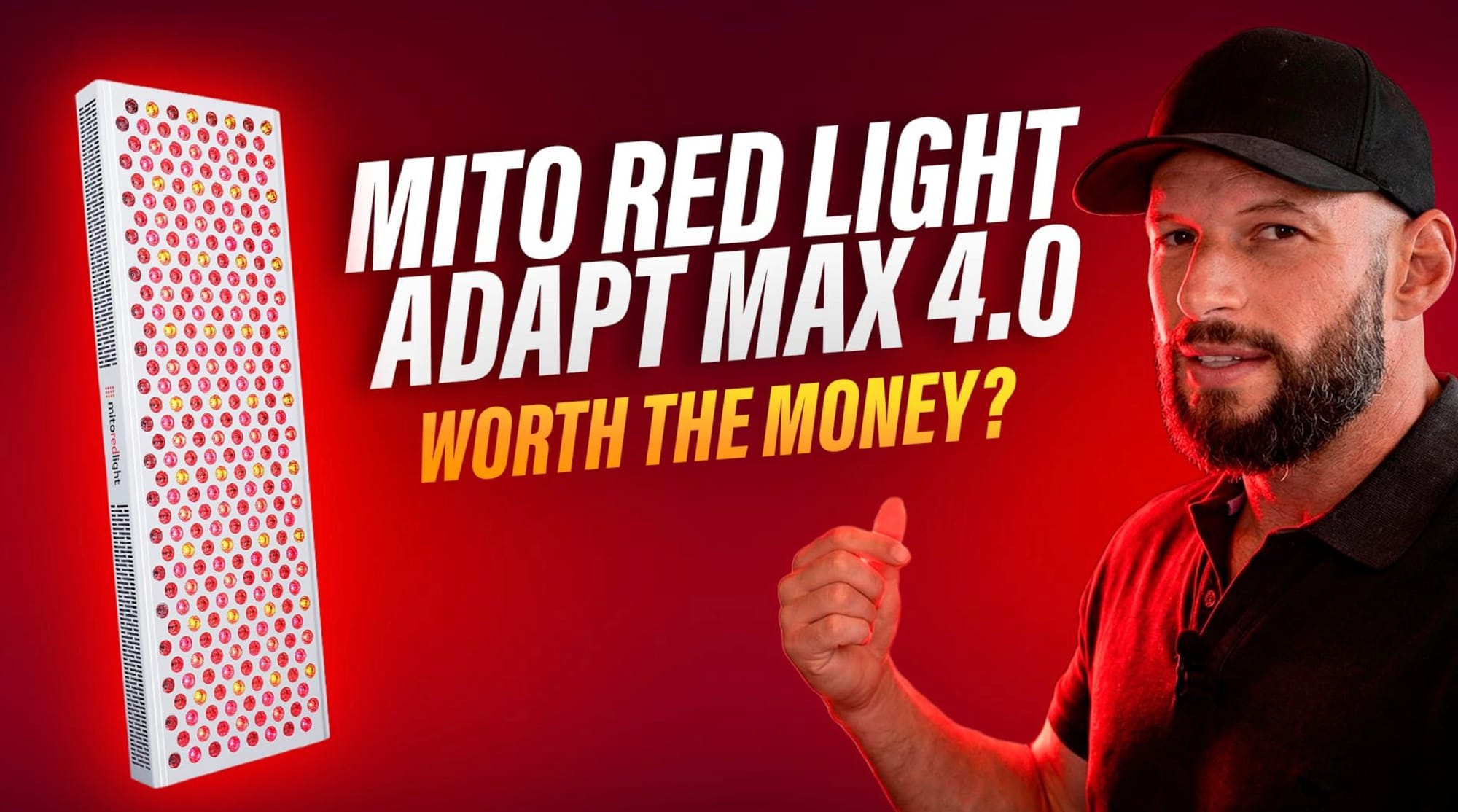
| 8 | MitoRed Light MitoADAPT Max 4.0 | 43.00 |
| 9 | Lightpath Diesel XL Combo | 41.25 |
| 10 | BestQool Pro300 | 40.75 |
| 11 | Sunlighten Red Light Therapy Panel | 37.25 |
Best Red Light Therapy Panels of 2026: 11 Panels Put to the Test
What is the best red light therapy panel in 2026? With so many brands promising powerful output, superior coverage, and advanced features, choosing the right panel isn't always straightforward. And the biggest numbers on a specification sheet don't necessarily translate into better performance.
To find out which panels actually deliver, I put 11 red light therapy panels through nine rounds of testing, combining independent laboratory measurements, hands-on experience, and scientific analysis. This year's comparison takes a closer look at what really matters: therapeutic wavelengths, useful light intensity, treatment coverage, ease of use, and overall value.
The goal isn't simply to find the most powerful or expensive panel. It's to determine which device provides the best combination of effective treatment, practical features, and fair pricing.
Round 1: Coverage — How Much of Your Body Is Actually Treated?
One of the most important things I look for in a red light therapy panel is coverage. After all, what's the point of a powerful panel if the light is concentrated in a small area instead of spread evenly across your body?
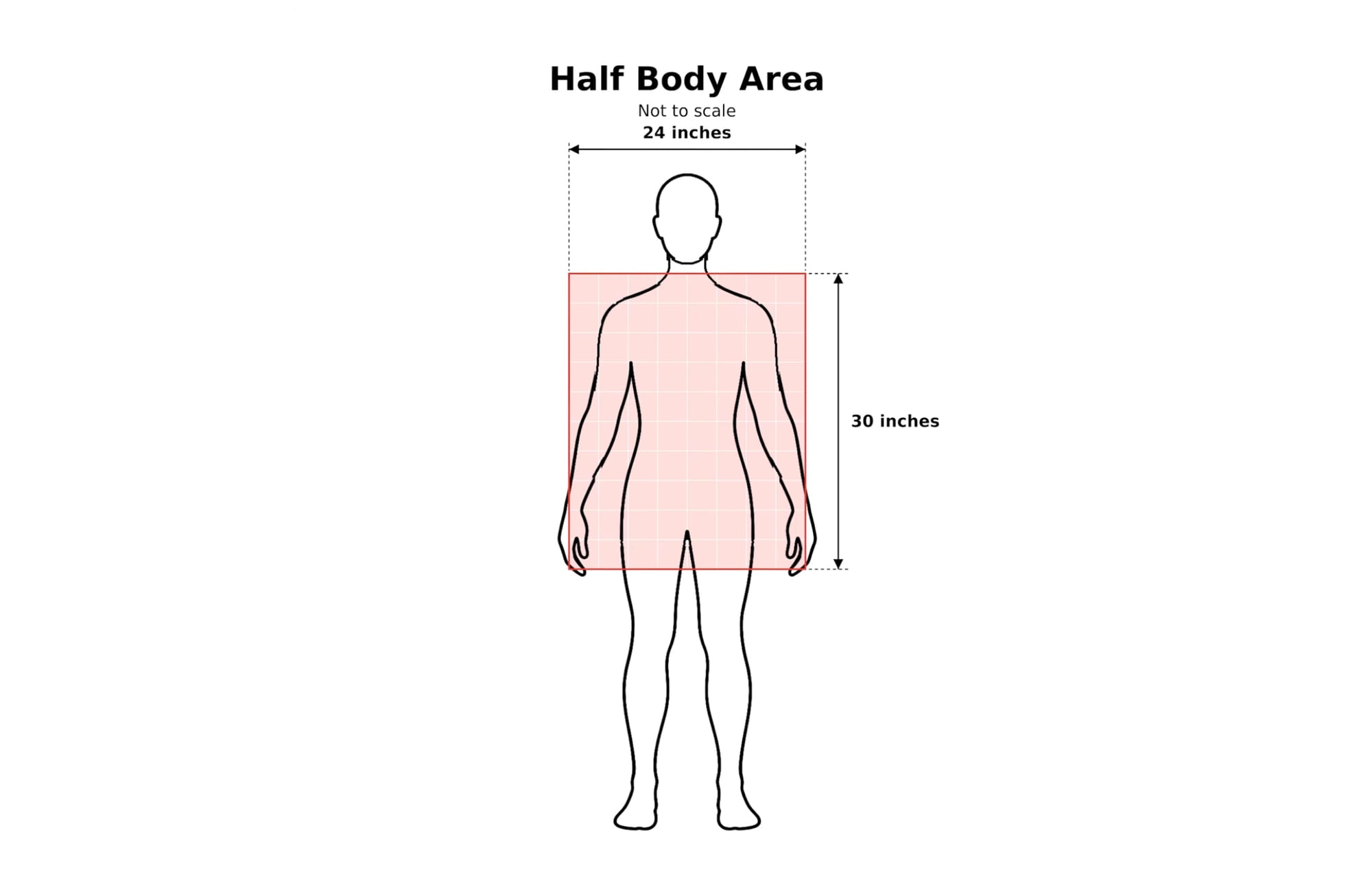
For this round, I used independent laboratory data to measure how much of a 24 × 30-inch treatment area received at least 30 mW/cm² of red and near-infrared light at a distance of 12 inches. This represents approximately half the body, whether you're treating your torso, back, or legs.
The higher the coverage percentage, the more of that area receives light at or above the intensity threshold I've selected for this comparison.
The Results Were Surprisingly Different
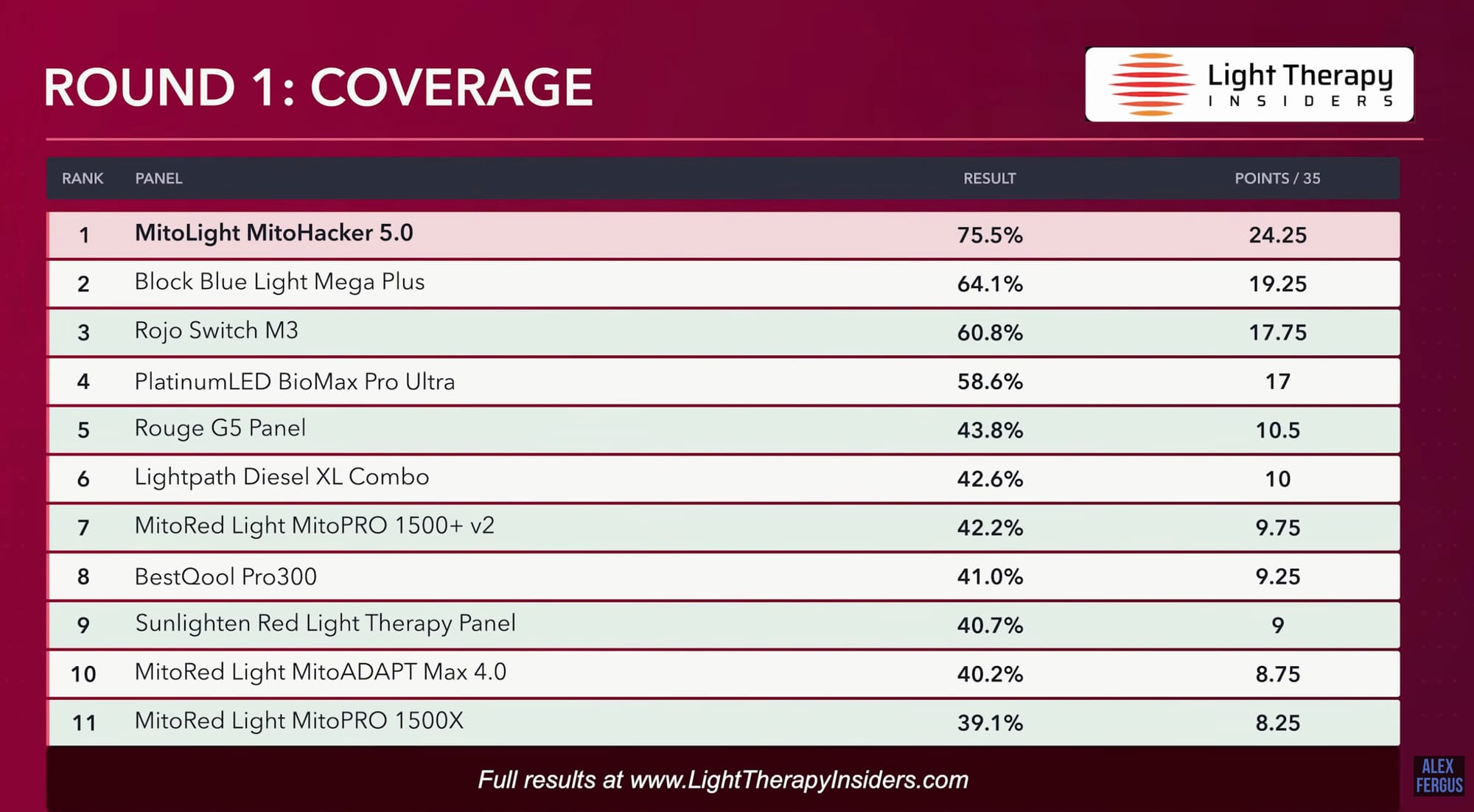
What stood out immediately was how poorly some of these panels performed. Seven of the 11 panels achieved less than 45% coverage, despite being designed and marketed for half-body treatments.
That's disappointing. If you're investing in a large red light therapy panel, you would expect it to provide useful light intensity across a substantial portion of your body, not just a relatively small area.
Things improved considerably when we reached the top four. The PlatinumLED BioMax Pro Ultra achieved 58.6% coverage, followed by the new Rojo Switch M3 at 60.8%. The Block Blue Light MEGA-PLUS performed even better at 64.1%.
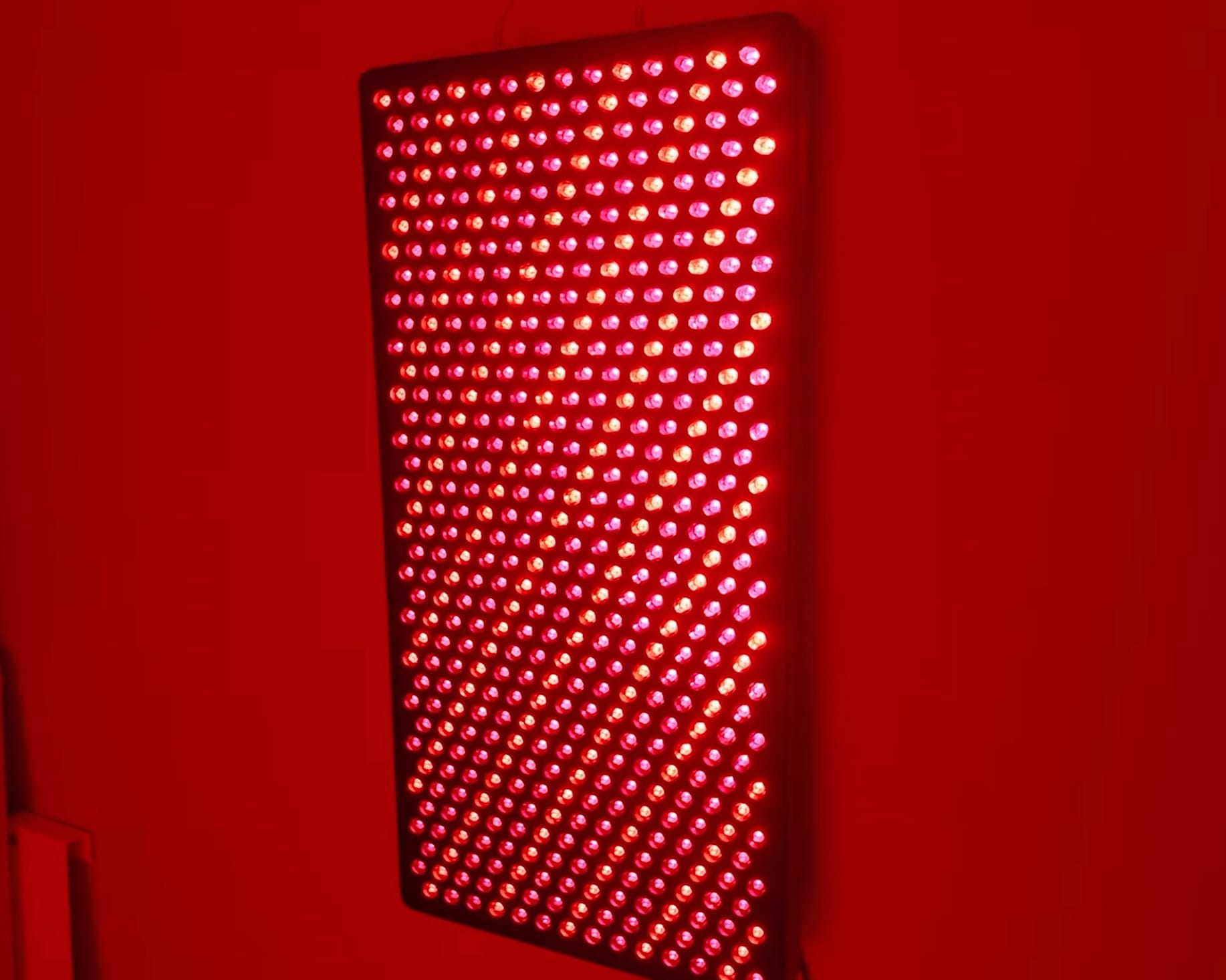
But the clear winner was the Mito Light MitoHacker 5.0, achieving 75.5% coverage.
And when you look at the panel, it's easy to understand why. It's enormous! It's not only wider than the other panels in this comparison, but also quite tall. That extra size helps it deliver useful light intensity across a much larger treatment area.
For anyone looking to treat large areas of the body, that's a significant advantage. However, I'm particularly interested to see how the Mito Light MitoHacker 5.0 performs in the remaining rounds, especially on price.
Coverage is worth a maximum of 35 points in this year's comparison, making it one of the most heavily weighted categories.
Round 1 Winner: Mito Light MitoHacker 5.0 — 75.5% Coverage (24.25 Points)
Round 1 Results: Coverage
Round 2: Average Irradiance — Does More Power Mean Better Performance?
Next up is average irradiance, which measures the average amount of light detected across the same 24 × 30-inch half-body treatment area used in Round 1.
I've talked a lot recently about why extremely high irradiance isn't necessarily better for red light therapy, and I still stand by that. However, having extra power does provide flexibility, especially when you can adjust the intensity. Think of it like buying a car. You might not need all that horsepower, but it's nice to have it available when you do.
Still, I didn't want raw power to dominate this comparison, so average irradiance accounts for just 5% of the overall score.
The Results: A New Leader in Power Output
The independent laboratory results revealed considerable differences between the panels. The MitoRed Light models generally finished toward the bottom, while the BioMax Pro Ultra took second place at 48.58 mW/cm². That's notable because the BioMax has historically been one of the most powerful panels I've tested.
However, the MitoHacker 5.0 claimed first place with 54.77 mW/cm², approximately 13% higher than the BioMax. Combined with its impressive coverage results from Round 1, it's off to a strong start.
After two rounds, the MitoHacker has taken first place in both categories, although there's still plenty of testing ahead.
Round 2 Winner: MitoHacker 5.0 — 54.77 mW/cm² (4.25 Points)
Round 2 Results: Average Irradiance
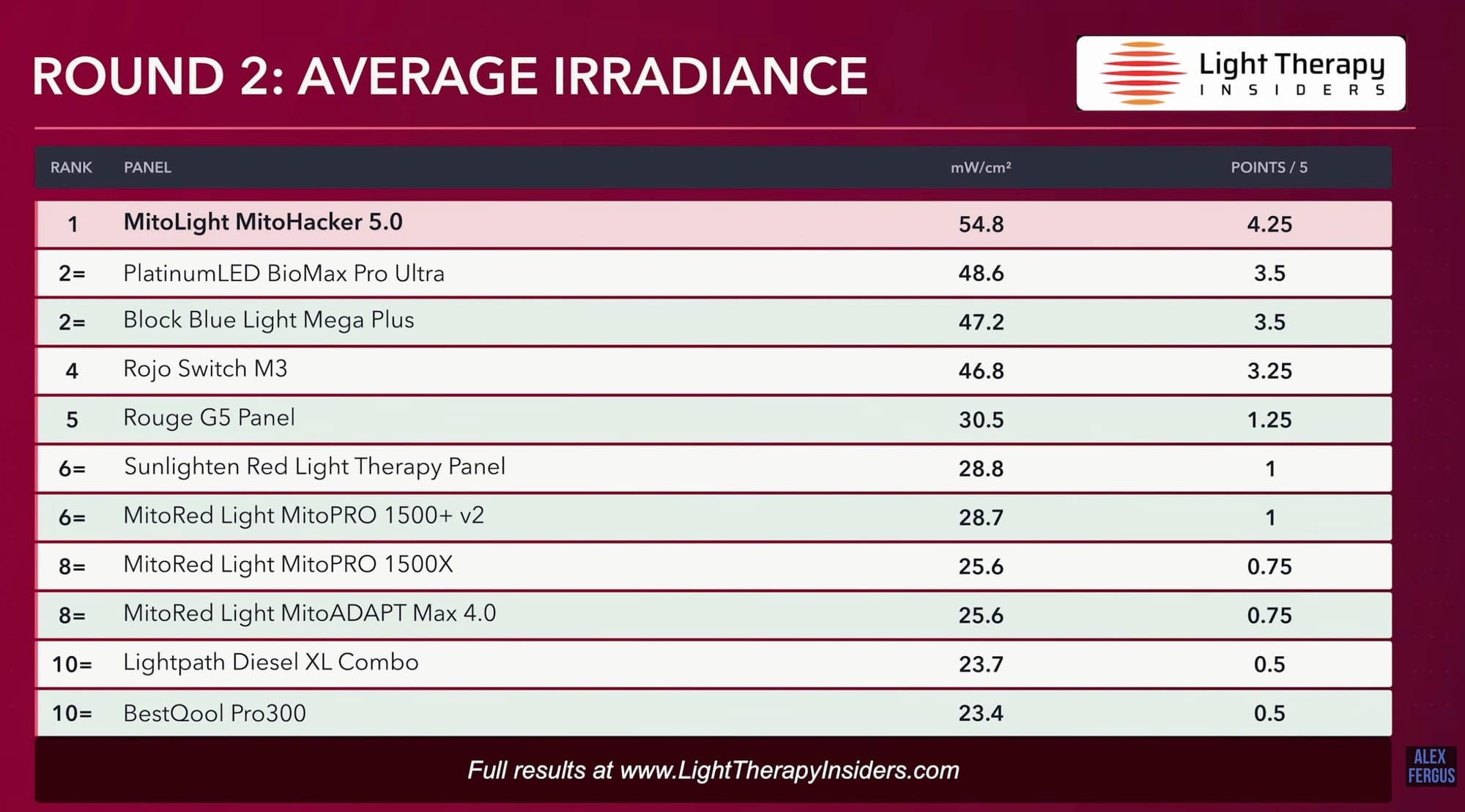
One important detail worth mentioning is that the MitoHacker delivered approximately 13% higher average irradiance than the BioMax Pro Ultra, which finished second in measured output. That's an interesting result given the BioMax's history of strong performance.
Round 2 Winner: Mito Light MitoHacker 5.0 — 54.77 mW/cm² (4.25 Points)

Overall Standings After Round 2: MITOHacker Takes an Early Lead
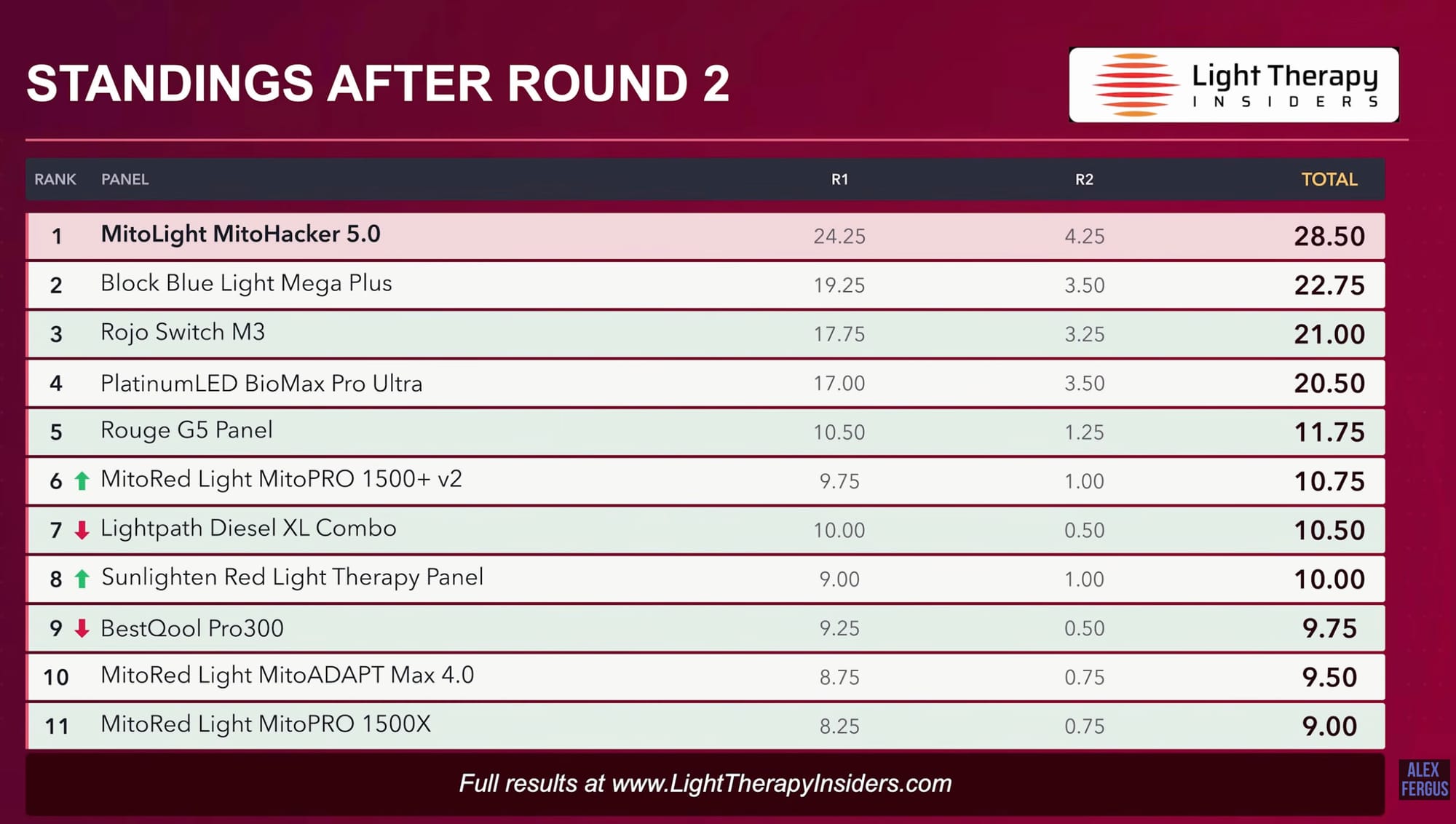
With coverage and average irradiance testing complete, the Mito Light MitoHacker 5.0 has taken first place in both rounds, building an early lead with 28.5 points. Block Blue Light MEGA-PLUS follows in second place with 22.75 points, while the Rojo Switch M3 sits third with 21 points.
Round 3: Uniformity — How Evenly Is the Light Distributed?
A powerful red light therapy panel isn't necessarily effective if most of its energy is concentrated in one area. That's why uniformity matters. For this round, I measured how evenly the light was distributed across a 24 × 30-inch treatment area at a distance of 12 inches.
The results were quite revealing. Most panels achieved uniformity scores in the 40% range, with two falling below 40%. The BioMax Pro Ultra performed reasonably well at 47.41%, but the Block Blue Light MEGA-PLUS pulled ahead with 52.61%.
Once again, though, the Mito Light MitoHacker 5.0 dominated with 68.05% uniformity, delivering a substantially more even spread of light than its competitors. Combined with its impressive coverage and irradiance results, it's becoming clear that this panel is in a league of its own when it comes to measured performance.
With 10 points available in this round, the MitoHacker continues to extend its lead after three consecutive wins.
Round 3 Results: Uniformity
Round 3 Winner: Mito Light MitoHacker 5.0 — 68.05% Uniformity (6 Points)
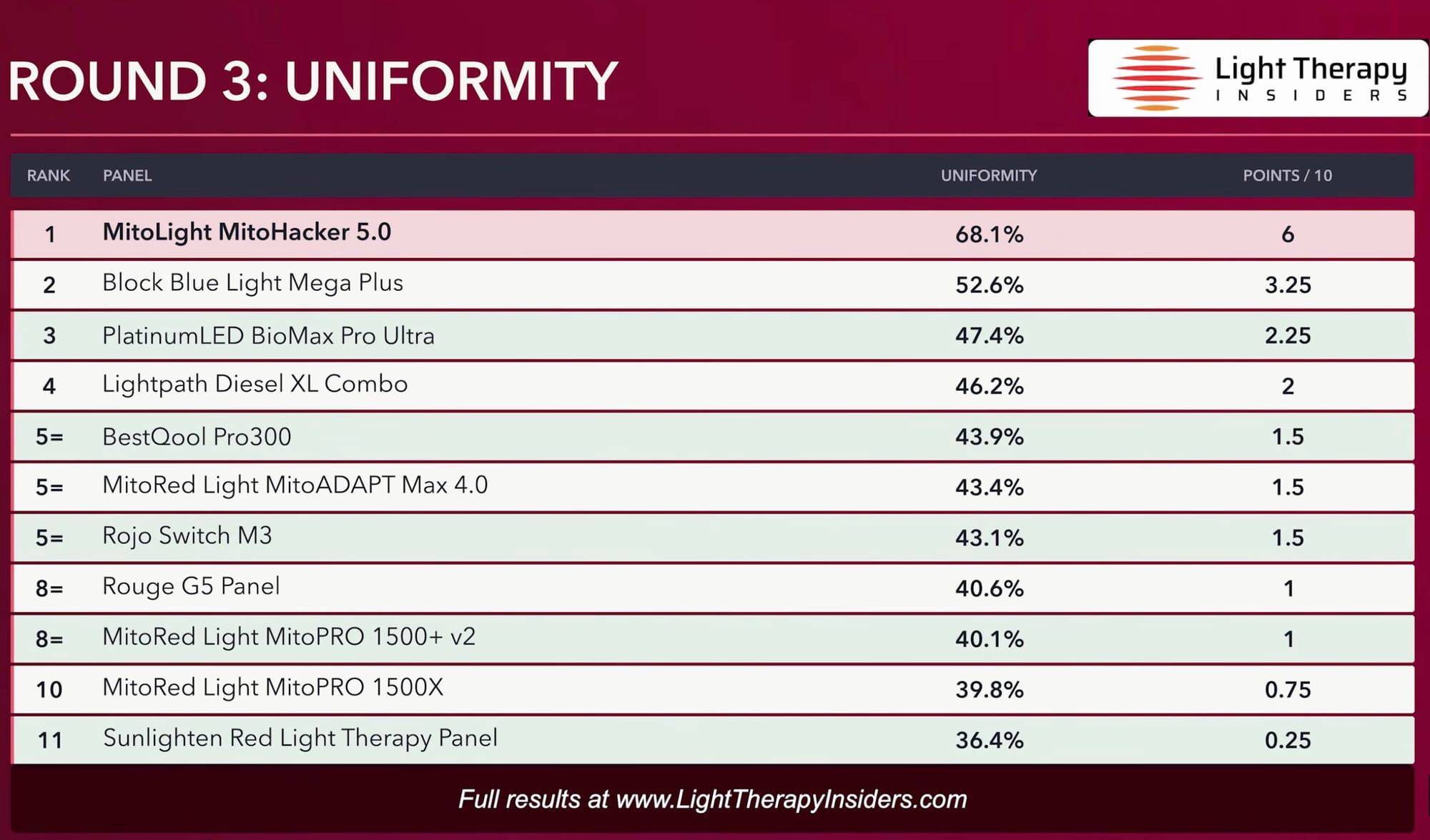
The Block Blue Light MEGA-PLUS finishes second with 52.61% (3.25 points), followed by the BioMax Pro Ultra at 47.41% (2.25 points).
Overall Standings After Round 3: MitoHacker Extends Its Lead
After three rounds, the MitoHacker 5.0 is pulling away from the competition with 34.5 points, putting it 8.5 points ahead of the Block Blue Light MEGA-PLUS in second place.
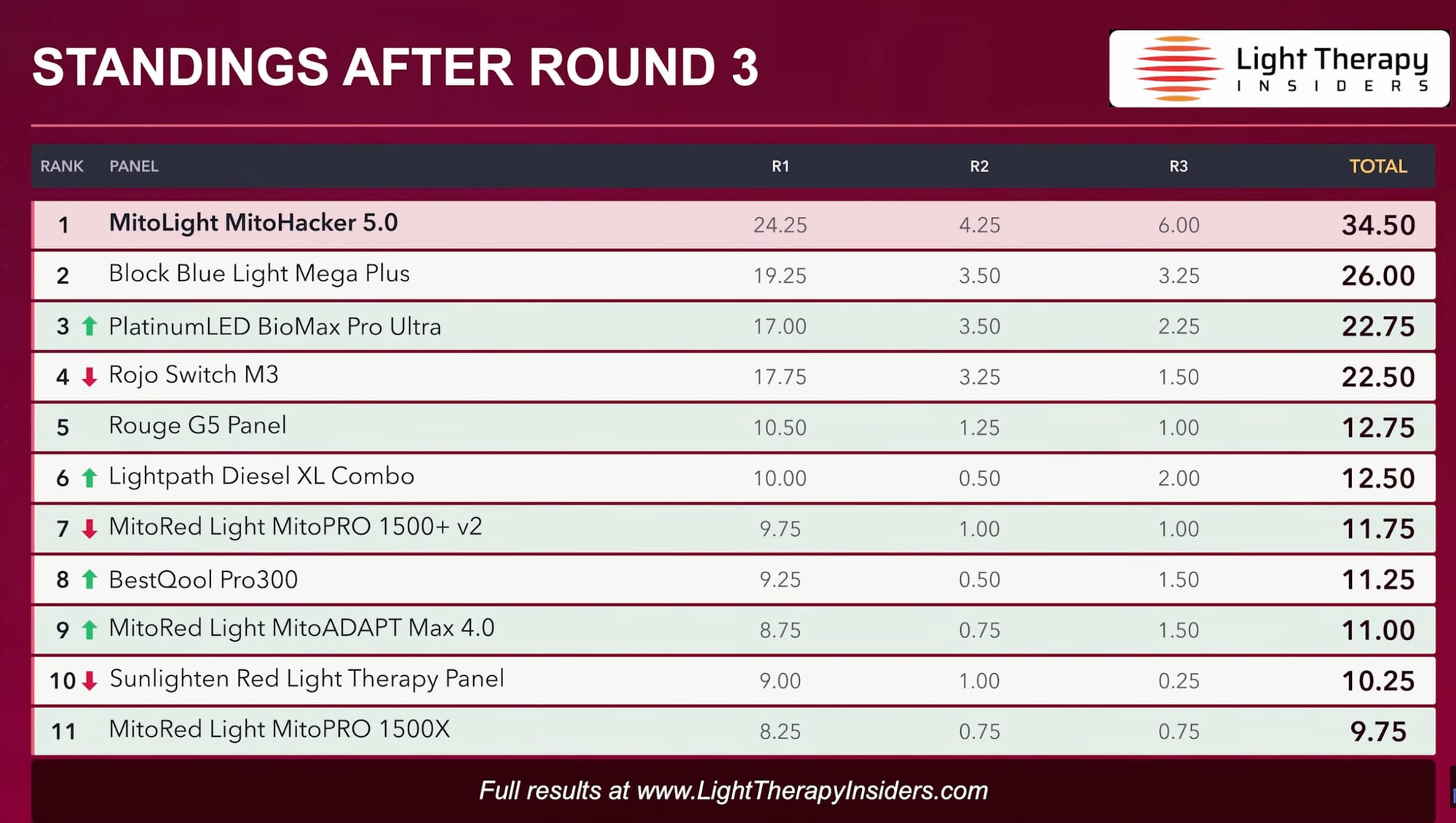
The Mito Light MitoHacker 5.0 has now won all three performance categories, but with six rounds remaining, the overall winner is far from decided.
Round 4: Optical Stability — Does Light Output Drop Over Time?
Optical stability is a new addition to my testing this year. LED performance can change as a panel heats up, meaning the light intensity at the beginning of a session may differ from what you're getting 20 minutes later.
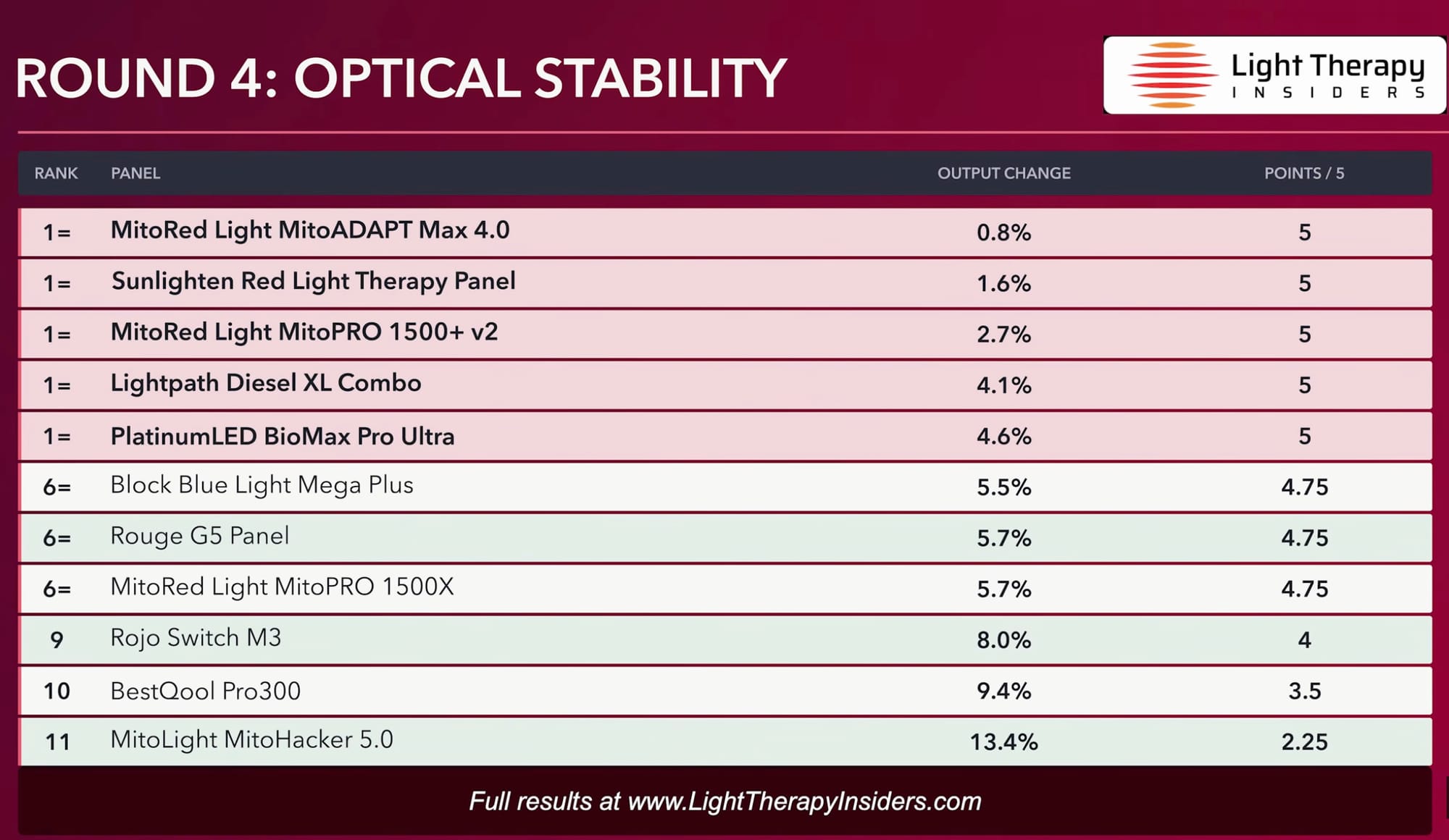
To measure this, I had Mike from Light Lab test all 11 panels over a 20-minute period, comparing their initial output with their output at the end. The smaller the percentage change, the better the optical stability.
The results were better than I expected. Five panels earned the maximum five points, with the MitoRed Light MitoADAPT Max 4.0 showing the smallest change at just 0.8%. The Sunlighten panel followed at 1.6%, while the MitoPRO 1500+ v2, Lightpath Diesel XL Combo, and BioMax Pro Ultra also demonstrated excellent stability.
The biggest surprise was the Mito Light MitoHacker 5.0. After dominating the first three rounds, it finished last with a 13.4% change in output. That's not a disastrous result, but it's noticeably higher than the competition and earns it just 2.25 out of five points.
Overall, most panels maintained relatively stable output throughout the 20-minute test, which is encouraging.
Round 4 Winner: MitoRed Light MitoADAPT Max 4.0 — 0.8% Output Change (5 Points)
Overall Standings After Round 4: MITOHacker Holds Its Lead
After four rounds, the top four remain unchanged. The MitoHacker 5.0 continues to lead, followed by the Block Blue Light MEGA-PLUS in second, BioMax Pro Ultra in third, and Rojo Switch M3 in fourth.
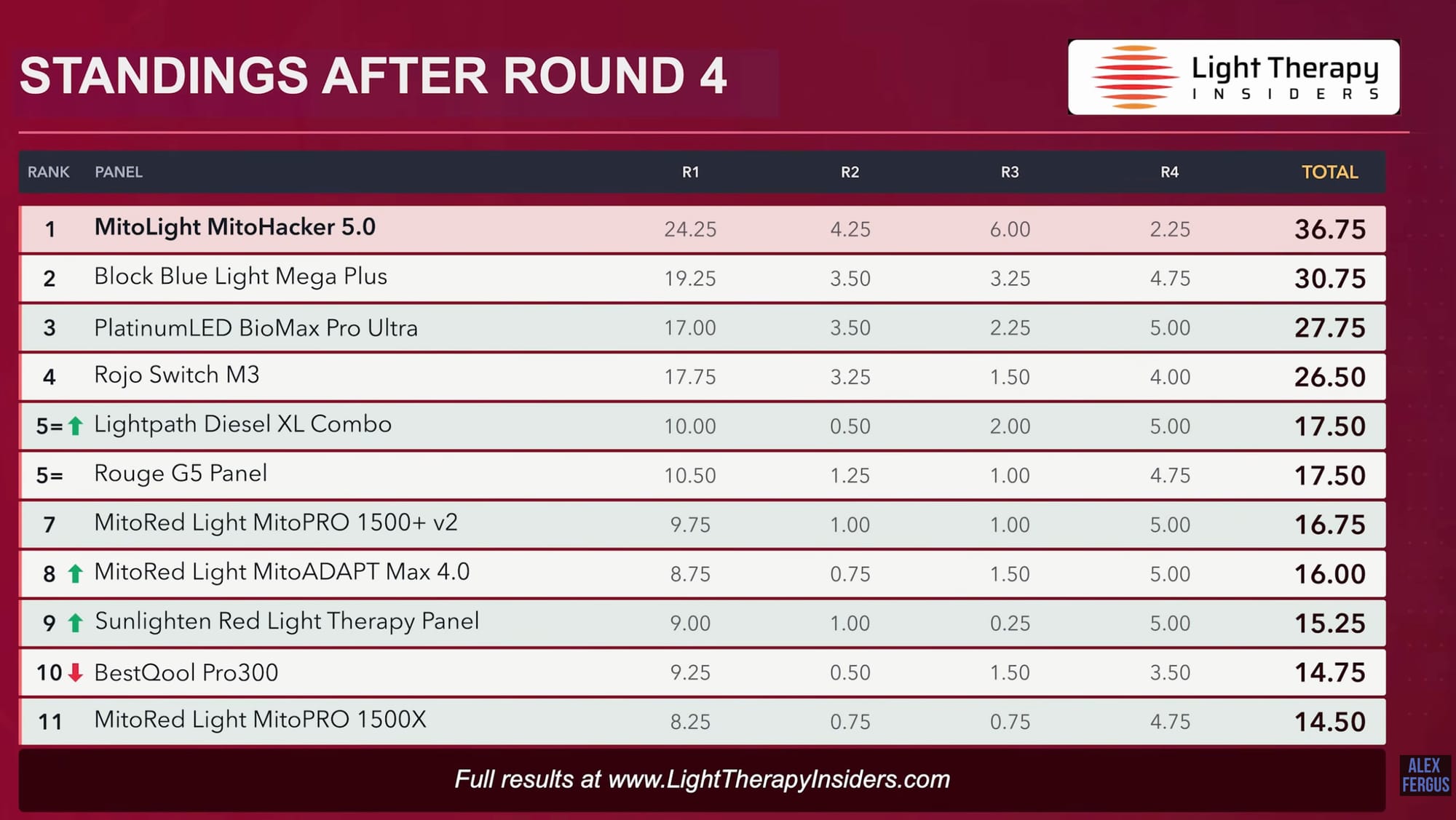
The Mito Light MitoHacker's lead has narrowed to six points following its last-place finish in optical stability, but it remains the clear overall leader as we head into Round 5.
Round 5: Wavelengths — More Isn't Always Better
This year's wavelength testing is quite different from my previous comparisons. In the past, I awarded more points to panels offering more wavelengths. But after reviewing the latest research and independent laboratory results, I've changed my approach.
The reality is that a good combination of red and near-infrared light is more important than simply having lots of wavelengths. While additional wavelengths may offer benefits, the scientific evidence isn't equally strong for all of them. More importantly, some panels emit such small amounts of energy at certain wavelengths that their practical value is questionable.
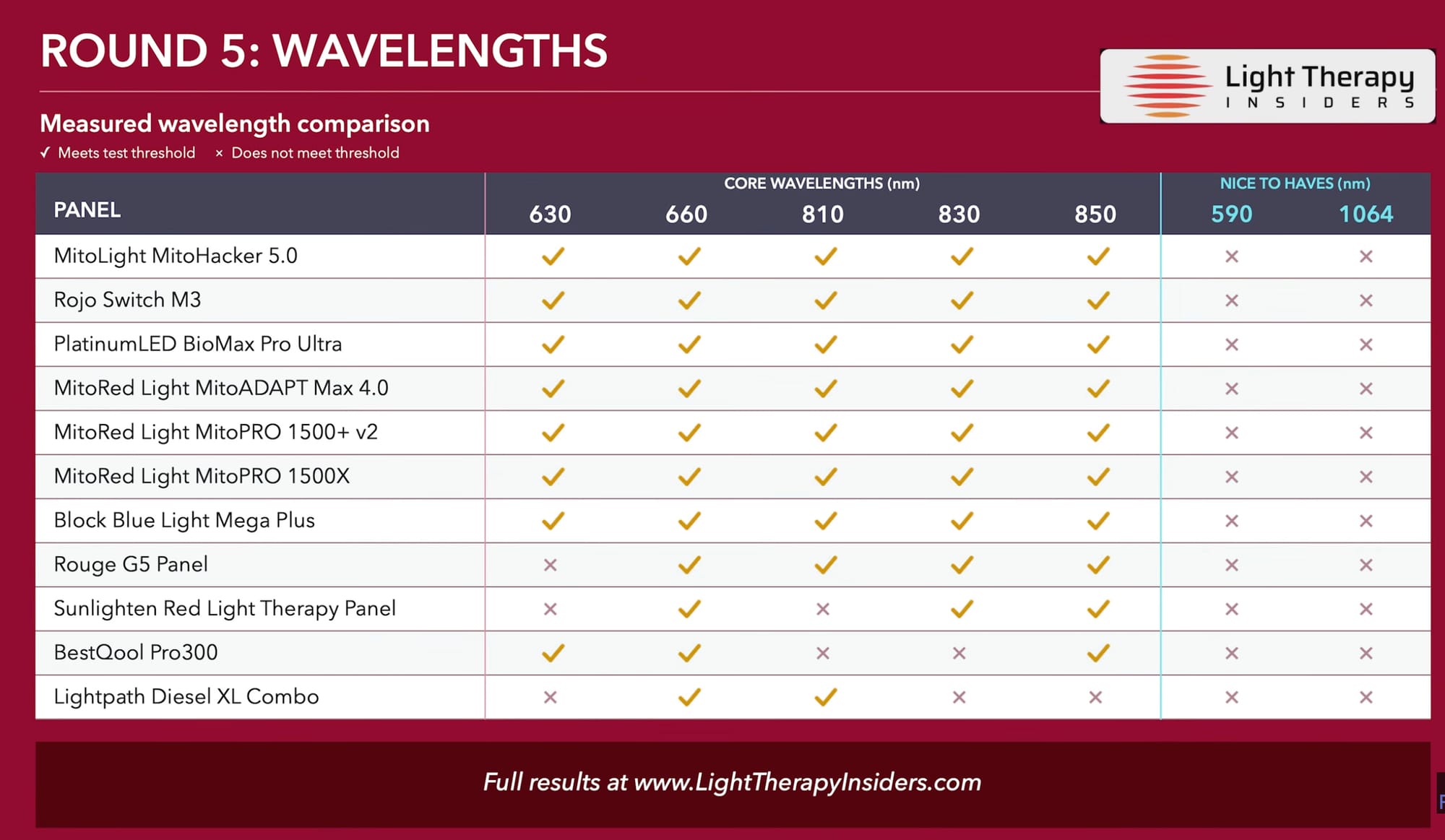
That's why I've introduced a new requirement: each wavelength must deliver at least 0.5 watts of optical power to count toward the score. Simply detecting a wavelength on a spectrometer isn't enough.
I awarded points for five core wavelengths: 630, 660, 810, 830, and 850 nm, with two optional wavelengths, 590 nm amber and 1064 nm near-infrared, worth half a point each.
The Results: Some Surprising Findings
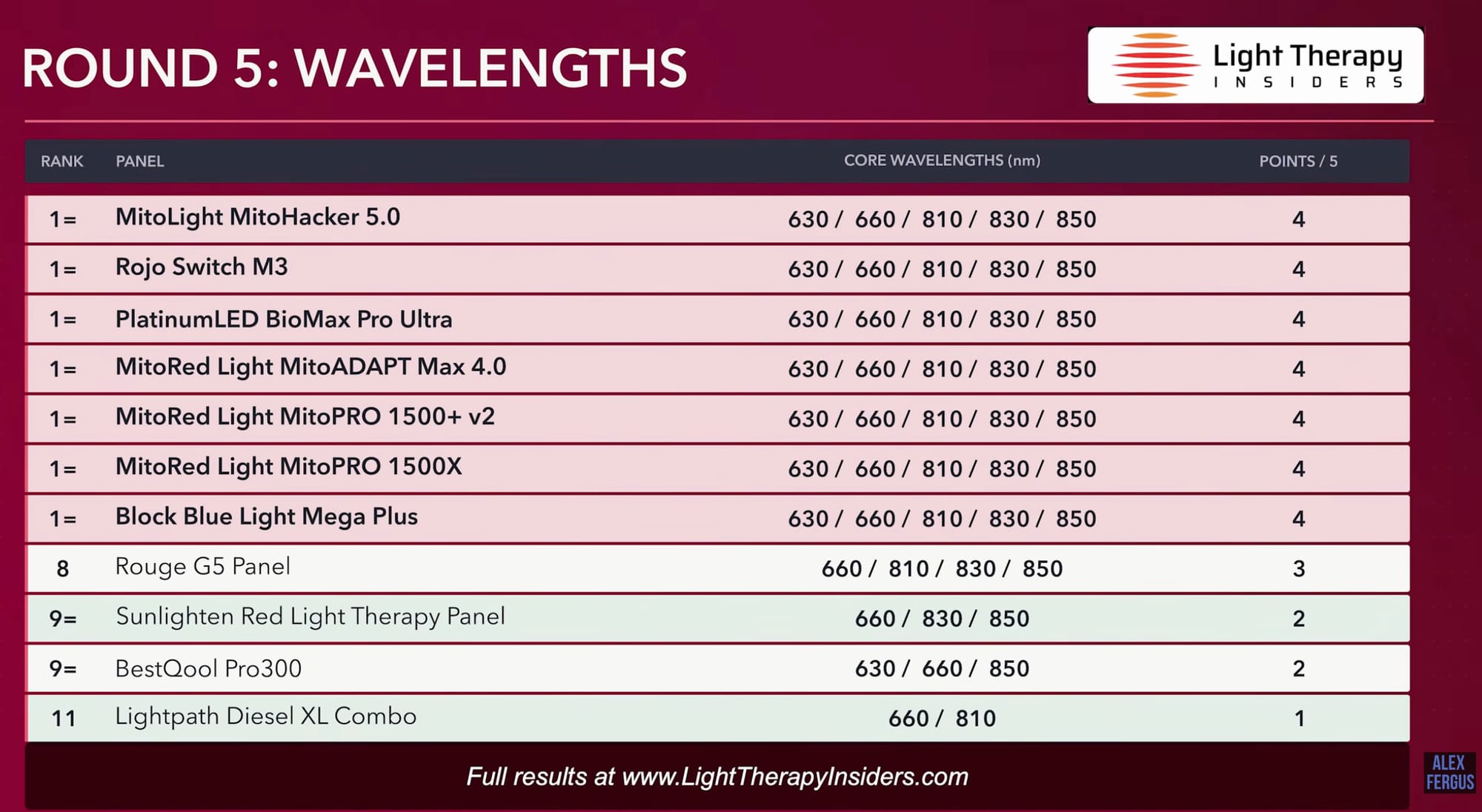
Not a single panel met the minimum power threshold for 590 nm or 1064 nm, despite some manufacturers advertising these wavelengths. However, many performed well across the core wavelengths, with seven panels scoring four out of five points.
The Lightpath Diesel XL Combo finished last, while the Rouge G5 placed eighth despite offering numerous wavelengths. In both cases, the issue was insufficient output at the wavelengths being evaluated. The Lightpath and Mito Red Light panels also emitted 950 nm light, but I didn't award points for this wavelength because I don't consider the evidence for its benefits compelling enough.
This round highlights an important lesson: the number of advertised wavelengths matters far less than how much useful light a panel actually delivers at each wavelength.
Overall Standings After Round 5: Changes in the Middle of the Pack
After five rounds, the Mito Light MitoHacker 5.0 remains firmly in first place, followed by Block Blue Light MEGA-PLUS, BioMax Pro Ultra, and Rojo Switch M3. The top four positions remain unchanged.
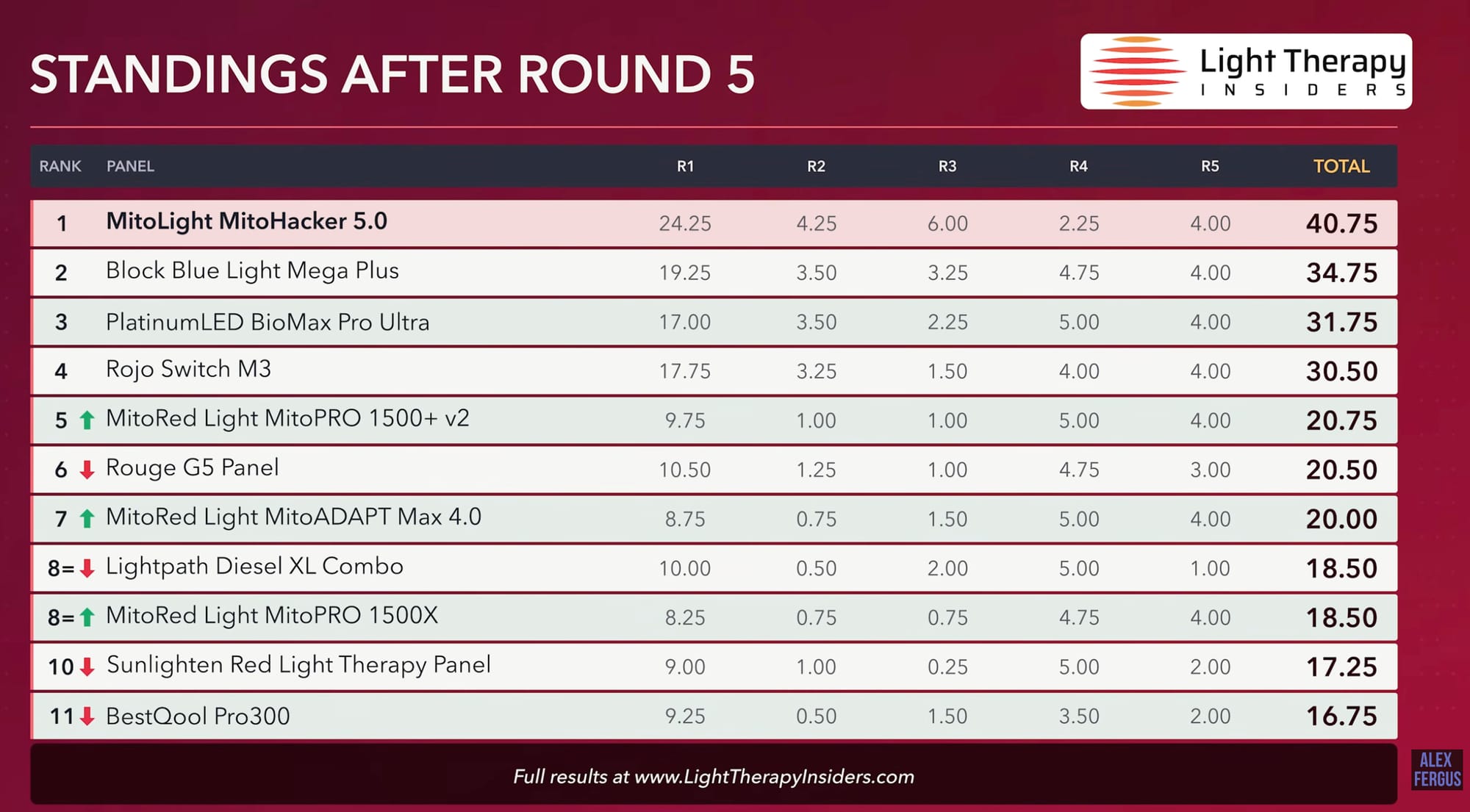
With four rounds remaining, the MitoHacker continues to lead, but the competition is far from over.
Round 6: Red vs. Near-Infrared Balance — Finding the Right Mix
The final round of performance testing looks at the balance between red and near-infrared light. Ideally, I want a panel that delivers a relatively even 50/50 split. While some panels allow you to adjust this using dimmers or smart modes, I believe a well-designed panel should provide a good balance straight out of the box.
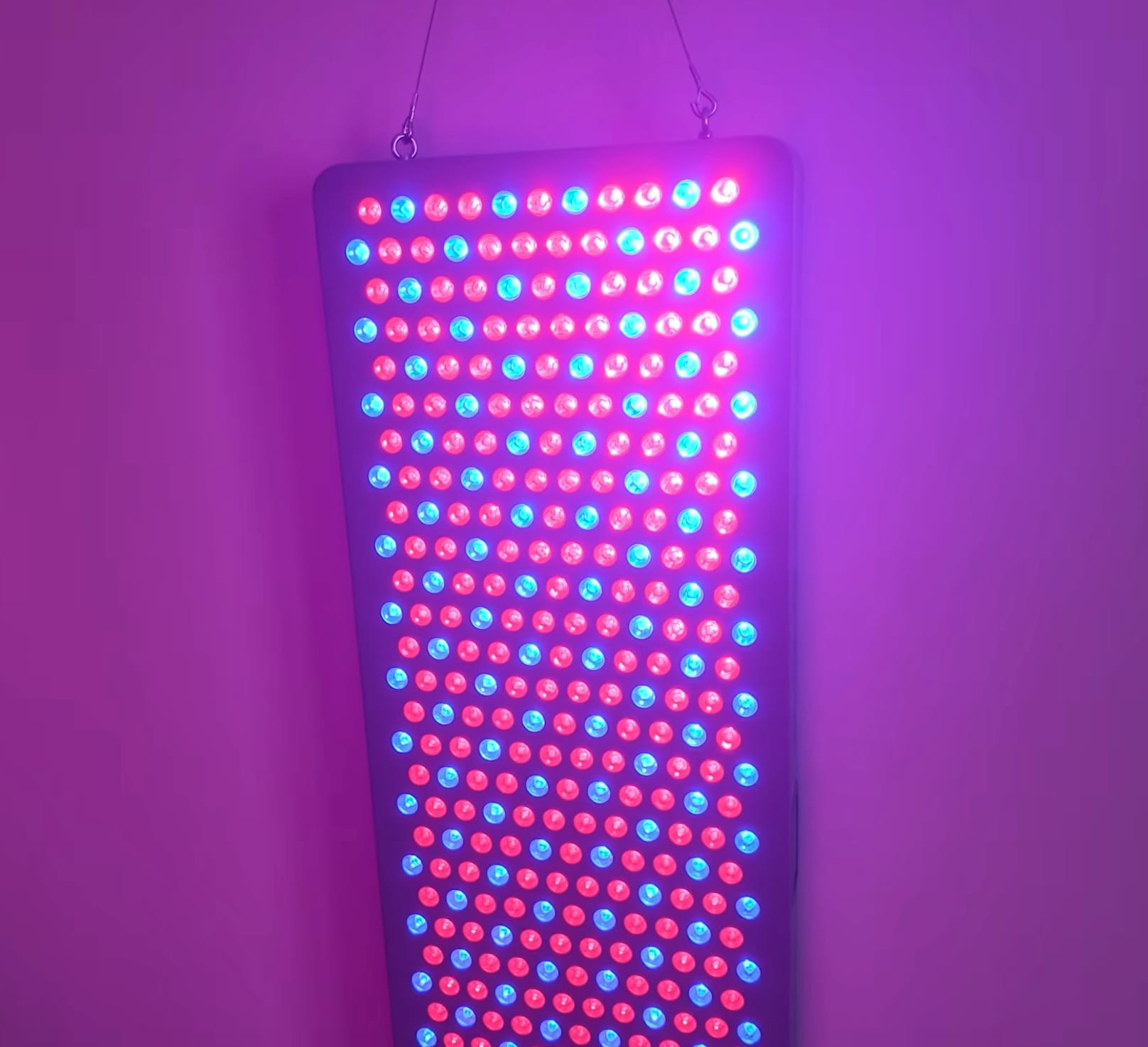
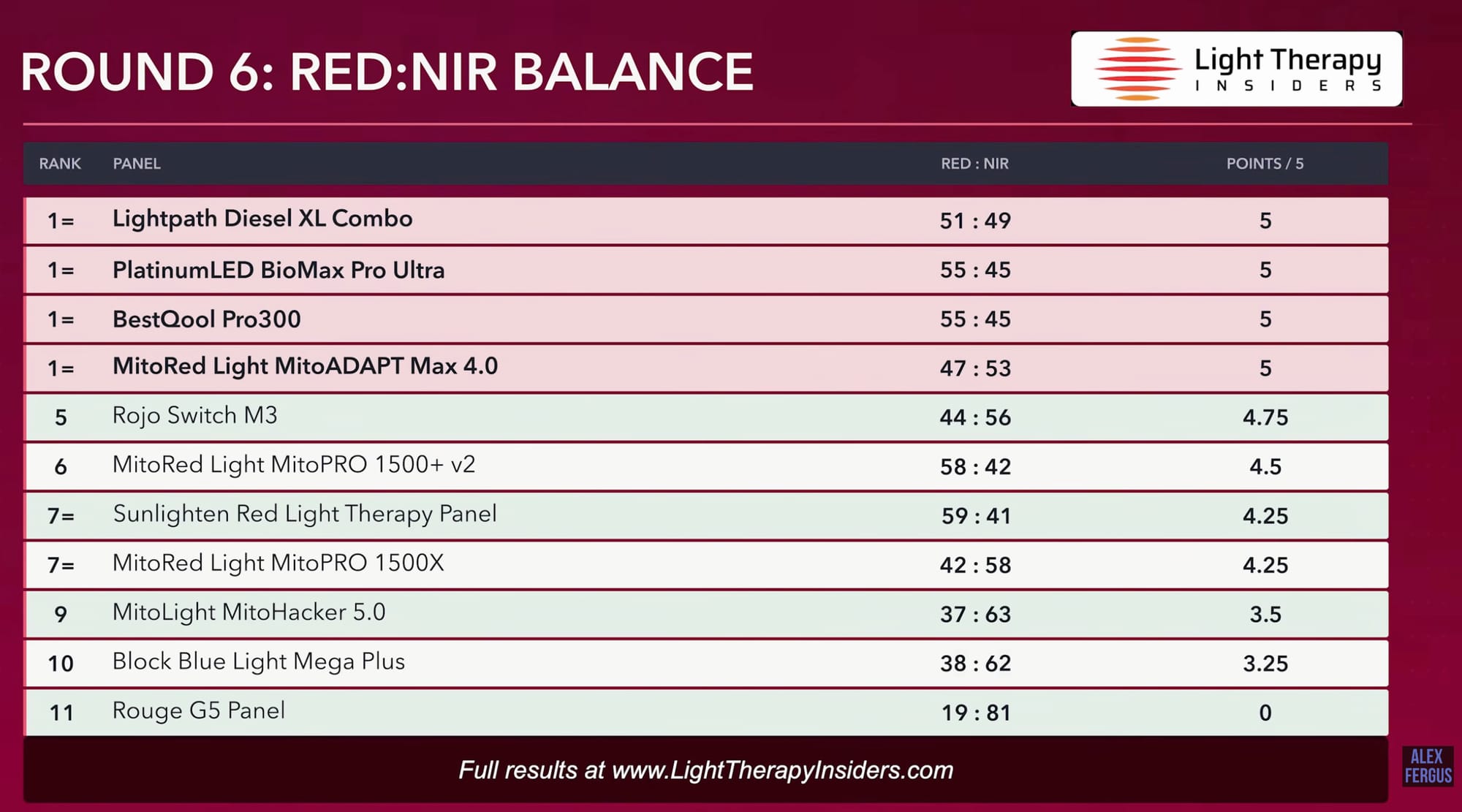
The results revealed some surprising differences. The Rouge G5 finished last with a 19.3% red to 80.7% near-infrared split, earning zero out of five points. Interestingly, the MitoHacker 5.0 and Block Blue Light MEGA-PLUS also favored near-infrared light, with red light accounting for just 37.1% and 36.8% of their output, respectively.
Four panels stood out for their excellent balance: the Lightpath Diesel XL Combo (51:49), BioMax Pro Ultra (54.7:45.3), BestQool Pro300 (54.9:45.1), and MitoRed Light MitoADAPT Max 4.0 (47.1:52.9). All four earned the maximum five points.
Round 6 Winners: Four Panels Tied — 5 Points Each
Overall Standings After Round 6: MitoHacker Wins the Performance Battle
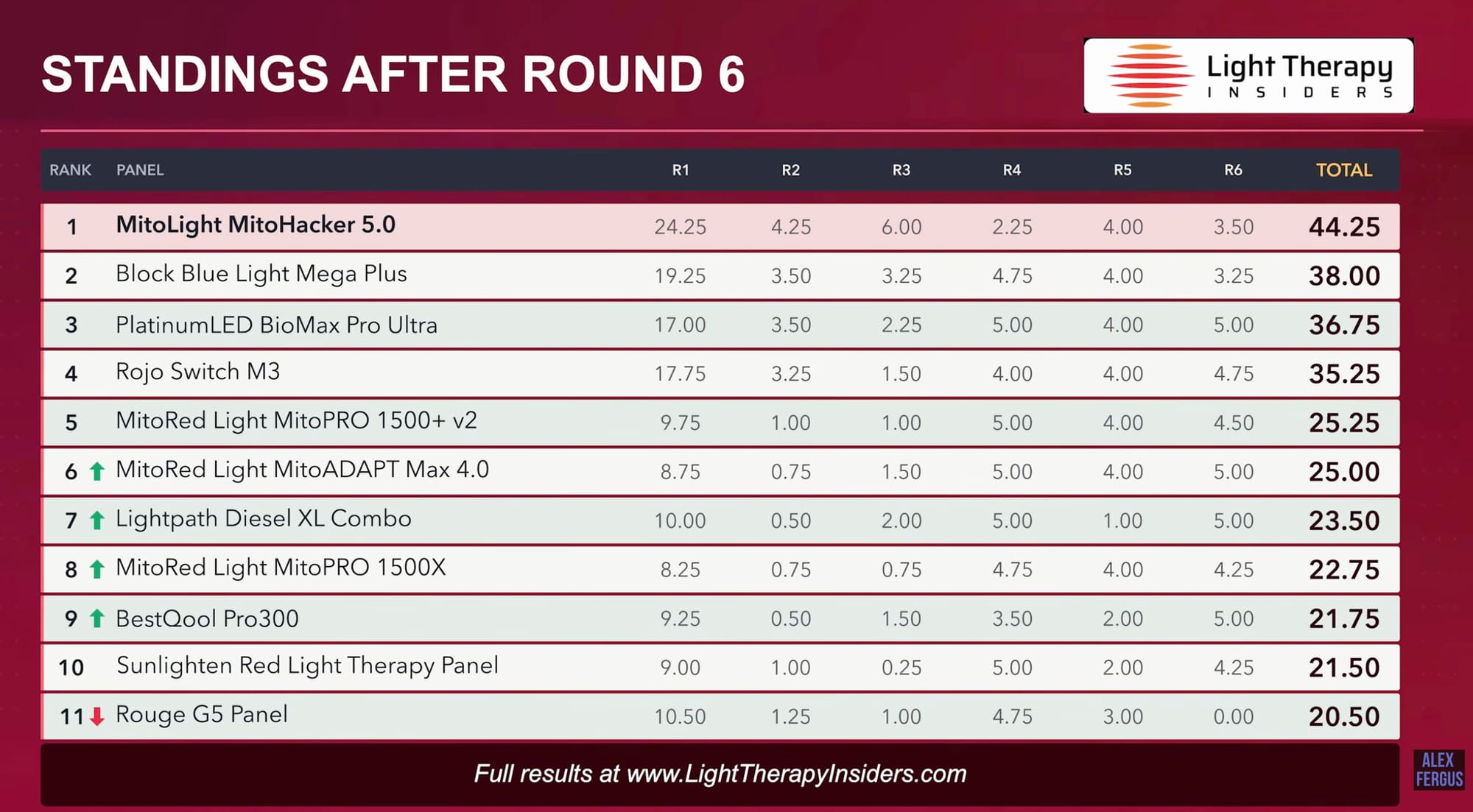
With all six performance rounds complete, the MitoHacker 5.0 takes first place with 44.25 points, maintaining a 6.25-point lead over Block Blue Light MEGA-PLUS. The BioMax Pro Ultra holds third, followed closely by the Rojo Switch M3.
But performance is only part of the equation. We still need to consider usability, ownership experience, and price before determining which panel is the best overall.
Round 7: Ease of Use — Features, Controls, and Practicality
A red light therapy panel can deliver outstanding performance, but if it's complicated or frustrating to use, does that really make it a great panel?
Red light therapy devices have changed dramatically over the years. Early models were simple, often featuring nothing more than an on/off switch. Today, we're seeing panels with adjustable intensity, pulsing, independent wavelength controls, smartphone apps, dosing calculators, and customizable treatment zones. While these features can be useful, more technology doesn't necessarily mean a better experience.
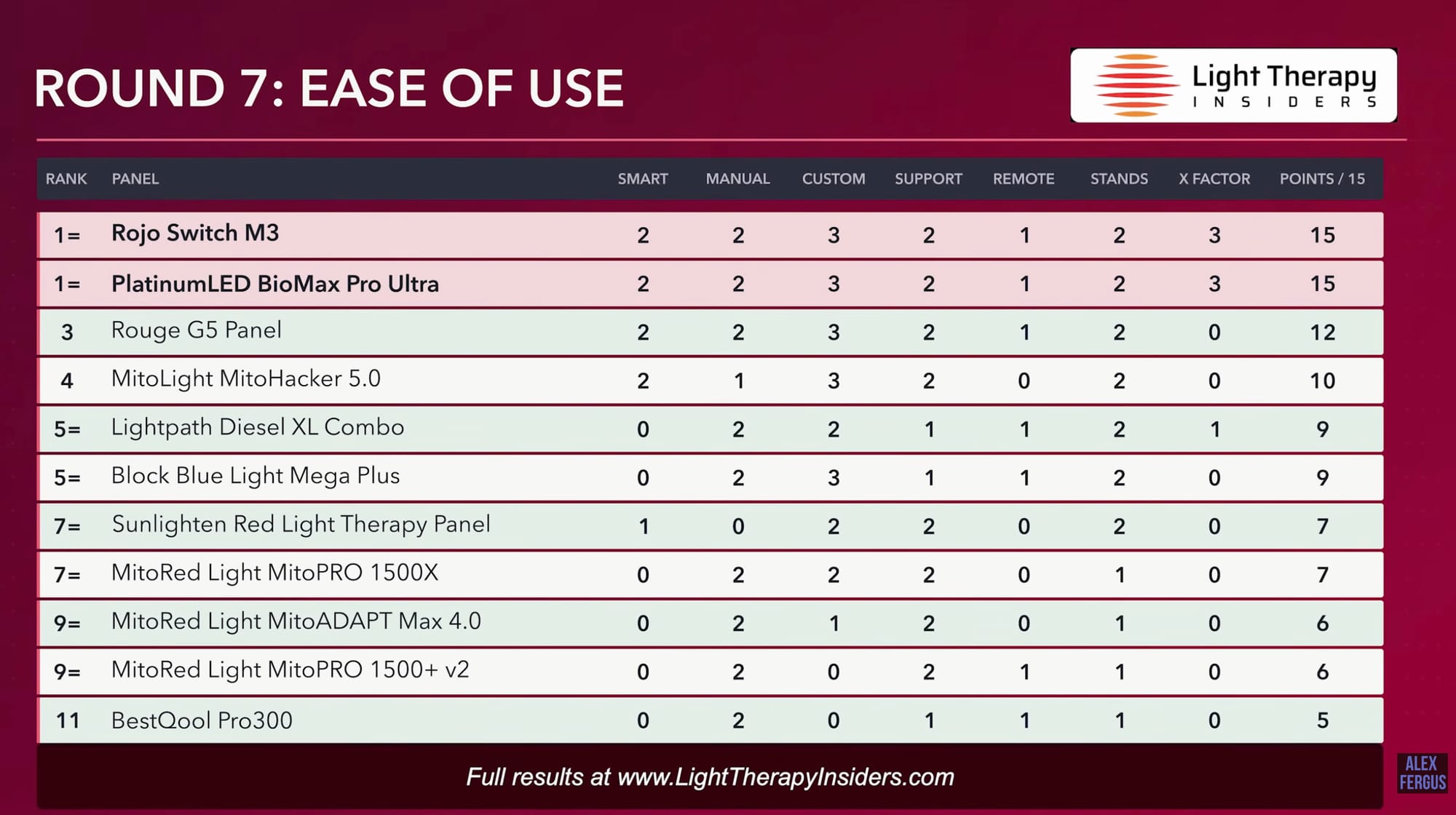
For this round, I evaluated each panel across several categories, including smart treatment modes, manual controls, customization, remote access, customer support, stands, and unique features.
Smart modes earned points for offering preset treatments such as recovery, skin health, or deep tissue therapy. I also looked at how easily users could adjust intensity and wavelengths, whether companies offered phone or live chat support, and the availability of stands for different treatment positions. After all, these are large, expensive devices, and being able to position them comfortably or get help when needed makes a real difference.
The X-Factor: Three Panels That Stand Out
Three panels earned bonus points for offering something genuinely different.
The Lightpath Diesel XL Combo earned one bonus point for incorporating blue light alongside red and near-infrared. While I don't personally consider blue light essential for most users, it does provide another treatment option.
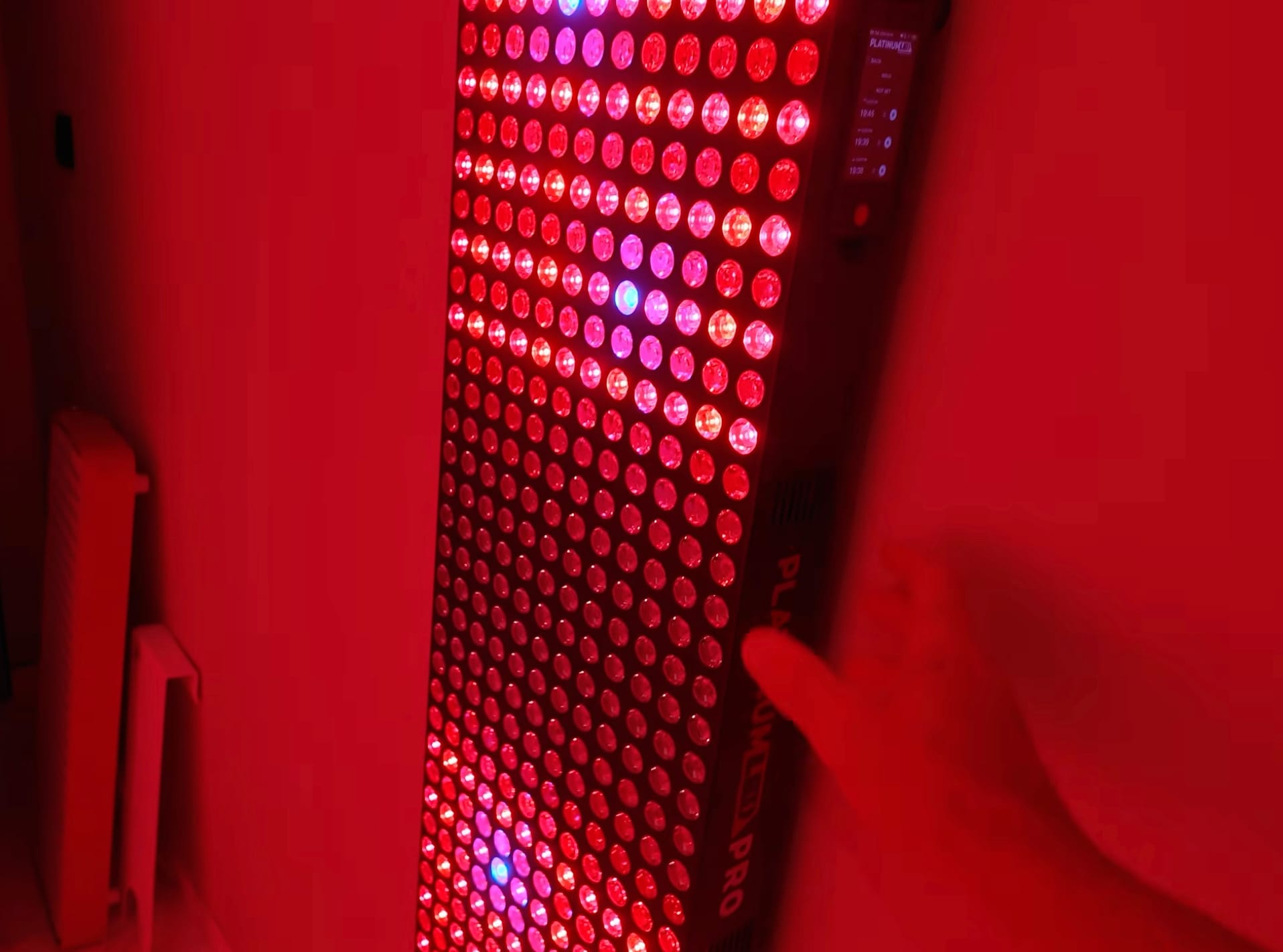
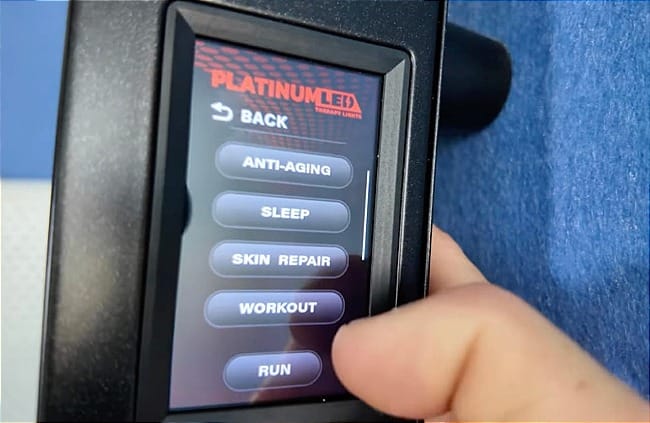
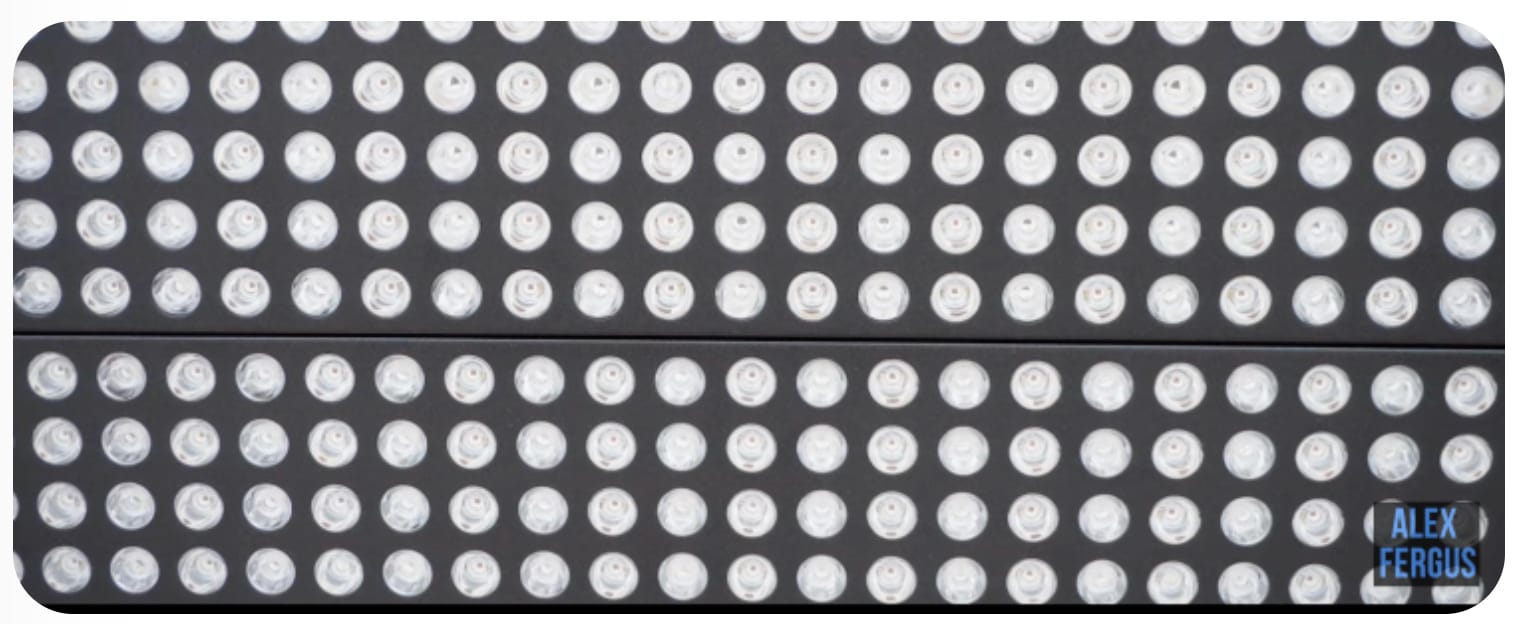
The BioMax Pro Ultra earned three bonus points for its edge-to-edge LED design, which reduces gaps when combining panels, and independent zone controls that allow you to adjust the top, middle, and bottom sections separately. This is particularly useful for avoiding excessive light exposure to the face. It also features a removable remote that can be used independently or attached to the panel.
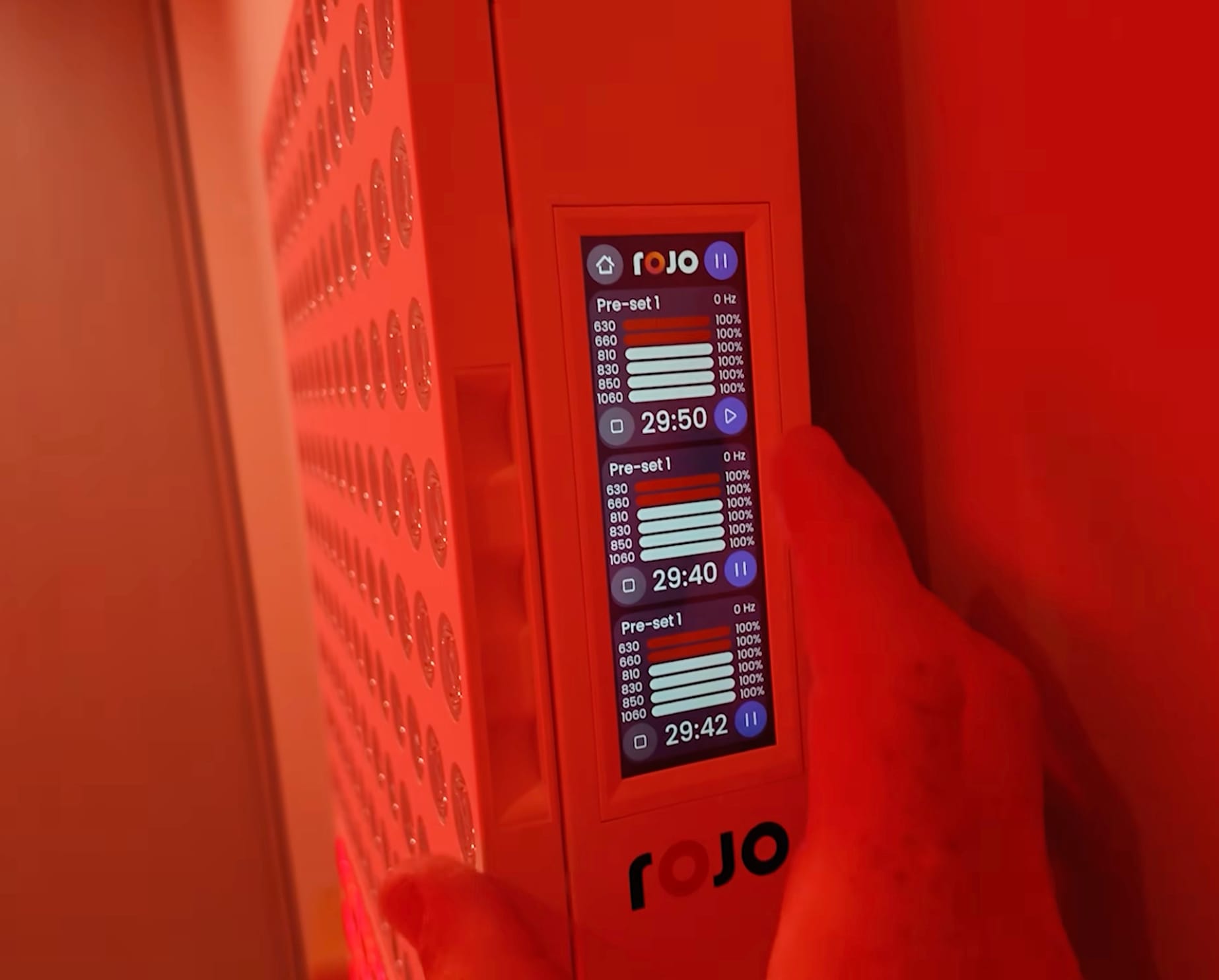
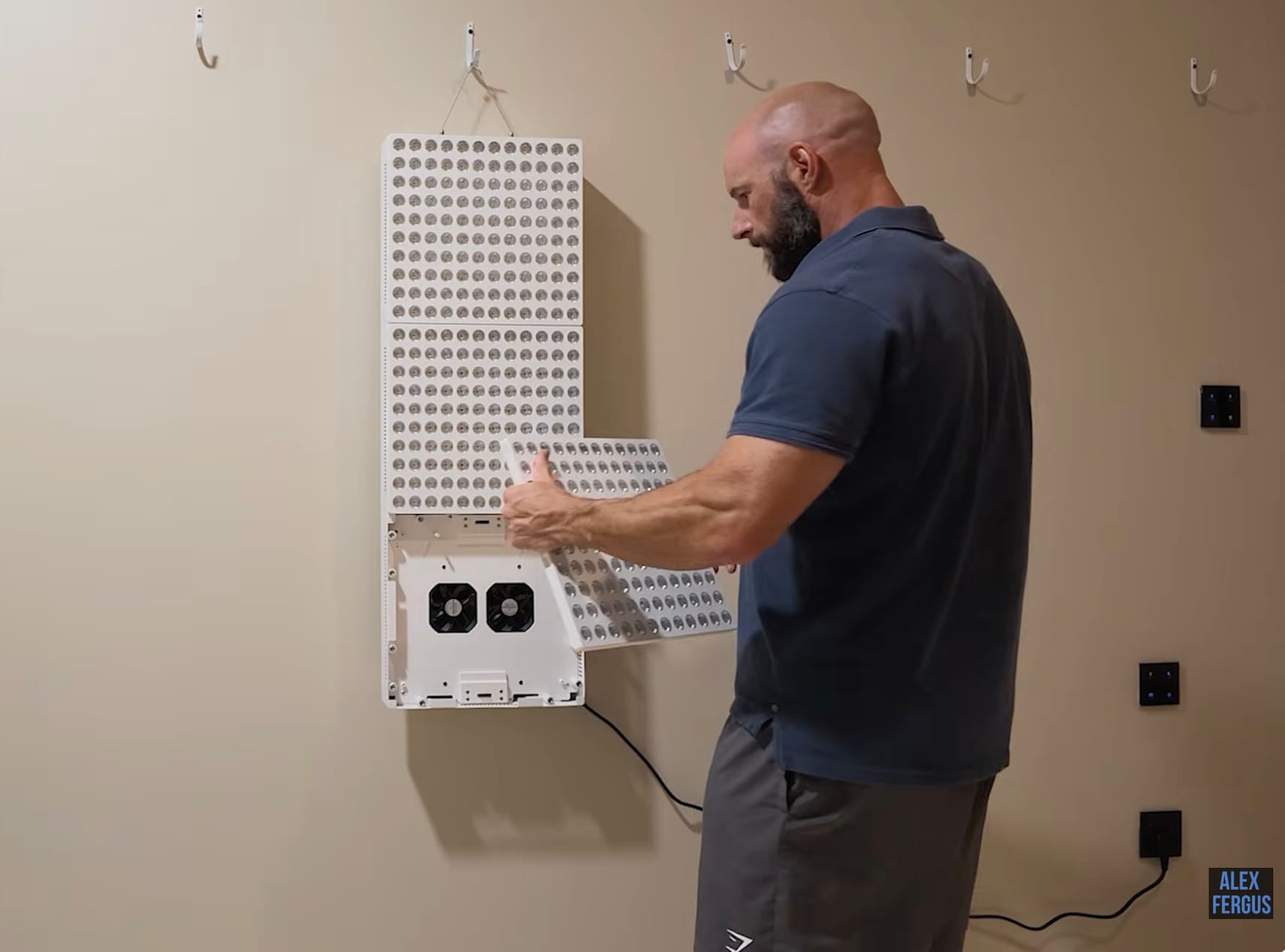
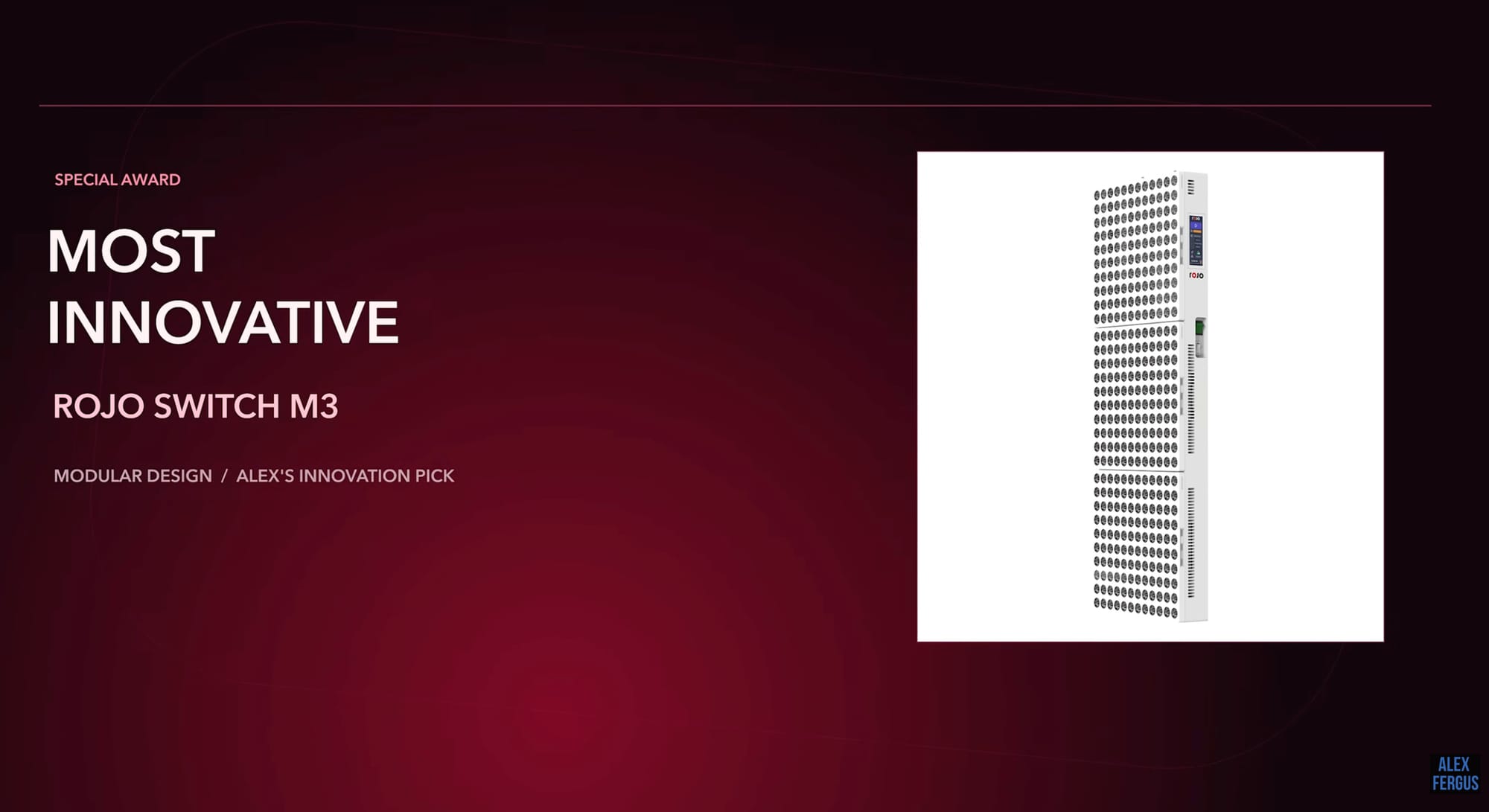
The Rojo Switch M3 also earned three bonus points for its innovative modular LED design. You can swap out sections to customize wavelengths for different applications, including acne, skin health, and deep tissue treatments. I tested the standard universal configuration for this comparison, but the flexibility is impressive. It also offers independent zone control, an advanced touchscreen with joule calculations based on intensity and treatment time, and optional wraparound configurations.
Round 7 Results: Rojo and BioMax Share First Place
The Rojo Switch M3 and BioMax Pro Ultra tied for first with perfect scores of 15 out of 15 points, combining extensive customization with innovative, practical features.
The Rouge G5 followed with 12 points, while the MitoHacker 5.0 earned 10. Lightpath Diesel XL Combo and Block Blue Light MEGA-PLUS tied at nine points, followed by the MitoRed Light panels with six or seven points each. The budget-friendly BestQool Pro300 finished last with five points.
This round highlights why performance alone doesn't tell the whole story. A panel that's easy to operate, flexible, and well-supported can make a significant difference in the overall ownership experience.
Round 7 Winners: Rojo Switch M3 and BioMax Pro Ultra — 15/15 Points Each
Overall Standings After Round 7: BioMax Closes the Gap
Round 7 has shaken up the leaderboard! The MitoHacker 5.0 still leads with 54.25 points, but the BioMax Pro Ultra has climbed into second with 51.75 points, narrowing the gap to just 2.5 points. The Rojo Switch M3 moves into third, while Block Blue Light MEGA-PLUS drops from second to fourth.
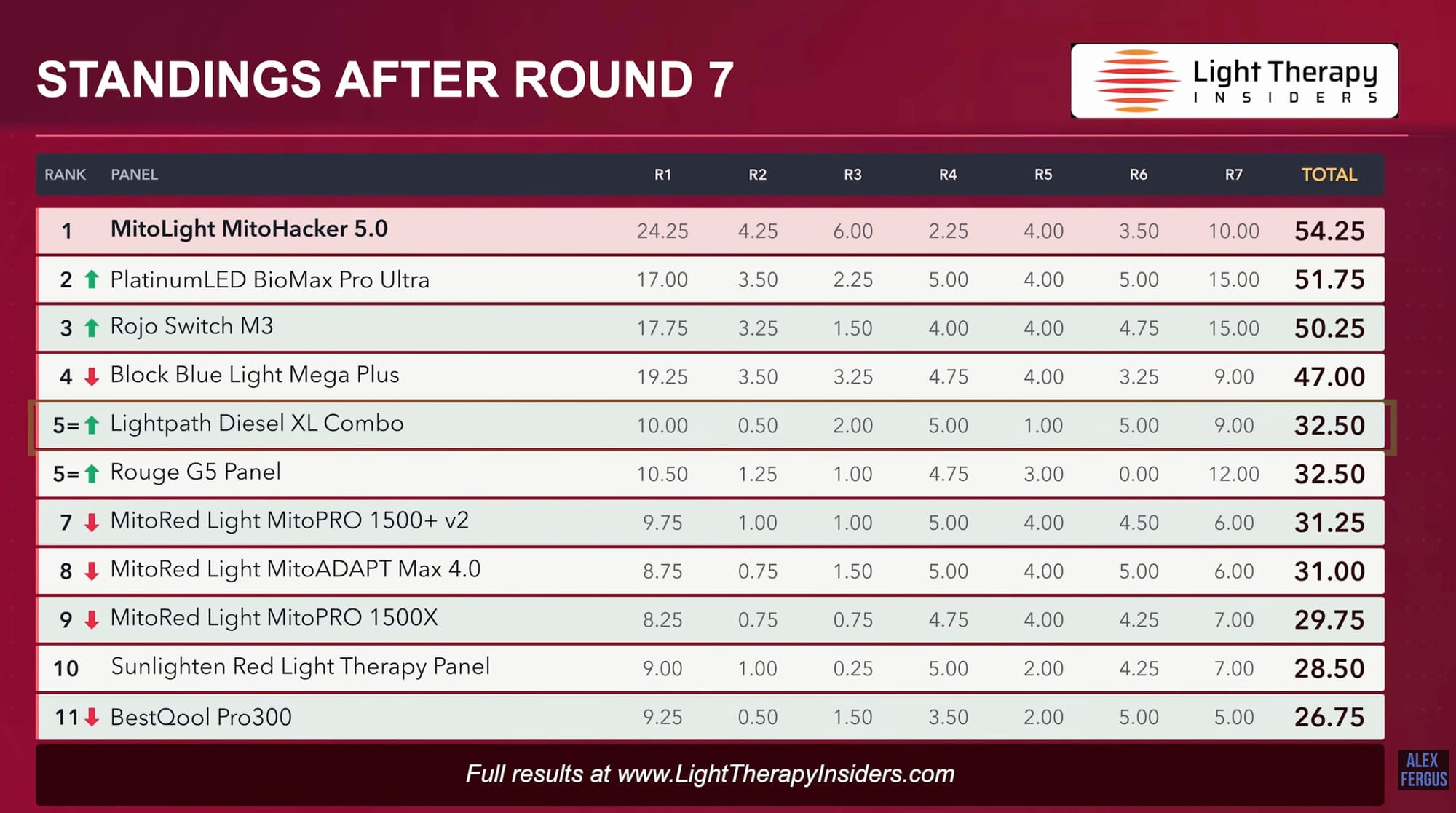
With only two rounds remaining, the competition is much closer than it was after performance testing. The MitoHacker may have the strongest laboratory results, but the BioMax and Rojo are proving that features and usability can make a significant difference when choosing the best red light therapy panel.
Round 8: Extras — Warranty, Support, and Long-Term Ownership
A great red light therapy panel isn't just about performance and features. It's also about what happens after you buy it. For Round 8, worth 10% of the overall score, I looked at several factors that can make a difference to long-term ownership.
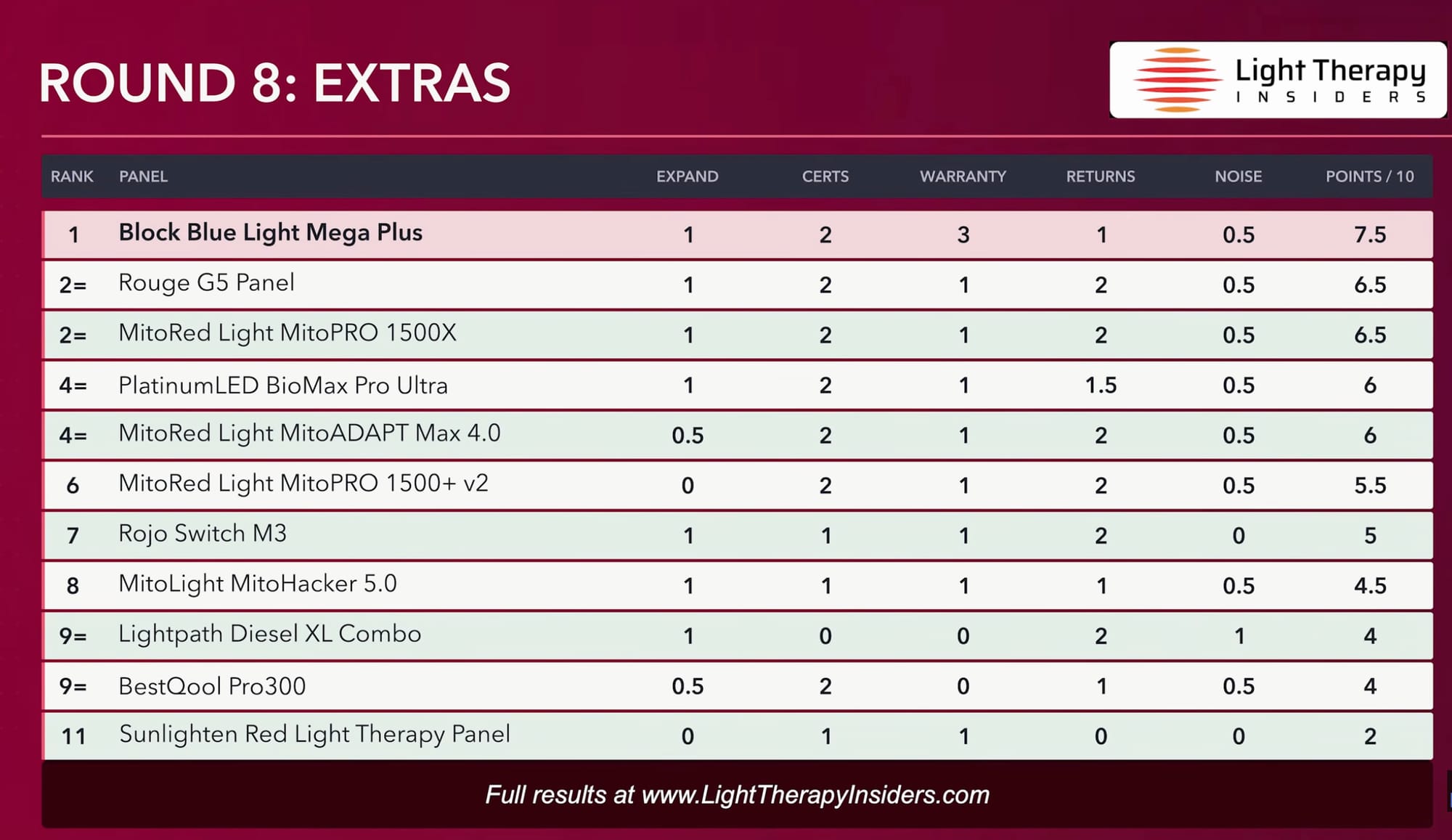
These included expansion options, such as connecting additional panels to build a larger treatment array, along with certifications and compliance, warranty coverage, return policies, and operating noise. After all, even a powerful panel can become frustrating if it's excessively loud or comes with limited protection.
Round 8 Results: Block Blue Light Takes First Place
The Block Blue Light MEGA-PLUS finished first with 7.5 out of 10 points, largely thanks to its impressive five-year warranty, which stood out from the competition.
The Rouge G5 and MitoRed Light MitoPRO 1500X tied for second with 6.5 points each. The BioMax Pro Ultra and MitoADAPT Max 4.0 followed with six points, while most other panels scored between four and 5.5 points.
At the bottom was the Sunlighten Red Light Therapy Panel, earning just two points due to its limited extras and ownership features.
Overall Standings After Round 8: Just One Point Separates the Leaders
With eight rounds complete, the competition is tighter than ever. The Mito Light MitoHacker 5.0 remains in first place with 58.75 points, but the BioMax Pro Ultra is now just one point behind at 57.75. The Rojo Switch M3 holds third with 55.25 points, followed closely by Block Blue Light MEGA-PLUS at 54.5.
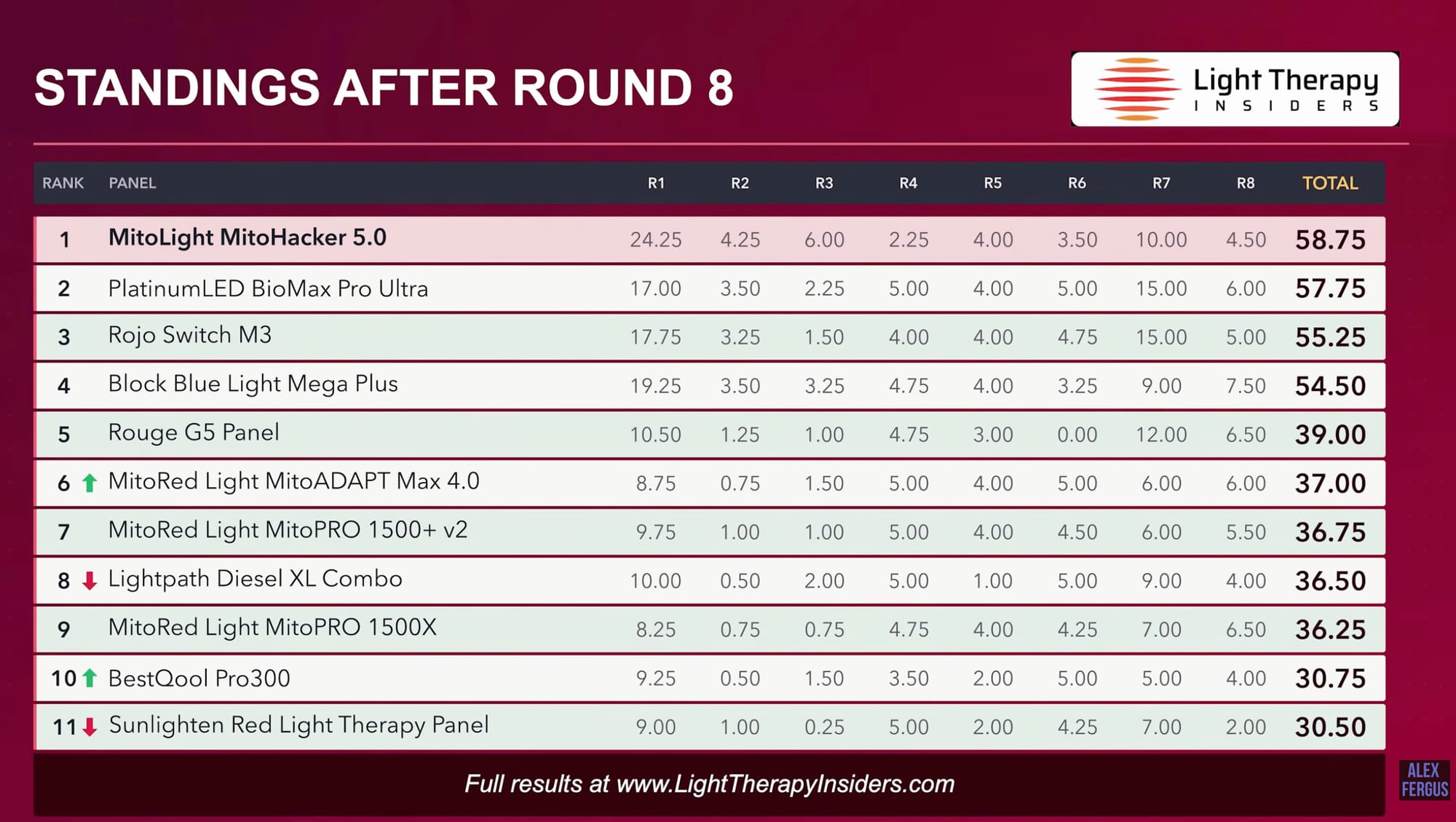
What's particularly interesting is how close the top four panels have become. I established the scoring system and category weightings before entering the test results, so I didn't know how the final rankings would unfold.
Now, with just one round remaining and another 10 points available, the overall winner is far from decided. Performance gave the MitoHacker an early advantage, but the BioMax, Rojo, and Block Blue Light panels have steadily closed the gap.
Round 9: Price — Which Red Light Therapy Panel Offers the Best Value?
For the final round, we're looking at price, which accounts for 10% of the overall score. After testing performance, features, and usability, it's time to see how much these panels actually cost.
Rather than using retail prices, I've calculated the discounted price using available codes and links, including shipping and applicable taxes. To keep the comparison consistent, I used a delivery address in Austin, Texas, for all 11 panels. Prices may vary depending on your location.
Round 9 Results: BestQool Takes First Place
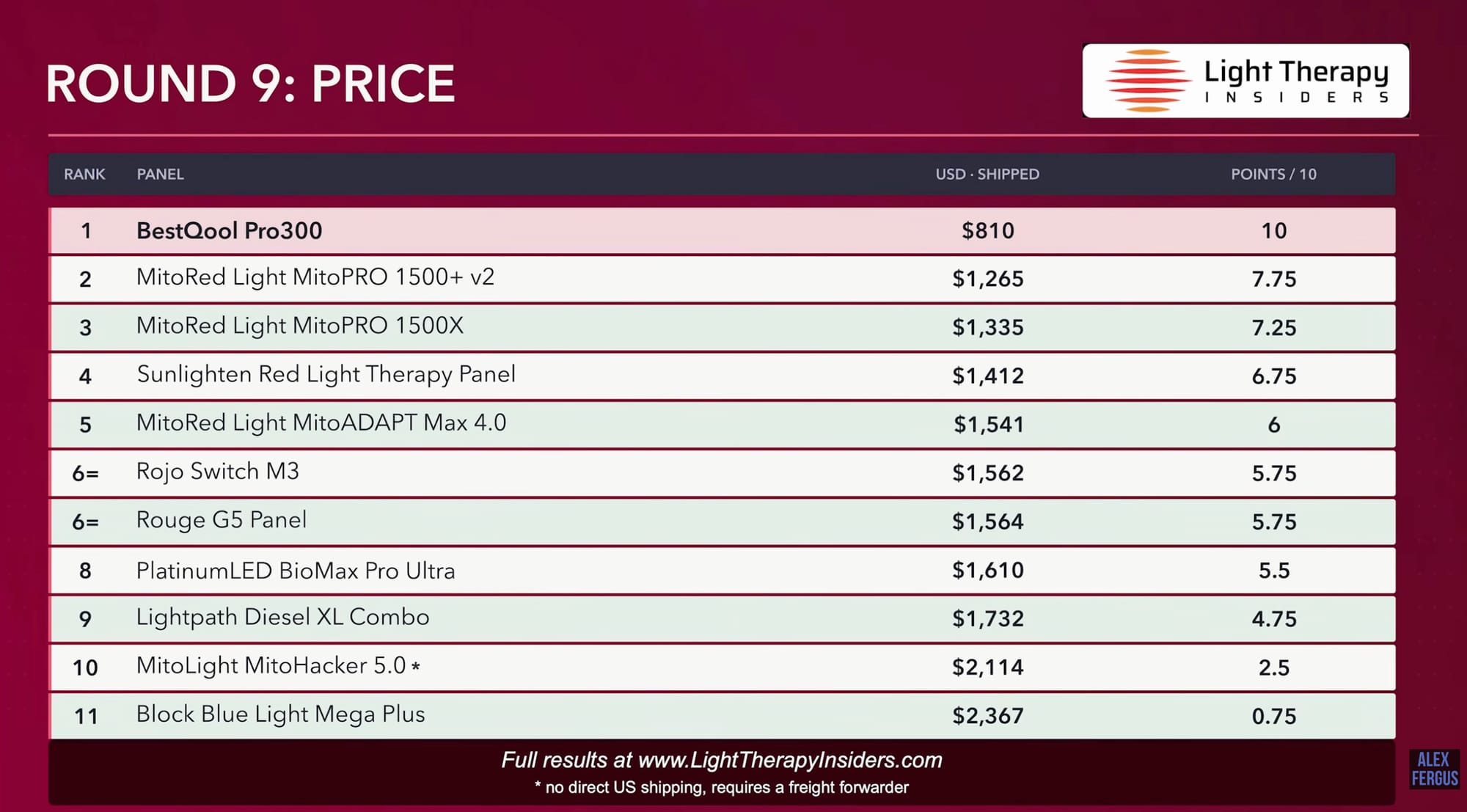
At the expensive end, the Block Blue Light MEGA-PLUS costs $2,367, making it the most expensive panel in this comparison. The MitoHacker 5.0 follows at $2,114. Both are large panels, reinforcing a familiar trend: bigger treatment areas often come with bigger price tags.
The Lightpath Diesel XL Combo costs $1,732, followed by the BioMax Pro Ultra at $1,610. Several other panels fall into a similar price range, including the Rouge G5 ($1,564), Rojo Switch M3 ($1,562), and MitoADAPT Max 4.0 ($1,541).
Moving down the price list, the Sunlighten panel costs $1,412, while the MitoPRO 1500X and MitoPRO 1500+ v2 come in at $1,335 and $1,265, respectively.
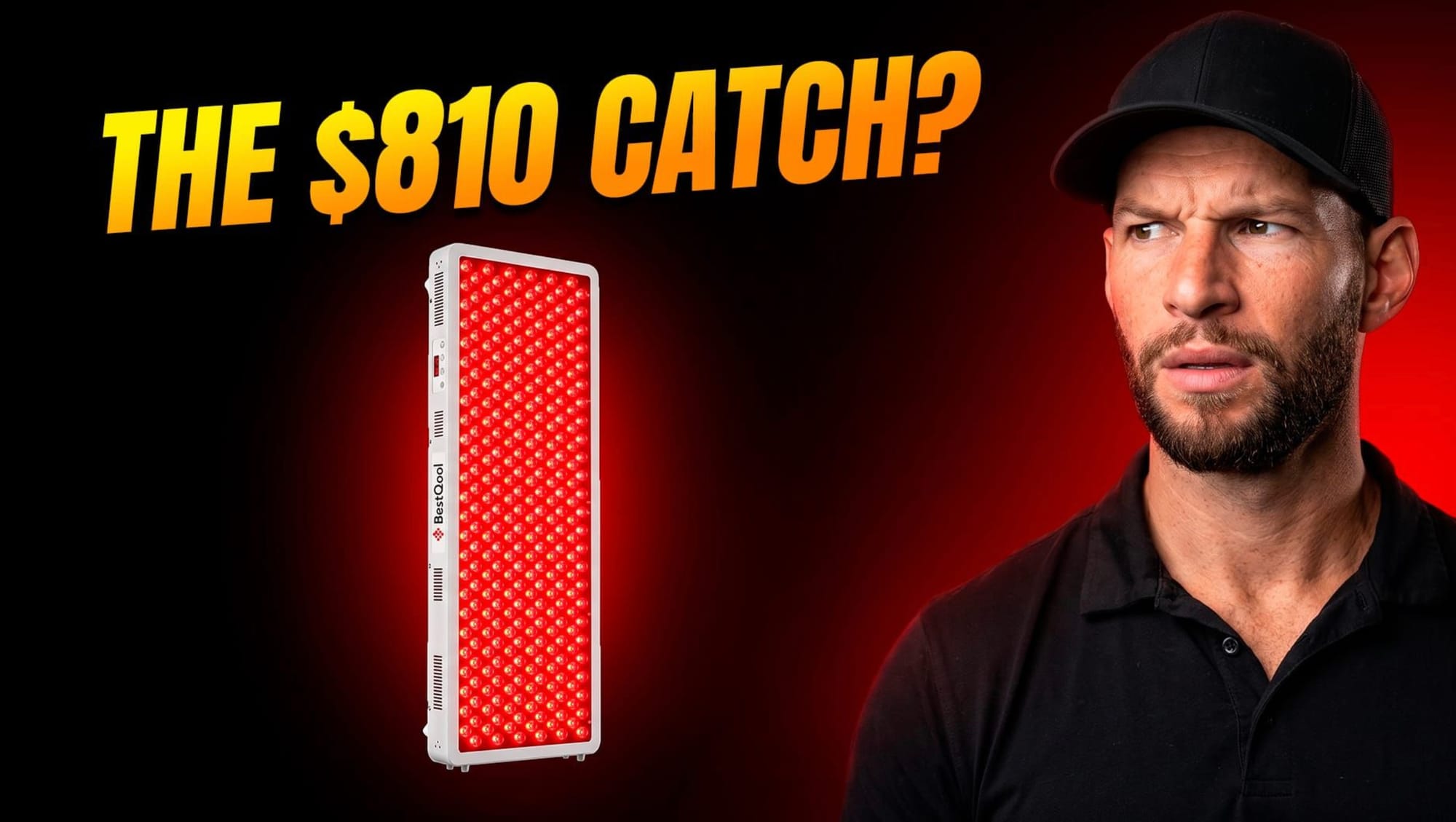
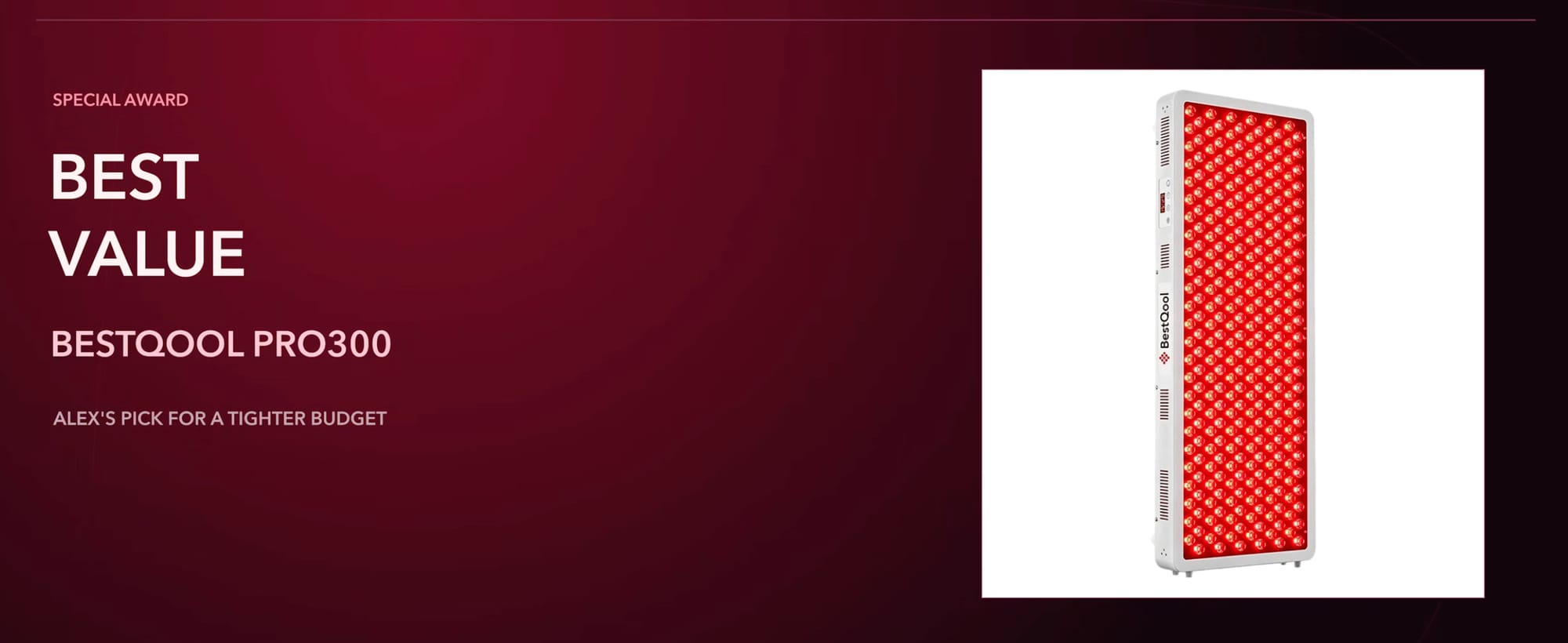
But the clear winner is the BestQool Pro300 at just $810, earning a perfect 10 out of 10 points. It's the only panel under $1,000 and considerably cheaper than everything else tested.
If you're working with a tighter budget, the BestQool is certainly worth considering. It may not offer the same coverage, power, or advanced features as the premium models, but not everyone needs those extras. Depending on your treatment goals, you could save a substantial amount of money without investing in a high-end panel.
Round 9 Winner: BestQool Pro300 — $810 (10/10 Points)
Final Standings: The Best Red Light Therapy Panels of 2026
After nine rounds of independent laboratory testing, hands-on evaluations, and comparisons of features, usability, and price, it's time to reveal the final rankings.
Before we get to the top five, let's look at how the other six panels performed.
Positions 6–11: How the Rest of the Panels Ranked
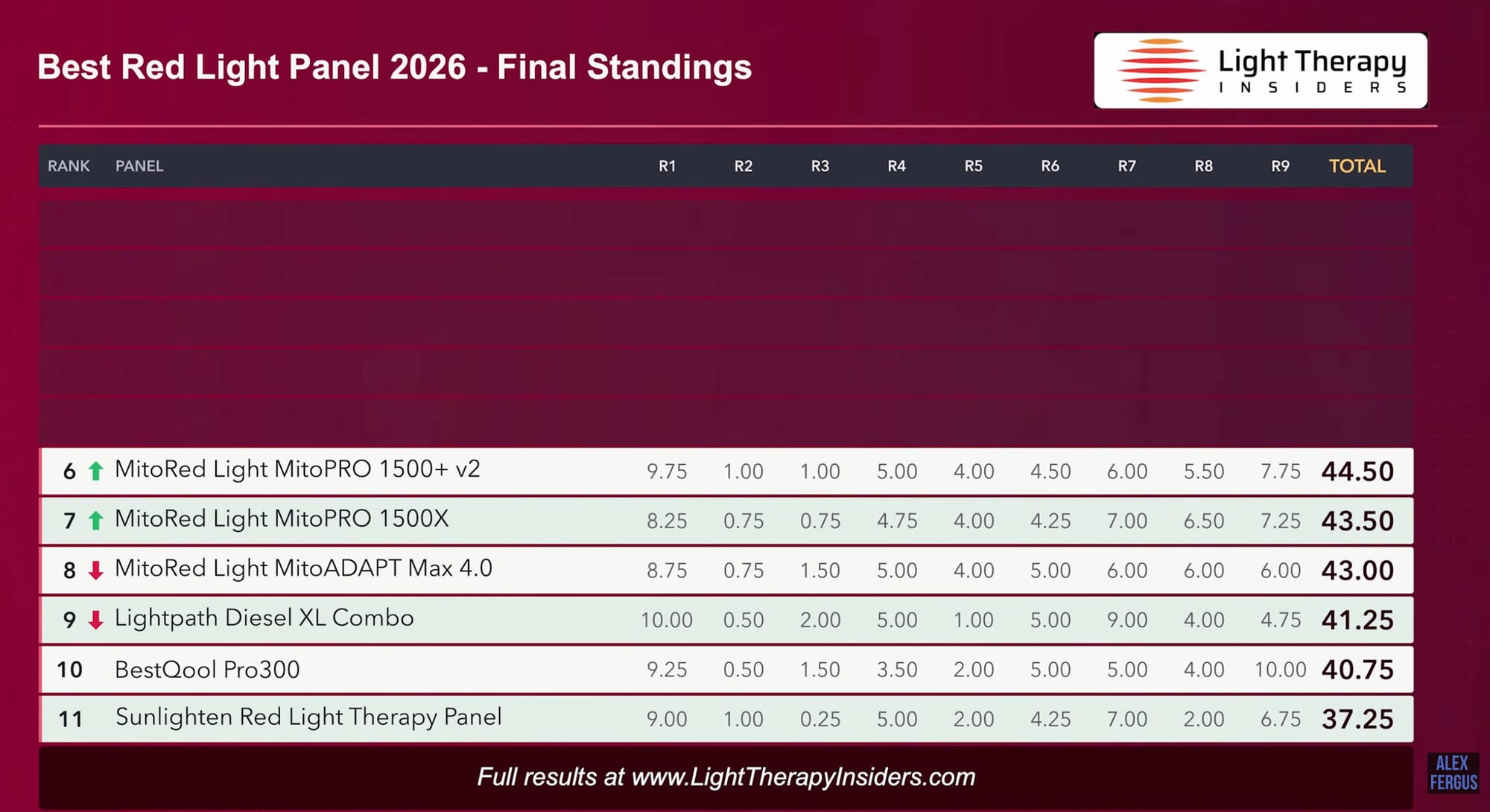
In 11th place is the Sunlighten Red Light Therapy Panel, finishing with 37.25 points. Its simple design and limited features made it difficult to compete with the more advanced panels.
The BestQool Pro300 takes 10th place with 40.75 points, followed by the Lightpath Diesel XL Combo in ninth with 41.25 points. Although BestQool finished near the bottom overall, its $810 price makes it an interesting option for anyone looking for a more affordable red light therapy panel.
Interestingly, all three MitoRed Light panels finished together in sixth, seventh, and eighth places:
- 6th — MitoPRO 1500+ v2: 44.5 points
- 7th — MitoPRO 1500X: 43.5 points
- 8th — MitoADAPT Max 4.0: 43 points
That's just 1.5 points separating all three models out of a possible 100. I've mentioned before that I find the MitoRed Light lineup somewhat confusing, and these results reinforce that observation. With such similar overall scores, perhaps there's an argument for simplifying the range rather than offering so many closely competing models.
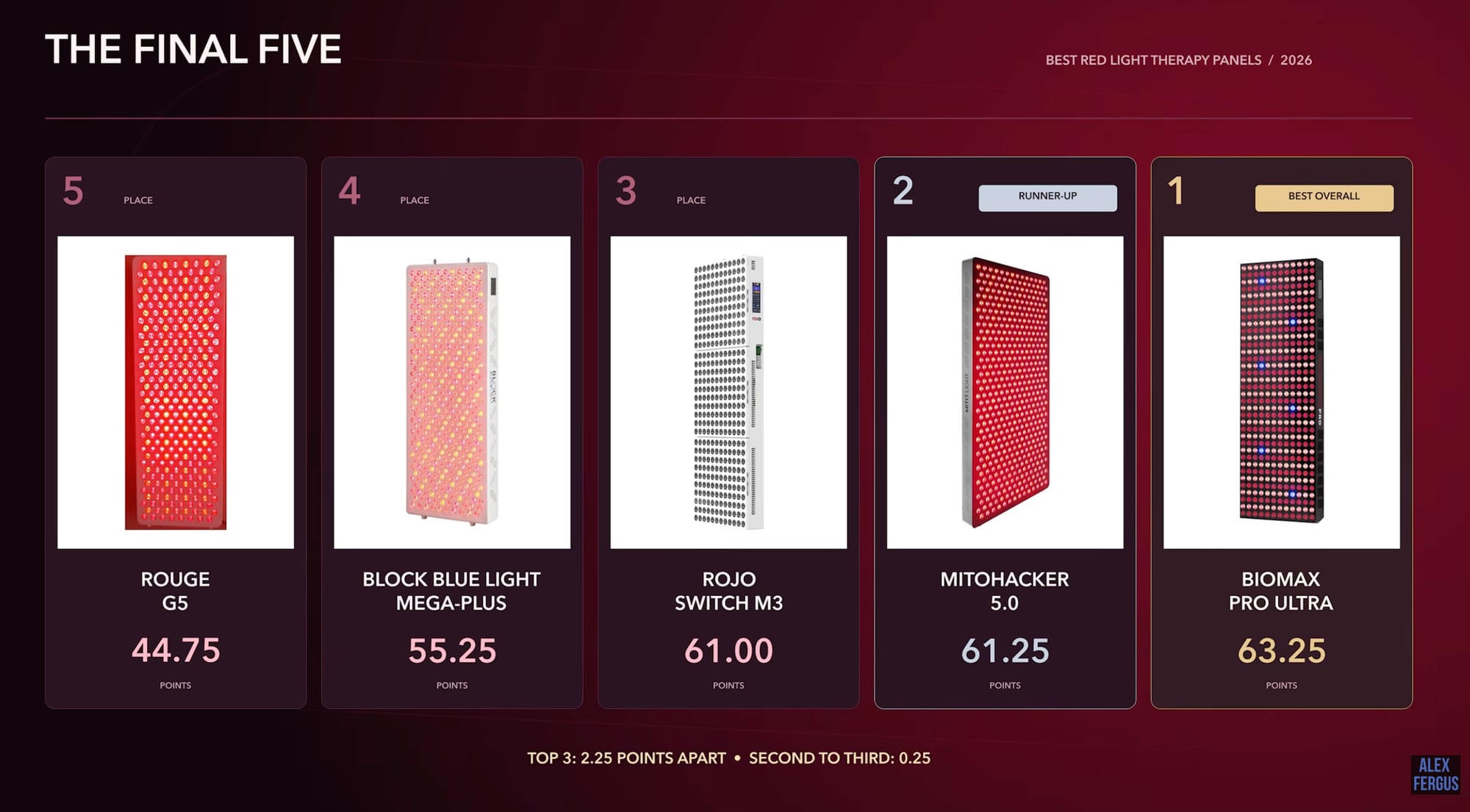
That leaves us with the top five red light therapy panels of 2026. And with the competition so close heading into the final round, the results are particularly interesting.
Top 5 Best Red Light Therapy Panels of 2026–2027
After nine rounds of testing, the results are finally in. These are the five highest-scoring red light therapy panels heading into 2027, ranked on performance, features, usability, and price.
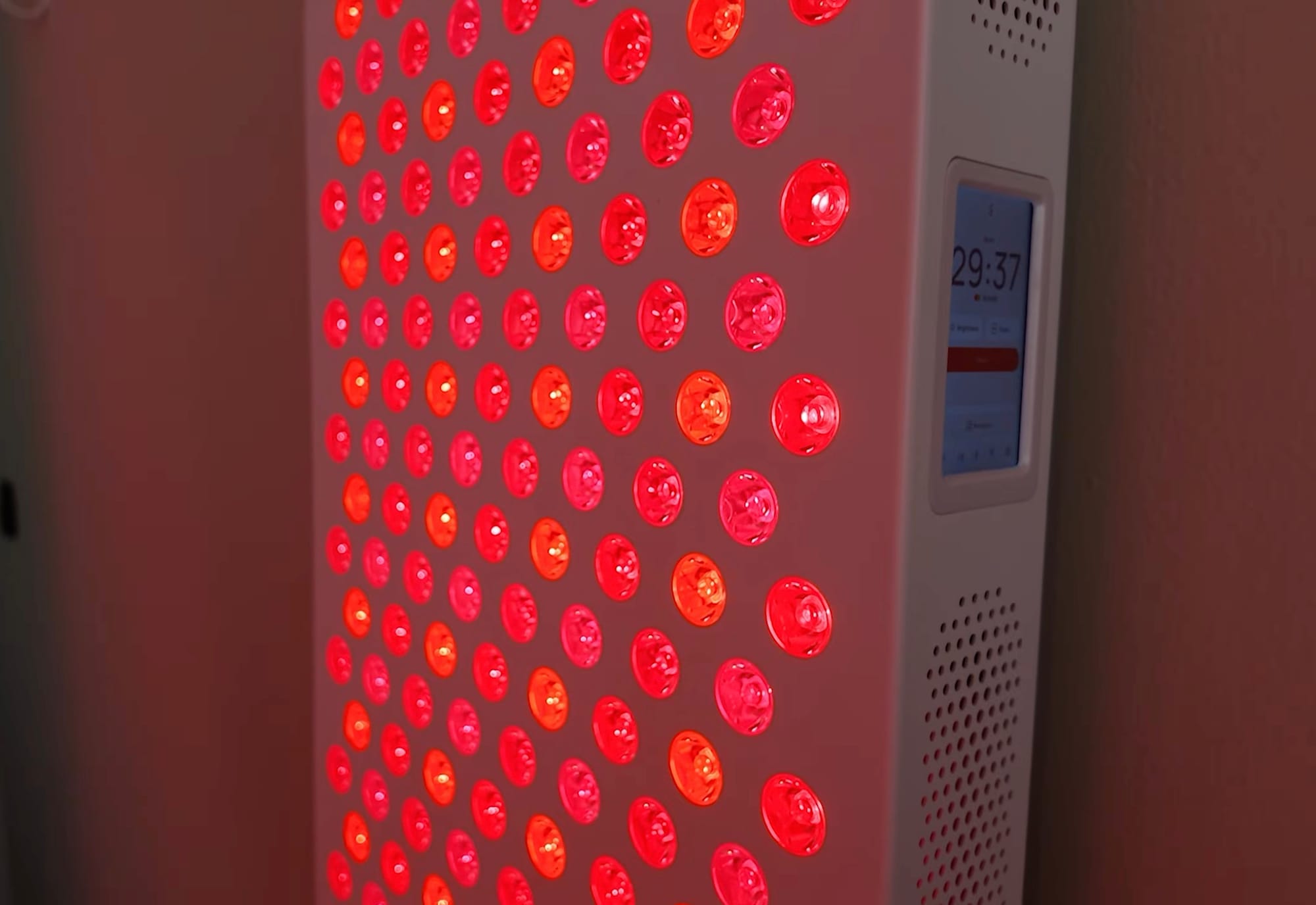
5th Place: Rouge G5 — 44.75 Points
The Rouge G5 finishes fifth, which may be disappointing considering how well previous Rouge panels have performed in my comparisons. While it offers some excellent features and scored strongly for ease of use, its laboratory performance held it back.
The biggest setback was its poor red-to-near-infrared balance, with just 19.3% of its output coming from red light. That cost it all five available points in Round 6 and significantly affected its overall ranking.
It's still a good panel, but the competition has become incredibly strong.
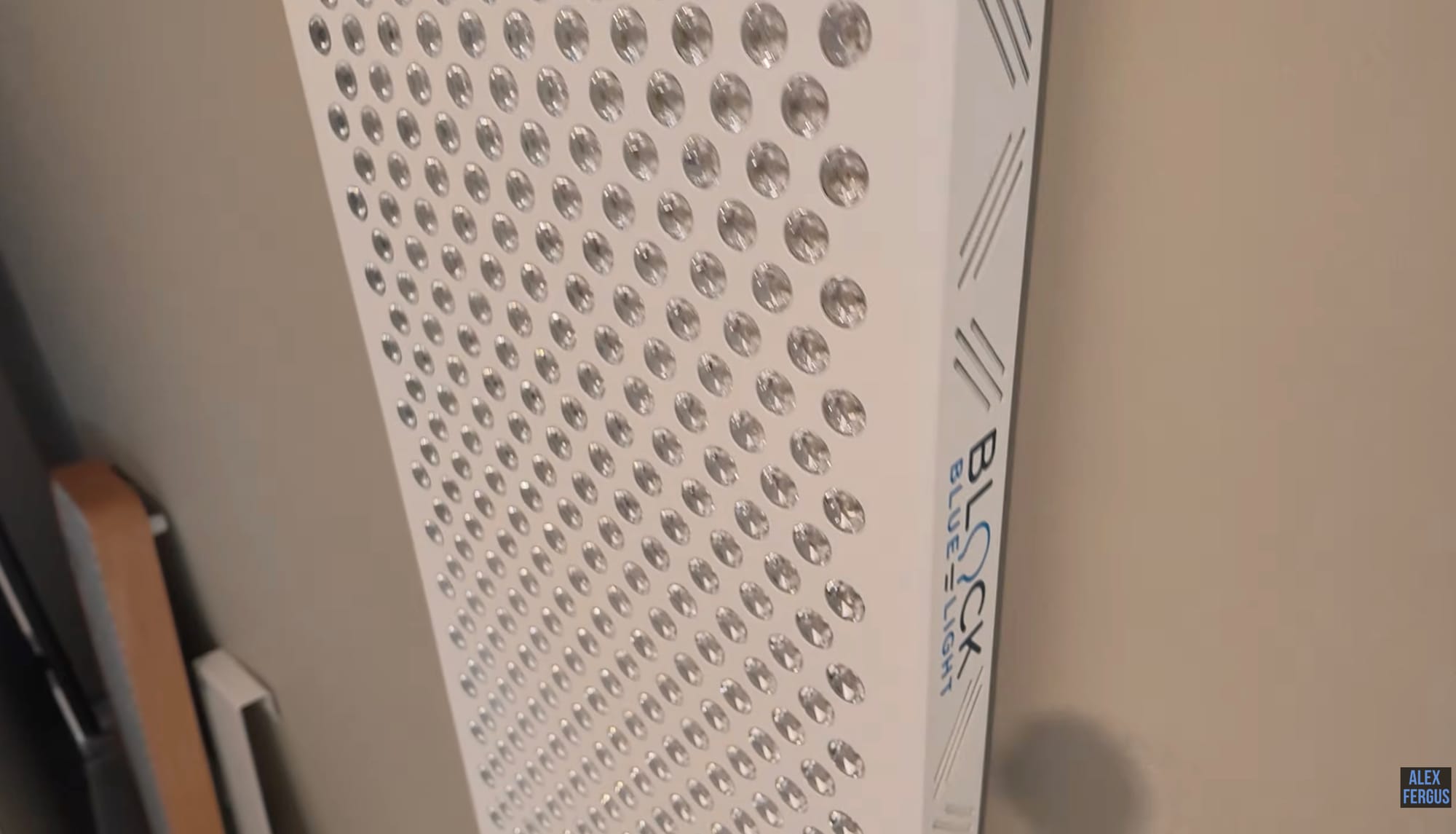
4th Place: Block Blue Light MEGA-PLUS — 55.25 Points
The Block Blue Light MEGA-PLUS started this comparison exceptionally well, delivering strong coverage, irradiance, and uniformity results. It also impressed with its five-year warranty, earning first place in Round 8.
However, it lost ground in the later rounds, particularly when price came into play. At $2,367 delivered, it was the most expensive panel tested, which ultimately hurt its final score.
Nevertheless, it's a solid, high-performing panel from an established company.
3rd Place: Rojo Switch M3 — 61 Points
The Rojo Switch M3 is one of the most innovative red light therapy panels I've tested. Its interchangeable LED modules, independent zone controls, advanced touchscreen, and optional wraparound configurations make it exceptionally versatile.
It also delivered strong laboratory results and earned a perfect 15 out of 15 points for ease of use.
I'd be more than happy to use this panel every day. In fact, just 0.25 points separate the Rojo from second place, showing how incredibly close the competition has become.
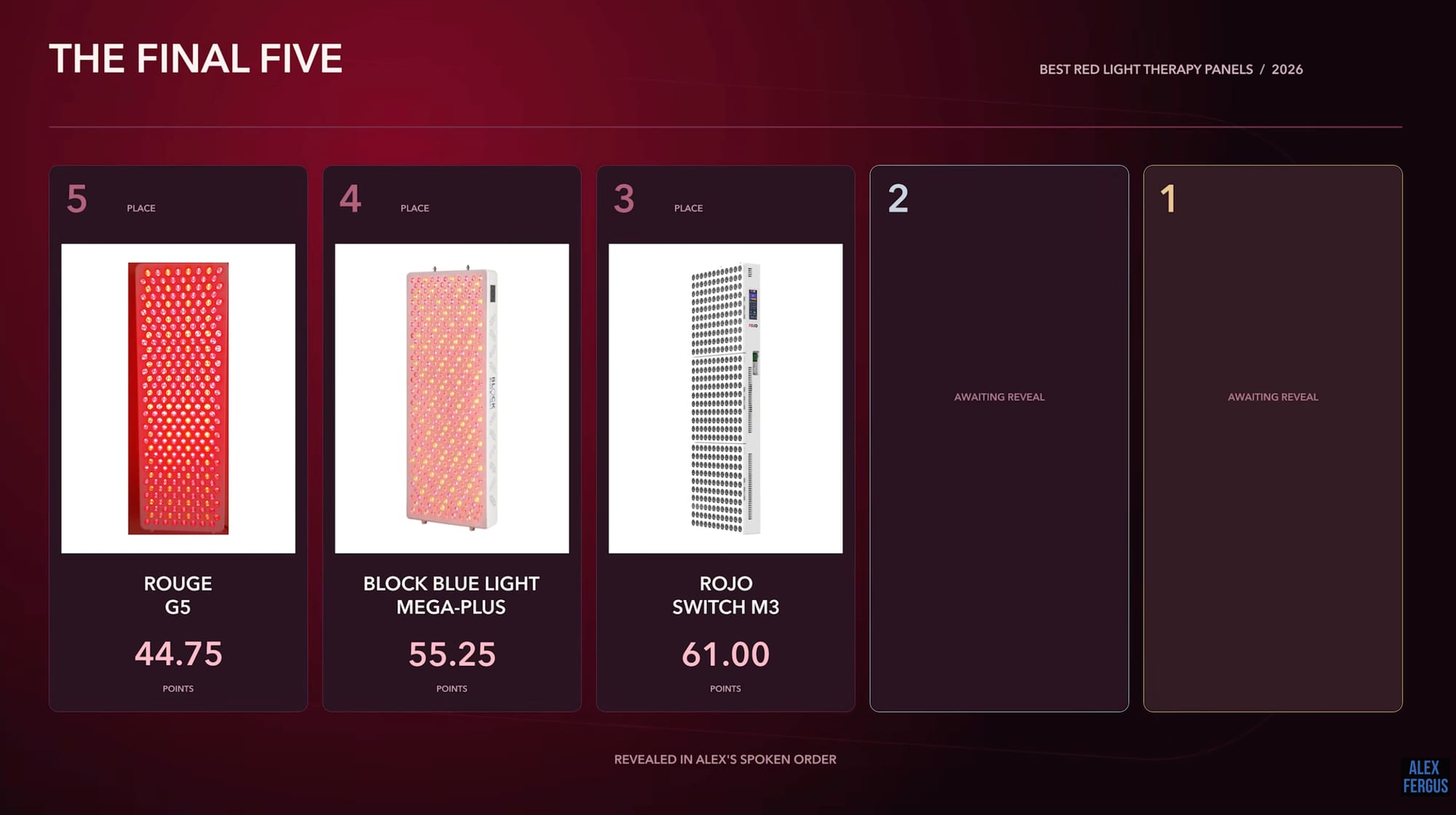
And Then There Were Two…
Only 2.5 points separate first and third place, making this one of the closest finishes I've seen in years.
The Mito Light MitoHacker 5.0 dominated the performance testing and held first place for eight consecutive rounds. But the BioMax Pro Ultra steadily closed the gap with its excellent features, usability, and more competitive price.
So, did the MitoHacker hold on to its lead, or did the BioMax pull off a last-minute victory?
Let's reveal the winner.
The Winner: PlatinumLED BioMax Pro Ultra — Best Red Light Therapy Panel of 2026–2027
After nine rounds of testing, the PlatinumLED BioMax Pro Ultra takes first place as the best red light therapy panel of 2026, heading into 2027!
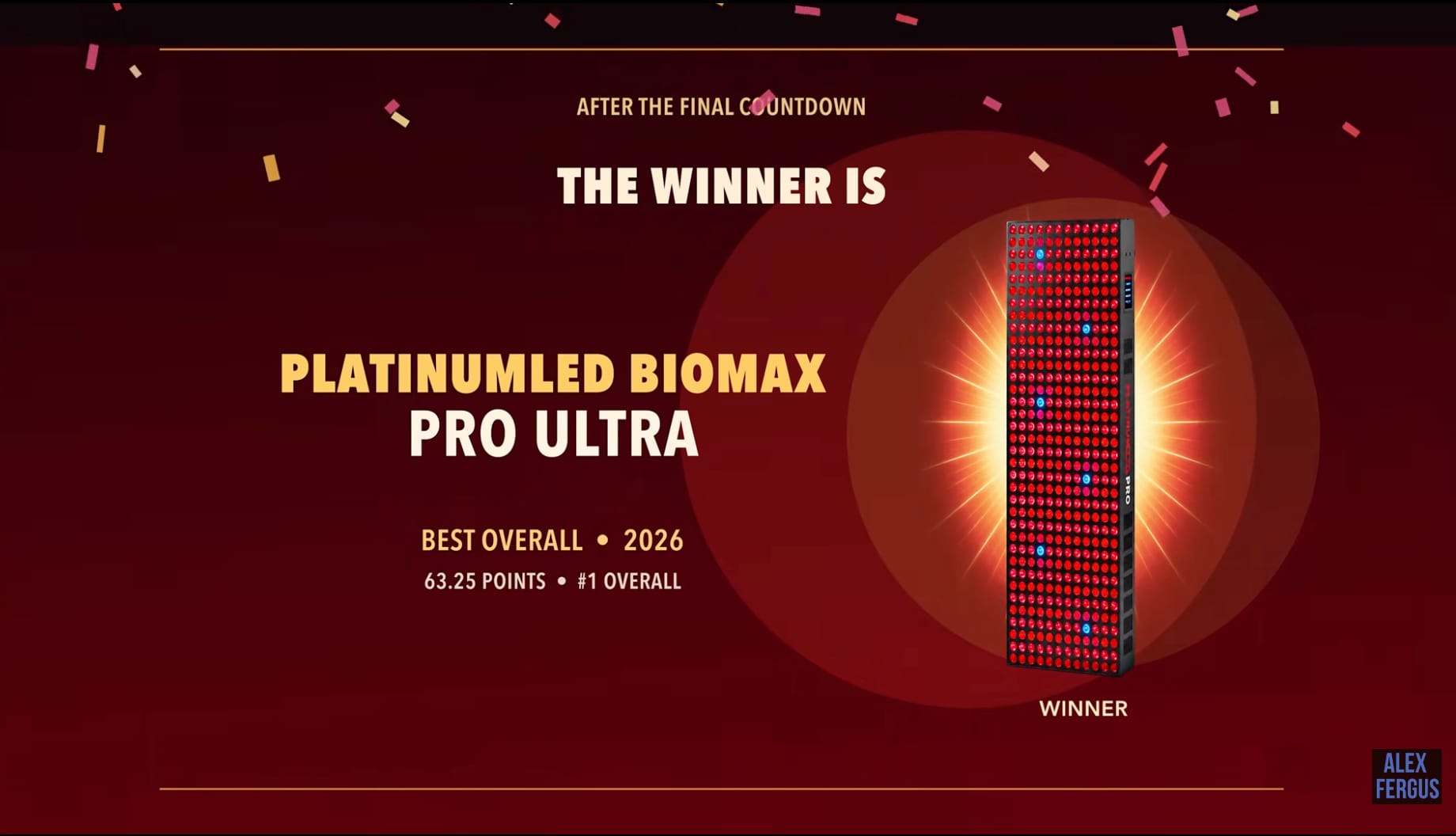
And what a finish! The MitoHacker 5.0 had led the competition through all eight previous rounds, only to be overtaken by the BioMax in the final price round. I couldn't have scripted a closer finish if I'd tried.
2nd Place: Mito Light MitoHacker 5.0
The Mito Light MitoHacker 5.0 deserves enormous credit. It dominated the performance testing, delivering outstanding coverage, irradiance, and uniformity. It's powerful, easy to use, and an excellent all-around panel.
However, there's one major limitation: the Mito Light MitoHacker is only available in the European Union. If you live in the EU, it's absolutely worth considering. Outside the EU, it's not currently a practical purchasing option.
That effectively makes the Rojo Switch M3 the second-best option for buyers outside Europe, and considering how closely it finished behind the MitoHacker, that's an impressive result.
1st Place: Why the BioMax Pro Ultra Won
The BioMax Pro Ultra delivered the strongest overall combination of laboratory performance, practical features, usability, and price.
Its powerful output, generous treatment area, and effective wavelength selection helped it perform consistently well throughout the scientific testing. But what really sets it apart is how PlatinumLED continues to improve its panels.
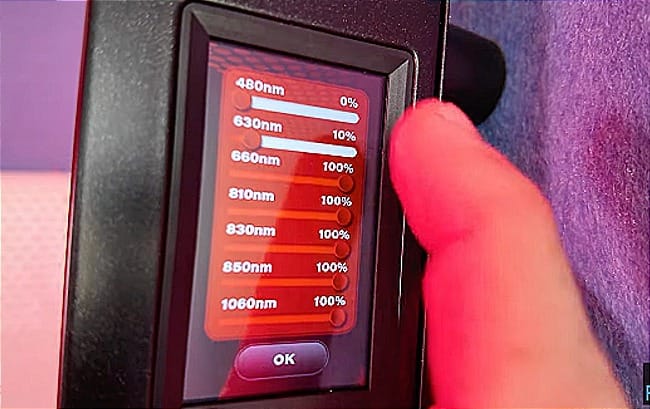
The edge-to-edge LED design minimizes gaps when combining multiple panels, while independent zone controls allow you to adjust intensity across different treatment areas. The removable remote is another practical addition that makes everyday use easier.
PlatinumLED has been a strong performer in my previous comparisons, and this year's independent laboratory testing reinforces why. The company continues to innovate while maintaining the fundamentals that matter most.
At $1,610 delivered using the available discount, the BioMax also offers an excellent balance of performance, features, and value compared with several more expensive competitors.
For those reasons, I believe it's a deserving winner.
Overall Winner: PlatinumLED BioMax Pro Ultra — Best Red Light Therapy Panel of 2026–2027
A Special Mention: Rojo Switch M3
The Rojo Switch M3 deserves recognition for its extraordinary innovation. Its interchangeable LED modules, advanced controls, customizable treatment zones, and optional wraparound configurations offer flexibility that few other panels can match.
Ultimately, its lower uniformity and optical stability scores held it back from taking the title. However, these are areas that could improve in future generations, and I wouldn't be surprised to see other manufacturers adopt some of Rojo's ideas.
Special Awards: Most Innovative and Best Value
Beyond the overall rankings, two panels deserve additional recognition.
Most Innovative: Rojo Switch M3
This award was an easy decision. The Rojo Switch M3 introduces genuinely different technology, particularly its modular LED system that allows users to customize the panel for specific applications.
It's one of the most interesting developments I've seen in red light therapy panels, and I'm excited to see where this technology goes.

Best Value: BestQool Pro300
At just $810, the BestQool Pro300 is approximately $455 cheaper than the next least expensive panel in this comparison.
It doesn't match the performance or advanced features of the premium models, but for someone on a limited budget, it's certainly worth considering.
However, before purchasing, I'd also recommend looking at smaller panels from established brands such as PlatinumLED and Block Blue Light. You may find a compact model with better features or performance that still fits your budget.
Final Thoughts: What Makes the Best Red Light Therapy Panel?
This year's comparison reinforced something important: the most powerful panel isn't necessarily the best panel to own.
The MitoHacker dominated the early performance rounds, but the BioMax Pro Ultra ultimately won by combining excellent scientific results with thoughtful features, practical usability, and competitive pricing.
It's also worth remembering that the best panel for you may depend on your treatment goals, available space, budget, and how you intend to use it.
Putting this comparison together took months of research, independent testing, late nights, and more stress than I'd care to repeat. But I hope the results help you make a more informed decision rather than relying solely on manufacturer specifications or marketing claims.
I'd love to hear your thoughts. Were you surprised by the winner? Is there a panel you think deserved to rank higher? Let me know in the comments, and keep an eye out for more detailed reviews and follow-up testing from this comparison.
Items Mentioned
🔥🔥 Check this blog daily for the latest Red Light Therapy Black Friday and Cyber Monday deals: https://aferg.co/black-friday-cyber-monday 🔥🔥
⭐ Sunlighten- Use code Fergus at https://aferg.co/sunlighten
⭐ Mito Light Europe - Use code ALEX at https://aferg.co/mitolight for 5% off!
⭐ MitoRed Light - use https://aferg.co/7d221 for 5% off sitewide.
⭐ Rojo Light Therapy - Use discount code ALEX at https://aferg.co/rojo-rlt for 10% off.
⭐ LightpathLED - Use discount code ALEX at https://aferg.co/lightpathled to get 5% off.
⭐ BestQool - use code ALEX at https://aferg.co/Bestqool to save 10%.
⭐ Block Blue Light - Use this link: https://aferg.co/BlockBlueLight to save 15% on Block Blue Light's products. The discount will automatically be applied at checkout.
⭐ PlatintmLED Therapy Lights- Use the discount link https://aferg.co/redled to save 5%
⭐ Rouge - Use discount code ALEX at https://aferg.co/rougecare for $50 off.
Alex's Bio
Alex Fergus wrote this blog post. Alex is an ISSN Sports Nutrition Specialist, Fitness Professional, and certified Superhuman Coach who continues to expand his knowledge base and help people across the world with their health and wellness. Alex is recognized as the National Record Holder in Powerlifting and Indoor Rowing and has earned the title of the Australian National Natural Bodybuilding Champion. Having worked as a health coach and personal trainer for over a decade, Alex now researches all things health and wellness and shares his findings on this blog.
🏆 Best Red Light Therapy Panels 2026 – Final Rankings
Here are the final standings after nine rounds of independent testing. Each panel was evaluated across multiple performance categories, with the highest total score determining the winner.
| Rank | Panel | Total Score |
|---|---|---|
| 🥇 1 | PlatinumLED BioMax Pro Ultra | 63.25 |
| 🥈 2 | MitoLight MitoHacker 5.0 | 61.25 |
| 🥉 3 | Rojo Switch M3 | 61.00 |
| 4 | Block Blue Light Mega Plus | 55.25 |
| 5 | Rouge G5 Panel | 44.75 |
| 6 | MitoRed Light MitoPRO 1500+ v2 | 44.50 |
| 7 | MitoRed Light MitoPRO 1500X | 43.50 |
| 8 | MitoRed Light MitoADAPT Max 4.0 | 43.00 |
| 9 | Lightpath Diesel XL Combo | 41.25 |
| 10 | BestQool Pro300 | 40.75 |
| 11 | Sunlighten Red Light Therapy Panel | 37.25 |