
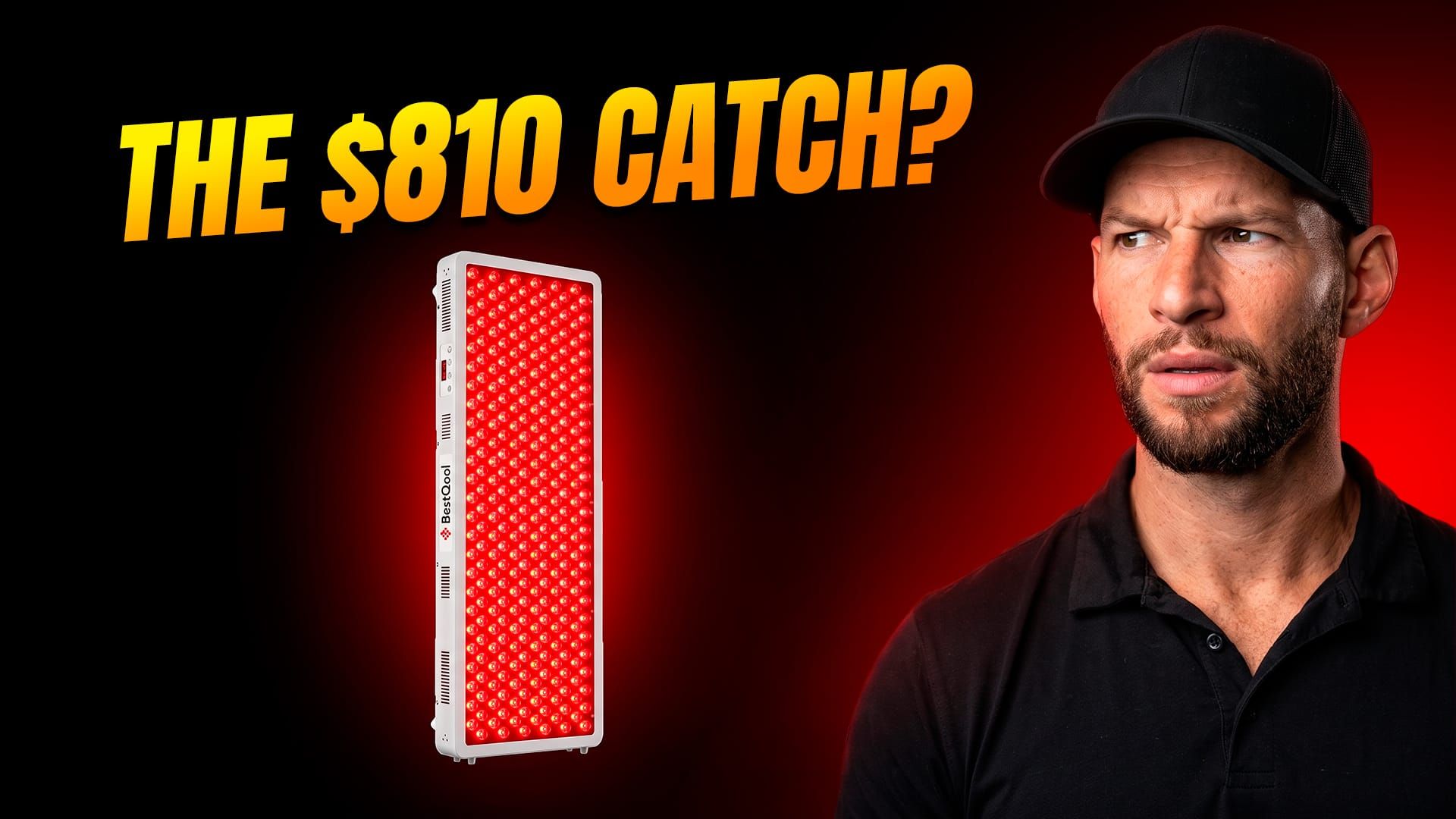
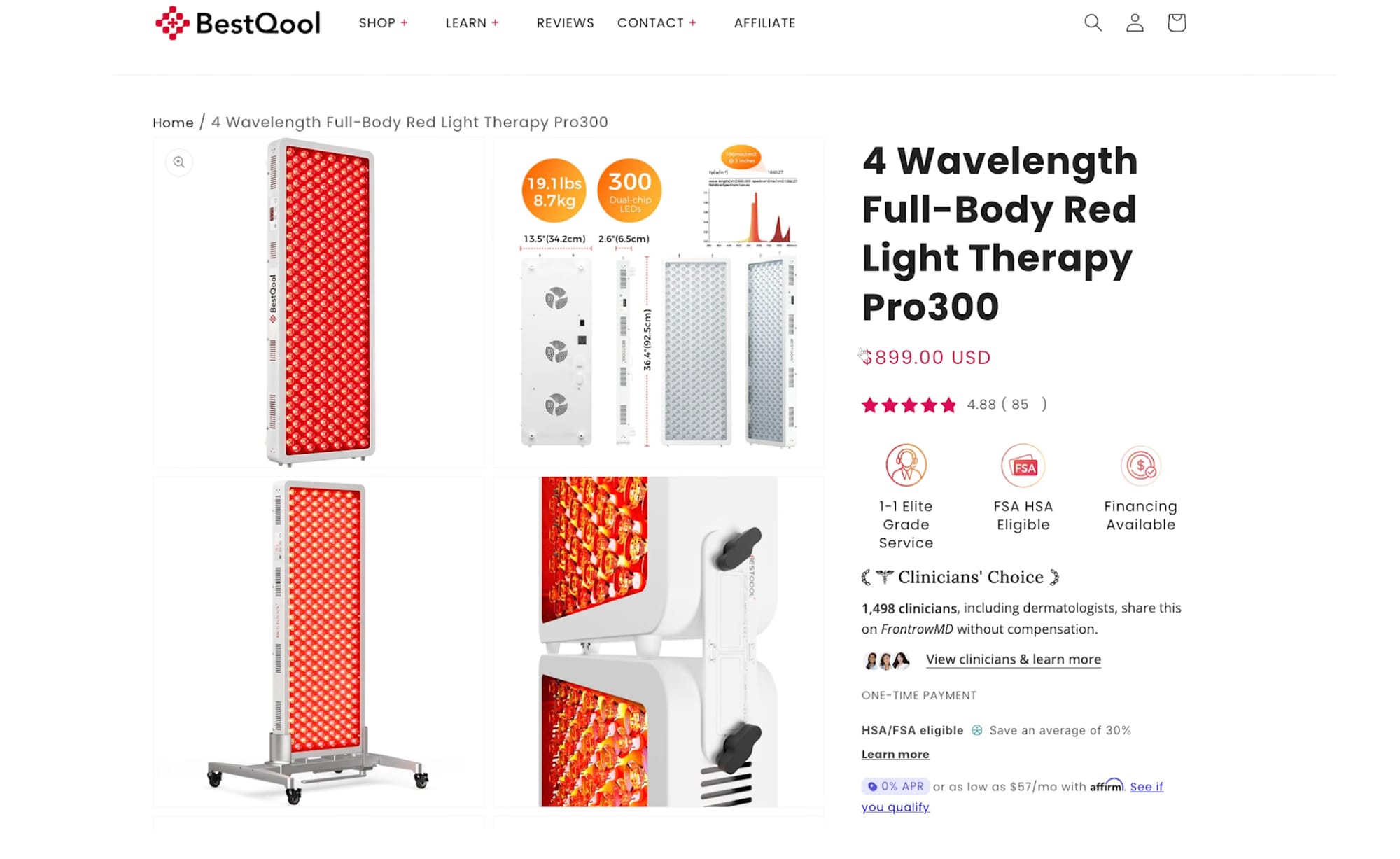
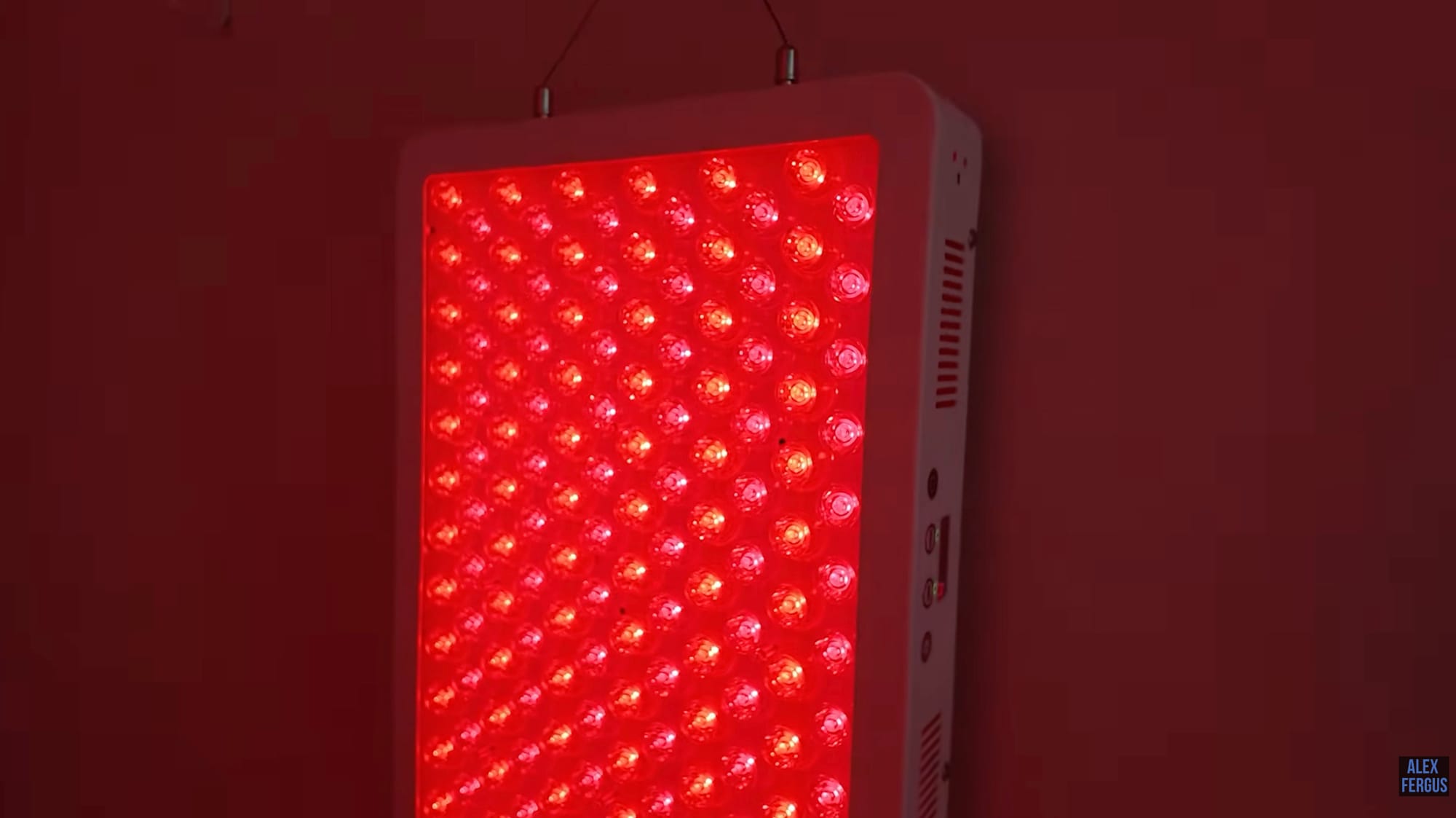
The Bestqool Pro 300 is a half-body red light therapy panel that costs just over $800 with my discount, making it one of the more affordable options in its size category. With four advertised wavelengths, including 940nm near-infrared light, it certainly looks appealing on paper. But does its performance match its attractive price?
To find out, I sent the Bestqool Pro 300 to an independent laboratory for testing, focusing on wavelength accuracy, power output, coverage, and light uniformity. I also examined its features, usability, warranty, and overall value. Unfortunately, while there are a few things to like, the testing revealed some significant shortcomings.
What Makes the Bestqool Pro 300 Interesting?
The Bestqool Pro 300's biggest selling point is its price. Half-body red light therapy panels often cost $1,200 or more, so finding one for approximately $810 is unusual. For someone wanting a larger panel without spending a fortune, that's an attractive proposition.
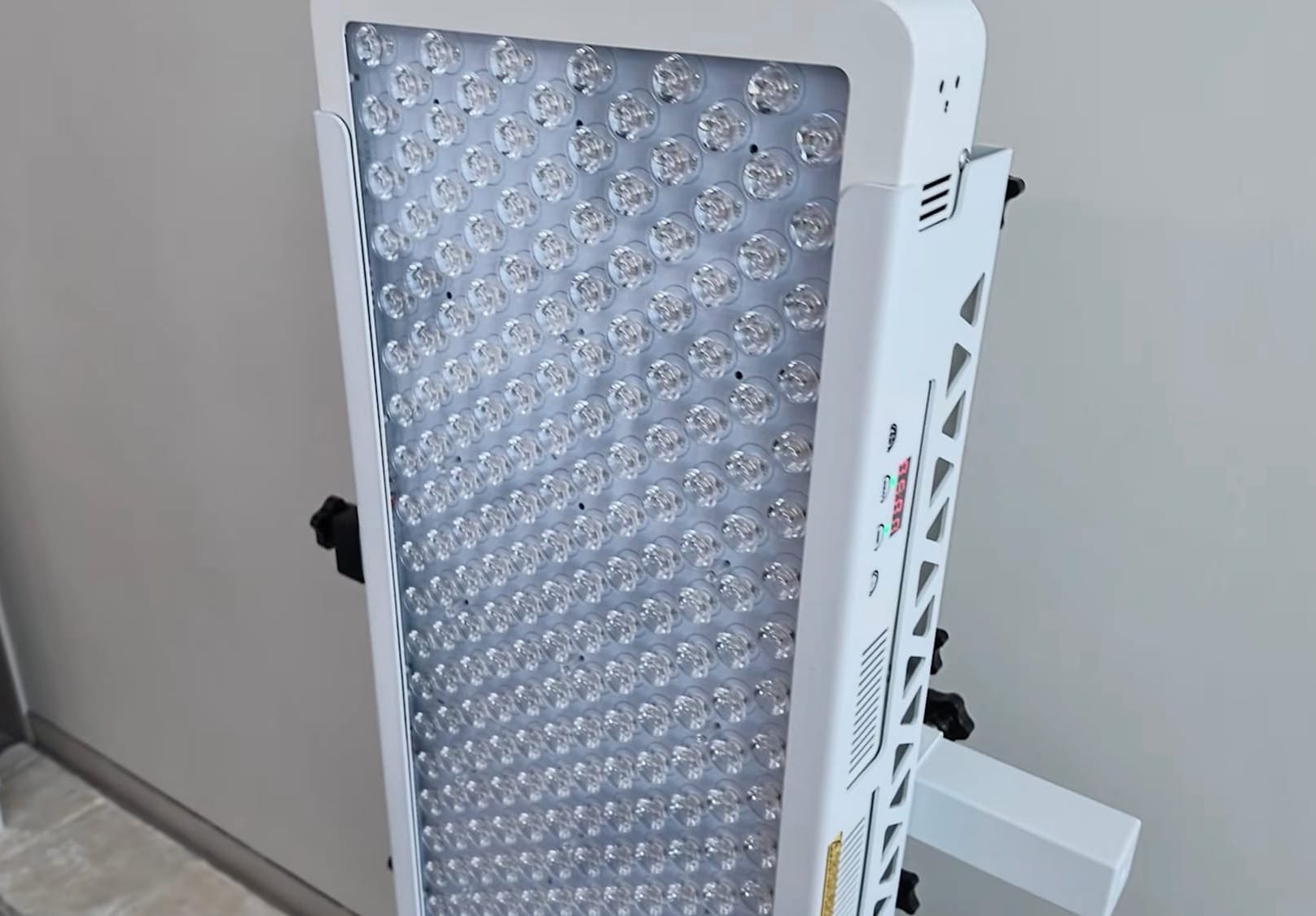
The panel measures approximately 36 inches tall and 14 inches wide, giving it a substantial treatment area compared with smaller desktop devices. It also includes 940nm near-infrared light, a wavelength that isn't featured in every competing panel.
However, the Bestqool Pro 300 is a relatively basic device. There are no advanced treatment modes, individual wavelength controls, or intensity adjustments. Whether those omissions matter depends on how you intend to use the panel, but they become more significant when we look at its actual performance.
Independent Lab Testing: Do the Wavelengths Match?
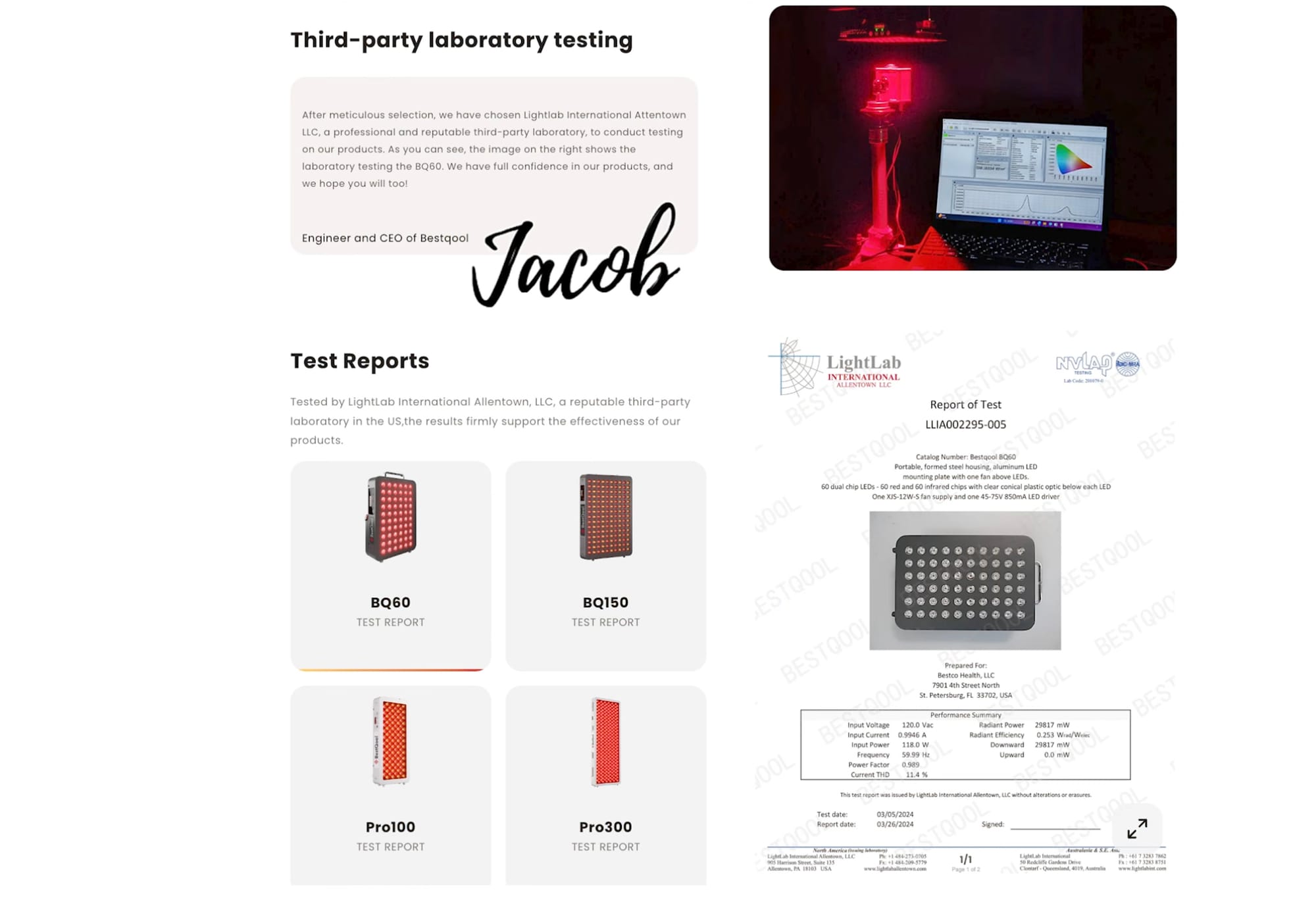
As part of my updated review process, I sent the Bestqool Pro 300 to Light Lab International for independent third-party testing. This gives us objective measurements rather than relying entirely on manufacturer specifications.
Bestqool advertises four wavelengths:
- 630nm red light
- 660nm red light
- 850nm near-infrared light
- 940nm near-infrared light
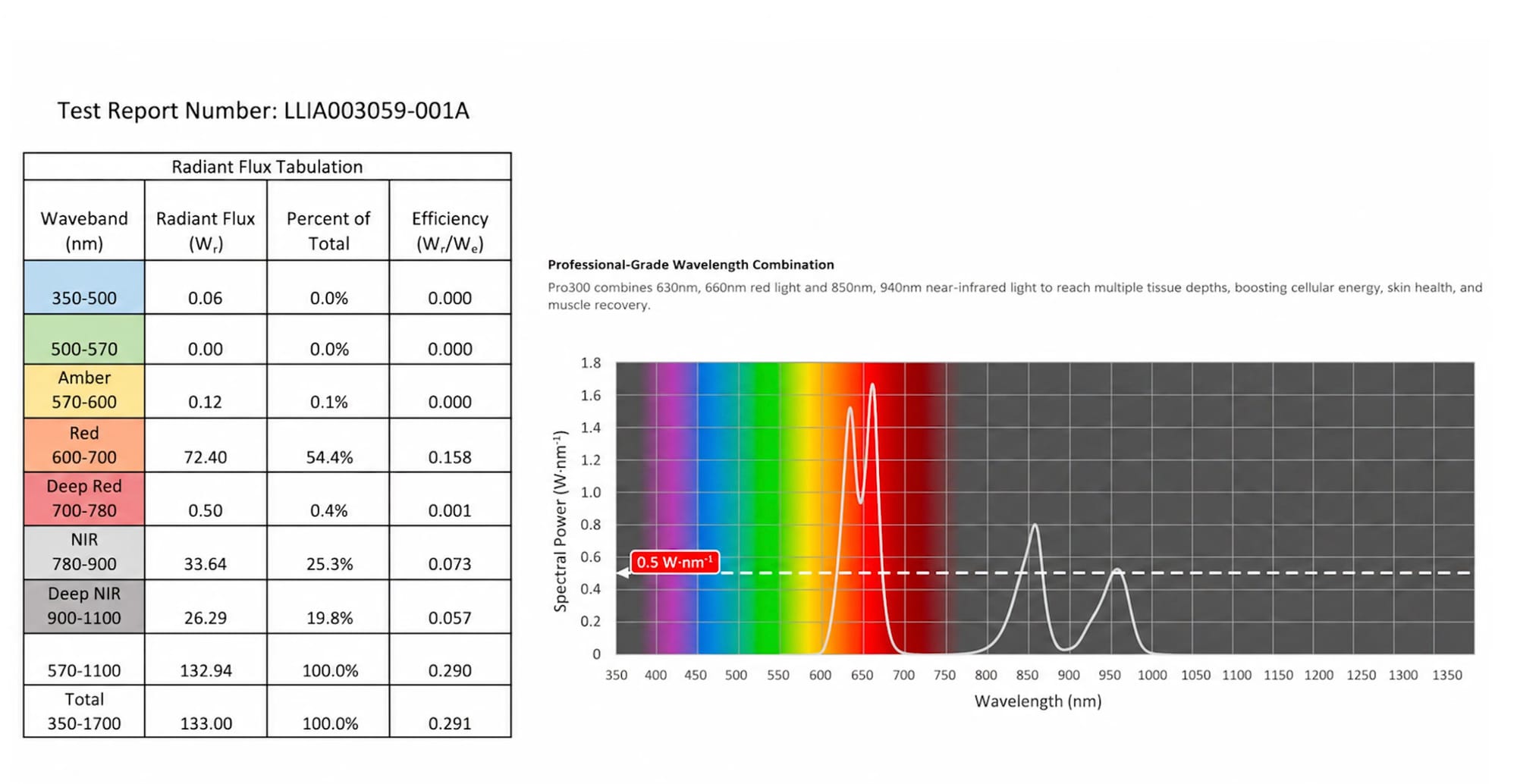
The good news is that the laboratory confirmed emissions corresponding to all four advertised wavelengths. Using my threshold of at least 0.5 watts of radiant output at each wavelength, all four passed.
The longer near-infrared emission was observed in the 940–950nm region. So, from a wavelength accuracy perspective, Bestqool delivered what it advertised.
However, accurate wavelengths are only part of the equation. How much light the panel produces and how evenly it distributes that light are equally important.
Power Output, Coverage, and Light Uniformity
For consistency across my panel reviews, I use independent laboratory measurements taken at a distance of 12 inches. I also evaluate three different treatment fields: full-body, half-body, and smaller targeted areas such as the face.
For the Bestqool Pro 300, the results were disappointing.
The panel achieved coverage scores of approximately 40–50% for the evaluated half-body treatment field. That means the distribution of energy across the treatment area wasn't particularly impressive, especially considering the physical size of the device.
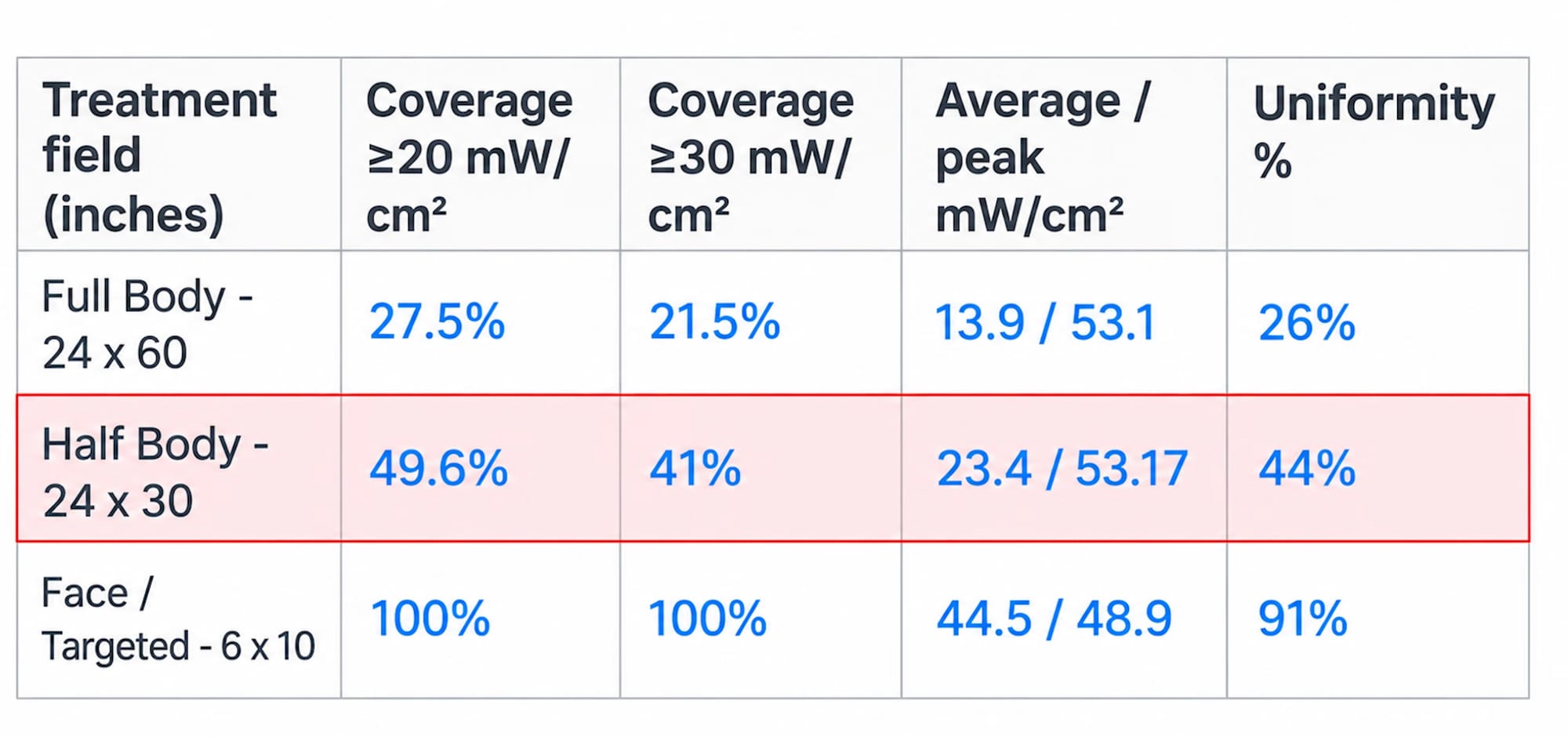
Light uniformity was another weakness. The Bestqool Pro 300 achieved a 44% uniformity score for half-body treatment, indicating that the light wasn't distributed particularly evenly across the area.
This matters because an uneven treatment field can leave some regions receiving considerably more light than others. A panel might look large enough to treat a substantial portion of your body, but that doesn't necessarily mean it's delivering a consistent dose everywhere.
There were two other notable findings. The red-to-near-infrared output ratio was about 55:45, a reasonable balance, but the panel lost about 9% of its power after 20 minutes of operation.
Overall, the Bestqool Pro 300 isn't particularly powerful, and its light distribution leaves plenty of room for improvement. The wavelength accuracy is encouraging, but it doesn't offset the weaker coverage and uniformity.
Features, Controls, and Everyday Usability
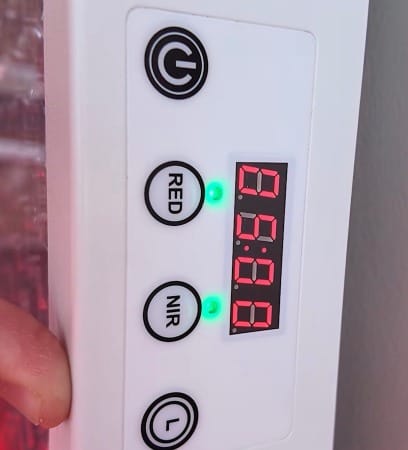
Operating the Bestqool Pro 300 is straightforward. Press the power button, then press start, and after a five-second countdown, the treatment begins. For anyone who prefers a simple device without complicated settings, that's certainly convenient.
Unfortunately, the control system feels underdeveloped. The screen is poor, the buttons aren't particularly impressive, and there is very little flexibility in adjusting treatments.
You cannot independently adjust wavelength intensity, select which wavelengths are operating, or customize the light output. There are also no pulsing options or smart treatment modes.
I don't believe every red light therapy panel needs dozens of features. Simplicity can be a positive, particularly when it makes a device easier to use. But there's a difference between a thoughtfully designed basic panel and one that feels unnecessarily limited.
Even a better-quality display and more intuitive controls would have improved the experience considerably.
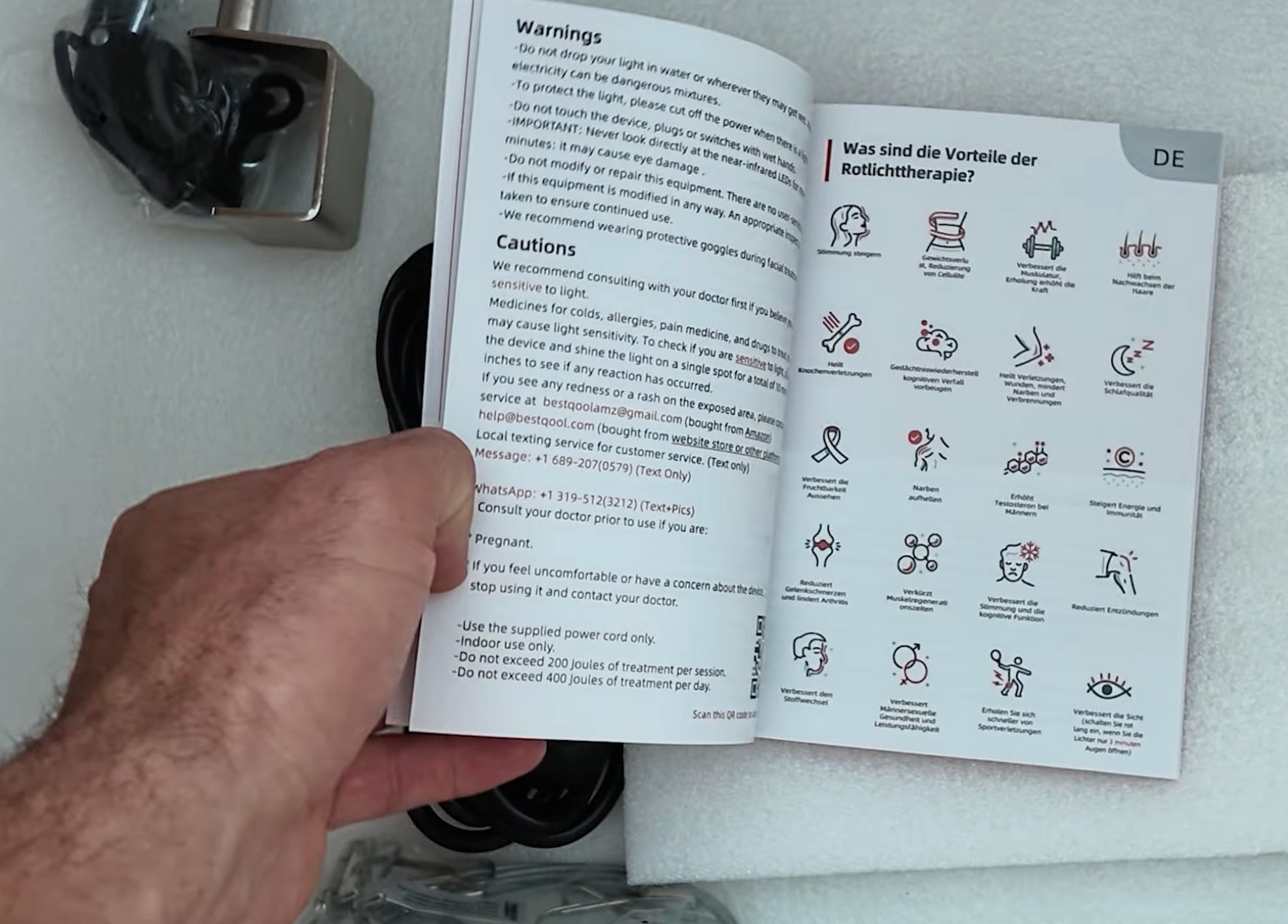
The panel includes a user manual, protective goggles, and hanging hooks. Optional stands are available, including a standard floor stand and a more versatile horizontal/vertical stand.
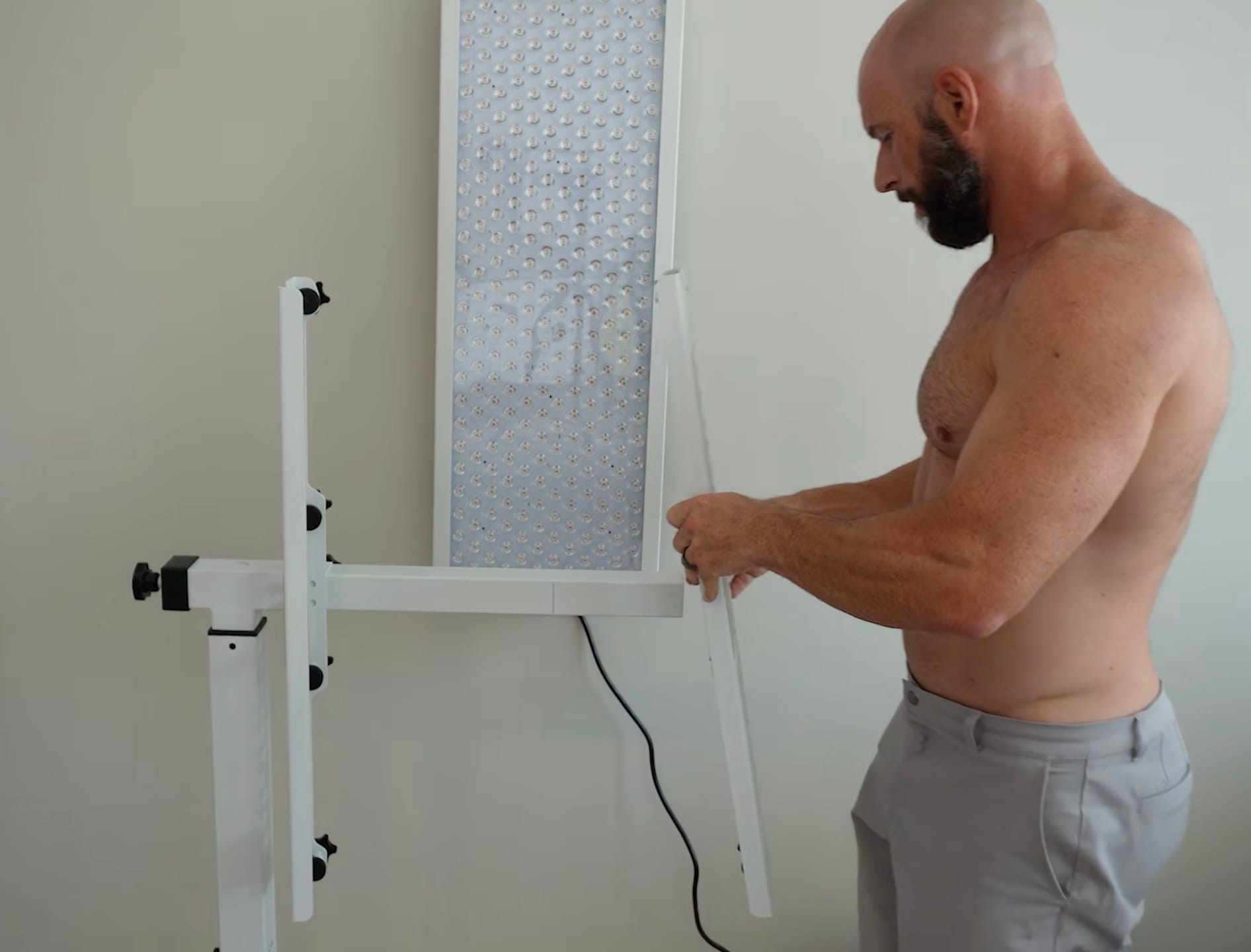
I tried the horizontal/vertical stand and actually liked it. It's easy to use, reasonably well designed, and universal, meaning it can accommodate other compatible red light therapy panels.
Price, Shipping, Warranty, and Returns
The Bestqool Pro 300 retails for $899, but a 10% discount brings the cost to about $810. That makes it significantly cheaper than many similarly sized panels.
Here's how the pricing and purchase conditions break down:
Item | Details |
|---|---|
Retail price | $899 |
Price with 10% discount | Approximately $810 |
USA shipping | Free |
International shipping | Approximately $150–$250 |
Standard floor stand | $270 |
Horizontal/vertical stand | $400 |
Warranty | 2 years |
Return policy | 30 days, no restocking fee |
For customers in the United States, the price is certainly attractive. However, international buyers need to account for shipping costs, taxes, and potential import duties.
With those additional expenses, the Bestqool Pro 300 could approach or exceed $1,000. At that price, I would seriously consider competing panels with stronger power output, better uniformity, and more features.
The two-year warranty and 30-day return policy are also relatively limited compared with some alternatives in this market.
Is the Bestqool Pro 300 Suitable for Skin and Deep Tissue?
One of the most important questions when choosing a red light therapy panel is what you actually intend to treat.
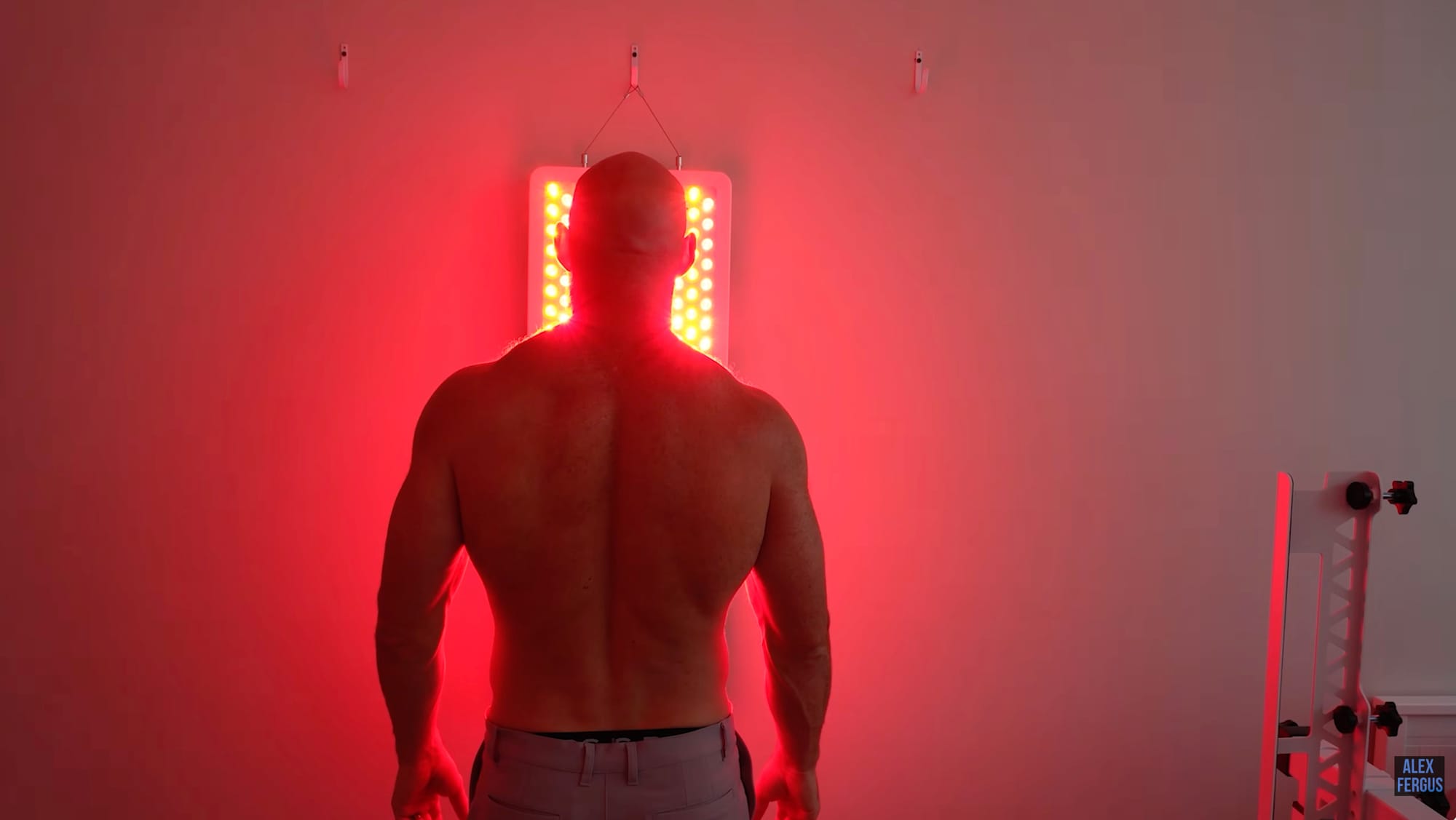
For surface-level applications, including general skincare and cosmetic treatments, the Bestqool Pro 300 may be adequate. It provides enough light output for smaller treatment areas, especially when you're not trying to cover a large portion of the body.
However, deeper tissue applications are a different story. If you're primarily interested in targeting muscles, joints, ligaments, or larger treatment areas, I would look elsewhere. The panel's relatively low power output and disappointing coverage make it a less appealing option for these purposes.
That doesn't mean the panel cannot deliver any useful light to deeper tissues. Rather, there are better-performing alternatives available, particularly if you're willing to spend a little more.
Is 940nm Near-Infrared Light a Benefit?
One of the Bestqool Pro 300's more unusual features is its inclusion of a substantial amount of light around 940–950nm.
Personally, I wouldn't prioritize this wavelength when choosing a panel. While this region of the near-infrared spectrum has some scientific interest, I don't see compelling evidence that makes it essential for a general-purpose red light therapy device.
If I were designing a panel, I would generally prefer 810nm or 830nm alongside 850nm, rather than placing so much emphasis on 940nm.
Of course, if you're specifically looking for a panel that emits a significant amount of light in the 940–950nm range, the Bestqool Pro 300 could be worth considering. But I wouldn't recommend choosing it solely because of that wavelength.
What I Like and Don't Like About the Bestqool Pro 300
There are some positives, especially given the price. But unfortunately, the negatives outweigh them.
What I like:
- The approximately $810 discounted price is very competitive for a panel of this size.
- Independent laboratory testing confirmed the advertised wavelengths.
- The panel includes a substantial amount of 940–950nm near-infrared light for those specifically interested in that range.
- Operation is simple, and the optional horizontal/vertical stand is a useful accessory.
What I don't like:
- Power output is relatively low compared with better-performing panels.
- Half-body coverage scores are disappointing.
- Light uniformity is poor at just 44%.
- The screen and control buttons feel low quality.
- There is no individual wavelength control, intensity adjustment, pulsing, or smart modes.
- The two-year warranty and 30-day return period are relatively short.
- International shipping costs can significantly reduce the panel's value.
For me, the biggest concerns aren't the missing smart modes or even the basic controls. They're the power output and light distribution. Those are fundamental aspects of a red light therapy panel, and they're precisely where the Bestqool Pro 300 struggles.
Final Verdict: Should You Buy the Bestqool Pro 300?
The Bestqool Pro 300 is an interesting example of why price alone shouldn't determine which red light therapy panel you buy. At about $810, it's undeniably affordable for its size, and independent lab results confirm its advertised wavelengths are present.
Unfortunately, that's where much of the good news ends. The panel delivers relatively weak power, disappointing coverage, and poor light uniformity. Its basic control system, limited customization, and shorter warranty further reduce its appeal.
If you're based in the United States, have a strict budget, and primarily want to treat smaller, surface-level areas, the Bestqool Pro 300 may still be worth considering. But if you want larger-area treatments, muscle recovery, or deeper tissue applications, I recommend looking at alternatives.
My overall rating is poor. While the low price is tempting, I believe it's worth investing in a panel that delivers stronger, more consistent light output. After all, a red light therapy panel is only a bargain if it performs well enough for your intended use.
Items Mentioned
⭐ Bestqool, view their product range at https://aferg.co/Bestqool and use code ALEX to save 10%.
Have You Seen These Reviews
♦️ Helio Cure Glow Review: They Actually Fixed the Problems!
♦️ This Back Pain Wrap Has Red Light, Heat & Vibration—But Does It Work?
♦️ PlatinumLED BioMax Go: They Finally Made a Handheld. Is It Any Good?
♦️ Sunlighten Red Light Therapy Panel Review: Powerful, But Something’s Missing
Found This Interesting? Then You Might Like
♦️ Methylene Blue And Red Light Therapy
♦️ 7 Red Light Therapy Myths That Are Wasting Your Time
♦️ Red Light Therapy And Facial Fat Loss: SURPRISING Science
♦️ How Your Bedroom Light is Wrecking Your Mental Health (And What to Do About It)
Alex's Bio
Alex Fergus wrote this blog post. Alex is an ISSN Sports Nutrition Specialist, Fitness Professional, and certified Superhuman Coach who continues to expand his knowledge base and help people across the world with their health and wellness. Alex is recognized as the National Record Holder in Powerlifting and Indoor Rowing and has earned the title of the Australian National Natural Bodybuilding Champion. Having worked as a health coach and personal trainer for over a decade, Alex now researches all things health and wellness and shares his findings on this blog.