
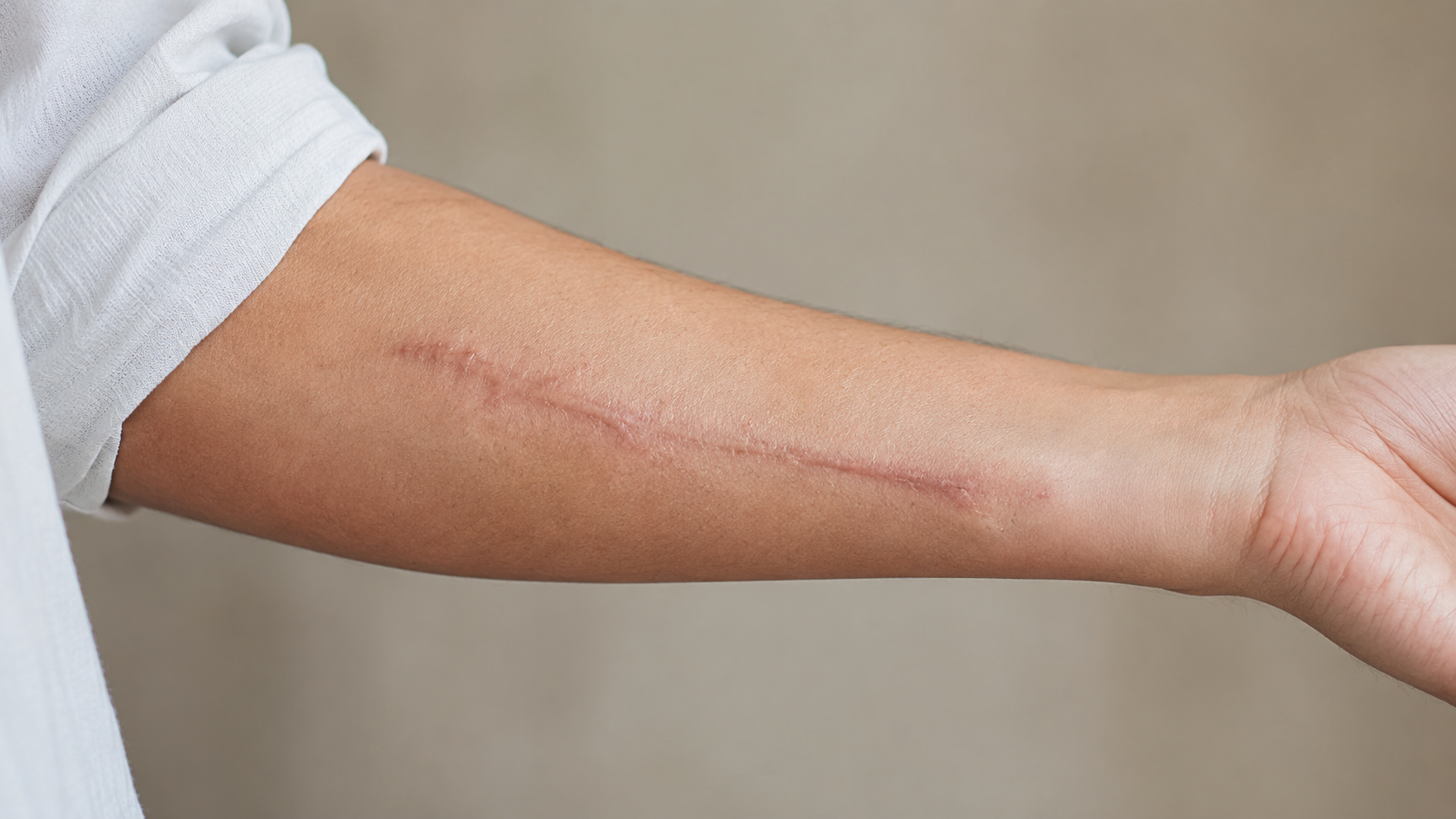
Another week, another newsletter. This week, a somewhat popular topic that we often get questions about in our Facebook group - scar tissue!
And, we've included our poll this week, on what distance people use their panels and tolerate it! Plus, a new review by Alex on a 1,064 nm-dominant panel, and more!
Stay tuned:
Red Light Therapy And Different Scars: New 2026 Review
This review is just out - from April 2026. The topic is "burn, hypertrophic, and post-surgical scars". That domain encompasses many different types of scars - hypertrophic here means from quick tissue growth, such as pregancy or the striae that I still have from starting in the gym as a teenager.
The researchers included previous studies with the following criteria:
- red light between 633-670nm
- near-infrared between 808-830nm
- using LED or lasers (also called "Low Level Laser Therapy" or "LLLT")
- monotherapy - so no other interventions.
Based on these criteria, a total of 7 studies were included. Here's the outcome of the study, described by the researchers:
"Results: Red LED improved [Vancouver Scar Scale - which measures discoloration, stiffness, and other criteria regarding scars] scores, pigmentation, and thickness in pediatric and adult burn scars, with greater benefits observed in scars < 12 months. In post-surgical scars, red LED reduced induration and improved [Patient and Observer Scar Assessment Scale] scores, with a biphasic dose-response favoring moderate fluence levels. Near-infrared [light therapy] improved color and elasticity in hypertrophic scars and reduced thickness, malleability, pain, and pruritus following hernia repair, thyroidectomy, and blepharoplasty. Across studies, [red light therapy] was well tolerated; transient erythema and warmth were most common, with rare blistering at higher fluences."
Let's break that statement down:
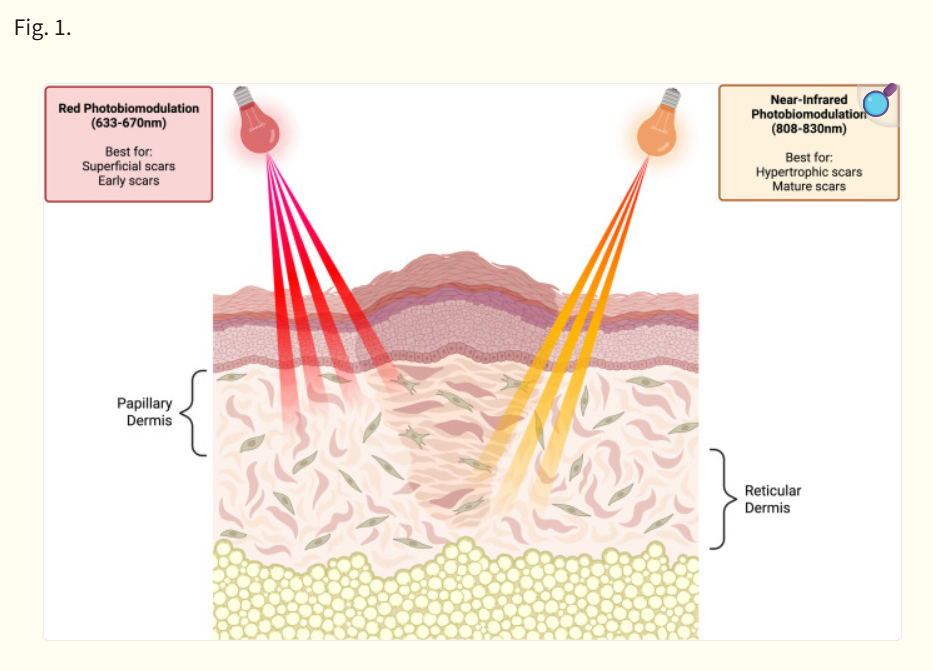
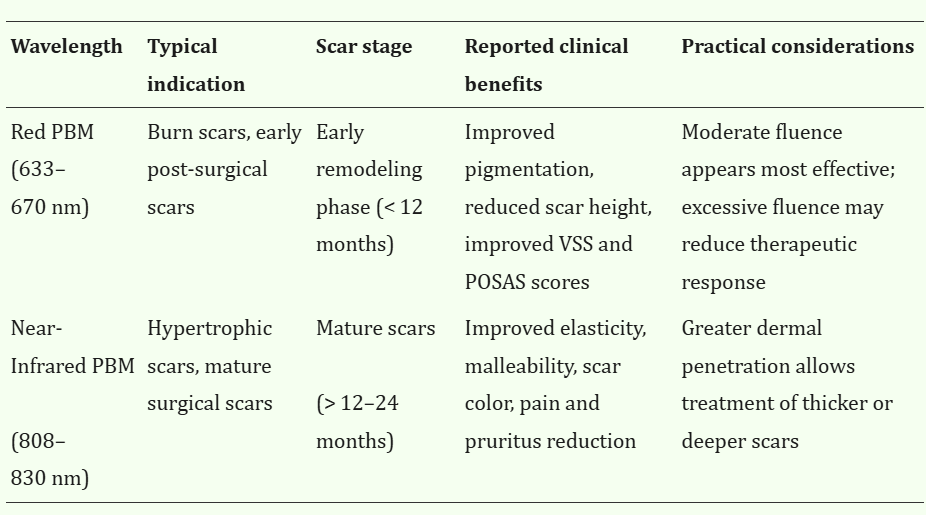
- Red light works best for early treatment as the outcomes in the first 12 months seem superior.
- Near-infrared light works as well, for different benefits, such as color and elasticity. (There's often discussion in our Facebook group about the use of near-infrared for superficial tissues such as the skin and eyes as many people think only red has benefits here)
- There were no real side effects, at most there was some redness and warmth, and, blistering apparently at higher doses (fluences).
- Generally though, mid-range doses work best, not the high doses. This accords to our viewpoint on wavelengths, penetration, etc.
Overall, the researchers showcase the benefits of different wavelengths in Figure 1 pretty decently:
What's interesting, moreover, is the good description and categorization of where red and near-infrared are best to be used specifically, in different cases, described in Table 1:
And, yes, we've got some criticism on this approach - more on that later.
(Also we'll publish a new episode in our advanced science red light therapy course on wound healing with our own breakdown of the data/science soon!)
Here's what researchers say regarding the use of red light - not near-infrared (NIR):
"Red LED therapy showed the most pronounced benefits in early burn scars and recent post-surgical scars. In pediatric and adult burn populations, scars younger than 12 months responded more robustly, suggesting that red wavelengths may be particularly effective during the early remodeling phase when fibroblast activity and collagen turnover are most active. In cosmetic postoperative scars, a biphasic dose-response was observed, with moderate fluence producing superior improvements in induration and [Patient and Observer Scar Assessment Scale] scores compared with both lower and higher doses."
So, again, moderate doses are best with red light, in the first 12 months after scar formation.
(I wish I'd knew this earlier, LOL!)
Then, there's the specific use of NIR described by the researchers:
"Near-infrared LED therapy generated consistent improvements across hypertrophic and post-surgical scars, including scars older than two years old and scars located in deeper anatomic sites. Improvements in pigmentation, elasticity, thickness, malleability, and patient satisfaction were observed across inguinal hernia repair, thyroidectomy, and blepharoplasty scars. The efficacy of near-infrared LED in older hypertrophic scars may reflect the deeper tissue penetration of 808–830 nm wavelengths, allowing modulation of fibroblast behavior and collagen remodeling even after the proliferative phase has subsided. The success of a self-administered 830 nm device in thyroidectomy patients further highlights the practicality and accessibility of [red light therapy] as an adjunctive treatment in routine postoperative care, although home use of medical devices using intense light should be considered with care."
The good news is that you yourself are able to apply this light therapy to scars. You generally don't need a medical professional to apply this, and LEDs are sufficient! So, any of the tabletop devices or handheld devices, will work well.
Lastly, there's the methodological quality of this review. I find it somewhat surprising that, no other wavelengths such as 590 nm amber or 850 nm NIR are included.
Then, there's the common issue that the wavelengths, devices, treatment protocols/frequencies, etc, all vary across the board. This is almost always the case in red light therapy research, and likely, not a good counterargument.
The conclusion is really good though, given the findings I've discussed so far:
"Red and near-infrared [light therapy] represents a safe, non-invasive adjunct for scar management. Current evidence suggests red wavelengths may be most effective for early, superficial scars, whereas near-infrared wavelengths may offer greater benefit for deeper or more mature scars. Although treatment parameters remain heterogenous, wavelength selection based on scar age and depth provides a rational framework for clinical use. Further, parameter-controlled trials are needed to establish the standard for this promising therapy."
Hard to go wrong with those guidelines. And if you want to learn more about dosing, check my guide HERE.
Red Light Therapy Poll:
We just posted another poll this week, with very surprising results, as it turns out that many people actually tolerate the light therapy panels with direct skin contact - which I'd personally NEVER thought to be true before:
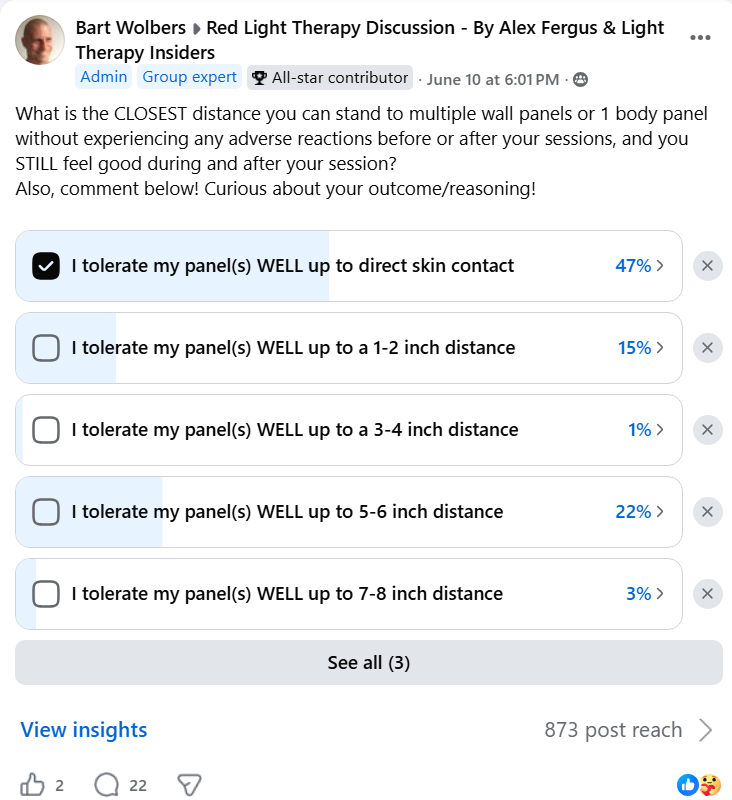
You can join the poll HERE, after joining our Facebook group HERE.
Also, Check Out Some Of Our Other Content:
Below you'll find some of our best content that you shouldn't miss:
- Best 1064nm Red Light Panel? Helio Glow Review & Lab Results - Back to reviewing by Alex, with a new brand and new panel that has quite an interesting 1,064 nm makeup. There are some huge pros and cons for this panel, so stay tuned...
- Red Light Therapy Certifications Explained: FDA, CE, UL & What They Really Mean - Should you really buy products based on certifications? Alex makes the case that most certifications don't focus on the most important essentials, and helps you understand what to really look out for when getting a product...
- Red Light Therapy For Cellulite: Why Adding Green Helps - Bart makes the case that red light therapy, and green light, help reduce cellulite mainly in women, but also if you target other lifestyle & nutrition strategies as well!
Light Therapy Advanced Science Course - Contains Content On Exercise Performance Too:
Join Bart's 100% free advanced science light therapy course above, where he takes deep dives into many different topics, such as mechanisms, neurology (Alzheimer's, Parkinson's, etc), exercise recovery, skin beauty & rejuvenation, and much more.
Some of the topics are only published in that course, such as UV light risks and benefits, addiction, anxiety, depression, and more. So join HERE!
Red Light Therapy Buyers Guide
 Alex Fergus
Red light therapy uses red and infrared light to achieve a biological effect. Dive into this topic and select a device that's right for you.
LED Mask Shopping Tool
My extension shopping tool compares all of the world's best (and not so good!) Red Light Masks.
How To Use Red Light Therapy 101: The Best Guide For Starters
 Alex Fergus
You have your device? Let me help you use it.
Red Light Panel Shopping Tool

My extension shopping tool compares all the world's best (and not-so-good!) Red Light Panels!
Exclusive - Discount Codes, Deals & Recommendations
 Alex Fergus
Shopping for a red light device? Use this resource to save! We've got deals for most of the big and best brands out there...
For a Limited Time shop at Block Blue Light and get p to 25% off. Use this link: https://aferg.co/BlockBlueLight to save . The discount will automatically be applied at checkout.