
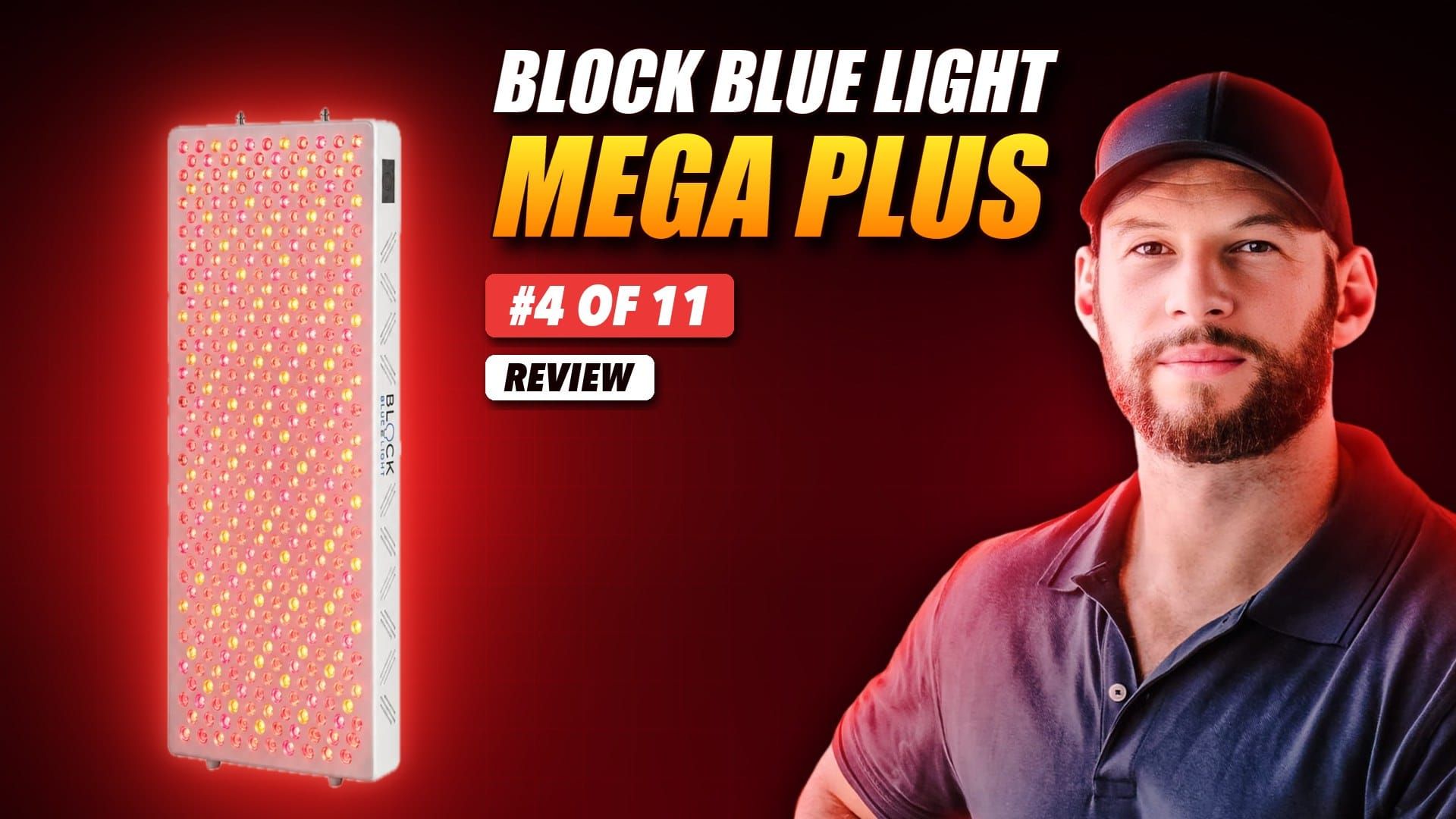
Block Blue Light calls the Mega Plus its most expansive Mega panel yet: a wide, 420-LED panel with seven wavelengths, a touchscreen and a five-year warranty. I put it through the same independent lab tests as the 10 other panels in my 2026 panel comparison.
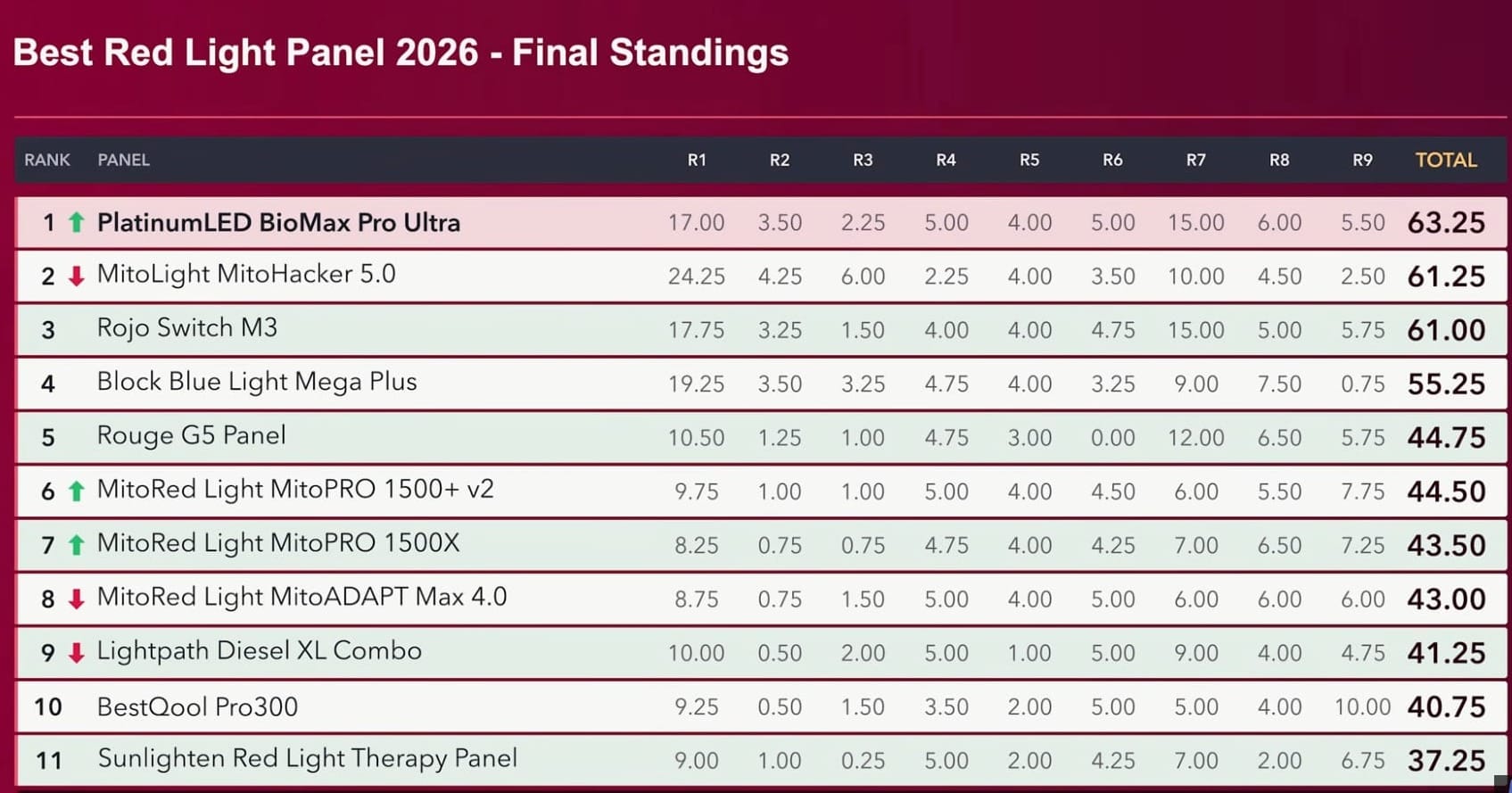
It finished 4th of 11 with 55.25 points. It was one of the strongest performers in the lab, but its price cost it heavily. Below, you'll find the lab's own measurements, including a heat map of its light, its spectrum and its output over a full session, plus how it compares with the original Mega and with its rivals.
🏆 Quick Answer: Is the Block Blue Light Mega Plus Worth It?
Score: 55.25 out of 100, 4th of 11 in my 2026 panel test.
The Mega Plus delivers some of the widest, most even light I measured, and it has the longest warranty in the test. But it leans heavily towards near-infrared (36.8% red), it has no built-in smart modes, and at $2,367 delivered it was the most expensive panel I tested.
- Best for: people who want wide, even coverage from a single flat panel and value a five-year warranty.
- Not ideal for: skin-first buyers (only 36.8% of its light is red) or anyone on a budget: it cost $757 more than the BioMax Pro Ultra, which won the test.
- Price when tested: $2,367 delivered to Austin, Texas, after the 15% discount through my link, with shipping and tax included.
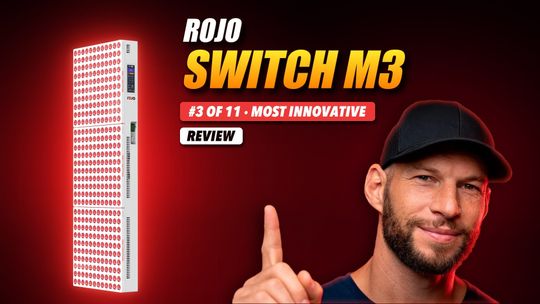
- Stronger choices: the PlatinumLED BioMax Pro Ultra (1st, 63.25 points, $1,610) and the Rojo Switch M3 (3rd, 61 points, $1,562; 2nd with its new 5-year warranty). Both cost about $800 less.
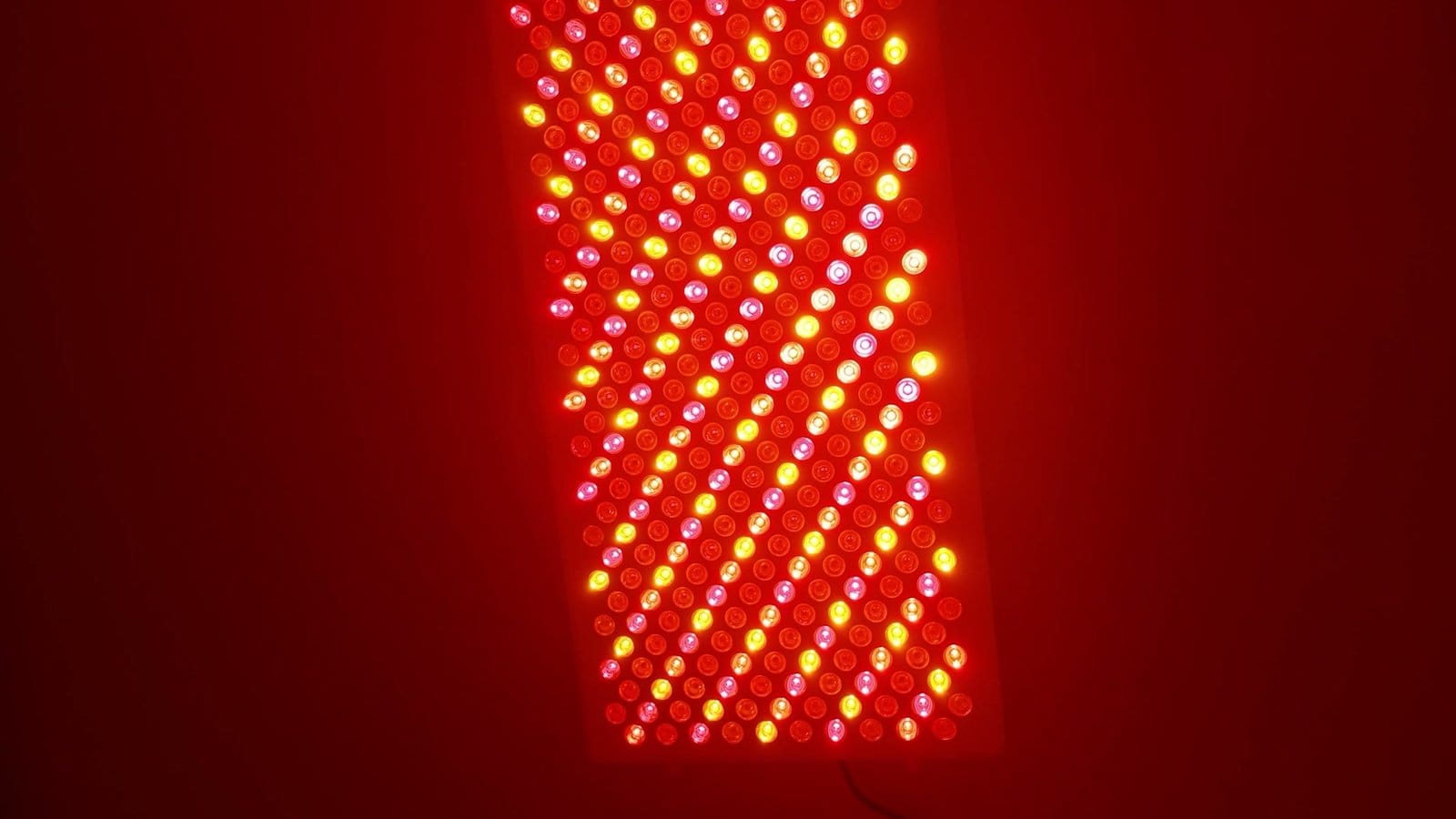
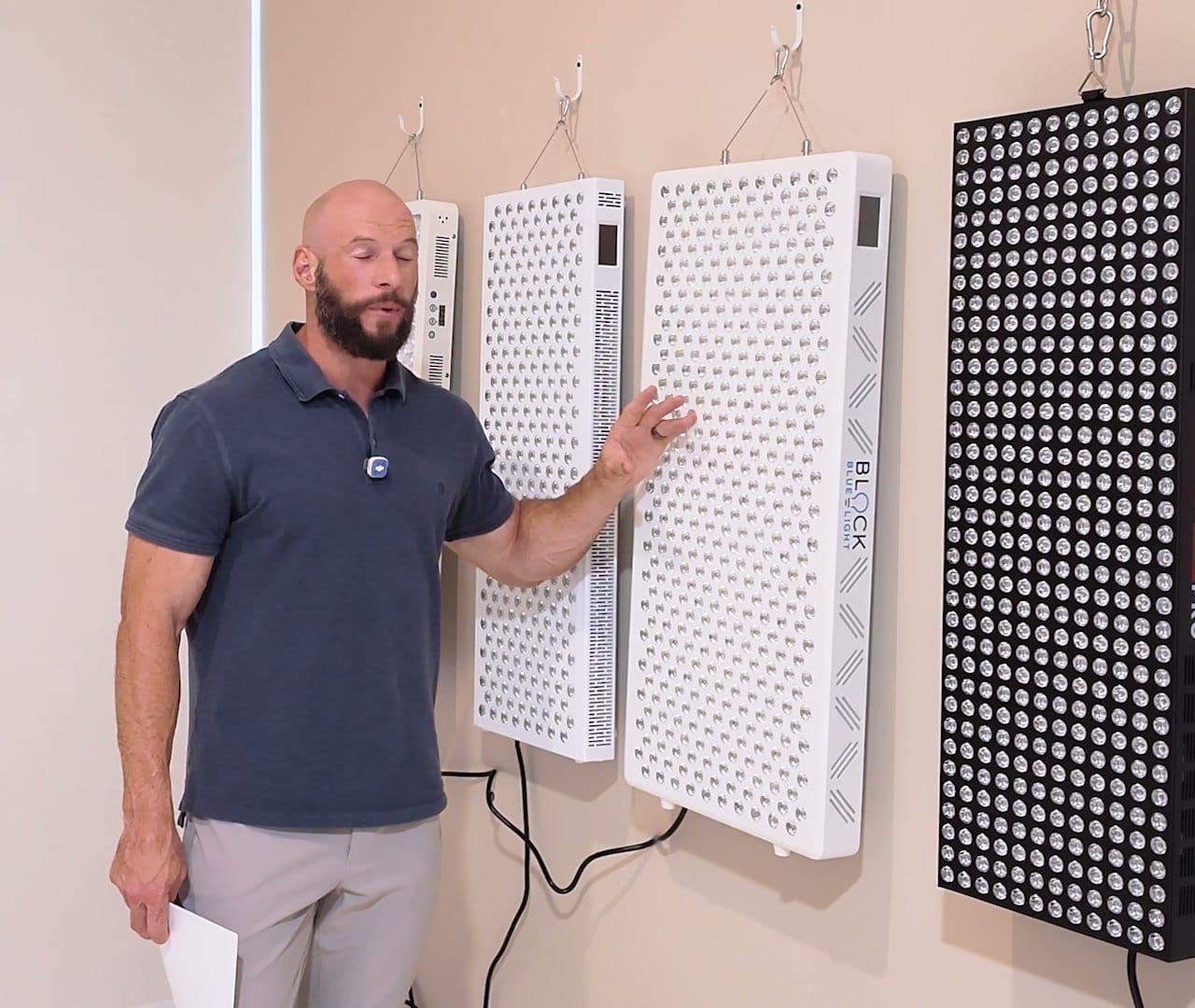
Block Blue Light Mega Plus
420 LEDs and seven wavelengths from 590 to 1060 nm, with per-wavelength dimming, near-infrared pulsing, four custom presets, a touchscreen, an app and a remote. Five-year warranty. My link takes 15% off automatically.
Key Lab Results at a Glance
- Light output: 260 W of light from 792 W of power (32.8% efficient).
- Face area at 12 inches: 81.4 mW/cm² on average (3.9% variation).
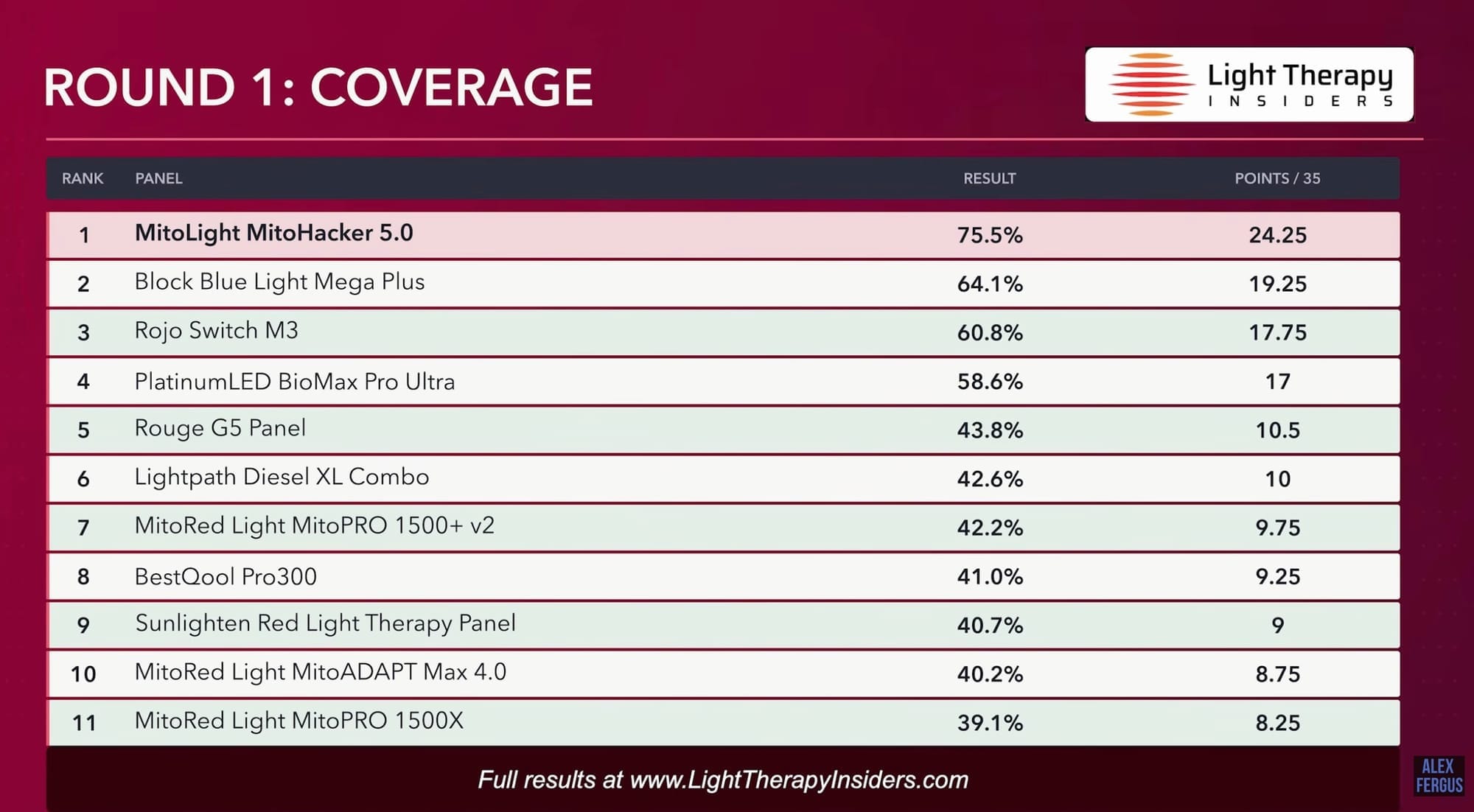
- 24 × 30 in test area: 47.2 mW/cm² on average, with 64.1% of the area at 30 mW/cm² or more (2nd of 11 for coverage).
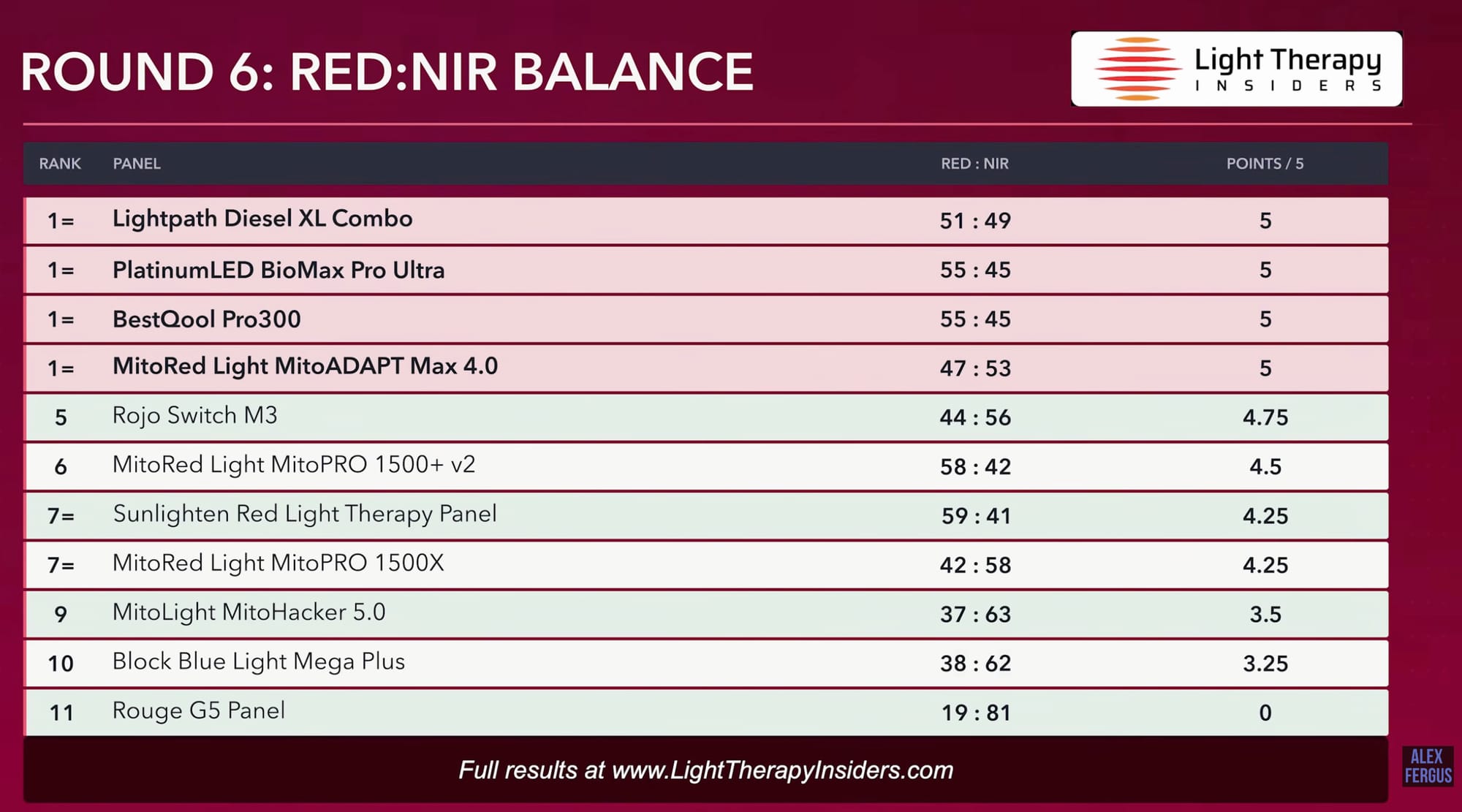
- Red vs. near-infrared: 36.8% red and 63.2% near-infrared (10th of 11 for balance).
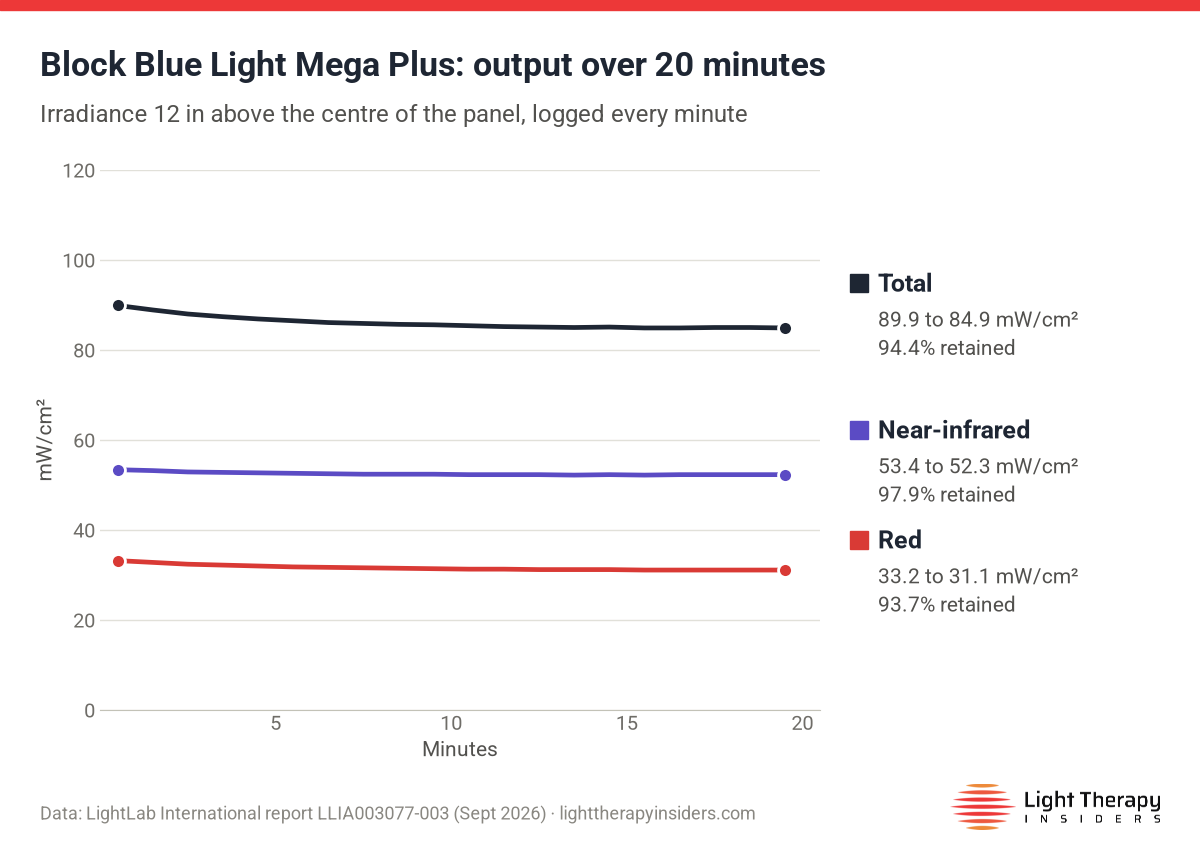
- Stability: 94.4% of its starting output after 20 minutes.
- Wavelengths: all five of my core wavelengths cleared 0.5 W/nm.
Here's how it scored in each round of my 2026 test:
| Round | Mega Plus Score | Rank (of 11) |
|---|---|---|
| 1. Coverage | 19.25 / 35 | 2nd |
| 2. Average irradiance | 3.5 / 5 | =2nd |
| 3. Uniformity | 3.25 / 10 | 2nd |
| 4. Optical stability | 4.75 / 5 | =6th |
| 5. Wavelengths | 4 / 5 | =1st |
| 6. Red:NIR balance | 3.25 / 5 | 10th |
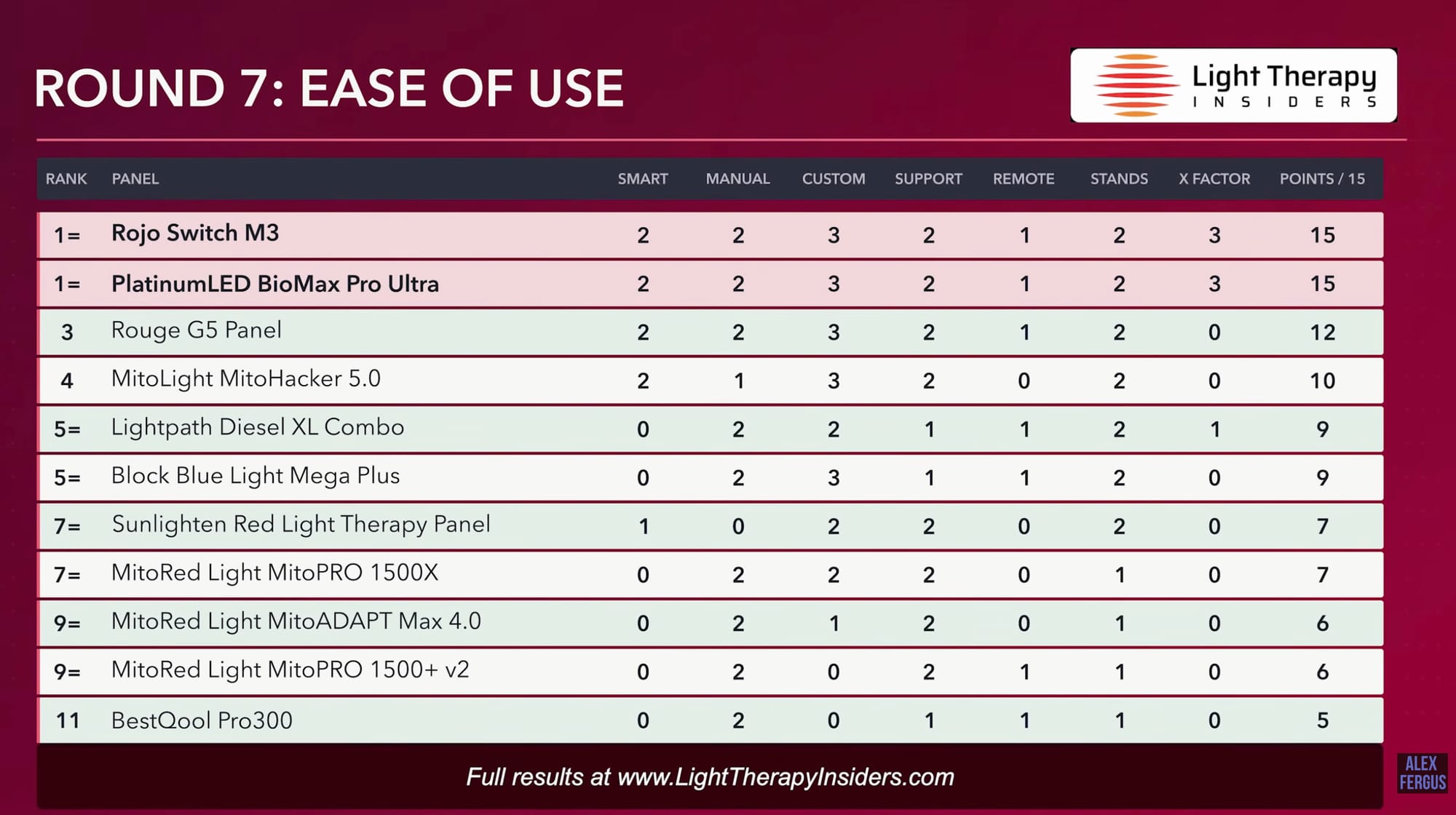
| 7. Ease of use | 9 / 15 | =5th |
| 8. Extras | 7.5 / 10 | 1st |
| 9. Price | 0.75 / 10 | 11th |
| Total | 55.25 / 100 | 4th |
What I Like
- Wide coverage: 64.1% of the 24 × 30 in test area got 30+ mW/cm², 2nd of 11
- Very even light: 2nd for uniformity, and its face area varied by just 3.9%
- Strong output: 81.4 mW/cm² over the face area and 47.2 mW/cm² across the test area at 12 inches
- A five-year warranty and the top extras score in my test (7.5 of 10)
- All five of my core wavelengths cleared 0.5 W/nm, and near-infrared output barely dropped over a session
What Could Be Better?
- The most expensive panel I tested: $2,367 delivered
- Near-infrared heavy: 36.8% red, 10th of 11 for balance
- No built-in smart modes, only four custom presets you set up yourself
- A 30-day trial, shorter than most rivals' return windows
- Its 590 nm amber and 1060 nm LEDs are a small part of the light
Block Blue Light Mega Plus Specs vs. Lab Results
Here's what Block Blue Light says about the Mega Plus, and what the independent lab measured:
| Spec | What Block Blue Light Says | What the Lab Measured |
|---|---|---|
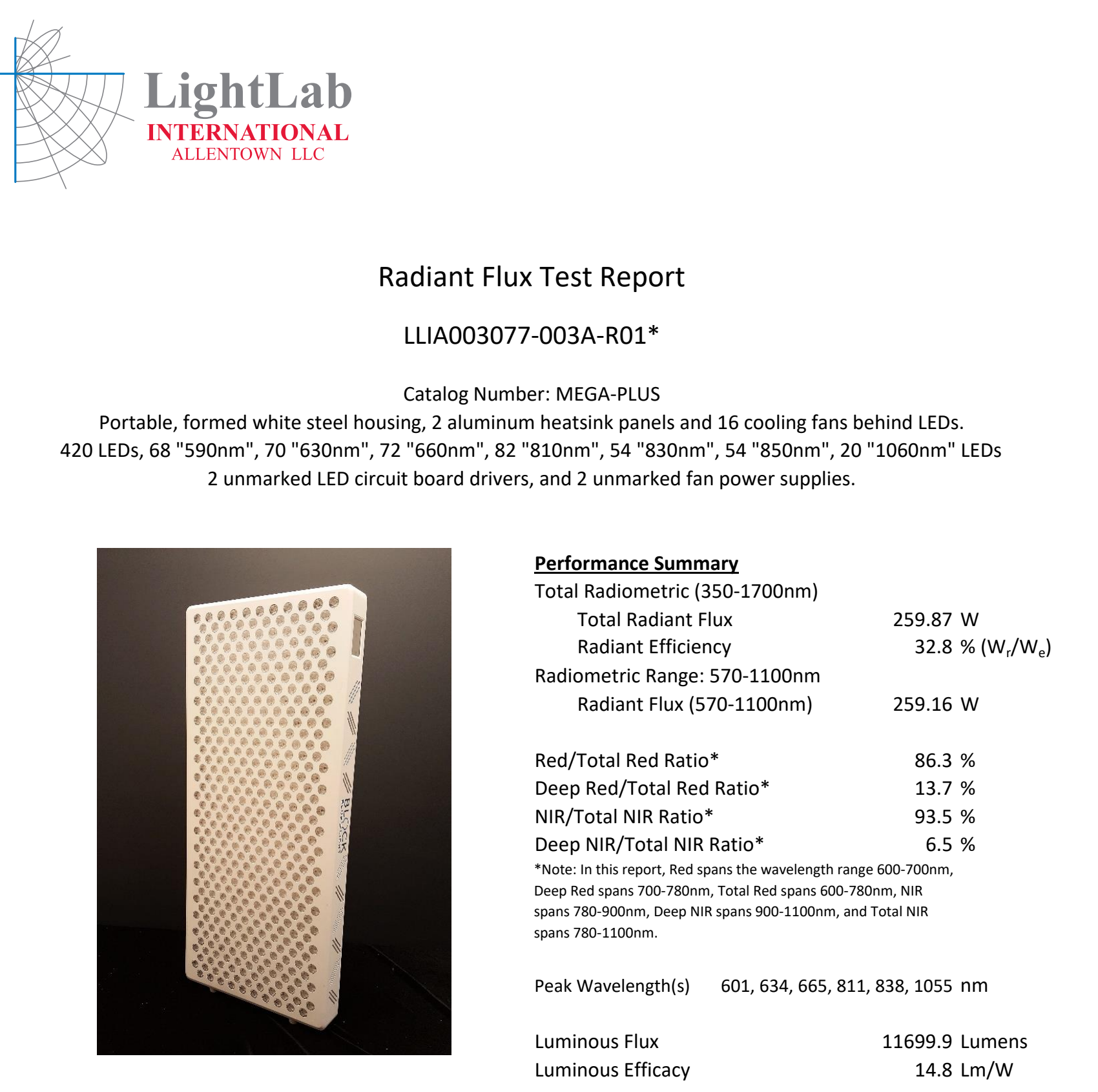
| LEDs | 420 × 5 W LEDs | 420 LEDs: 68 × 590, 70 × 630, 72 × 660, 82 × 810, 54 × 830, 54 × 850 and 20 × 1060 nm (the lab's LED labels) |
| Wavelengths | 590, 630, 650, 810, 830, 850 and 1060 nm | Peaks at 601, 634, 665, 811, 838 and 1055 nm |
| Red vs. near-infrared | Amber, red and near-infrared | 36.8% red, 63.2% near-infrared (amber is 1.8% of output) |
| Size | 93.5 × 40 × 6.5 cm (36.8 × 15.7 × 2.6 in) | Not measured |
| Irradiance | Up to 83.1 mW/cm² (distance not stated) | 81.4 mW/cm² over a face-sized area at 12 in; 47.2 mW/cm² average over 24 × 30 in |
| Power | 790 W | 792 W at 230 V |
| Light output | Not stated | 260 W of light: 32.8% of the power it draws |
| Controls | Touchscreen, app and remote; per-wavelength dimming; NIR pulsing; four presets | Not tested |
| Warranty and returns | 5 years; 30-day trial | Not applicable |
In the box: the panel, a remote, a power cable, an over-the-door hook, hanging cables with a height-adjusting pulley, protective eyewear and a printed manual. The lab ran the panel at 230 V.
Mega Plus vs. Mega: What's the Difference?
Block Blue Light still sells the original Mega. Here's how the two compare on Block Blue Light's own spec sheet (I only lab-tested the Mega Plus):
| Feature | Mega | Mega Plus |
|---|---|---|
| Size | 36.2 × 11.8 × 2.6 in | 36.8 × 15.7 × 2.6 in |
| LEDs | 300 × 5 W | 420 × 5 W |
| Wavelengths listed | 590, 630, 650, 810, 830, 850, 1060 nm | 590, 630, 650, 810, 830, 850, 1060 nm |
| Warranty | 5 years | 5 years |
| List price (7 Nov) | $1,499.95 | $2,559 |
The Mega Plus is about 4 inches wider, with 120 more LEDs, and costs about $1,060 more at list price. If you don't need the extra width, the original Mega is much cheaper. Here's my earlier Mega review.
How I Tested the Block Blue Light Mega Plus
The Mega Plus went through exactly the same process as all 11 panels in my 2026 panel comparison, so its scores sit directly beside theirs.
- Independent lab measurements. LightLab International, a photometric lab in Allentown, Pennsylvania, ran three tests in September 2026: total light output and spectrum in a 2-metre integrating sphere, output over 20 minutes, and an irradiance map at 12 inches measured every 2 inches (test report LLIA003077-003).
- Why 12 inches. I now test at 12 inches rather than 6, because readings taken close to the LEDs overstate how evenly a panel treats your body. Here's why.
- Nine scored rounds, 100 points. Coverage (35), average irradiance (5), uniformity (10), output stability (5), wavelengths (5), red-to-near-infrared balance (5), ease of use (15), extras such as warranty, returns, certifications, noise and expandability (10), and price (10).
Each brand, including Block Blue Light, paid LightLab for its own panel’s testing and provided its panel free of charge. The Mega Plus's scores use exactly the same lab data and scoring as every other panel.
Lab Results: How the Block Blue Light Mega Plus Performed
Coverage and Power at 12 Inches
Across the standard 24 × 30 in treatment area, the Mega Plus averaged 47.2 mW/cm² (=2nd of 11 for average irradiance), and 64.1% of the area got at least 30 mW/cm² (2nd for coverage).
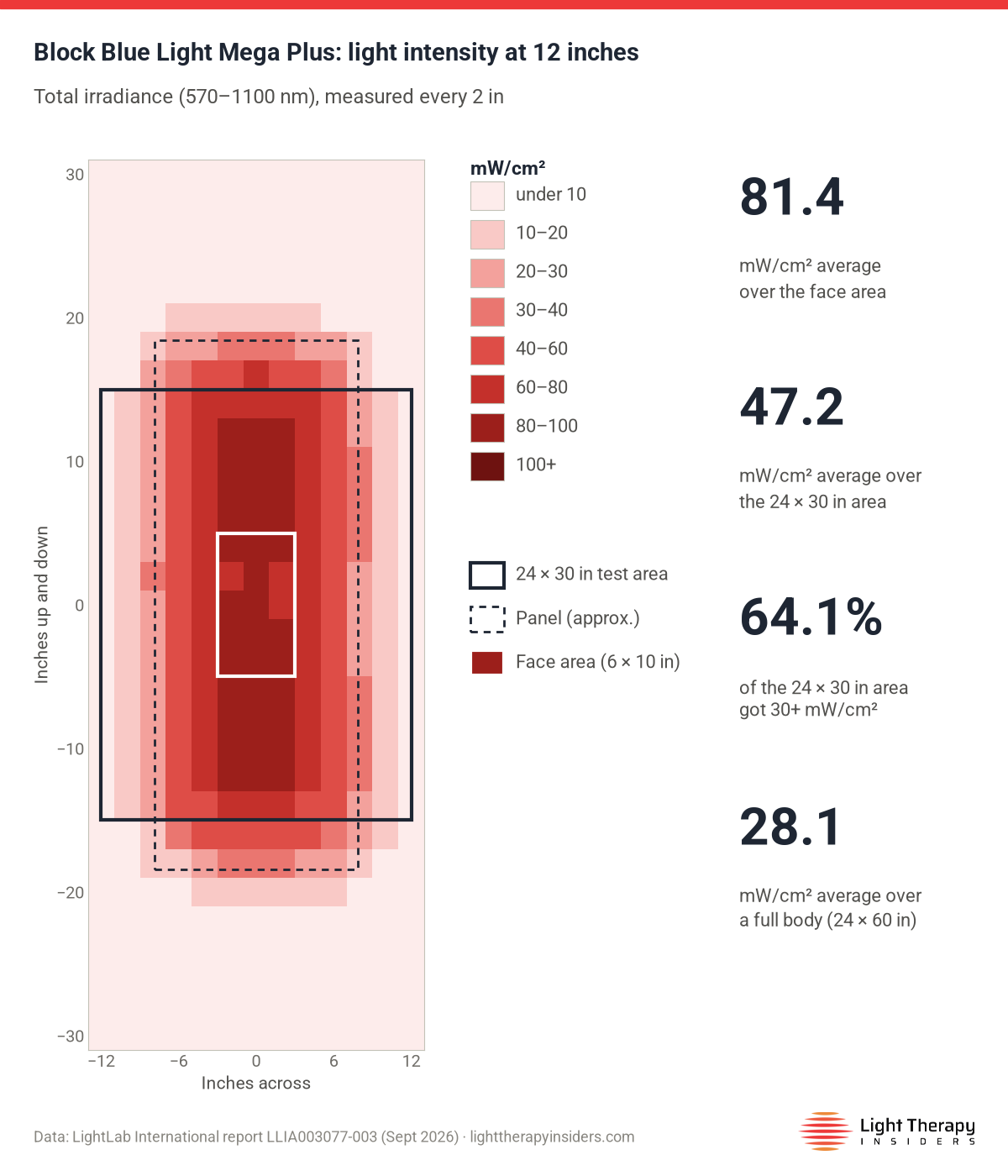
The heat map shows why it scored so well: a wide, even block of light about as wide as the panel itself. Across a full 24 × 60 in body area it averaged 28.1 mW/cm², 4th of the 11 panels.
Here's how the light holds up as the treatment area grows:
| Area at 12 in | Average (mW/cm²) | Lowest (mW/cm²) | Area at 30+ mW/cm² | Variation |
|---|---|---|---|---|
| Face (6 × 10 in) | 81.4 | 78.1 | 100% | 3.9% |
| Test area (24 × 30 in) | 47.2 | 3.3 | 64.1% | 66.7% |
| Full body (24 × 60 in) | 28.1 | 0.2 | 36.7% | 114.4% |
Evenness
Overall uniformity (average ÷ peak across the 24 × 30 in area) was 52.6%, 2nd of 11. Over a face-sized area at the centre, the light ranged from 78.1 to 89.7 mW/cm², varying by 3.9%. That's among the most even face-area results in the test, so whichever part of your face or body sits in front of the panel gets very similar light.
Output Over a Session
After 20 minutes the Mega Plus still delivered 94.4% of its starting output, =6th of 11 for stability (4.75 of 5 points). Red held at 93.7% and near-infrared at 97.9%.
As the LEDs warmed up, the peaks moved slightly longer, by up to 12 nm:
| Peak | After 30 sec | After 14.5 min | After 19.5 min |
|---|---|---|---|
| Amber | 596 nm | 601 nm | 601 nm |
| Red | 630 nm | 634 nm | 634 nm |
| Red | 661 nm | 665 nm | 665 nm |
| Near-infrared | 803 nm | 810 nm | 811 nm |
| Near-infrared | 832 nm | 838 nm | 838 nm |
| Deep near-infrared | 1045 nm | 1057 nm | 1057 nm |
Wavelengths
The lab found peaks at 601, 634, 665, 811, 838 and 1055 nm. All five of my core wavelengths (630, 660, 810, 830 and 850 nm) cleared the 0.5 W/nm bar, which earns 4 points, a score shared with six other panels. No panel cleared the bar for the two bonus wavelengths, 590 and 1064 nm.
| Wavelength | Measured (W/nm) | Counts in My Test? |
|---|---|---|
| 590 nm (bonus) | 0.193 | ✗ No |
| 630 nm | 1.369 | ✓ Yes |
| 660 nm | 1.637 | ✓ Yes |
| 810 nm | 2.352 | ✓ Yes |
| 830 nm | 1.702 | ✓ Yes |
| 850 nm | 1.399 | ✓ Yes |
| 1064 nm (bonus) | 0.112 | ✗ No |
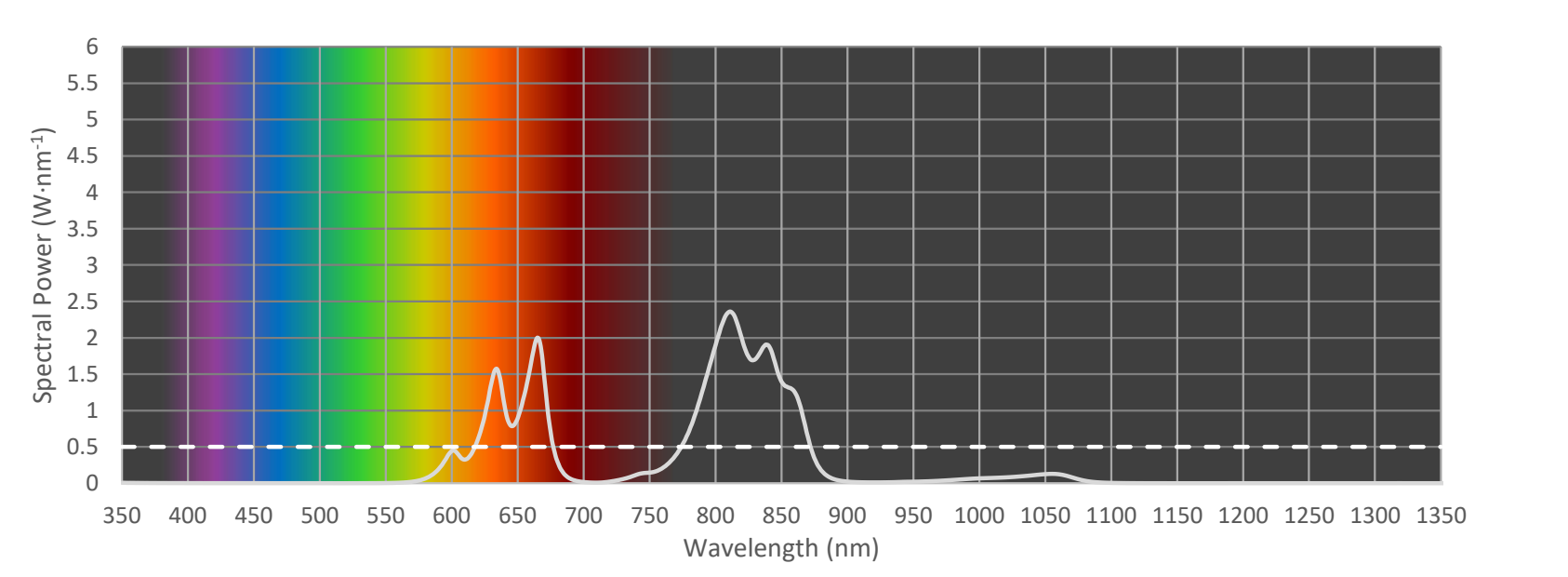
Its 590 nm amber reached 0.19 W/nm and its 1060 nm 0.11 W/nm, so neither earned the bonus points. Together, amber and the 900–1100 nm band make up under 6% of the light.
Red vs. Near-Infrared Balance
36.8% of the Mega Plus's light is red (600–780 nm) and 63.2% near-infrared (780–1100 nm). That cost it points: 3.25 of 5, 10th of 11. Red is the range most studied for skin, while near-infrared reaches deeper tissue, so out of the box the Mega Plus leans towards muscles, joints and recovery. You can dim the near-infrared wavelengths to shift the balance.
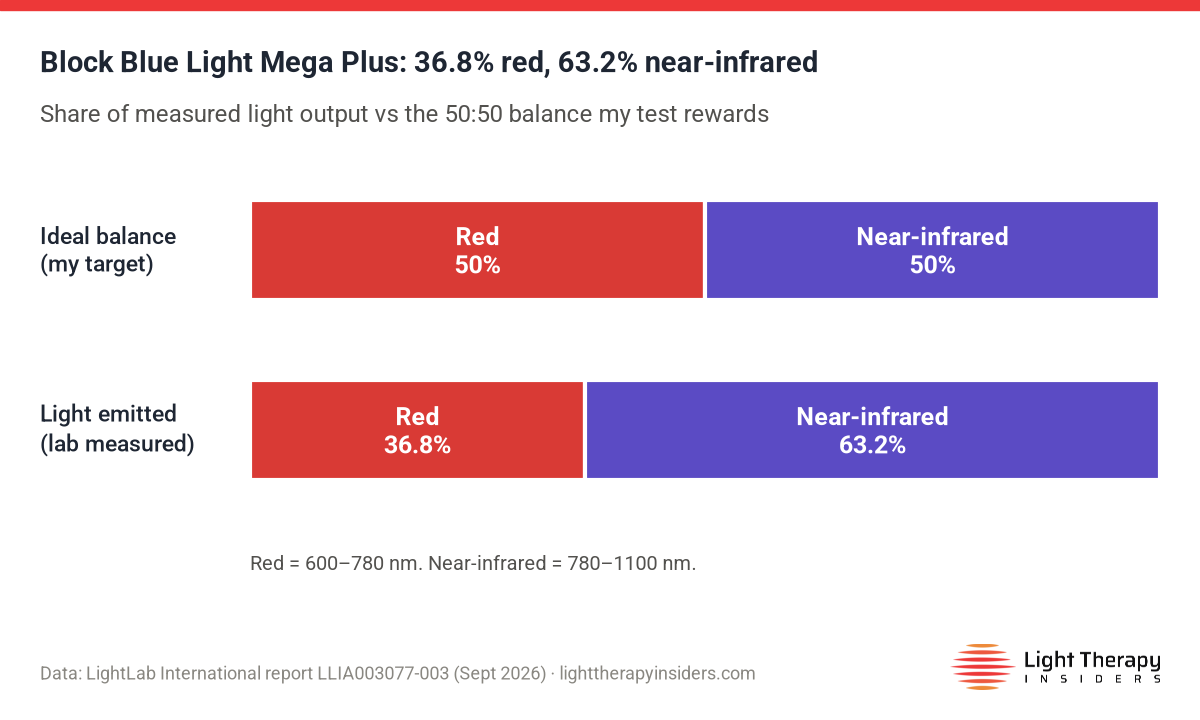
The lab's breakdown of where the light goes:
| Waveband | Light Output | Share |
|---|---|---|
| Amber (570–600 nm) | 4.77 W | 1.8% |
| Red (600–700 nm) | 80.75 W | 31.1% |
| Deep red (700–780 nm) | 12.80 W | 4.9% |
| Near-infrared (780–900 nm) | 150.35 W | 57.9% |
| Deep near-infrared (900–1100 nm) | 10.49 W | 4.0% |
| Total light output | 259.87 W | 100% |
Using the Block Blue Light Mega Plus
It scored 9 of 15 for ease of use (=5th): full marks for customisation, the manual, the remote and stand options, but 0 for built-in smart modes and 1 of 2 for support channels.
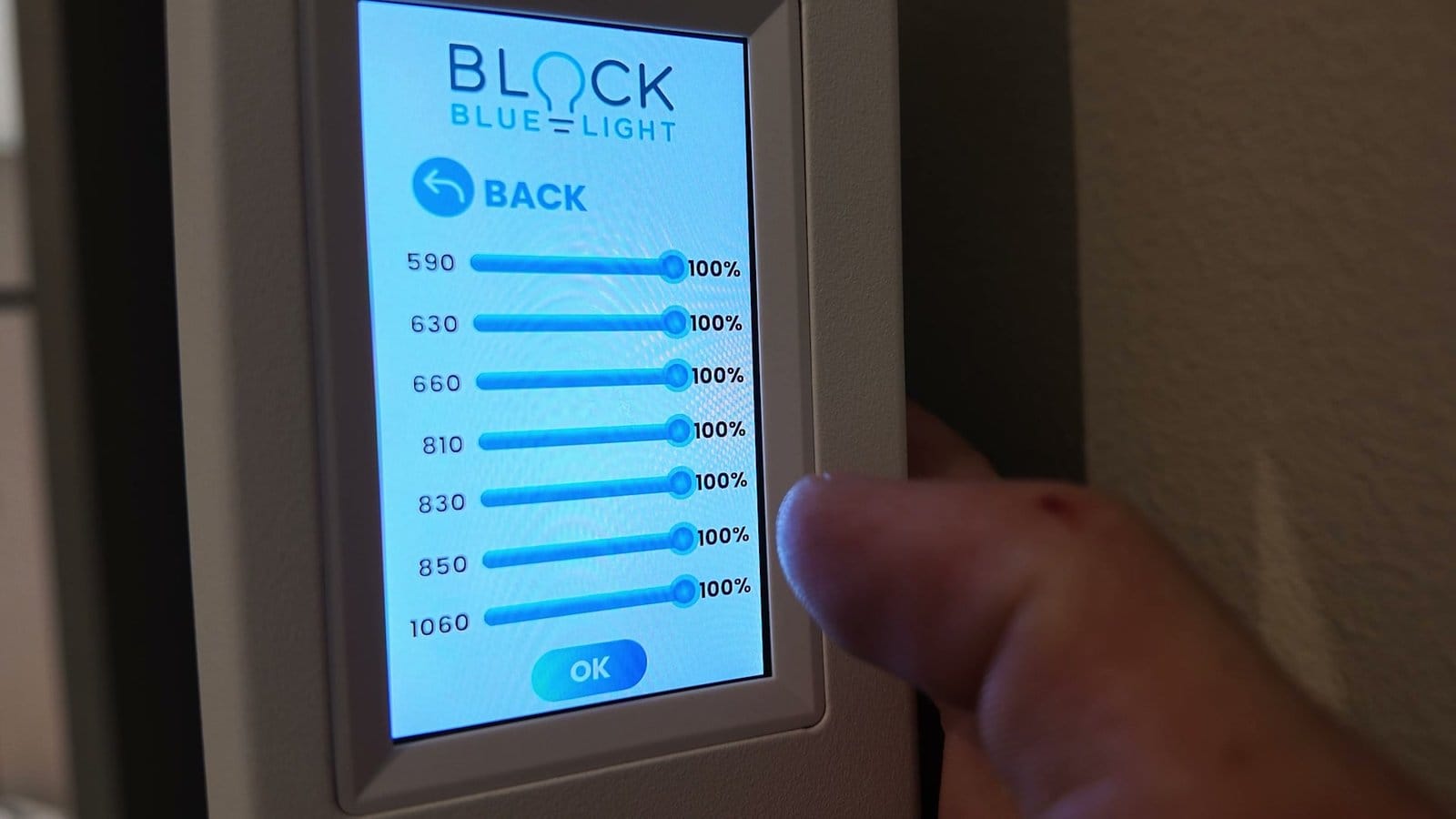
- Touchscreen with direct access to the timer, dimming, pulsing and presets
- Per-wavelength dimming from 1% to 100%
- Near-infrared pulsing from 0 to 9,999 Hz
- Four custom presets to save your favourite settings
- Bluetooth app and remote control
- Modular design: PowerPanels can be linked physically and electronically to build a bigger setup
A Starting Protocol
These starting points are based on what the research suggests for skin and on the lab's measurements at 12 inches.
- Face and skin: aim for about 5–9 J/cm². At 12 inches the Mega Plus delivers about 81 mW/cm² over the face with every wavelength on, so that dose takes roughly 1.0 to 1.8 minutes.
- Joints, muscles and recovery: 5–10 minutes per area at 12 inches. My dosing chart shows the ranges studies have used.
- Eyes: wear eye protection. Near-infrared is invisible, and these panels are bright. More in my eye safety guide.
Price, Shipping, Warranty and Returns
I priced every panel the same way: delivered to Austin, Texas, after my discount code or link, with shipping and tax included. On that basis the Mega Plus cost $2,367 at the time of filming and scored 0.75 of 10 for price (11th of 11).
- Discount: my Block Blue Light link takes 15% off automatically (already counted in the $2,367). The list price was $2,559 when I checked on 7 November.
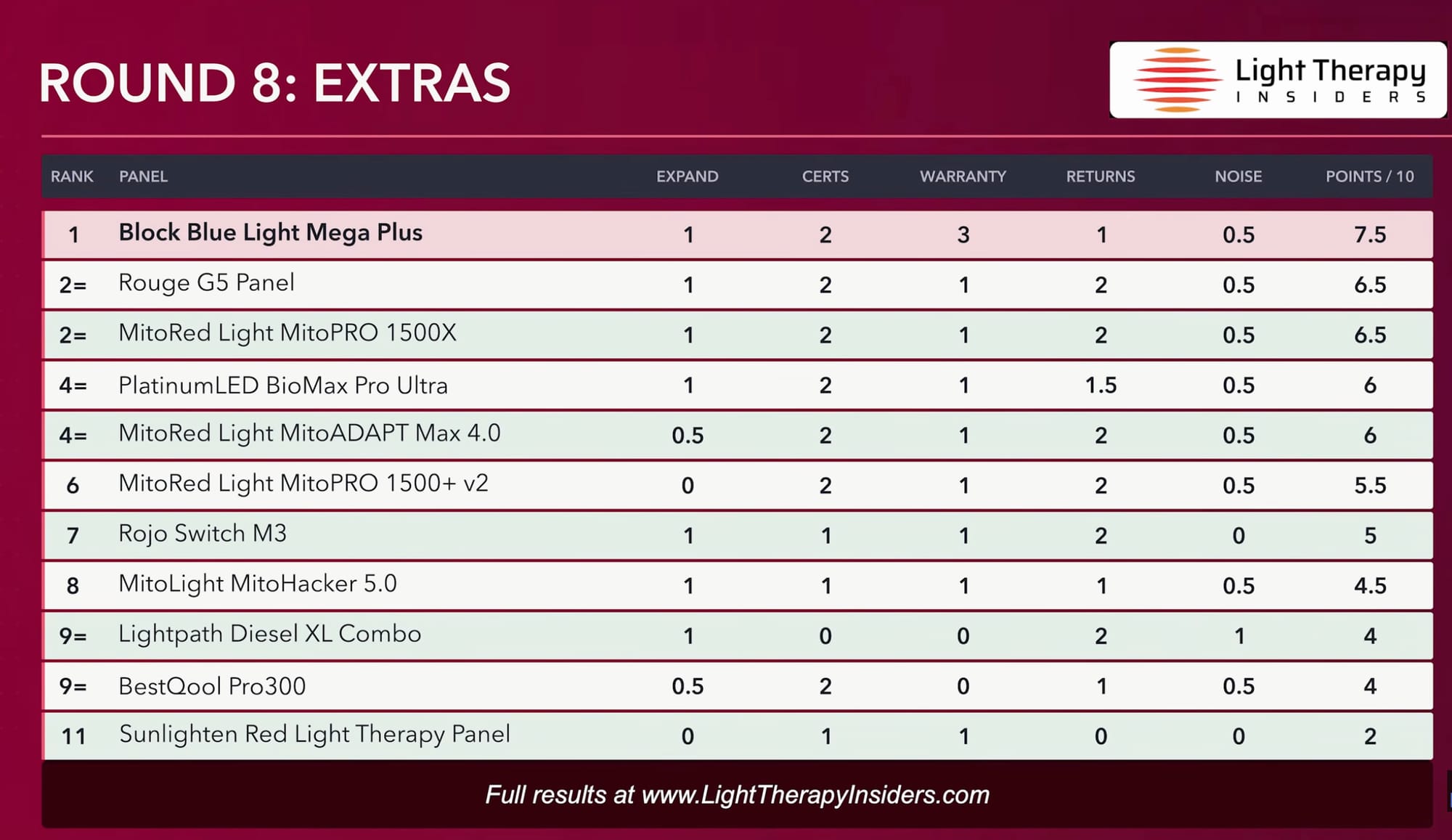
- Warranty: five years, the longest in my test, scoring 3 of 3.
- Returns: a 30-day trial with no restocking fee, scoring 1 of 3.
- Noise: between 40 and 50 dB in testing, scoring 0.5 of 1.
Overall it scored 7.5 of 10 for extras, the best in the test: 1 of 1 for expandability, 2 of 2 for certification evidence, 3 of 3 for warranty, 1 of 3 for returns and 0.5 of 1 for noise.
Who Should Buy the Block Blue Light Mega Plus?
Buy it if you:
- Want wide, even coverage from one flat panel
- Value a five-year warranty
- Want per-wavelength dimming and pulsing
- Mainly use red light therapy for muscles, joints and recovery
Look elsewhere if you:
- Are on a budget: the BioMax Pro Ultra and Rojo Switch M3 both cost about $800 less and scored higher
- Mainly want skin results: a red-rich panel suits you better
- Want built-in smart modes
- Want a long return window
Block Blue Light Mega Plus vs. the Alternatives
Here's how the Mega Plus compares with the panels around it in my 2026 test (all measured at 12 inches over the same 24 × 30 in area, and priced delivered to Texas after discount codes, with shipping and tax):
| Panel | 2026 Score | Area at 30+ mW/cm² | Avg. Irradiance (mW/cm²) | Red Share | Price Tested |
|---|---|---|---|---|---|
| PlatinumLED BioMax Pro Ultra | 63.25 (1st) | 58.6% | 48.6 | 54.7% | $1,610 |
| MitoLight MitoHacker 5.0 | 61.25 (2nd) | 75.5% | 54.8 | 37.1% | $2,114 |
| Rojo Switch M3 | 61.00 (3rd) | 60.8% | 46.8 | 43.6% | $1,562 |
| Block Blue Light Mega Plus | 55.25 (4th) | 64.1% | 47.2 | 36.8% | $2,367 |
| Rouge G5 Panel | 44.75 (5th) | 43.8% | 30.5 | 19.3% | $1,564 |
Best Overall Alternative: PlatinumLED BioMax Pro Ultra
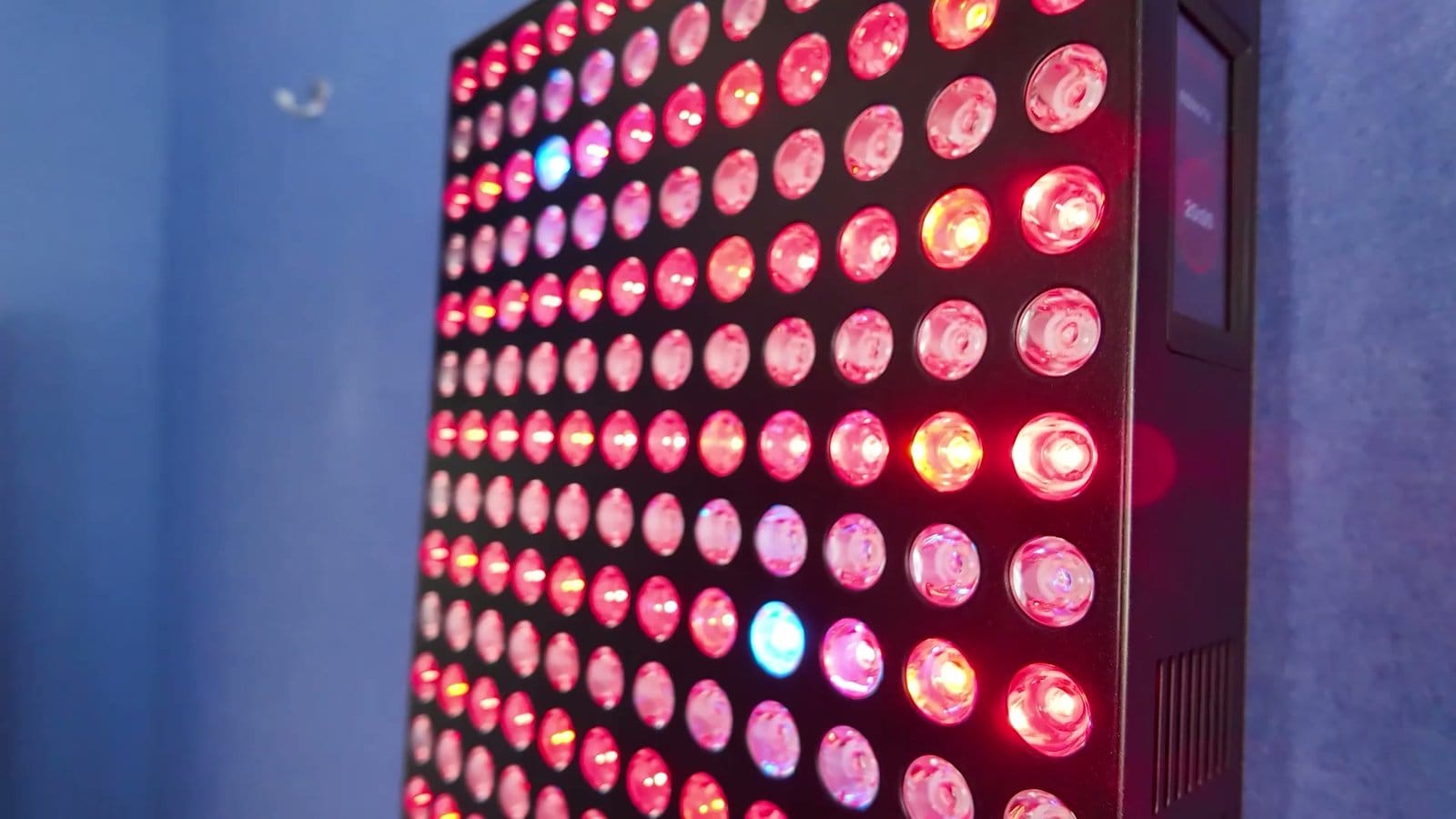
PlatinumLED BioMax Pro Ultra (2026 winner)
$757 less than the Mega Plus delivered: 1st place, similar average irradiance (48.6 vs. 47.2 mW/cm²), far more red light (54.7% vs. 36.8%), smart modes and full marks for ease of use. The Mega Plus covered more of the test area and has a longer warranty. 5% off through my link.
Read my full PlatinumLED BioMax Pro Ultra review.
Most Innovative Alternative: Rojo Switch M3
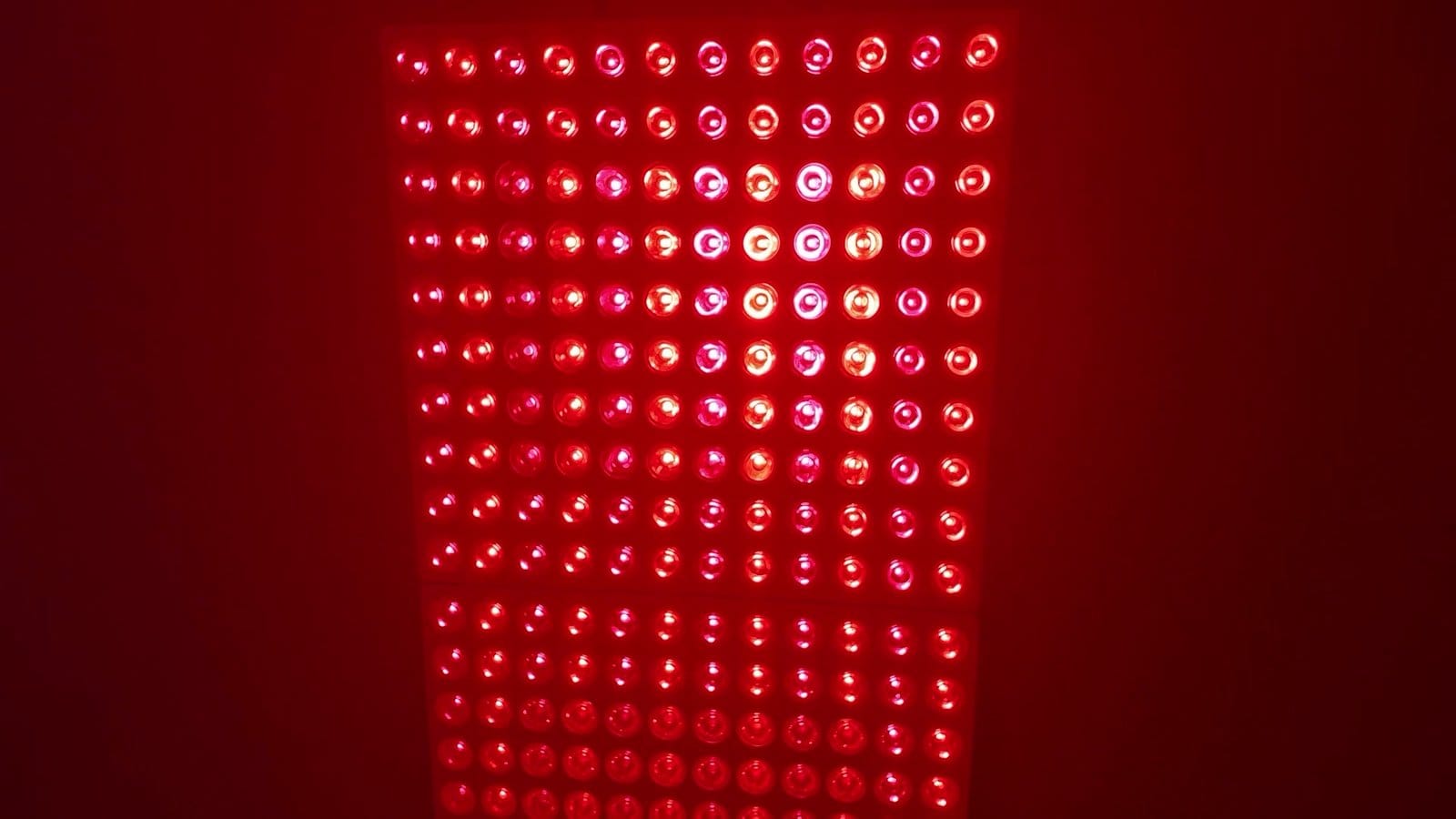
Rojo Switch M3 (3rd)
$805 less delivered: similar coverage (60.8% vs. 64.1%), slightly less average irradiance (46.8 vs. 47.2 mW/cm²), more red light (43.6%), and swappable modules with zone control. It's louder and less even. Code ALEX for 10% off.
Read my full Rojo Switch M3 review.
Other Panels to Consider
- vs. MitoHacker 5.0: 2nd place, wider coverage (75.5%) and about $250 cheaper delivered, but sold in the EU and UK only. MitoHacker 5.0 review
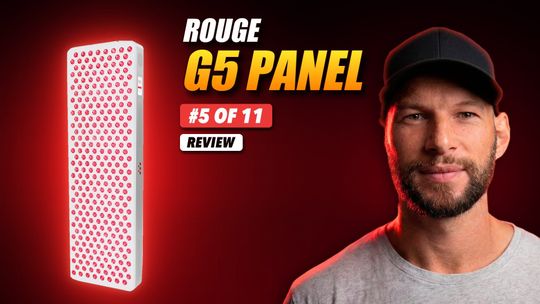
- vs. Rouge G5: about $800 cheaper, with better controls, but a much narrower strong zone and far less red light. Rouge G5 review
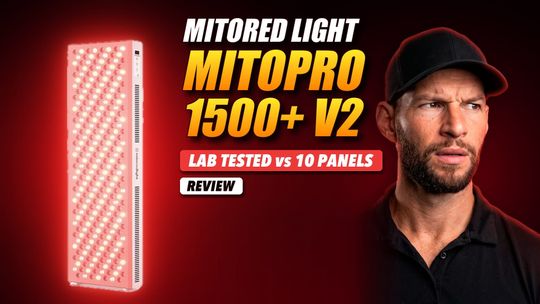
- vs. MitoPRO 1500+ v2: about $1,100 cheaper and red-rich (58.1%), but with much less coverage and almost no controls. MitoPRO 1500+ v2 review
⭐ My Reviews ⭐
Block Blue Light Mega Plus FAQ
Is the Block Blue Light Mega Plus worth it?
If you want wide, even coverage from one flat panel and a five-year warranty, and the price suits you, yes. It placed 4th of 11 in my 2026 lab test. For most buyers, the BioMax Pro Ultra and Rojo Switch M3 scored higher and cost about $800 less.
What's the difference between the Mega Plus and the Mega?
The Mega Plus is about 4 inches wider (15.7 vs. 11.8 in) with 420 LEDs instead of 300, and lists for about $1,060 more. Both have a five-year warranty.
Is the Mega Plus good for skin?
It works, but only 36.8% of its light is red. For the face, at 12 inches it delivers about 81 mW/cm², so a 5–9 J/cm² dose takes roughly 1 to 2 minutes with everything on. You can dim the near-infrared wavelengths for a redder session.
Does it have 1060 nm and 590 nm?
Yes, but both are a small part of the light: 0.11 W/nm at 1060 nm and 0.19 W/nm at 590 nm, below my 0.5 W/nm threshold.
Can I connect more panels?
Yes. Block Blue Light's PowerPanels can be linked physically and electronically to build a bigger setup.
What's the warranty and return policy?
A five-year warranty, the longest in my test, and a 30-day trial.
Is there a Block Blue Light discount?
Yes. My link takes 15% off automatically at checkout. See my discount codes page for other brands.
Final Thoughts
The Mega Plus is one of the best-performing flat panels I tested: wide, strong and remarkably even, with the longest warranty in the test. It's held back by a near-infrared-heavy balance, a lack of smart modes and, above all, its price.
If you want a big, even single panel and the warranty matters to you, it's a solid choice. If value matters more, the two panels that beat it cost about $800 less.
Score: 55.25 out of 100, 4th of 11 in my 2026 panel test.
- Buy the Mega Plus if you want wide, even coverage and a five-year warranty: check the Mega Plus price (15% off through my link).
- For most buyers, the PlatinumLED BioMax Pro Ultra is the better all-rounder: it won the 2026 test, and the link takes 5% off.
Items Mentioned
🔥🔥 Check this blog daily for the latest Red Light Therapy Black Friday and Cyber Monday deals: https://aferg.co/black-friday-cyber-monday 🔥🔥
⭐ Sunlighten- Use code Fergus at https://aferg.co/sunlighten
⭐ Mito Light Europe - Use code ALEX at https://aferg.co/mitolight for 5% off!
⭐ MitoRed Light - use https://aferg.co/7d221 for 5% off sitewide.
⭐ Rojo Light Therapy - Use discount code ALEX at https://aferg.co/rojo-rlt for 10% off.
⭐ LightpathLED - Use discount code ALEX at https://aferg.co/lightpathled to get 5% off.
⭐ BestQool - use code ALEX at https://aferg.co/Bestqool to save 10%.
⭐ Block Blue Light - Use this link: https://aferg.co/BlockBlueLight to save 15% on Block Blue Light's products. The discount will automatically be applied at checkout.
⭐ PlatinumLED Therapy Lights- Use the discount link https://aferg.co/redled to save 5%
⭐ Rouge - Use discount code ALEX at https://aferg.co/rougecare for $50 off.
✨ Have you explored my website ✨
Discover guides, reviews, and insights to help you make the most of light therapy
Alex's Bio
Alex Fergus wrote this blog post. Alex is an ISSN Sports Nutrition Specialist, Fitness Professional, and certified Superhuman Coach who continues to expand his knowledge base and help people across the world with their health and wellness. Alex is recognized as the National Record Holder in Powerlifting and Indoor Rowing and has earned the title of the Australian National Natural Bodybuilding Champion. Having worked as a health coach and personal trainer for over a decade, Alex now researches all things health and wellness and shares his findings on this blog.