
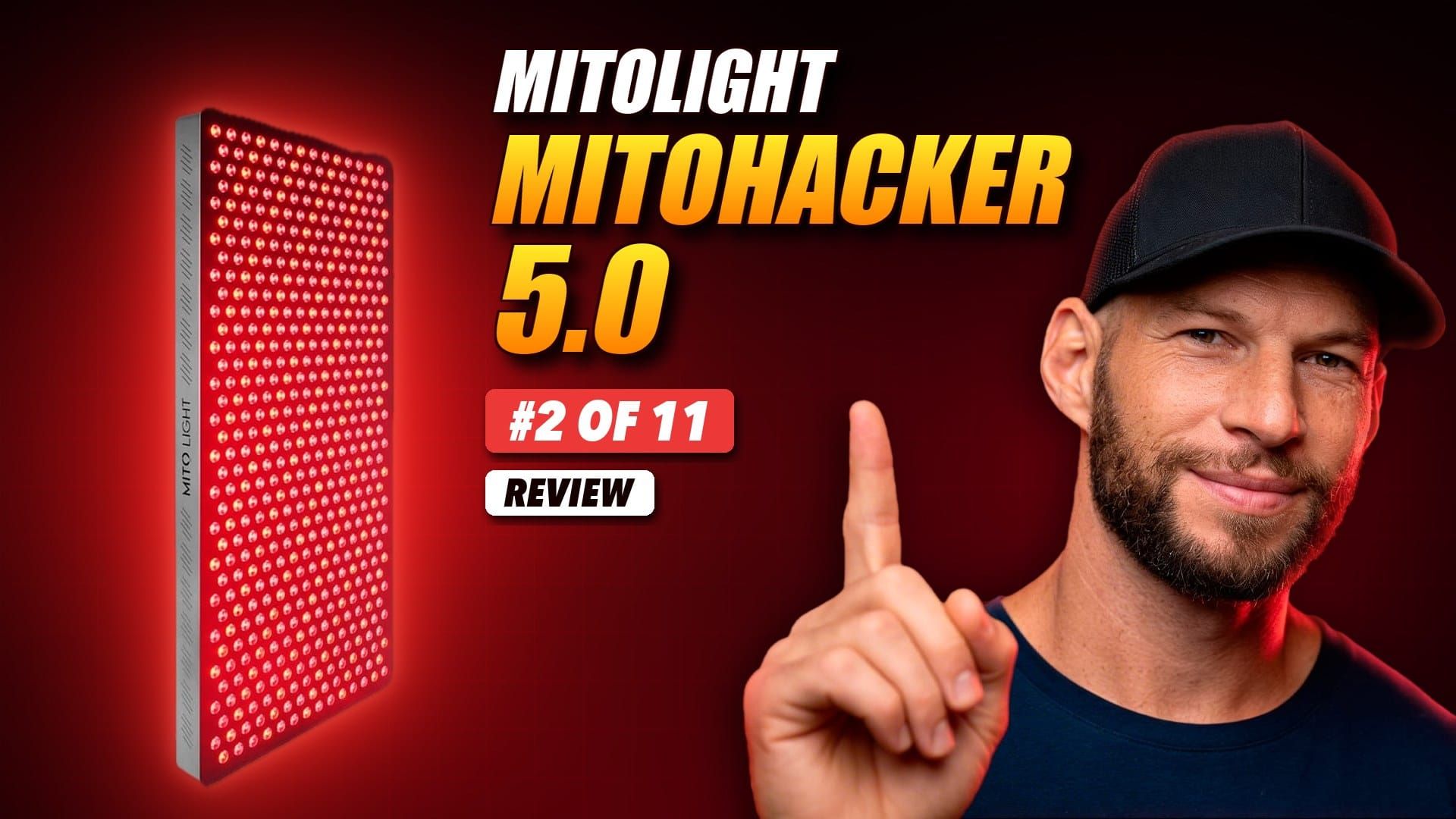
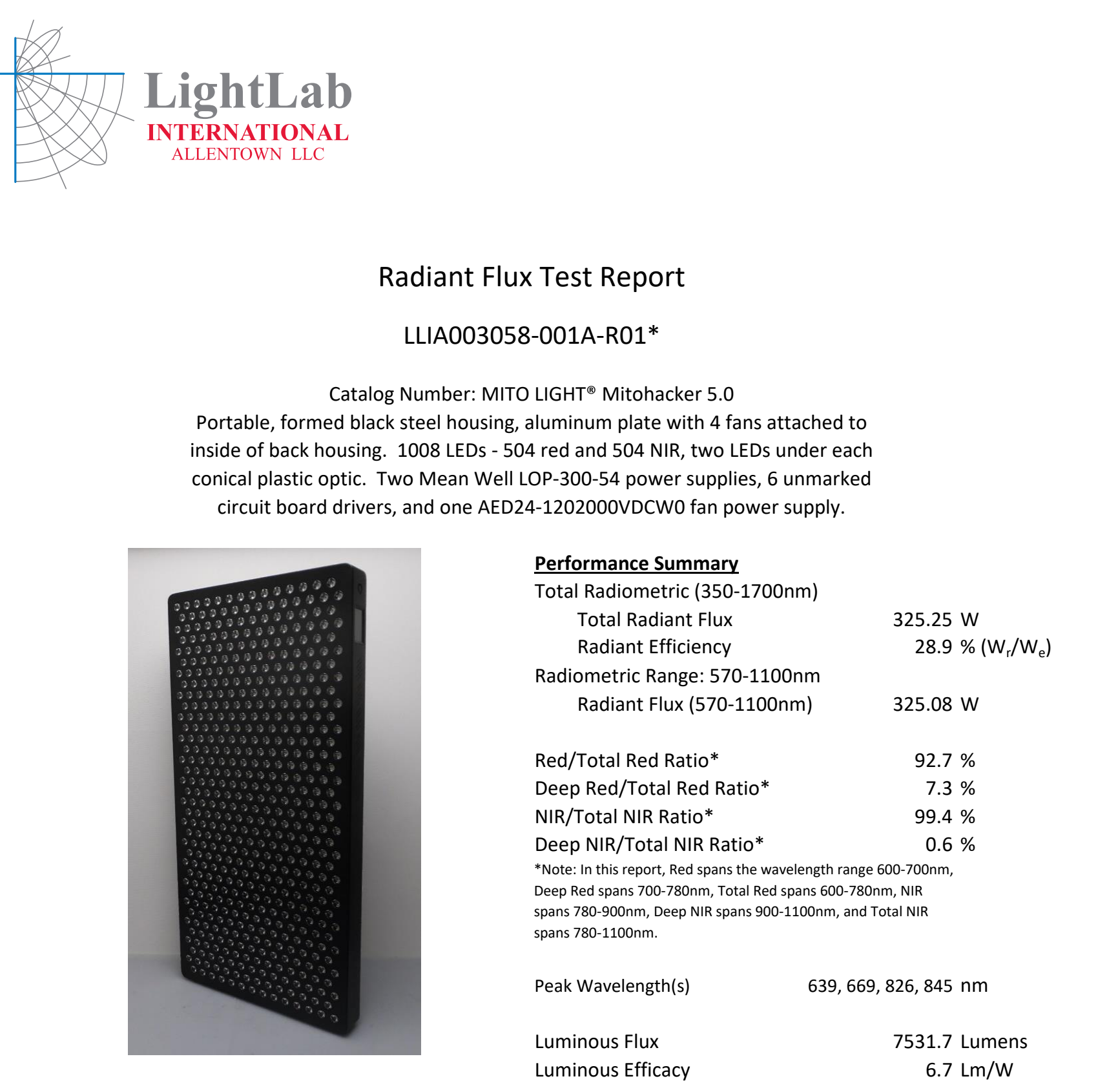
The MitoLight MitoHacker 5.0 is one of the widest panels I've tested: 40 inches tall and 19.5 inches wide, with 504 dual-chip LEDs and six wavelengths. I first reviewed it in February. This year I put it through the same independent lab tests as the 10 other panels in my 2026 panel comparison.
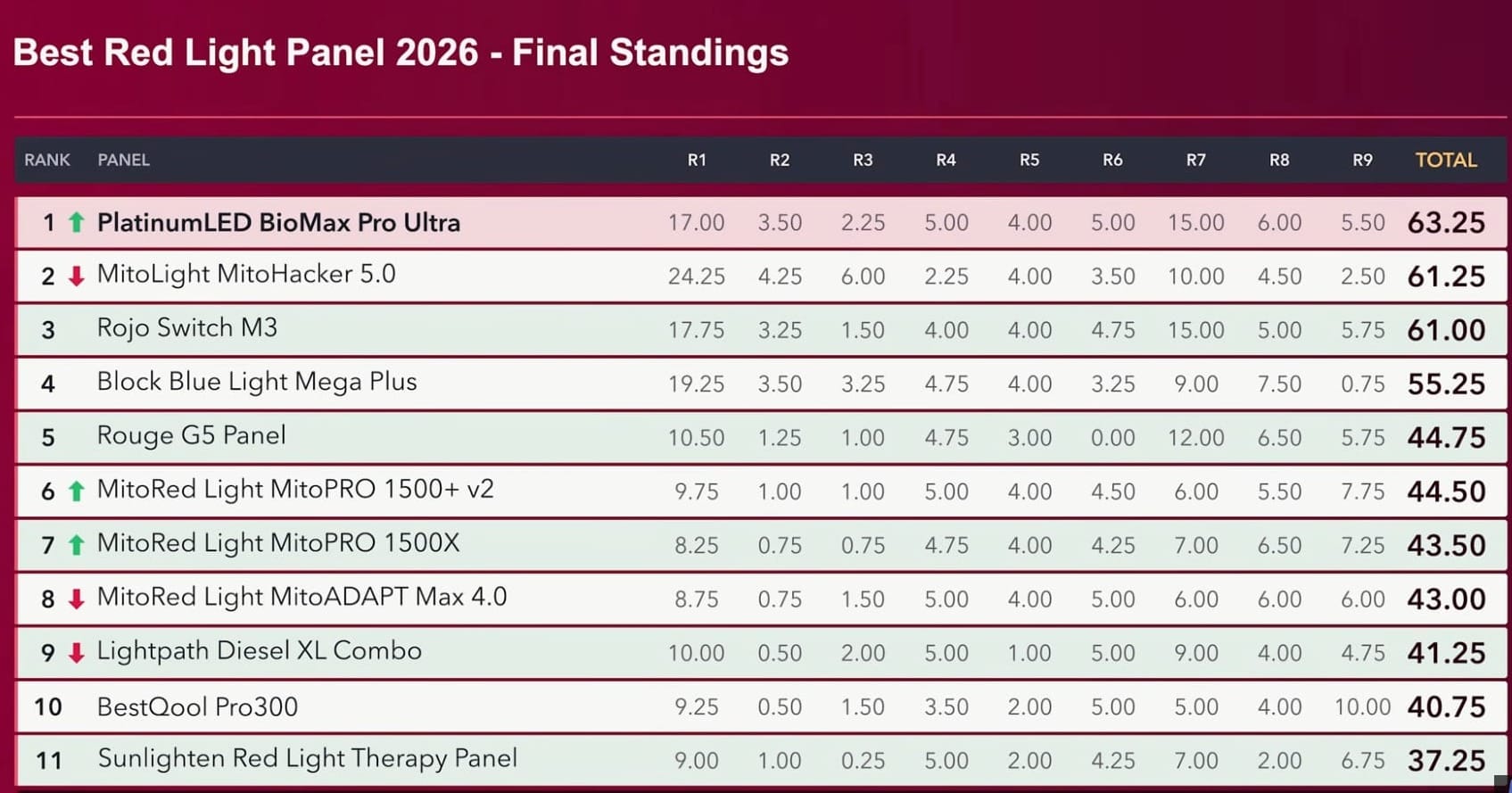
It finished 2nd of 11 with 61.25 points, after leading for eight of the nine rounds. It's the best-performing panel I measured, but it's sold in the EU and UK only. Below, you'll find the lab's own measurements, including a heat map of its light, its spectrum and its output over a full session, plus what's new in version 5.0 and how it compares with its rivals.
🏆 Quick Answer: Is the MitoLight MitoHacker 5.0 Worth It?
Score: 61.25 out of 100, 2nd of 11 in my 2026 panel test.
The MitoHacker 5.0 delivered the widest, strongest and most even light in my test, winning the coverage, average irradiance and uniformity rounds by clear margins. It lost ground on stability (last), its near-infrared-heavy balance (37.1% red), short warranty and return terms, and price. It's also only sold in the EU and UK.
- Best for: EU and UK buyers who want the widest, most even coverage from a single wall panel, mainly for muscles, joints and recovery.
- Not ideal for: anyone outside the EU and UK, skin-first buyers (only 37.1% of its light is red), or people who want a remote or a long warranty.
- Price: $2,114 at the time of filming, on the same delivered basis I used for every panel (after code ALEX, with shipping and tax).
- Stronger choices: the PlatinumLED BioMax Pro Ultra (1st, 63.25 points, $1,610) if you're outside the EU and UK or want steadier, redder light, or the Rojo Switch M3 (3rd, 61 points, $1,562) for modular controls.
MitoLight MitoHacker 5.0
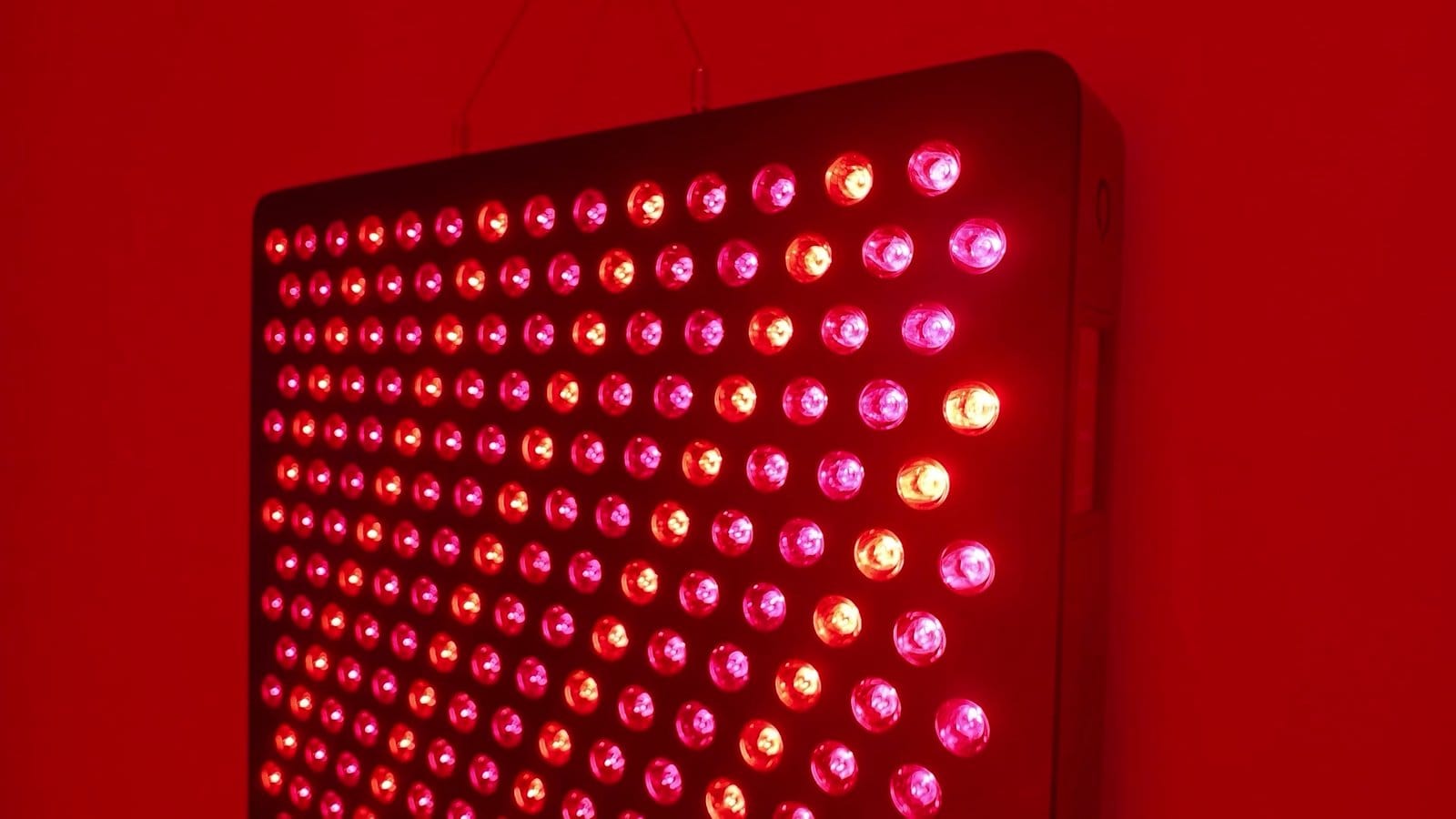
A 40 × 19.5 in panel with 504 dual-chip LEDs and six wavelengths, per-wavelength control, four preset modes, a sunrise light alarm and an app. Sold in the EU and UK. Code ALEX takes 5% off.
Key Lab Results at a Glance
- Light output: 325 W of light from 1126 W of power (28.9% efficient).
- Face area at 12 inches: 74.2 mW/cm² on average (3.1% variation).
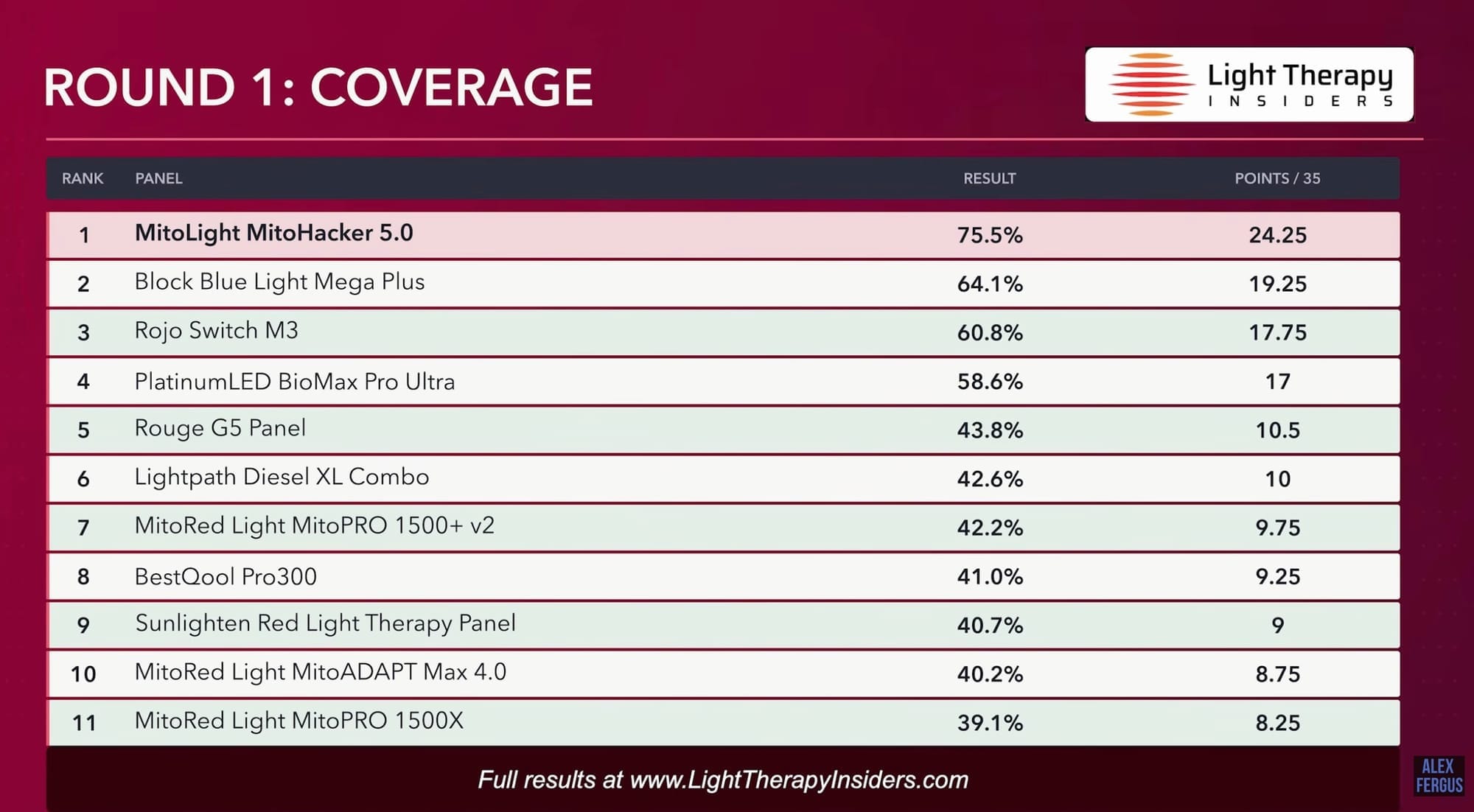
- 24 × 30 in test area: 54.8 mW/cm² on average, with 75.5% of the area at 30 mW/cm² or more (1st of 11 for coverage).
- Red vs. near-infrared: 37.1% red and 62.9% near-infrared (9th of 11 for balance).
- Stability: 86.6% of its starting output after 20 minutes.
- Wavelengths: all five of my core wavelengths cleared 0.5 W/nm.
Here's how it scored in each round of my 2026 test:
| Round | MitoHacker 5.0 Score | Rank (of 11) |
|---|---|---|
| 1. Coverage | 24.25 / 35 | 1st |
| 2. Average irradiance | 4.25 / 5 | 1st |
| 3. Uniformity | 6 / 10 | 1st |
| 4. Optical stability | 2.25 / 5 | 11th |
| 5. Wavelengths | 4 / 5 | =1st |
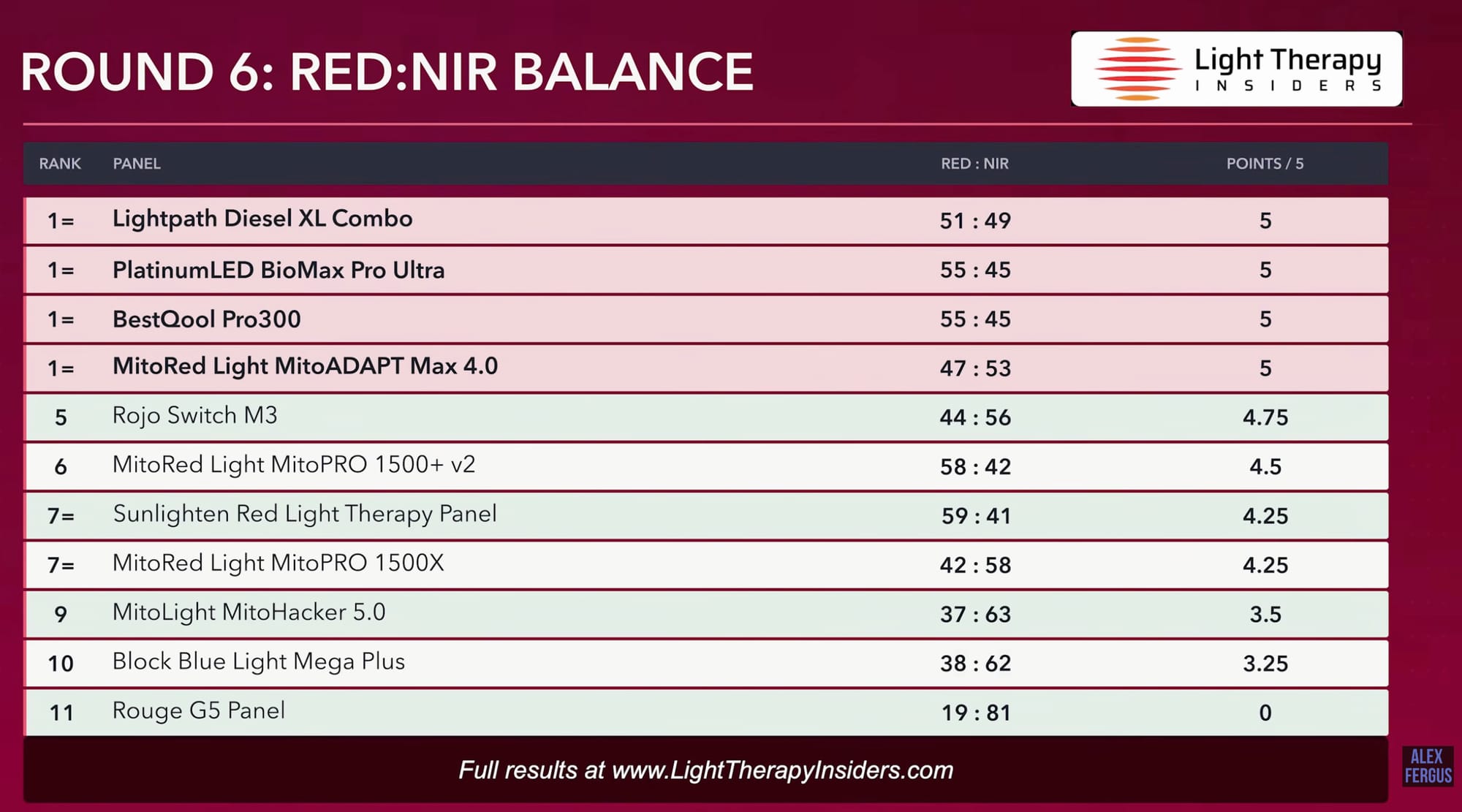
| 6. Red:NIR balance | 3.5 / 5 | 9th |
| 7. Ease of use | 10 / 15 | 4th |
| 8. Extras | 4.5 / 10 | 8th |
| 9. Price | 2.5 / 10 | 10th |
| Total | 61.25 / 100 | 2nd |
What I Like
- The best light performance in my test: 1st for coverage (75.5%), average irradiance (54.8 mW/cm²) and uniformity (68.0%)
- The most light of the 11 panels (325 W) and the strongest full-body average: 35.4 mW/cm² over 24 × 60 in
- Wide (19.5 in), so it gets close to shoulder-to-shoulder coverage for many people
- All five core wavelengths cleared 0.5 W/nm, with the strongest 830 and 850 nm output in the test
- Per-wavelength control, four preset modes, a sunrise light alarm and a free app; flicker-free, with no pulsing
What Could Be Better?
- Sold in the EU and UK only
- The least stable panel: output fell 13.4% over 20 minutes, and red fell 18.6%
- Near-infrared heavy: 37.1% red, 9th of 11 for balance
- A 30-day return window and 3-year warranty: 4.5 of 10 for extras (8th)
- No remote, and it drew the most power of any panel (1,126 W) while being the least efficient (28.9%)
MitoLight MitoHacker 5.0 Specs vs. Lab Results
Here's what MitoLight says about the MitoHacker 5.0, and what the independent lab measured:
| Spec | What MitoLight Says | What the Lab Measured |
|---|---|---|
| LEDs | 504 multi-wavelength dual-chip LEDs | 1,008 chips: 504 red and 504 near-infrared, two under each lens |
| Wavelengths | 630, 660, 670, 810, 830 and 850 nm | Peaks at 639, 669, 826 and 845 nm |
| Red vs. near-infrared | Three red and three near-infrared wavelengths | 37.1% red, 62.9% near-infrared |
| Size | 101.5 × 49.5 × 6.5 cm (40 × 19.5 × 2.6 in) | Not measured |
| Irradiance | 90 mW/cm² at 15 cm (6 in) | 74.2 mW/cm² over a face-sized area at 12 in; 54.8 mW/cm² average over 24 × 30 in |
| Power | Not checked | 1,126 W at 230 V |
| Light output | Not stated | 325 W of light, the most in my test: 28.9% of the power it draws |
| Controls | Touchscreen, per-wavelength control, four preset modes, light alarm, app, Wi-Fi linking | Not tested |
| Warranty and returns | 3 years; 30-day money-back guarantee | Not applicable |
In the box: the panel, a hanging system, power and connection cables, protective glasses and a manual. Stands are sold separately. MitoLight lists CE and RoHS certification. The lab ran the panel at 230 V.
What's New in the MitoHacker 5.0, and Where Can You Buy It?
Version 5.0 is a big step up from the MitoHacker 4.0. Here's what MitoLight says changed:
| What Changed | MitoHacker 5.0 (MitoLight's Figures) |
|---|---|
| Size | 101.5 × 49.5 cm, 33% larger than the 4.0 |
| LEDs | 504 dual-chip LEDs, 24% more than the 4.0 |
| Wavelength control | Each of the six wavelengths can be adjusted individually |
| Preset modes | Four one-touch modes |
| Light alarm | Sunrise wake-up with silent fans |
| Display | A higher-resolution touchscreen |
| Linking | Over Wi-Fi, one panel can control other 5.0 and 4.0 panels |
In use, I found the touchscreen sharper than before, but with more settings the menus have more layers, and a slightly bigger screen would help. The four preset modes are basic: session times are largely fixed, and they don't radically change the output. There's no remote; the free app does that job.
The catch is availability. MitoLight ships the MitoHacker 5.0 to the EU and the UK only. If you live elsewhere, such as the US, Canada or Australia, it isn't a practical option, and any warranty claim or return would mean shipping a large panel back to Europe. Outside the EU and UK, the BioMax Pro Ultra won my test and the Rojo Switch M3 placed 3rd.
How I Tested the MitoLight MitoHacker 5.0
The MitoHacker 5.0 went through exactly the same process as all 11 panels in my 2026 panel comparison, so its scores sit directly beside theirs.
- Independent lab measurements. LightLab International, a photometric lab in Allentown, Pennsylvania, ran three tests in September 2026: total light output and spectrum in a 2-metre integrating sphere, output over 20 minutes, and an irradiance map at 12 inches measured every 2 inches (test report LLIA003058-001).
- Why 12 inches. I now test at 12 inches rather than 6, because readings taken close to the LEDs overstate how evenly a panel treats your body. Here's why.
- Nine scored rounds, 100 points. Coverage (35), average irradiance (5), uniformity (10), output stability (5), wavelengths (5), red-to-near-infrared balance (5), ease of use (15), extras such as warranty, returns, certifications, noise and expandability (10), and price (10).
Each brand, including MitoLight, paid LightLab for its own panel’s testing and provided its panel free of charge. The MitoHacker 5.0's scores use exactly the same lab data and scoring as every other panel.
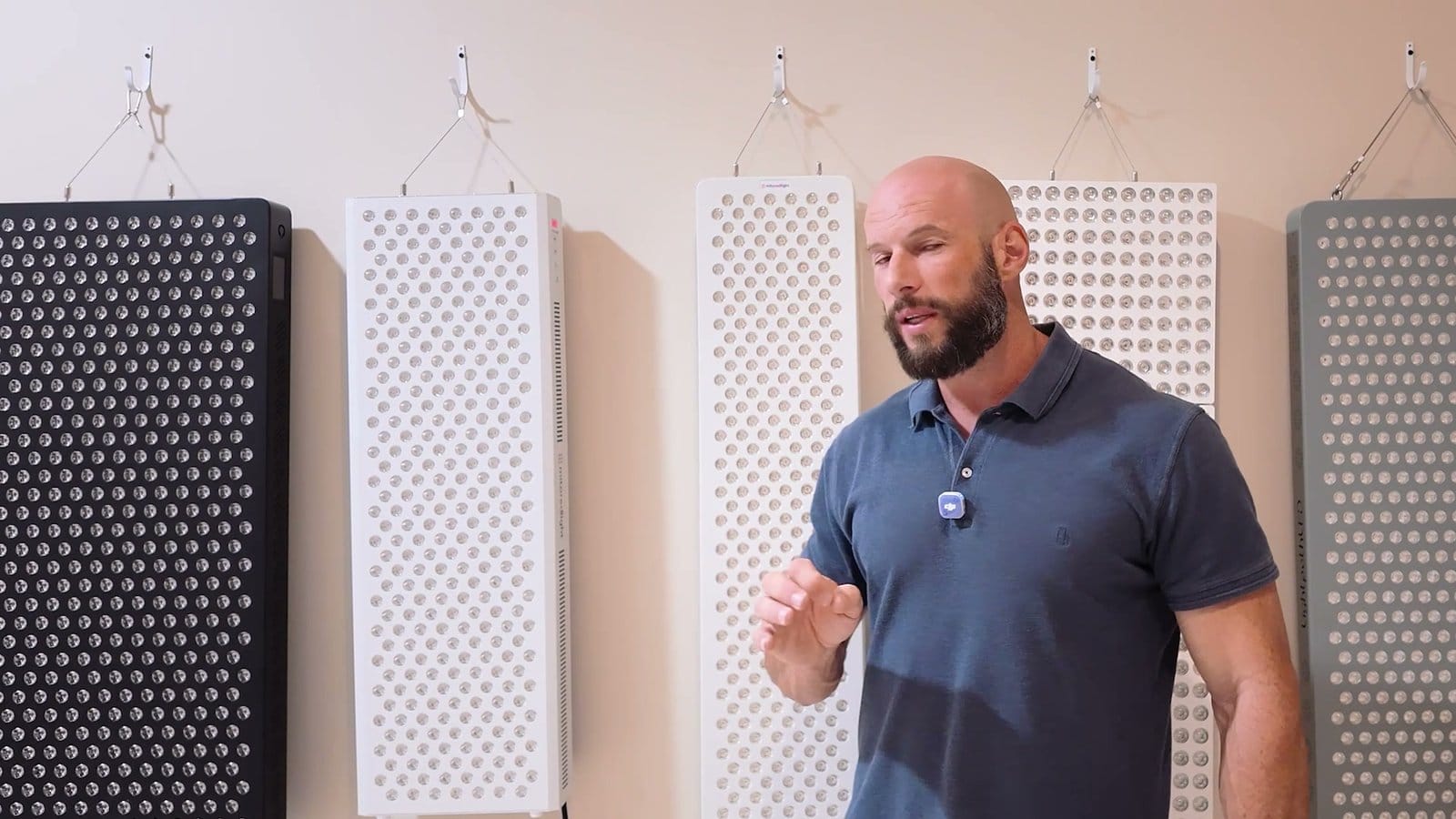
I also reviewed the MitoHacker 5.0 on its own before the 2026 lab test. Here's that original video:
Lab Results: How the MitoLight MitoHacker 5.0 Performed
Coverage and Power at 12 Inches
Across the standard 24 × 30 in treatment area, the MitoHacker 5.0 averaged 54.8 mW/cm² (1st of 11 for average irradiance), and 75.5% of the area got at least 30 mW/cm² (1st for coverage).
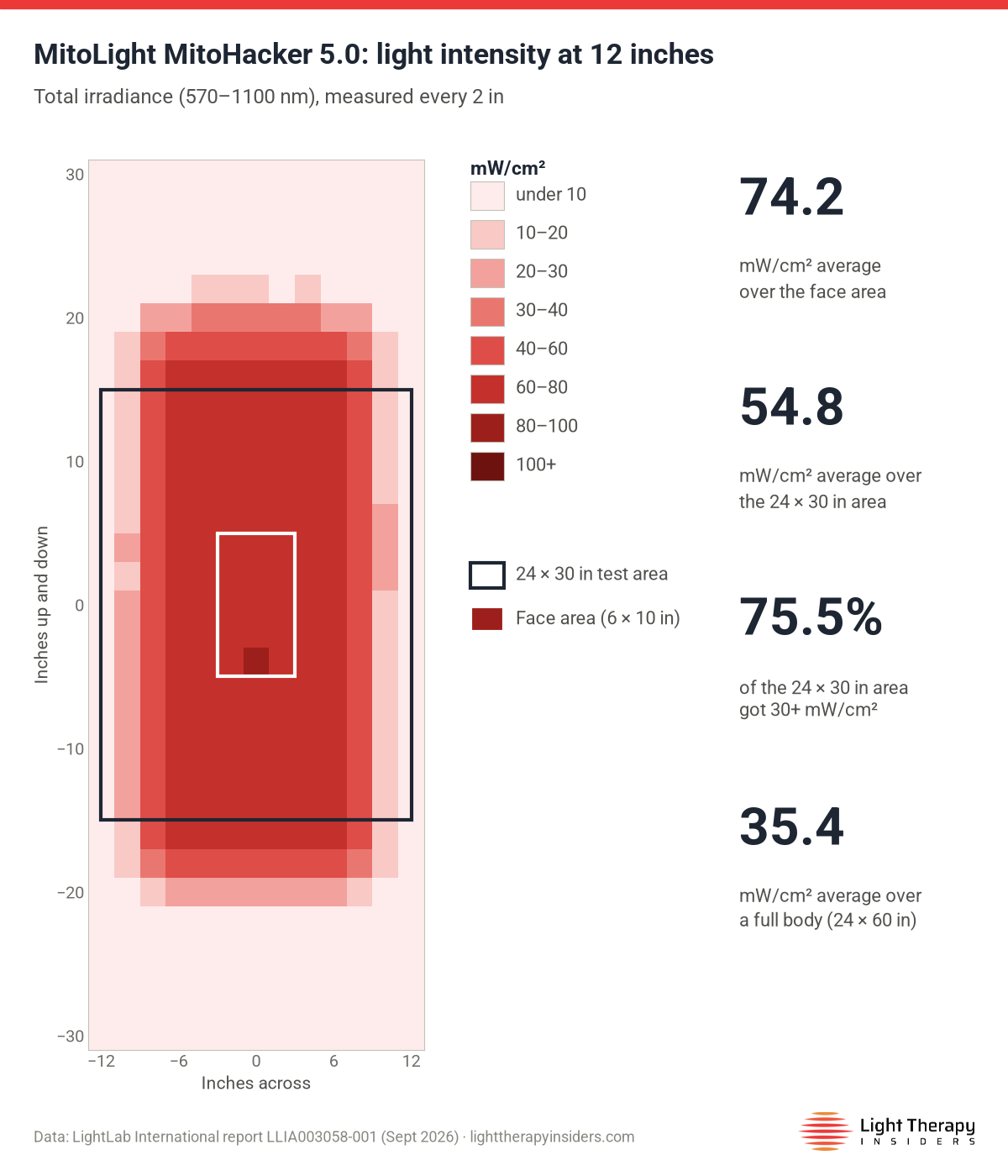
The heat map shows a wide, even block of strong light that fills most of the test area. Across a full 24 × 60 in body area it averaged 35.4 mW/cm², the best of the 11 panels, and 48.5% of that larger area still got 30+ mW/cm².
Here's how the light holds up as the treatment area grows:
| Area at 12 in | Average (mW/cm²) | Lowest (mW/cm²) | Area at 30+ mW/cm² | Variation |
|---|---|---|---|---|
| Face (6 × 10 in) | 74.2 | 71.6 | 100% | 3.1% |
| Test area (24 × 30 in) | 54.8 | 5.5 | 75.5% | 52.4% |
| Full body (24 × 60 in) | 35.4 | 0.2 | 48.5% | 94.3% |
Evenness
Overall uniformity (average ÷ peak across the 24 × 30 in area) was 68.0%, 1st of 11. Over a face-sized area at the centre, the light ranged from 71.6 to 80.5 mW/cm², varying by 3.1%. That's the second-most even face area in the test, and its 68.0% overall uniformity won that round by a wide margin.
Output Over a Session
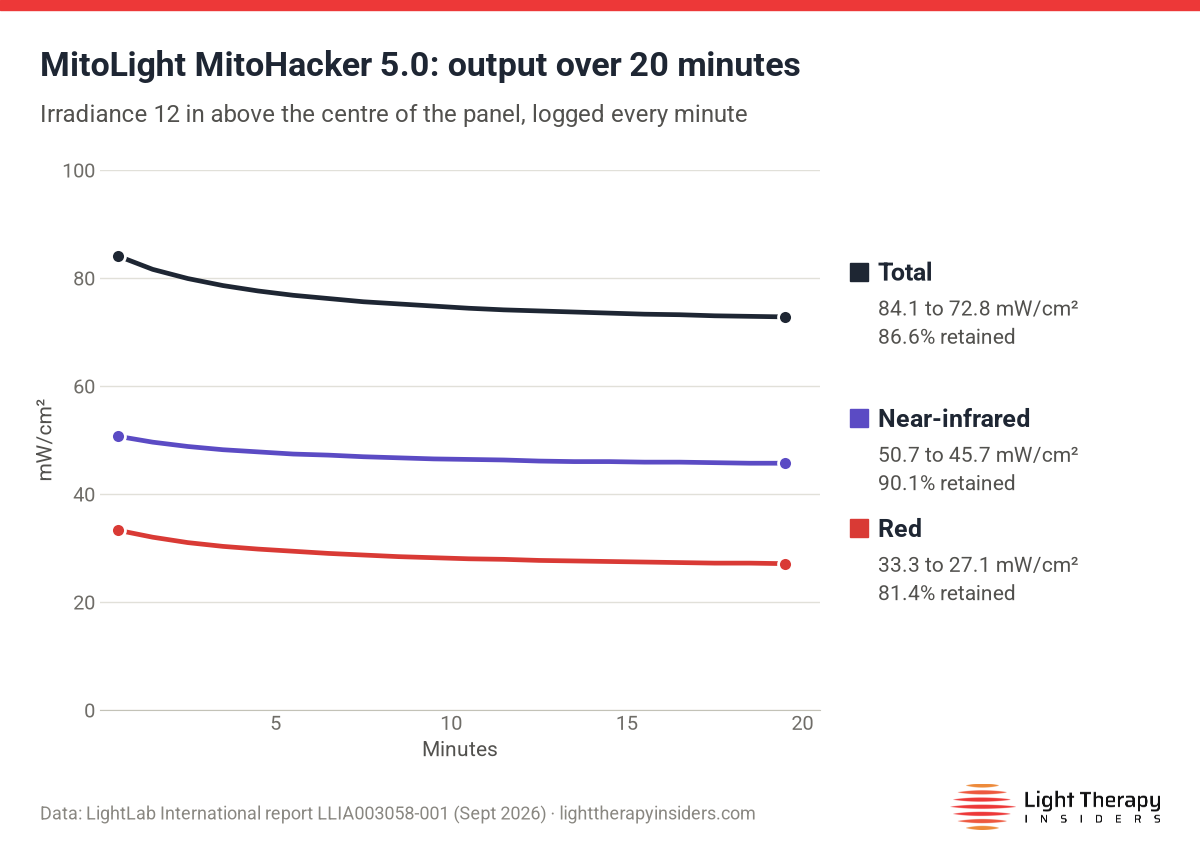
After 20 minutes the MitoHacker 5.0 still delivered 86.6% of its starting output, 11th of 11 for stability (2.25 of 5 points). Red held at 81.4% and near-infrared at 90.1%.
As the LEDs warmed up, the peaks moved slightly longer, by up to 11 nm:
| Peak | After 30 sec | After 14.5 min | After 19.5 min |
|---|---|---|---|
| Red | 631 nm | 637 nm | 637 nm |
| Red | 662 nm | 668 nm | 668 nm |
| Near-infrared | 813 nm | 823 nm | 824 nm |
| Near-infrared | 834 nm | 843 nm | 844 nm |
Wavelengths
The lab found peaks at 639, 669, 826 and 845 nm. All five of my core wavelengths (630, 660, 810, 830 and 850 nm) cleared the 0.5 W/nm bar, which earns 4 points, a score shared with six other panels. No panel cleared the bar for the two bonus wavelengths, 590 and 1064 nm.
| Wavelength | Measured (W/nm) | Counts in My Test? |
|---|---|---|
| 590 nm (bonus) | 0.002 | ✗ No |
| 630 nm | 0.969 | ✓ Yes |
| 660 nm | 1.893 | ✓ Yes |
| 810 nm | 2.022 | ✓ Yes |
| 830 nm | 2.848 | ✓ Yes |
| 850 nm | 2.666 | ✓ Yes |
| 1064 nm (bonus) | 0.000 | ✗ No |
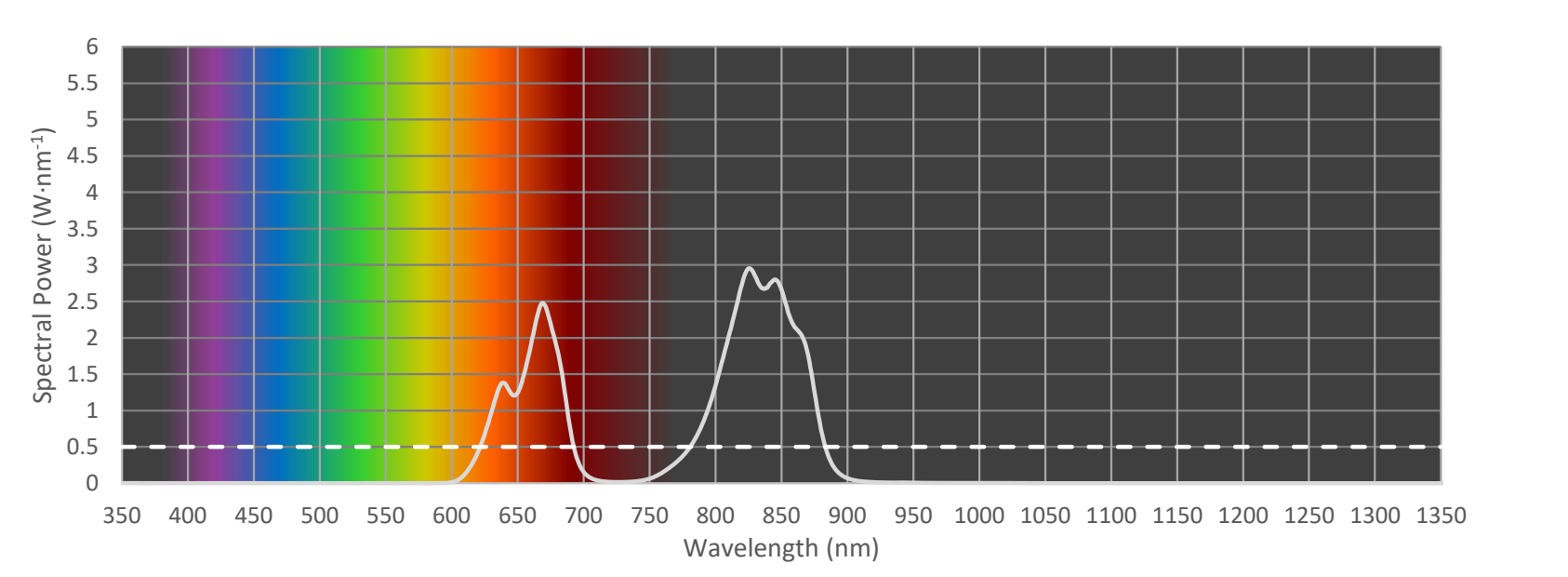
Its 830 nm (2.85 W/nm) and 850 nm (2.67 W/nm) output were the strongest in the test. Its 670 nm LEDs appear to merge with its 660 nm output in a single peak at 669 nm. There's no amber or 1060 nm output.
Red vs. Near-Infrared Balance
37.1% of the MitoHacker 5.0's light is red (600–780 nm) and 62.9% near-infrared (780–1100 nm). That cost it points: 3.5 of 5, 9th of 11. Red is the range most studied for skin, while near-infrared reaches deeper tissue, so out of the box the MitoHacker leans towards muscles, joints and recovery. You can turn down the near-infrared wavelengths individually to shift the balance.
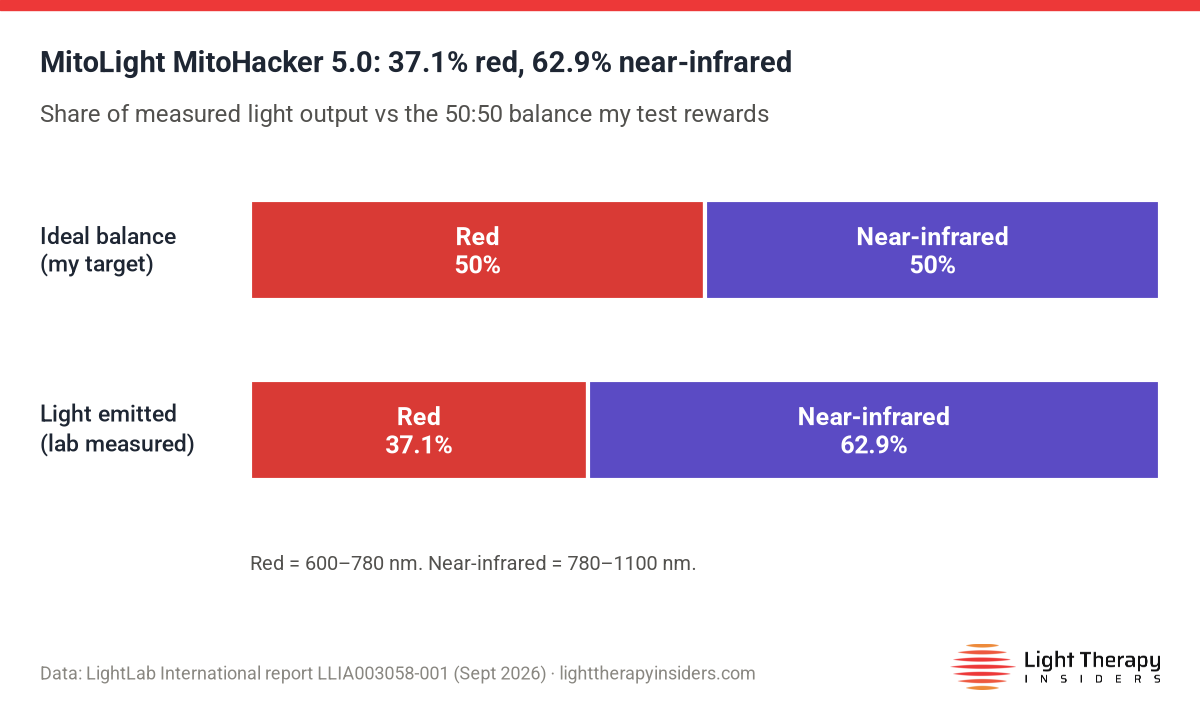
The lab's breakdown of where the light goes:
| Waveband | Light Output | Share |
|---|---|---|
| Red (600–700 nm) | 111.77 W | 34.4% |
| Deep red (700–780 nm) | 8.78 W | 2.7% |
| Near-infrared (780–900 nm) | 203.26 W | 62.5% |
| Deep near-infrared (900–1100 nm) | 1.21 W | 0.4% |
| Total light output | 325.25 W | 100% |
Using the MitoLight MitoHacker 5.0
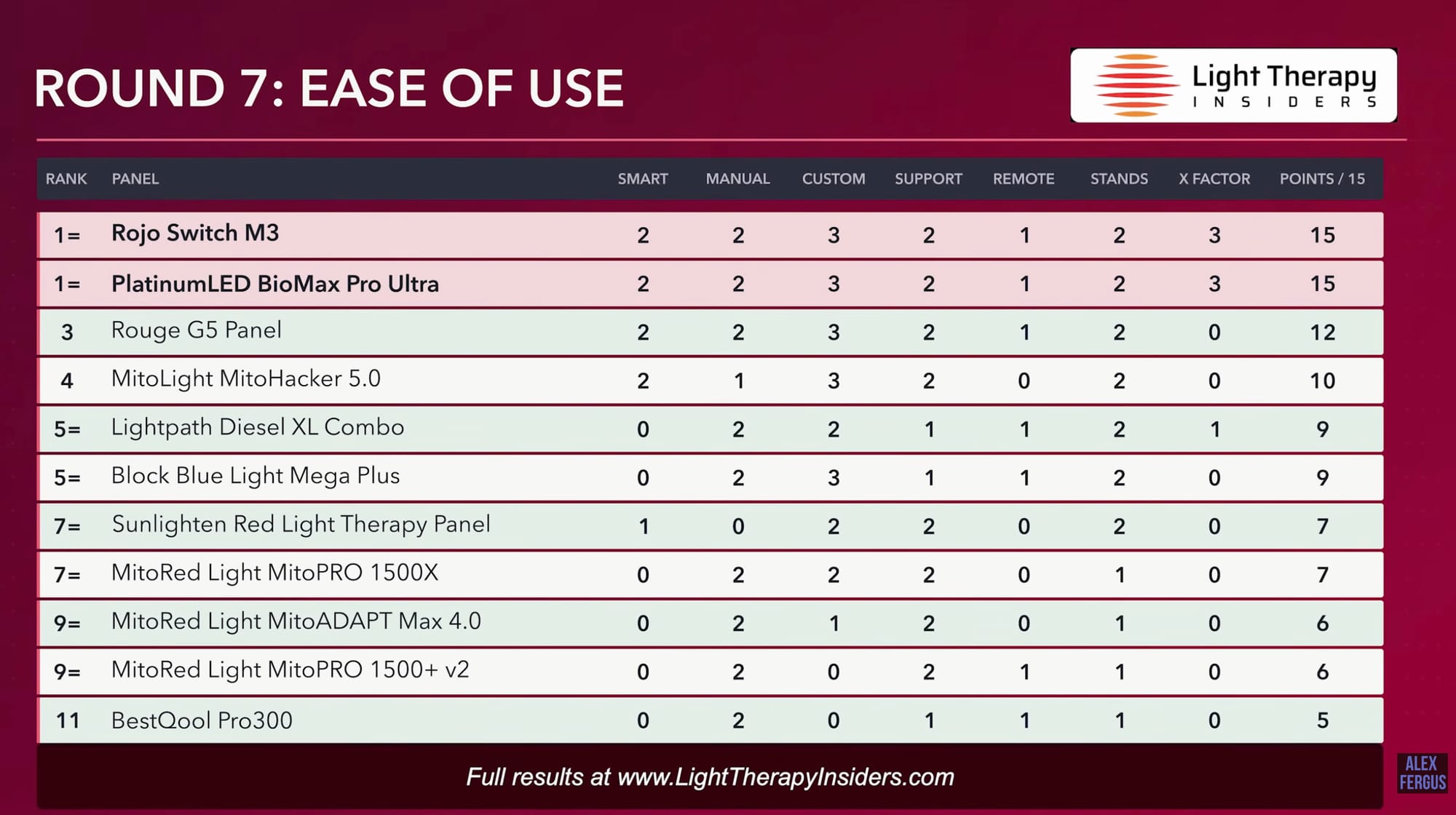
It scored 10 of 15 for ease of use (4th): full marks for smart modes, customisation, support and stands, but 1 of 2 for the manual, no points for a remote and no X-factor points.
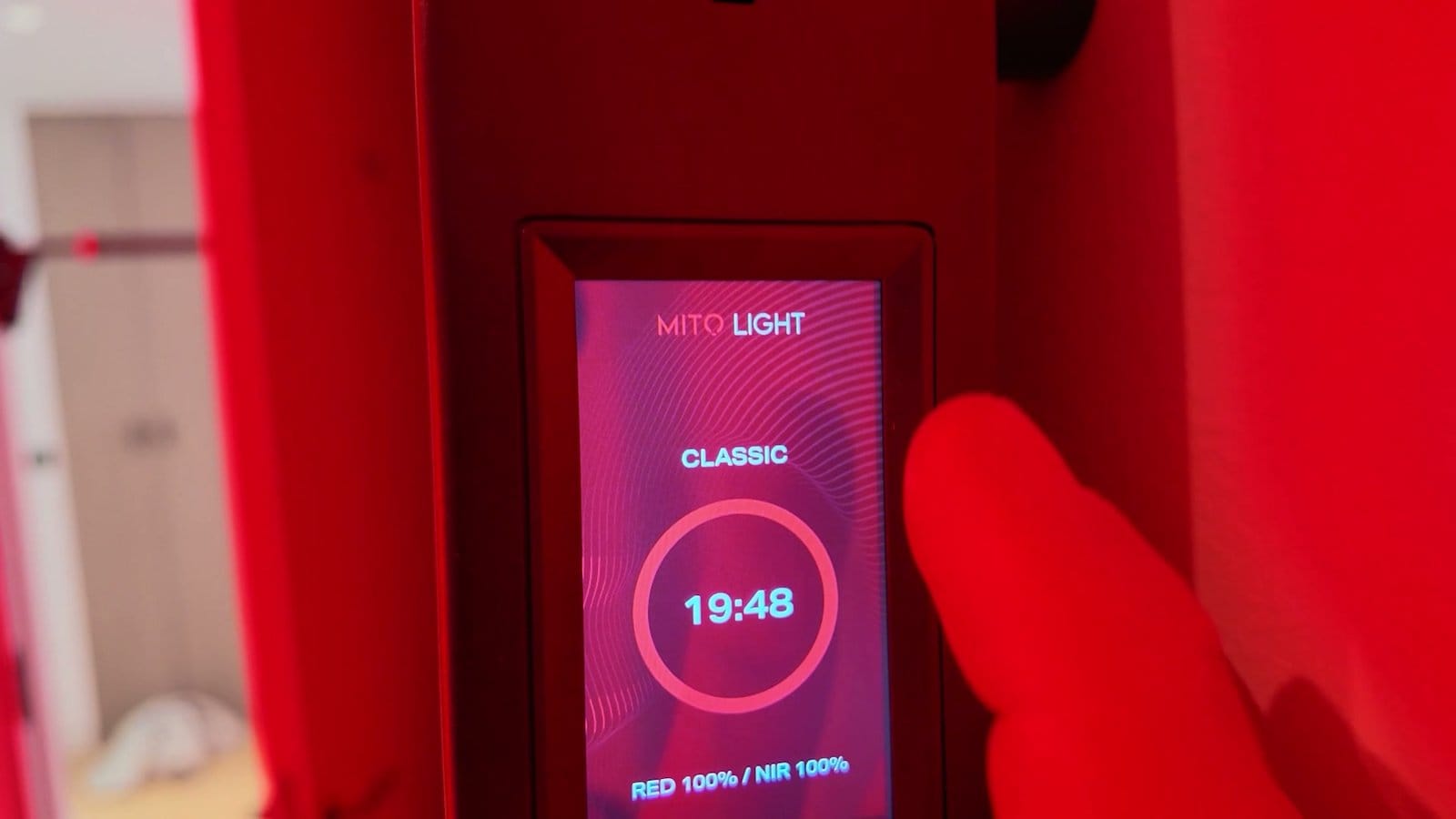
- Touchscreen with intensity adjustable percentage by percentage and a timer you set minute by minute
- Individual control of all six wavelengths
- Four preset modes for one-touch sessions
- Light alarm that simulates a sunrise
- Free MITO LIGHT app (iOS and Android) to control the panel, save personal modes and use the alarm and evening modes
- Wi-Fi linking: one panel can control other Generation 5.0 and 4.0 panels
- Stands sold separately: a dedicated Mitohacker floor stand, plus lift and electric stands
A Starting Protocol
These starting points are based on what the research suggests for skin and on the lab's measurements at 12 inches.
- Face and skin: aim for about 5–9 J/cm². At 12 inches the MitoHacker 5.0 delivers about 74 mW/cm² over the face with every wavelength on, so that dose takes roughly 1.1 to 2.0 minutes.
- Joints, muscles and recovery: 5–10 minutes per area at 12 inches. My dosing chart shows the ranges studies have used.
- Eyes: wear eye protection. Near-infrared is invisible, and these panels are bright. More in my eye safety guide.
Price, Shipping, Warranty and Returns
I priced every panel the same way: delivered to Austin, Texas, after my discount code or link, with shipping and tax included. On that basis the MitoHacker 5.0 cost $2,114 at the time of filming and scored 2.5 of 10 for price (10th of 11).
- Discount: code ALEX takes 5% off at MitoLight (already counted in the $2,114 price at the time of filming).
- Shipping: to the EU and UK only, and free within the EU.
- Warranty: 3 years, scoring 1 of 3.
- Returns: a 30-day money-back guarantee, scoring 1 of 3.
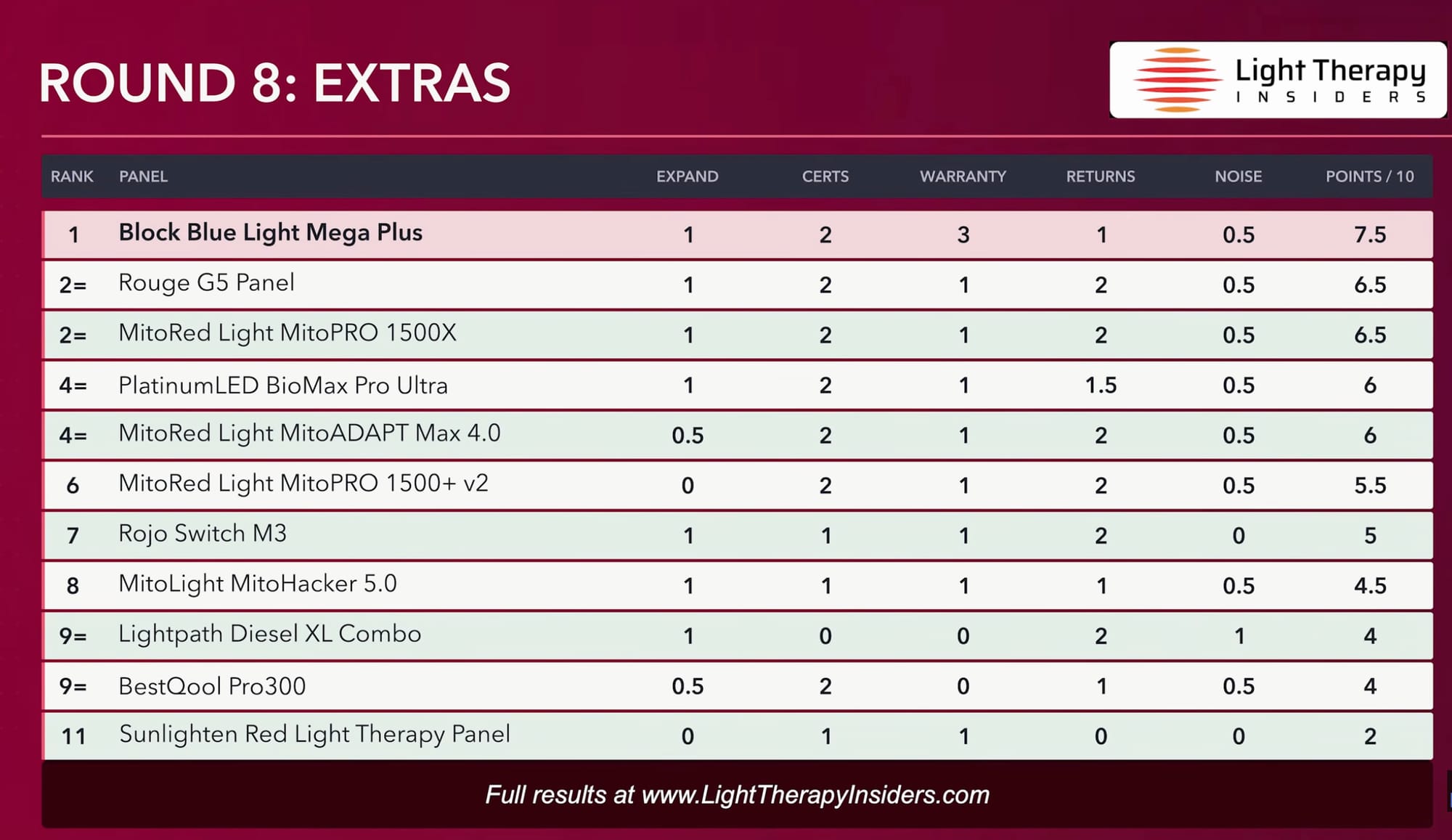
Overall it scored 4.5 of 10 for extras (8th): 1 of 1 for expandability, 1 of 2 for certification evidence, 1 of 3 for warranty, 1 of 3 for returns and 0.5 of 1 for noise (40–50 dB).
Who Should Buy the MitoLight MitoHacker 5.0?
Buy it if you:
- Live in the EU or UK
- Want the widest, most even coverage from one wall panel
- Mainly use red light therapy for muscles, joints and recovery
- Want per-wavelength control and a sunrise alarm
Look elsewhere if you:
- Live outside the EU and UK
- Mainly want red light for skin: the BioMax Pro Ultra is 54.7% red, won my test and cost $504 less
- Want a remote, a long warranty or a long return window
- Want a panel you can reconfigure: see the Rojo Switch M3
MitoLight MitoHacker 5.0 vs. the Alternatives
Here's how the MitoHacker 5.0 compares with the panels around it in my 2026 test (all measured at 12 inches over the same 24 × 30 in area, and priced delivered to Texas after discount codes, with shipping and tax):
| Panel | 2026 Score | Area at 30+ mW/cm² | Avg. Irradiance (mW/cm²) | Red Share | Price Tested |
|---|---|---|---|---|---|
| PlatinumLED BioMax Pro Ultra | 63.25 (1st) | 58.6% | 48.6 | 54.7% | $1,610 |
| MitoLight MitoHacker 5.0 | 61.25 (2nd) | 75.5% | 54.8 | 37.1% | $2,114 |
| Rojo Switch M3 | 61.00 (3rd) | 60.8% | 46.8 | 43.6% | $1,562 |
| Block Blue Light Mega Plus | 55.25 (4th) | 64.1% | 47.2 | 36.8% | $2,367 |
| Rouge G5 Panel | 44.75 (5th) | 43.8% | 30.5 | 19.3% | $1,564 |
Best Overall Alternative: PlatinumLED BioMax Pro Ultra
PlatinumLED BioMax Pro Ultra (2026 winner)
$504 less on my test's basis, and sold worldwide from warehouses in the US and Europe. Less coverage (58.6% vs. 75.5%) and average irradiance (48.6 vs. 54.8 mW/cm²), but steadier output, more red light (54.7%), stronger light over the face and a perfect ease-of-use score. 5% off through my link.
Read my full PlatinumLED BioMax Pro Ultra review.
Most Innovative Alternative: Rojo Switch M3
Rojo Switch M3 (3rd)
$552 less: 60.8% coverage, 46.8 mW/cm² on average, more red light (43.6%) and swappable modules with zone control. Rojo now offers a 5-year warranty. With that, instead of the 3 years it offered when I tested, it would have scored 63 points and finished 2nd, ahead of the MitoHacker. Ships worldwide. Code ALEX for 10% off.
Read my full Rojo Switch M3 review.
Other Panels to Consider
- vs. Block Blue Light Mega Plus: $253 more, also near-infrared heavy (36.8% red), with less coverage (64.1%) but a 5-year warranty. Block Blue Light Mega Plus review
- vs. Rouge G5 Panel: $550 less, but with a much narrower strong zone (43.8% coverage) and only 19.3% red light. Rouge G5 Panel review
- vs. MitoLight Master 5.0: if you want head-to-toe coverage in one pass, MitoLight's taller Master 5.0 is the step up. I haven't lab-tested it.
⭐ My Reviews ⭐
MitoLight MitoHacker 5.0 FAQ
Is the MitoLight MitoHacker 5.0 worth it?
If you live in the EU or UK and want the widest, most even coverage from a single panel, yes. It placed 2nd of 11 in my 2026 lab test and won every coverage, power and evenness round. Outside the EU and UK it isn't a practical option, and the BioMax Pro Ultra won overall.
Can I buy the MitoHacker 5.0 in the UK or outside Europe?
MitoLight ships the MitoHacker 5.0 to the EU and the UK. It isn't sold elsewhere, and returns or warranty claims would mean shipping it back to Europe. Outside the EU and UK, the BioMax Pro Ultra and Rojo Switch M3 are my top picks.
MitoHacker 5.0 vs. BioMax Pro Ultra: which is better?
The MitoHacker puts more light over a wider area, more evenly. The BioMax is steadier, has more red light (54.7% vs. 37.1%), stronger light over the face and better controls, costs $504 less on my test's basis and is sold worldwide. It won overall by 2 points.
Is the MitoHacker 5.0 good for skin?
It works, but only 37.1% of its light is red. For the face, at 12 inches it delivers about 74 mW/cm², so a 5–9 J/cm² dose takes roughly 1 to 2 minutes with everything on. Turn down the near-infrared wavelengths for a redder session.
What's new in the MitoHacker 5.0?
Compared with the 4.0, MitoLight says it's 33% larger with 24% more LED chips, and it adds individual control of all six wavelengths, four preset modes, an improved light alarm and a sharper touchscreen.
Does it come with a remote or a stand?
Neither. The free app works as a remote, and stands are sold separately, including a dedicated Mitohacker floor stand.
What's the warranty and return policy?
A 3-year warranty and a 30-day money-back guarantee, both shorter than several rivals offer.
Is there a MitoLight discount code?
Yes. Code ALEX takes 5% off at MitoLight. See my discount codes page for other brands.
Final Thoughts
The MitoHacker 5.0 is the best-performing panel I measured in 2026: the widest coverage, the highest average irradiance and the most even light, by clear margins. It led my test for eight of the nine rounds.
It's held back by the biggest drop in output over a session, a near-infrared-heavy balance, short warranty and return terms, and its price. If you're in the EU or UK and mainly use red light therapy for recovery, it's an excellent choice. Everywhere else, the BioMax Pro Ultra is the one to buy.
Score: 61.25 out of 100, 2nd of 11 in my 2026 panel test.
- Buy the MitoHacker 5.0 if you're in the EU or UK and want the widest, most even light: check the latest MitoHacker 5.0 price and use code ALEX for 5% off.
- Outside the EU and UK, the PlatinumLED BioMax Pro Ultra won the 2026 test, and the link takes 5% off.
Items Mentioned
🔥🔥 Check this blog daily for the latest Red Light Therapy Black Friday and Cyber Monday deals: https://aferg.co/black-friday-cyber-monday 🔥🔥
⭐ Sunlighten- Use code Fergus at https://aferg.co/sunlighten
⭐ Mito Light Europe - Use code ALEX at https://aferg.co/mitolight for 5% off!
⭐ MitoRed Light - use https://aferg.co/7d221 for 5% off sitewide.
⭐ Rojo Light Therapy - Use discount code ALEX at https://aferg.co/rojo-rlt for 10% off.
⭐ LightpathLED - Use discount code ALEX at https://aferg.co/lightpathled to get 5% off.
⭐ BestQool - use code ALEX at https://aferg.co/Bestqool to save 10%.
⭐ Block Blue Light - Use this link: https://aferg.co/BlockBlueLight to save 15% on Block Blue Light's products. The discount will automatically be applied at checkout.
⭐ PlatinumLED Therapy Lights- Use the discount link https://aferg.co/redled to save 5%
⭐ Rouge - Use discount code ALEX at https://aferg.co/rougecare for $50 off.
✨ Have you explored my website ✨
Discover guides, reviews, and insights to help you make the most of light therapy
Alex's Bio
Alex Fergus wrote this blog post. Alex is an ISSN Sports Nutrition Specialist, Fitness Professional, and certified Superhuman Coach who continues to expand his knowledge base and help people across the world with their health and wellness. Alex is recognized as the National Record Holder in Powerlifting and Indoor Rowing and has earned the title of the Australian National Natural Bodybuilding Champion. Having worked as a health coach and personal trainer for over a decade, Alex now researches all things health and wellness and shares his findings on this blog.