
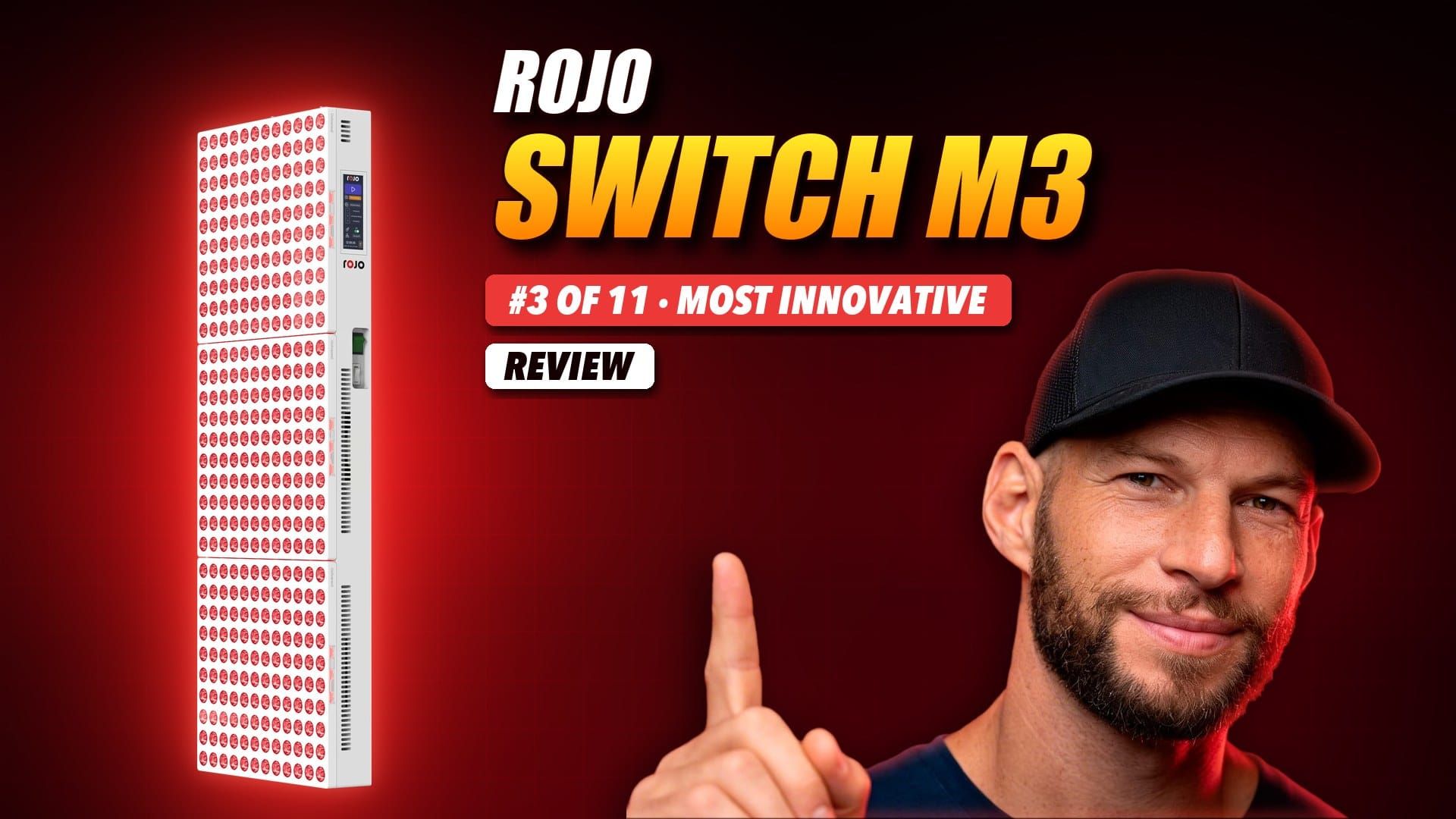
The Rojo Switch M3 is the most unusual panel in my 2026 comparison. Instead of one fixed panel, it's a hub that holds three swappable light modules, each with its own wavelength mix. I put it through the same independent lab tests as the 10 other panels in my 2026 panel comparison.
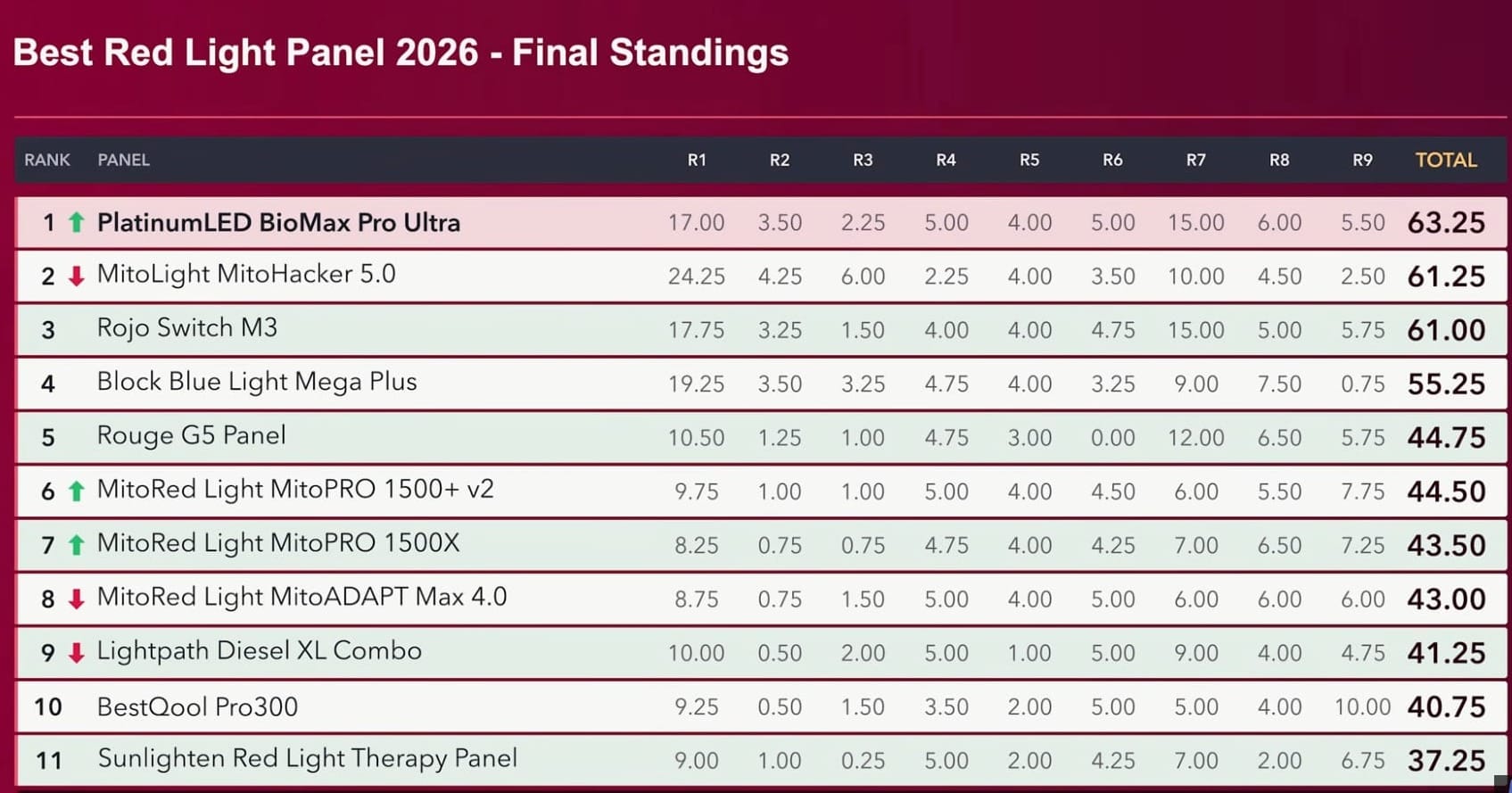
It finished 3rd of 11 with 61 points, just 0.25 points behind second place, and won my Most Innovative award. Below, you'll find the lab's own measurements, including a heat map of its light, its spectrum and its output over a full session. I also explain how the modular system works, how it compares with its rivals, and who should buy it.
🏆 Quick Answer: Is the Rojo Switch M3 Worth It?
Score: 61 out of 100, 3rd of 11 in my 2026 panel test.
Rojo now offers a 5-year warranty. With it, the Switch M3 would have scored 63 and placed 2nd, 0.25 points behind the winner.
The Switch M3 pairs strong, well-balanced light with the most flexible controls I've tested: swap modules, run each one separately, and see an estimated dose on screen. It tied for first on ease of use and scored well on coverage and power. It lost points for stability, noise and extras.
- Best for: people who want one system they can reconfigure and expand over time, and anyone after a powerful, well-balanced panel with precise controls.
- Not ideal for: noise-sensitive users (it measured over 50 dB in my test) or anyone who wants the simplest possible panel.
- Price when tested: $1,562 delivered to Austin, Texas, after code ALEX (10% off), with shipping and tax included.
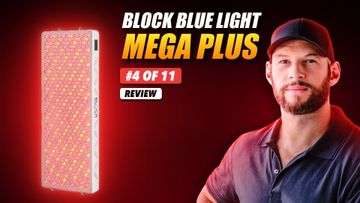
- Stronger choices: the PlatinumLED BioMax Pro Ultra (1st, 63.25 points, $1,610) for $48 more, or the Block Blue Light Mega Plus (4th, 55.25 points) if you want wider coverage from a single flat panel.
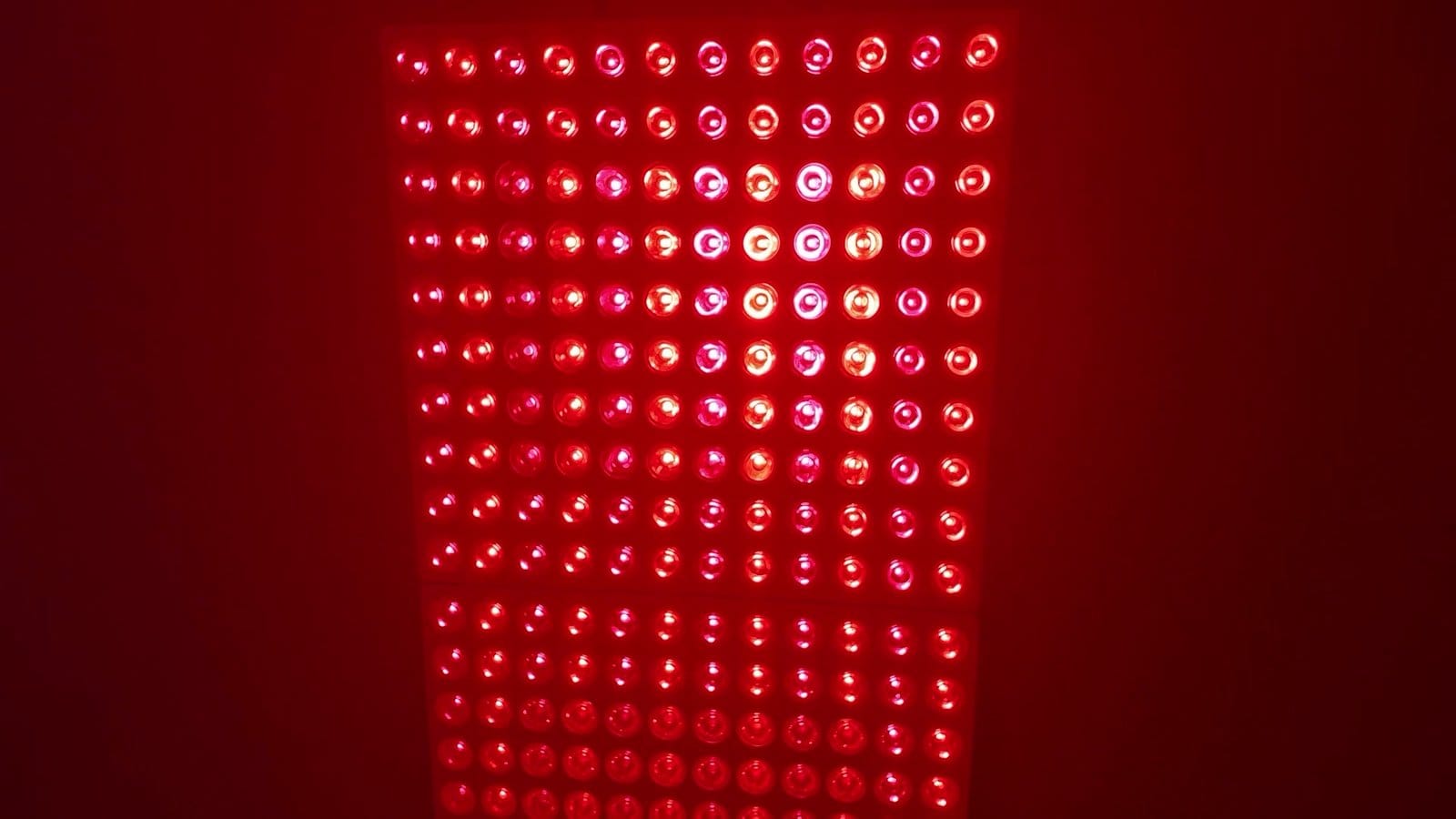
Rojo Switch M3
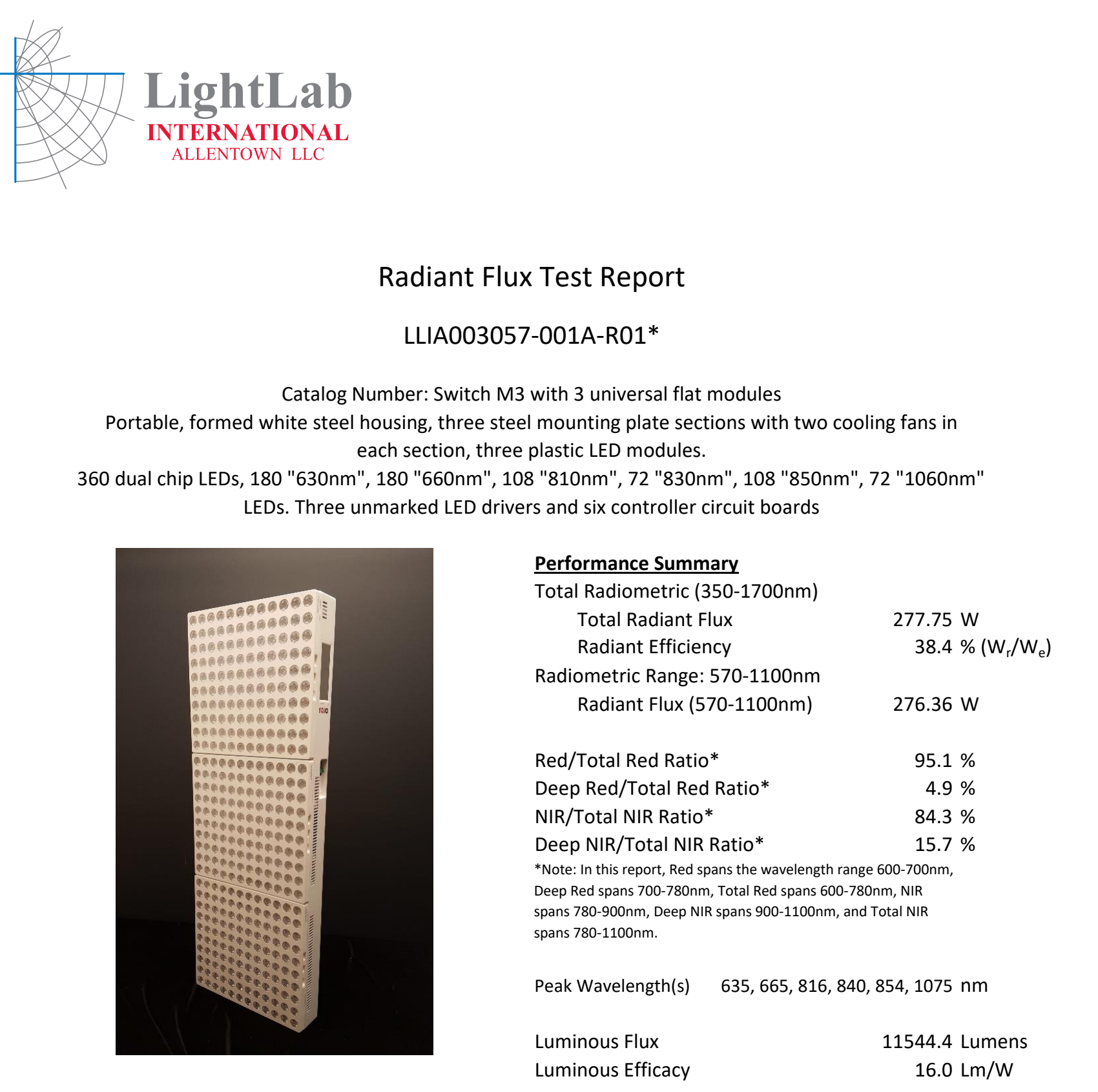
An M3 hub with three swappable light modules. I tested three Universal Flat modules: 360 dual-chip LEDs across six wavelengths, with independent zone control, a live joules display, smart modes, an app and a remote. Use code ALEX for 10% off.
Key Lab Results at a Glance
- Light output: 278 W of light from 723 W of power (38.4% efficient).
- Face area at 12 inches: 87.5 mW/cm² on average (13.6% variation).
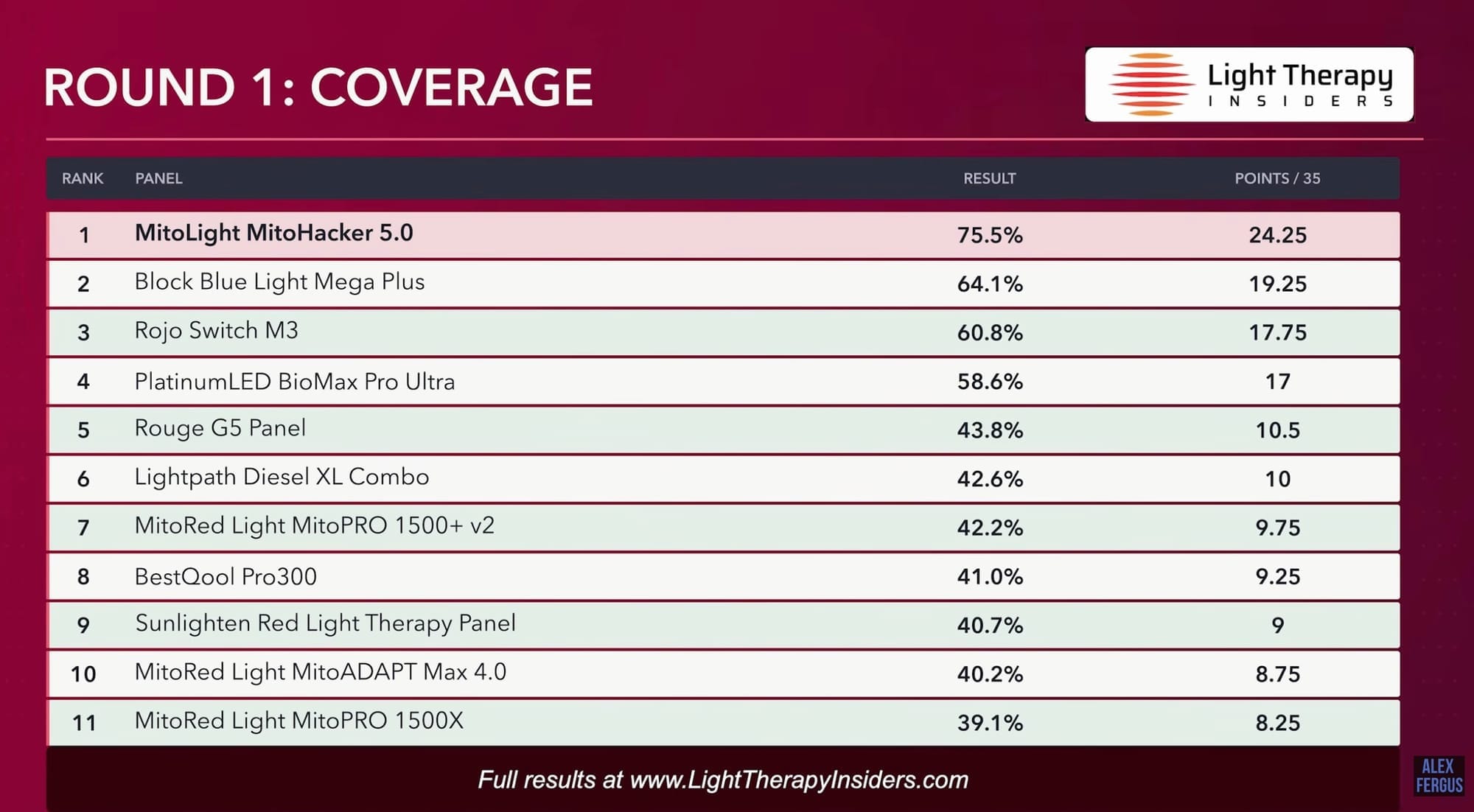
- 24 × 30 in test area: 46.8 mW/cm² on average, with 60.8% of the area at 30 mW/cm² or more (3rd of 11 for coverage).
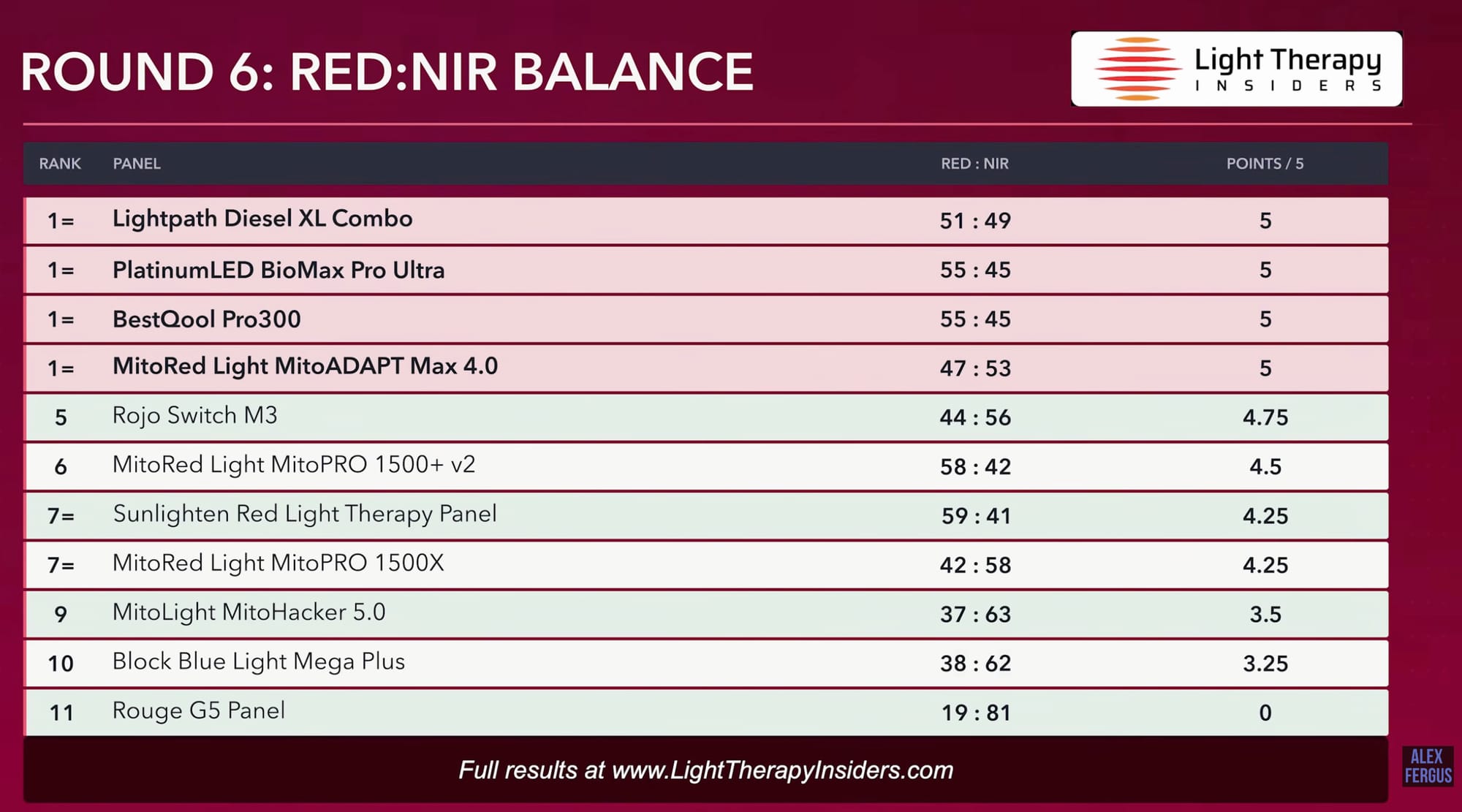
- Red vs. near-infrared: 43.6% red and 56.4% near-infrared (5th of 11 for balance).
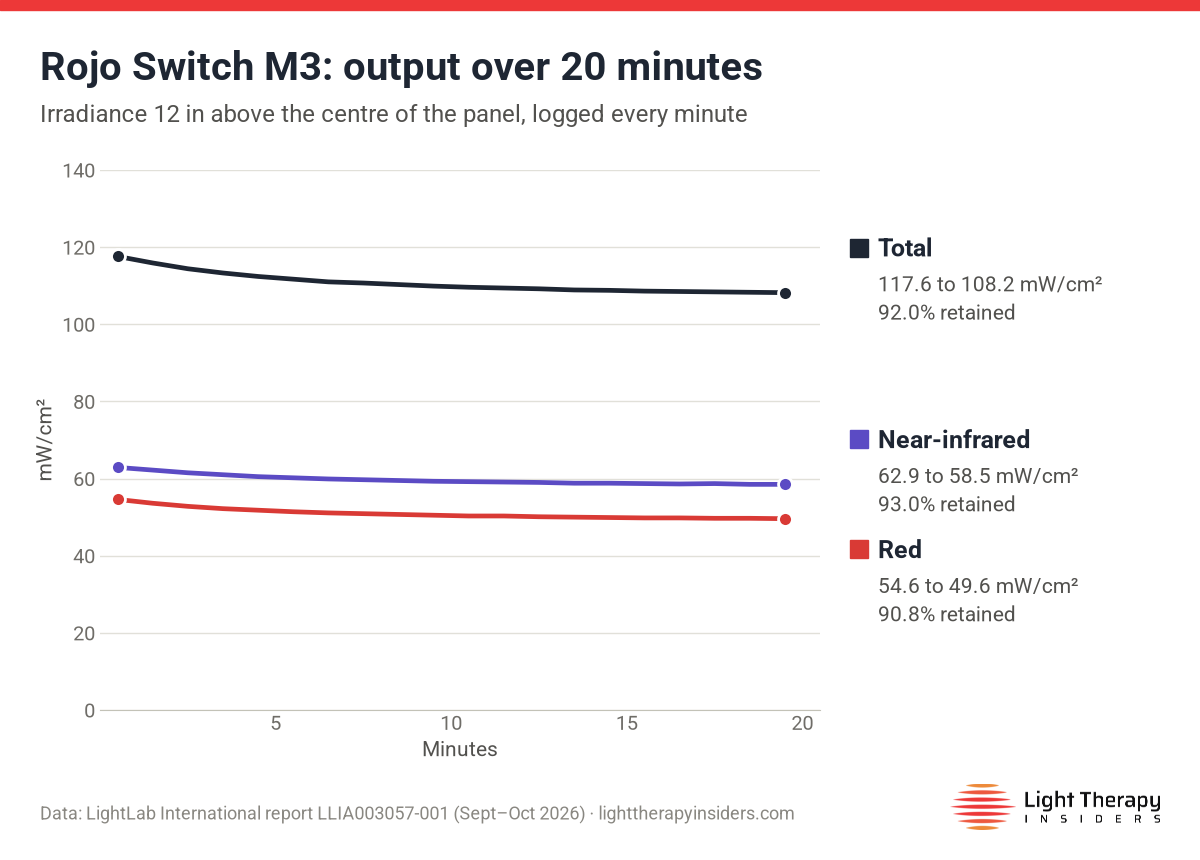
- Stability: 92.0% of its starting output after 20 minutes.
- Wavelengths: all five of my core wavelengths cleared 0.5 W/nm.
Here's how it scored in each round of my 2026 test:
| Round | Switch M3 Score | Rank (of 11) |
|---|---|---|
| 1. Coverage | 17.75 / 35 | 3rd |
| 2. Average irradiance | 3.25 / 5 | 4th |
| 3. Uniformity | 1.5 / 10 | =5th |
| 4. Optical stability | 4 / 5 | 9th |
| 5. Wavelengths | 4 / 5 | =1st |
| 6. Red:NIR balance | 4.75 / 5 | 5th |
| 7. Ease of use | 15 / 15 | =1st |
| 8. Extras | 5 / 10 | 7th |
| 9. Price | 5.75 / 10 | =6th |
| Total | 61 / 100 | 3rd |
What I Like
- Genuinely modular: modules swap magnetically, come in Flat or Winged designs, and more hubs can be added later
- Each module runs independently, with per-wavelength dimming, smart modes, custom presets and a live joules estimate
- Strong output: 87.5 mW/cm² over the face area and 46.8 mW/cm² across the 24 × 30 in test area at 12 inches
- Well balanced at 43.6% red, and all five of my core wavelengths cleared 0.5 W/nm
- The strongest 1060 nm output of the 11 panels I tested
What Could Be Better?
- Loud: it measured over 50 dB in my test, so it scored 0 for noise
- Output fell 8% over 20 minutes, 9th of 11 for stability
- Less even than the best panels: tied 5th for uniformity, and its face area varied by 13.6%, the most in the test
- Only 5 of 10 for extras when tested, including 1 of 2 for certification evidence
- More decisions up front: hub size, module types, Flat or Winged, and stands
Rojo Switch M3 Specs vs. Lab Results
Here's what Rojo says about the Switch M3, and what the independent lab measured:
| Spec | What Rojo Says | What the Lab Measured |
|---|---|---|
| Configuration | M3 hub with three swappable modules (I tested three Universal Flat modules) | 360 dual-chip LEDs across three modules, each with two cooling fans |
| Wavelengths | Set by the modules you choose | Universal modules: 630, 660, 810, 830, 850 and 1060 nm LEDs; peaks at 635, 665, 816, 840, 854 and 1075 nm |
| Red vs. near-infrared | Depends on the module mix | 43.6% red, 56.4% near-infrared |
| Power draw | Not checked | 723 W at 120 V |
| Light output | Not stated | 278 W of light: 38.4% of the power it draws |
| Irradiance at 12 in | Not stated | 46.8 mW/cm² average over a 24 × 30 in area; 87.5 mW/cm² over a face-sized area |
| Controls | Touchscreen, ROJO LED app and remote; per-wavelength intensity, zone control, smart modes, live joules | Not tested |
| Warranty and returns | 5-year warranty (it was 3 years when I filmed the test) and a 60-day money-back guarantee | Not applicable |
Rojo ships free worldwide, though duties and taxes may apply outside the US.
How the Rojo Switch System Works
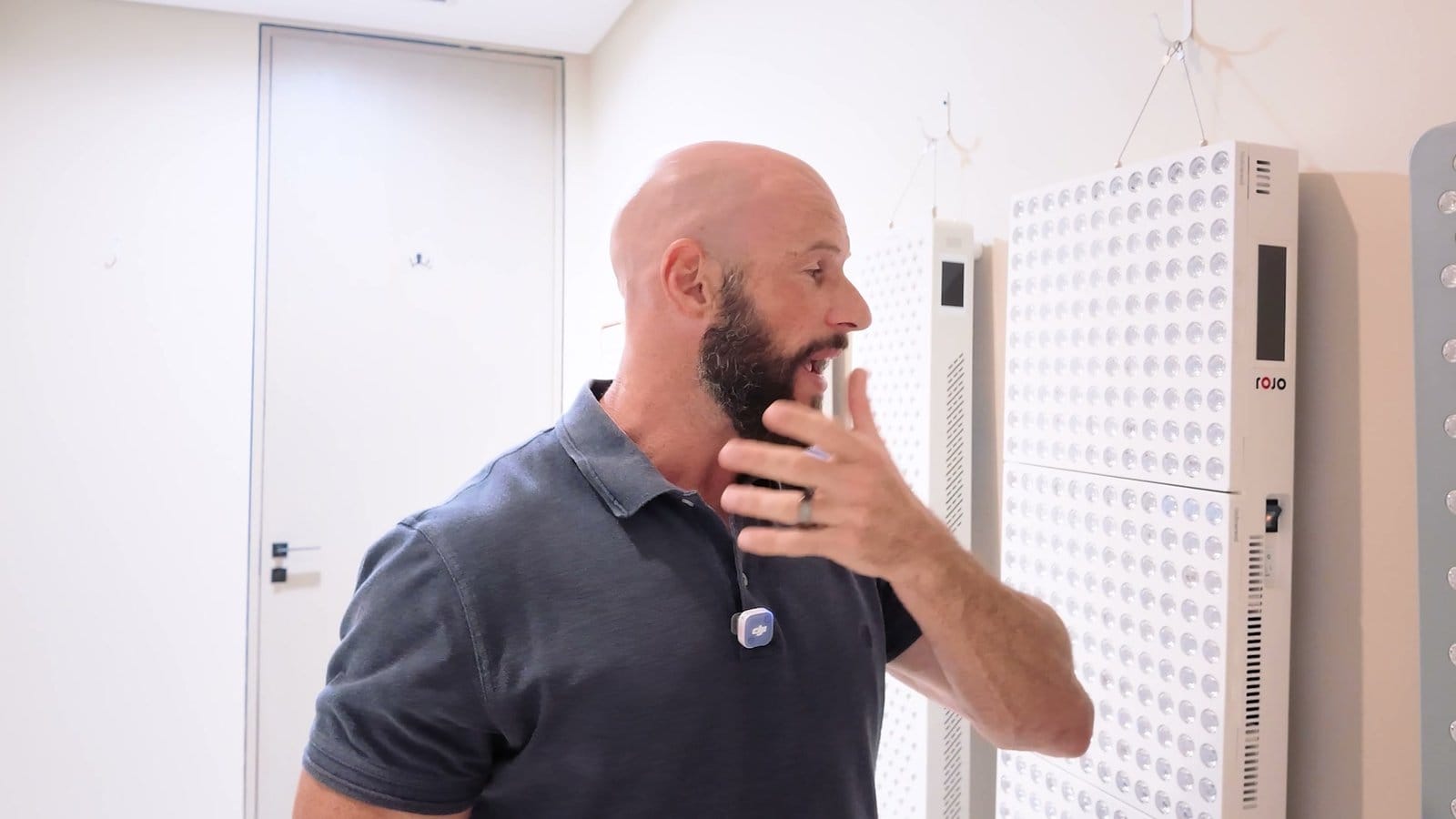
Every Switch starts with a hub. The M1 holds one module, the M2 two and the M3 three. Rojo currently offers eight module types (Universal, Recovery, Repair, Rejuvenate, Classic, Derma Cleanse, Wellness and Standard), each with its own wavelength mix, in Flat or Winged designs. Winged modules have side panels that angle light around your body.
Modules swap magnetically, and on the M2 and M3 each one can run its own settings: different wavelengths, intensity and session time in different zones. M2 and M3 hubs can also be joined into larger systems that run as one panel in the ROJO LED app.
I tested the M3 with three Universal Flat modules, so the lab numbers below apply to that setup. Other modules change the wavelength mix, so expect different results with them.
How I Tested the Rojo Switch M3
The Switch M3 went through exactly the same process as all 11 panels in my 2026 panel comparison, so its scores sit directly beside theirs.
- Independent lab measurements. LightLab International, a photometric lab in Allentown, Pennsylvania, ran three tests in September and October 2026: total light output and spectrum in a 2-metre integrating sphere, output over 20 minutes, and an irradiance map at 12 inches measured every 2 inches (test report LLIA003057-001).
- Why 12 inches. I now test at 12 inches rather than 6, because readings taken close to the LEDs overstate how evenly a panel treats your body. Here's why.
- Nine scored rounds, 100 points. Coverage (35), average irradiance (5), uniformity (10), output stability (5), wavelengths (5), red-to-near-infrared balance (5), ease of use (15), extras such as warranty, returns, certifications, noise and expandability (10), and price (10).
Each brand, including Rojo, paid LightLab for its own panel’s testing and provided its panel free of charge. The Switch M3's scores use exactly the same lab data and scoring as every other panel.
Lab Results: How the Rojo Switch M3 Performed
Coverage and Power at 12 Inches
Across the standard 24 × 30 in treatment area, the Switch M3 averaged 46.8 mW/cm² (4th of 11 for average irradiance), and 60.8% of the area got at least 30 mW/cm² (3rd for coverage).
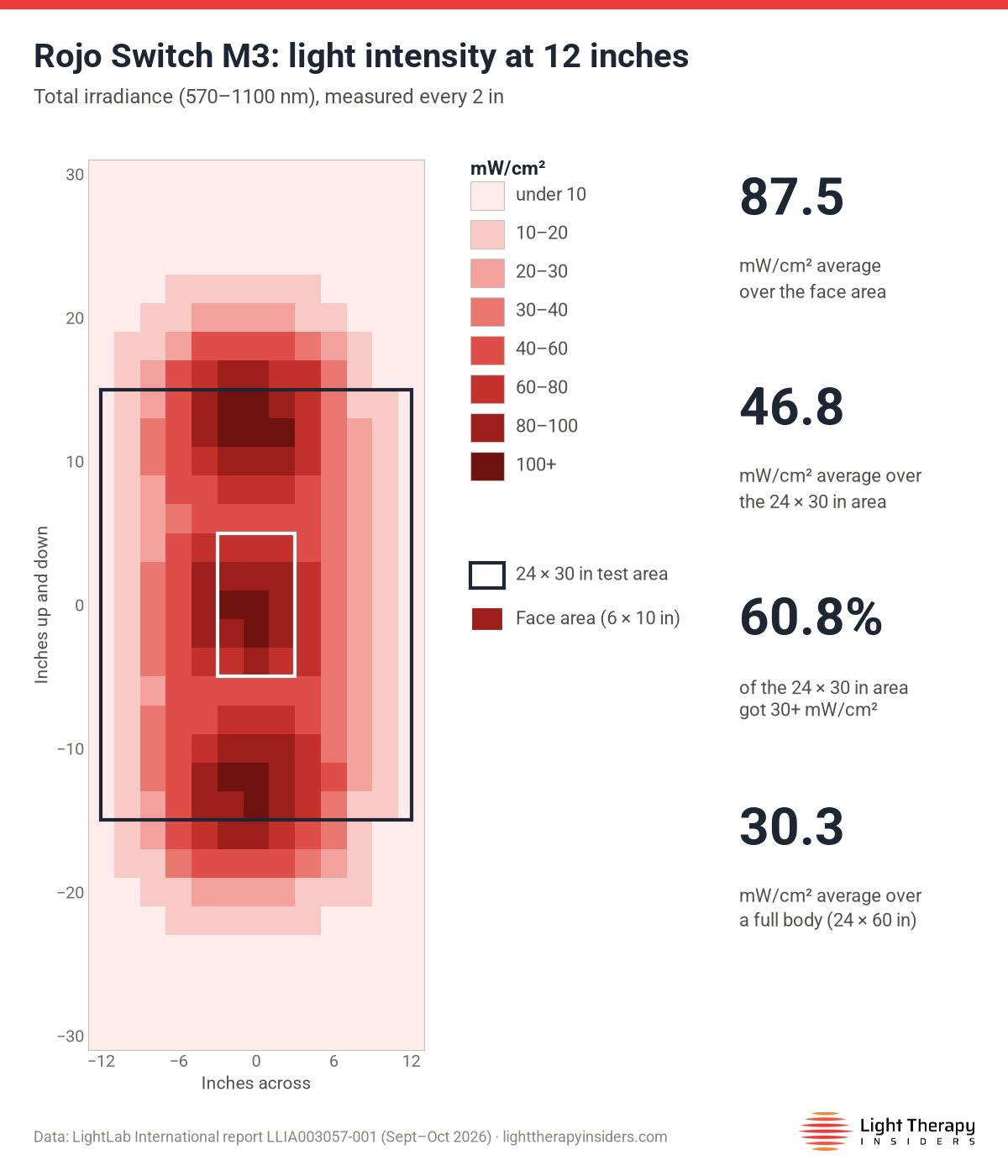
The heat map shows a tall, broad block of strong light, with readings above 100 mW/cm² in the hottest spots. Across a full 24 × 60 in body area it averaged 30.3 mW/cm², 2nd of the 11 panels behind the MitoHacker 5.0.
Here's how the light holds up as the treatment area grows:
| Area at 12 in | Average (mW/cm²) | Lowest (mW/cm²) | Area at 30+ mW/cm² | Variation |
|---|---|---|---|---|
| Face (6 × 10 in) | 87.5 | 72.5 | 100% | 13.6% |
| Test area (24 × 30 in) | 46.8 | 5.4 | 60.8% | 72.3% |
| Full body (24 × 60 in) | 30.3 | 0.2 | 37.1% | 109.9% |
Evenness
Overall uniformity (average ÷ peak across the 24 × 30 in area) was 43.1%, =5th of 11. Over a face-sized area at the centre, the light ranged from 72.5 to 106.0 mW/cm², varying by 13.6%. That's the trade-off for its power: the face area is very strong, but less uniform than the most even panels.
Output Over a Session
After 20 minutes the Switch M3 still delivered 92.0% of its starting output, 9th of 11 for stability (4 of 5 points). Red held at 90.8% and near-infrared at 93.0%.
As the LEDs warmed up, the peaks moved slightly longer, by up to 6 nm:
| Peak | After 30 sec | After 14.5 min | After 19.5 min |
|---|---|---|---|
| Red | 631 nm | 634 nm | 635 nm |
| Red | 661 nm | 665 nm | 665 nm |
| Near-infrared | 810 nm | 815 nm | 815 nm |
| Near-infrared | 837 nm | 843 nm | 843 nm |
| Near-infrared | 851 nm | 857 nm | 857 nm |
| Deep near-infrared | 1068 nm | 1069 nm | 1069 nm |
Wavelengths
The lab found peaks at 635, 665, 816, 840, 854 and 1075 nm. All five of my core wavelengths (630, 660, 810, 830 and 850 nm) cleared the 0.5 W/nm bar, which earns 4 points, a score shared with six other panels. No panel cleared the bar for the two bonus wavelengths, 590 and 1064 nm.
| Wavelength | Measured (W/nm) | Counts in My Test? |
|---|---|---|
| 590 nm (bonus) | 0.005 | ✗ No |
| 630 nm | 1.925 | ✓ Yes |
| 660 nm | 2.480 | ✓ Yes |
| 810 nm | 1.804 | ✓ Yes |
| 830 nm | 1.594 | ✓ Yes |
| 850 nm | 1.503 | ✓ Yes |
| 1064 nm (bonus) | 0.333 | ✗ No |
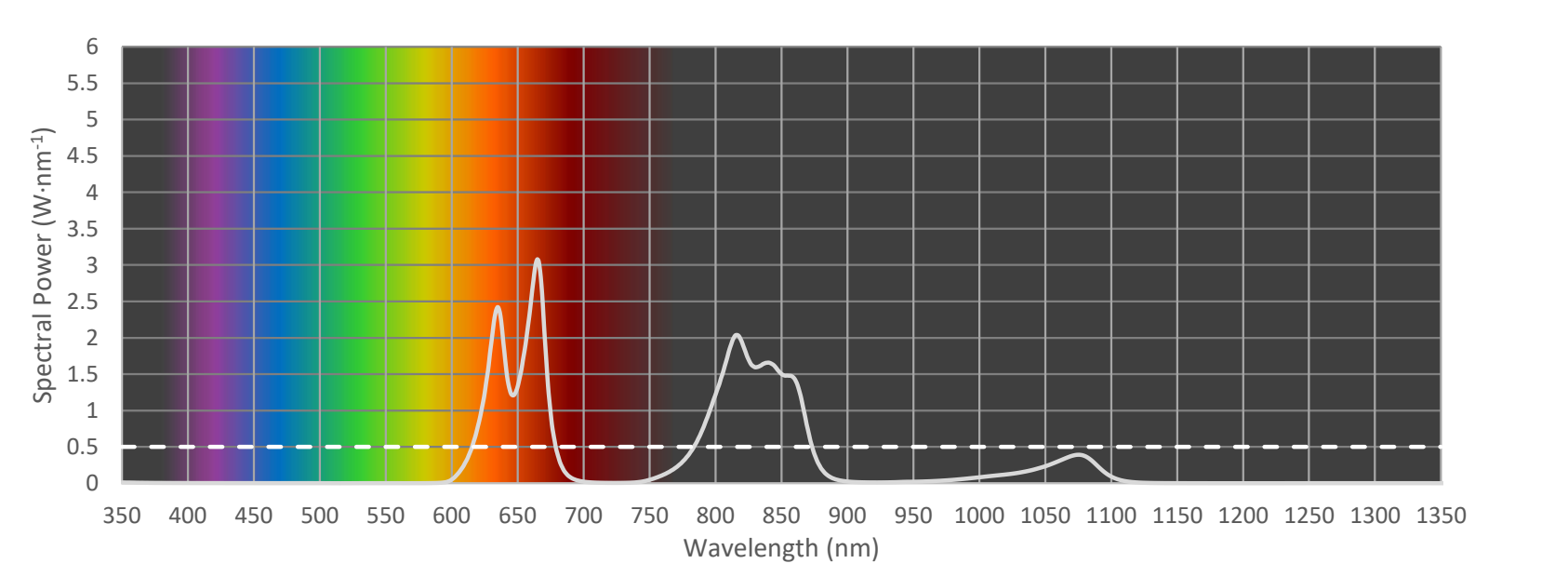
Rojo's Universal module also produced the strongest 1060 nm output of the 11 panels: 0.33 W/nm, though that's still short of the 0.5 W/nm needed to earn the bonus point.
Red vs. Near-Infrared Balance
43.6% of the Switch M3's light is red (600–780 nm) and 56.4% near-infrared (780–1100 nm). That's close to the 50:50 balance my test rewards, and it earned 4.75 of 5 points. Red is the range most studied for skin, while near-infrared reaches deeper tissue, so this mix suits both. You can shift it further either way with the per-wavelength dimming or different modules.
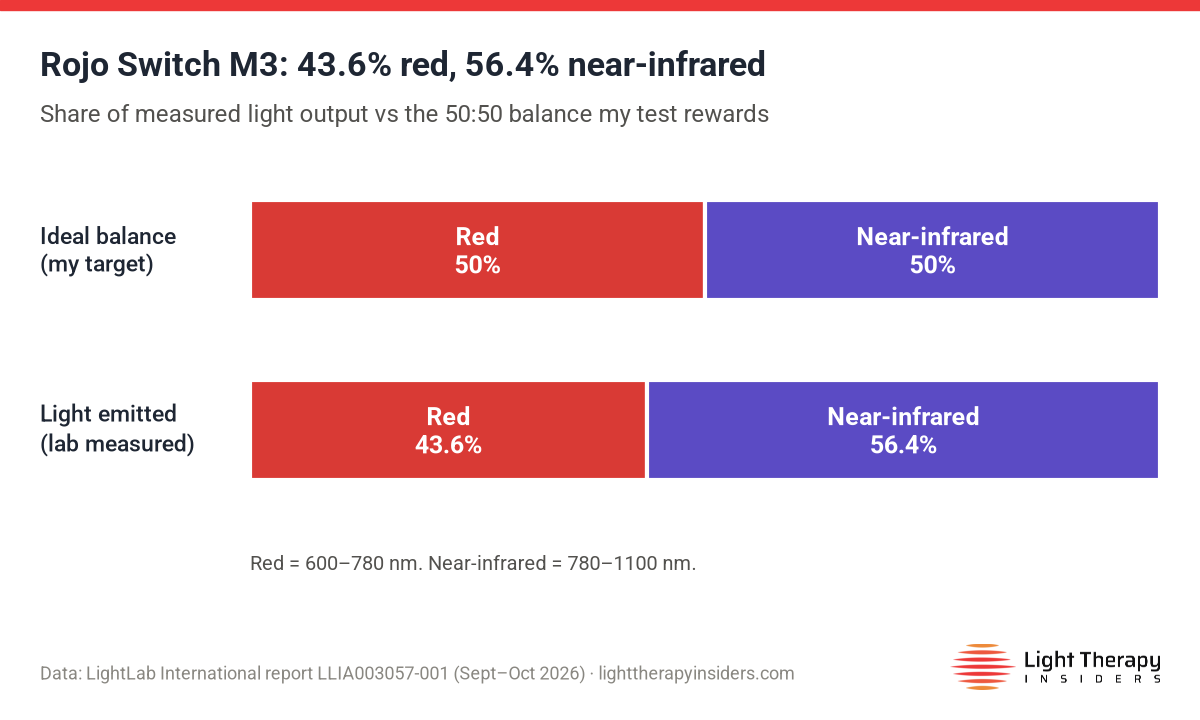
The lab's breakdown of where the light goes:
| Waveband | Light Output | Share |
|---|---|---|
| Red (600–700 nm) | 114.40 W | 41.2% |
| Deep red (700–780 nm) | 5.93 W | 2.1% |
| Near-infrared (780–900 nm) | 131.30 W | 47.3% |
| Deep near-infrared (900–1100 nm) | 24.52 W | 8.8% |
| Total light output | 277.75 W | 100% |
Using the Rojo Switch M3
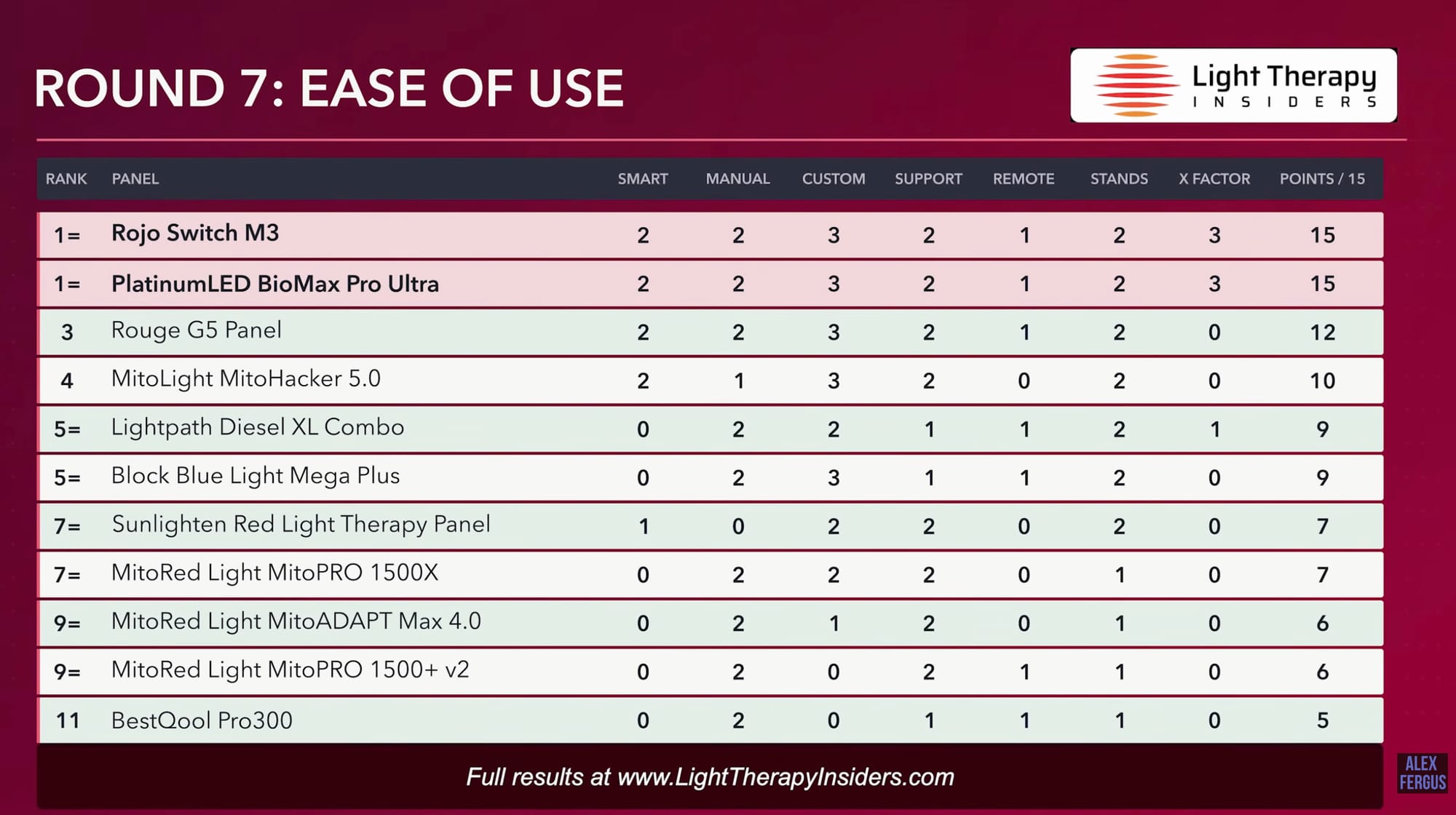
It scored a perfect 15 of 15 for ease of use, tying with the BioMax Pro Ultra, including all three X-factor points for its modular design.
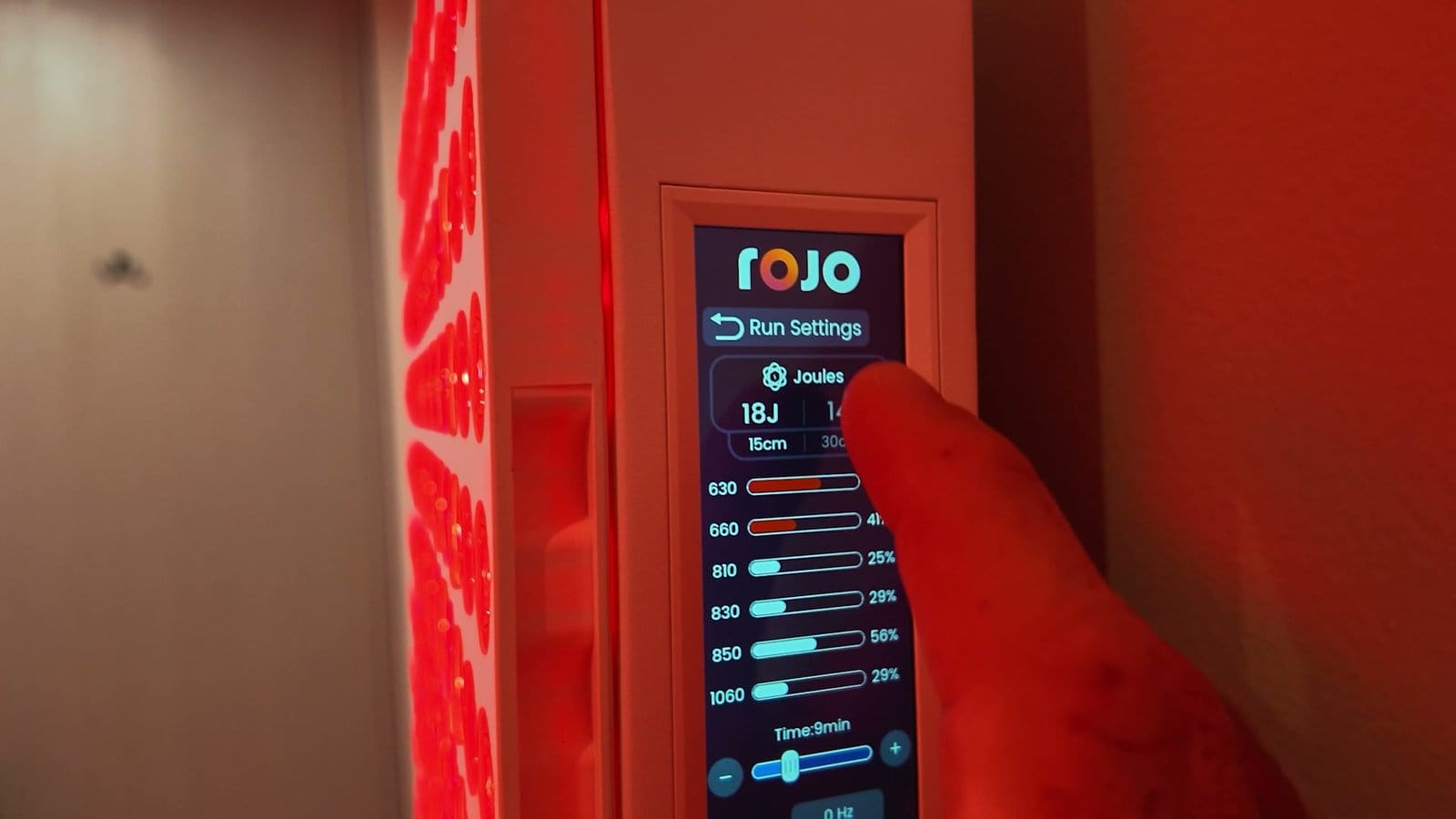
- Touchscreen with per-wavelength intensity control and session timer
- Independent zone control: run each module with its own wavelengths, intensity and time, or start, pause and reset them separately
- Live joules estimate that updates as you change intensity, time and distance
- Smart Modes and custom presets for one-touch sessions
- ROJO LED app and remote: the app can run several hubs as one panel
- Stands: hand-crank, motorised and floor stands; multi-hub setups need a floor stand
A Starting Protocol
These starting points are based on what the research suggests for skin and on the lab's measurements at 12 inches.
- Face and skin: aim for about 5–9 J/cm². At 12 inches the Switch M3 delivers about 87 mW/cm² over the face with every wavelength on, so that dose takes roughly 1.0 to 1.7 minutes.
- Joints, muscles and recovery: 5–10 minutes per area at 12 inches. My dosing chart shows the ranges studies have used.
- Eyes: wear eye protection. Near-infrared is invisible, and these panels are bright. More in my eye safety guide.
Price, Shipping, Warranty and Returns
I priced every panel the same way: delivered to Austin, Texas, after my discount code or link, with shipping and tax included. On that basis the Switch M3 cost $1,562 at the time of filming and scored 5.75 of 10 for price (=6th of 11).
- Discount: code ALEX takes 10% off at Rojo (already counted in the $1,562). Rojo's Switch launch offer (25% off Switch kits plus a free LED face mask, ending 30 November) was running when I checked on 7 November, so check today's price.
- Shipping: free worldwide, though duties and taxes may apply outside the US.
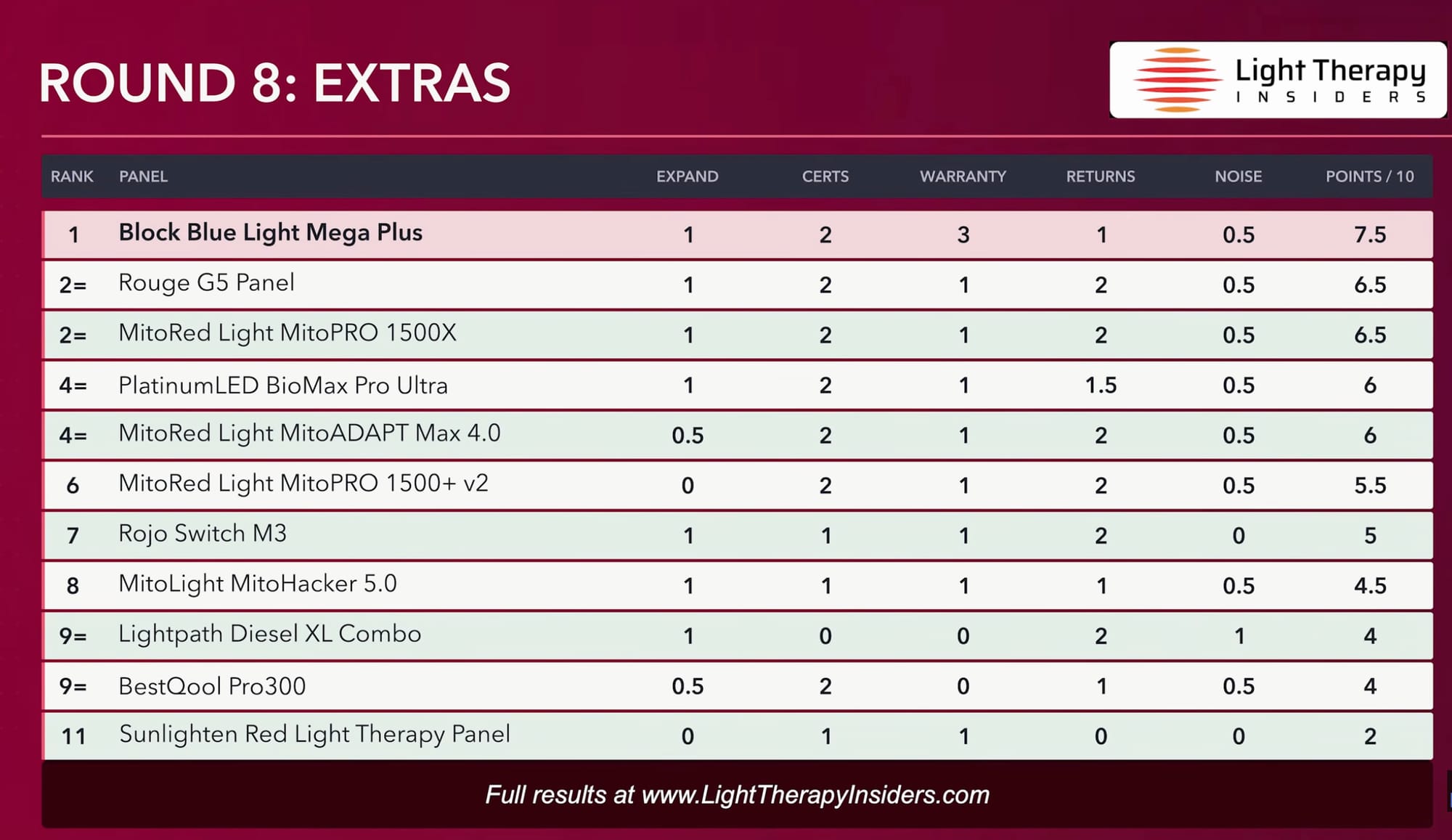
- Warranty: 5 years. When I filmed the test, Rojo's warranty was 3 years, which scored 1 of 3. A 5-year warranty scores 3 of 3, which would have lifted the Switch M3 to 63 points and 2nd place, 0.25 behind the BioMax Pro Ultra.
- Returns: a 60-day money-back guarantee, scoring 2 of 3.
Overall it scored 5 of 10 for extras: 1 of 1 for expandability, 1 of 2 for certification evidence, 1 of 3 for warranty (3 years at the time), 2 of 3 for returns and 0 of 1 for noise. With the 5-year warranty Rojo offers now, it would score 7 of 10.
Who Should Buy the Rojo Switch M3?
Buy it if you:
- Want a system you can reconfigure with different modules as your goals change
- Want separate control of different body zones in one session
- Want strong, well-balanced light with every core wavelength
- Plan to expand to a larger multi-hub setup later
Look elsewhere if you:
- Are sensitive to fan noise
- Want the simplest set-and-forget panel
- Want my overall winner: the BioMax Pro Ultra costs $48 more
- Live in Europe and want the best lab performance: see the MitoHacker 5.0
Rojo Switch M3 vs. the Alternatives
Here's how the Switch M3 compares with the panels around it in my 2026 test (all measured at 12 inches over the same 24 × 30 in area, and priced delivered to Texas after discount codes, with shipping and tax):
| Panel | 2026 Score | Area at 30+ mW/cm² | Avg. Irradiance (mW/cm²) | Red Share | Price Tested |
|---|---|---|---|---|---|
| PlatinumLED BioMax Pro Ultra | 63.25 (1st) | 58.6% | 48.6 | 54.7% | $1,610 |
| MitoLight MitoHacker 5.0 | 61.25 (2nd) | 75.5% | 54.8 | 37.1% | $2,114 |
| Rojo Switch M3 | 61.00 (3rd) | 60.8% | 46.8 | 43.6% | $1,562 |
| Block Blue Light Mega Plus | 55.25 (4th) | 64.1% | 47.2 | 36.8% | $2,367 |
| Rouge G5 Panel | 44.75 (5th) | 43.8% | 30.5 | 19.3% | $1,564 |
Best Overall Alternative: PlatinumLED BioMax Pro Ultra
PlatinumLED BioMax Pro Ultra (2026 winner)
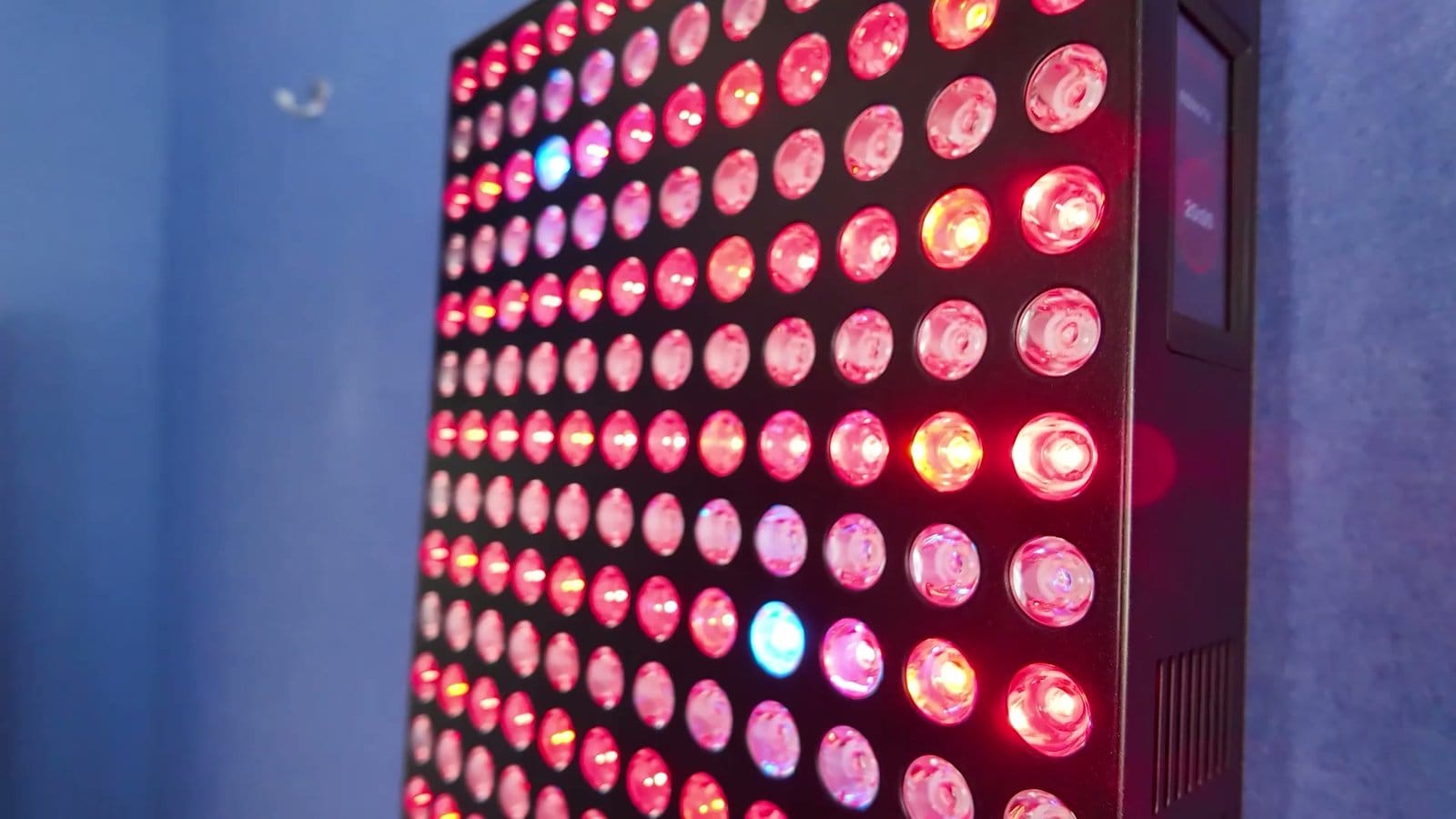
For $48 more than the Switch M3: 1st place, slightly more average irradiance (48.6 vs. 46.8 mW/cm²), more red light (54.7%), steadier output and the same perfect ease-of-use score. The Switch M3 covered more of the test area (60.8% vs. 58.6%). 5% off through my link.
Read my full PlatinumLED BioMax Pro Ultra review.
Widest Single Flat Panel: Block Blue Light Mega Plus
Block Blue Light Mega Plus (4th)
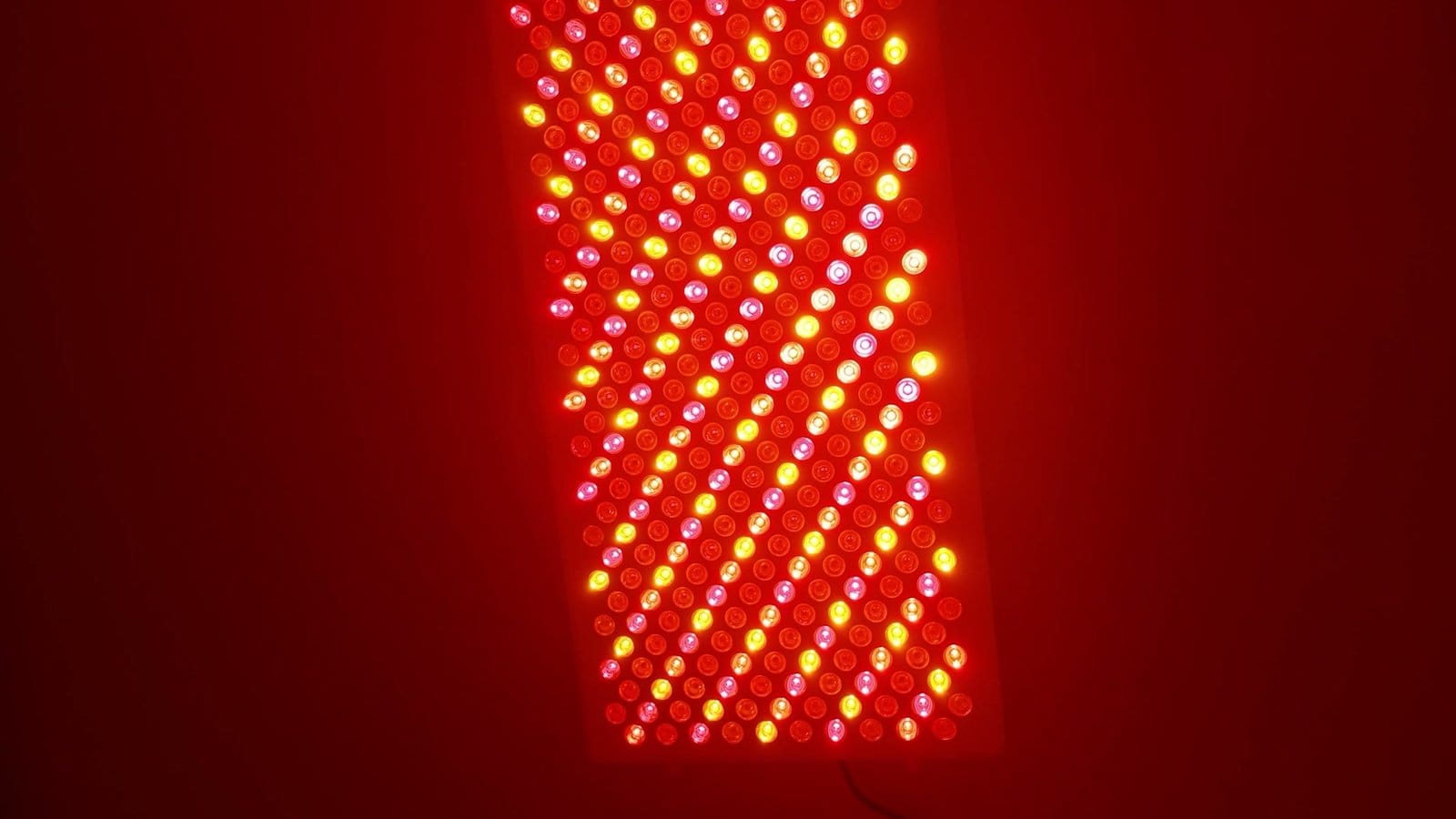
About $800 more delivered, but it covered 64.1% of the test area, with very even light and the top extras score in my test, including a five-year warranty. The Switch M3 has far more control and more red light (43.6% vs. 36.8%). 15% off through my link.
Read my full Block Blue Light Mega Plus review.
Other Panels to Consider
- vs. MitoHacker 5.0: 2nd place and the performance leader, with the widest coverage (75.5%), but sold in the EU and UK only. MitoHacker 5.0 review
- vs. Rouge G5: the same price, but it placed 5th, with far less red light (19.3%) and a much narrower strong zone. Rouge G5 review
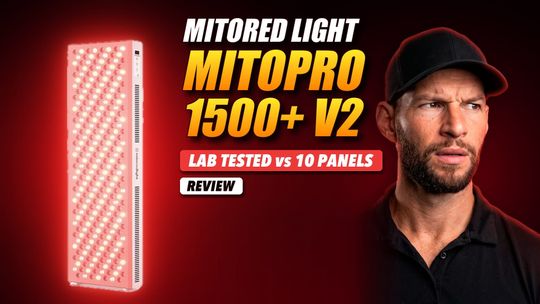
- vs. MitoPRO 1500+ v2: about $300 cheaper and simpler, with red-rich light, but much less coverage and almost no controls. MitoPRO 1500+ v2 review
⭐ My Reviews ⭐
Rojo Switch M3 FAQ
Is the Rojo Switch M3 worth it?
If the modular idea appeals to you, yes. It placed 3rd of 11 in my 2026 lab test (2nd if scored on its new 5-year warranty), with strong, well-balanced light and the best controls I've tested. If you just want the best all-round panel, the BioMax Pro Ultra won and costs $48 more.
What's the difference between the Switch M1, M2 and M3?
The number of modules the hub holds: one, two or three. The M3 gives the most coverage from a single hub, and M2 and M3 hubs can be joined for full-body setups.
Which modules did you test?
Three Universal Flat modules. Other modules use different wavelength mixes, so their results will differ from mine.
Is the Switch M3 good for skin?
Yes. 43.6% of its light is red, with strong 630 and 660 nm output. For the face, at 12 inches it delivers about 87 mW/cm², so a 5–9 J/cm² dose takes roughly 1 to 1¾ minutes. Lower the intensity or step back if you want longer sessions.
Is it loud?
It's one of the louder panels I tested: over 50 dB, which scored 0 for noise. Each module has two cooling fans.
What's the warranty?
Five years, plus a 60-day money-back guarantee. When I filmed my 2026 test, Rojo's warranty was 3 years, and that's what I scored. With 5 years, the Switch M3 would have scored 63 points and placed 2nd.
Is there a Rojo discount code?
Yes. Code ALEX takes 10% off at Rojo. See my discount codes page for other brands.
Final Thoughts
The Switch M3 is the most innovative panel I tested in 2026, and the lab results back it up: strong, well-balanced light with every core wavelength covered. It's let down by fan noise, a bigger drop in output over a session and a modest extras score.
If the idea of a light therapy system you can reconfigure and expand appeals to you, it's an easy recommendation. It finished 3rd, 2.25 points behind the BioMax Pro Ultra, and with the 5-year warranty Rojo offers now it would have been 2nd, just 0.25 points behind.
Score: 61 out of 100, 3rd of 11 in my 2026 panel test.
- Buy the Switch M3 if you want modular, zone-by-zone control and strong, balanced light: check the Rojo Switch M3 price and use code ALEX for 10% off.
- For most buyers, the PlatinumLED BioMax Pro Ultra is the better all-rounder: it won the 2026 test, and the link takes 5% off.
Items Mentioned
🔥🔥 Check this blog daily for the latest Red Light Therapy Black Friday and Cyber Monday deals: https://aferg.co/black-friday-cyber-monday 🔥🔥
⭐ Sunlighten- Use code Fergus at https://aferg.co/sunlighten
⭐ Mito Light Europe - Use code ALEX at https://aferg.co/mitolight for 5% off!
⭐ MitoRed Light - use https://aferg.co/7d221 for 5% off sitewide.
⭐ Rojo Light Therapy - Use discount code ALEX at https://aferg.co/rojo-rlt for 10% off.
⭐ LightpathLED - Use discount code ALEX at https://aferg.co/lightpathled to get 5% off.
⭐ BestQool - use code ALEX at https://aferg.co/Bestqool to save 10%.
⭐ Block Blue Light - Use this link: https://aferg.co/BlockBlueLight to save 15% on Block Blue Light's products. The discount will automatically be applied at checkout.
⭐ PlatinumLED Therapy Lights- Use the discount link https://aferg.co/redled to save 5%
⭐ Rouge - Use discount code ALEX at https://aferg.co/rougecare for $50 off.
✨ Have you explored my website ✨
Discover guides, reviews, and insights to help you make the most of light therapy
Alex's Bio
Alex Fergus wrote this blog post. Alex is an ISSN Sports Nutrition Specialist, Fitness Professional, and certified Superhuman Coach who continues to expand his knowledge base and help people across the world with their health and wellness. Alex is recognized as the National Record Holder in Powerlifting and Indoor Rowing and has earned the title of the Australian National Natural Bodybuilding Champion. Having worked as a health coach and personal trainer for over a decade, Alex now researches all things health and wellness and shares his findings on this blog.