

I had 11 red light therapy panels independently lab-tested for my 2026 panel comparison. That testing produced a lot of data: each panel's full spectrum, a 403-point map of where its light lands, its output over a 20-minute session and much more. This page puts all of it in one place, so you can compare any panels you like.
Pick up to four panels and every chart below updates to show them. You can overlay their spectra, compare their heat maps, see how their output changes as they warm up, rank all 11 on any measure and work out session times. Every panel links to its full review, and you can share a link to your comparison.
🏆 Quick Answer: Which Panel Did Best in the Lab?
- Best overall: PlatinumLED BioMax Pro Ultra. It won my 2026 test with 63.25 points: strong, balanced light (54.7% red), the steadiest output of the top four and a perfect ease-of-use score. Full review
- Best light performance: MitoLight MitoHacker 5.0. It had the widest coverage (75.5%), the highest average irradiance (54.8 mW/cm²) and the most even light, and placed 2nd. It's sold in the EU and UK only. Full review
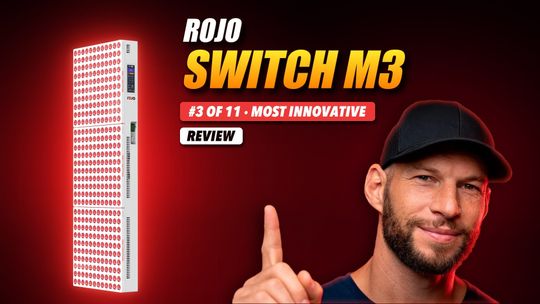
- Most innovative: Rojo Switch M3. It placed 3rd with 61 points, and with the 5-year warranty Rojo offers now, it would have placed 2nd. Full review
- Best value: BestQool Pro300. At $810 delivered at the time of filming, it was the cheapest panel in the test by $455. Full review
Your Comparison at a Glance
Spectrum: What Each Panel Actually Emits
This is the lab's measured spectrum for each panel: how much light it puts out at every wavelength from 400 to 1100 nm. Hover or tap the chart to read the values at any wavelength. The dashed line is the 0.5 W/nm a wavelength needed to count in my scoring.
Heat Maps: Where the Light Lands at 12 Inches
The lab measured each panel's light every 2 inches over a 24 × 60 in area, 12 inches away, which is roughly a whole body. All the maps use the same colour scale, so you can compare them directly. The large outlined box is the 24 × 30 in area I used for coverage, average irradiance and uniformity scoring, and the small box inside it is a face-sized area (6 × 10 in).
The coverage figures are the lab's own calculations for the 24 × 30 in area. The lab measured that area in finer detail, so counting the squares on these 2-inch maps won't match them exactly.
Optical Stability: Does the Output Drop Over a Session?
LEDs often lose some output as a panel warms up. The lab recorded each panel's output every minute for 20 minutes. Here, each panel starts at 100%, so you can see how much it drops, whatever its power.
Spectral irradiance 12 inches from the centre of the panel, at three points in the 20-minute test.
How All 11 Panels Rank on Every Lab Measure
Pick a measure to rank all 11 panels. Your selected panels are in colour. Tap a panel's row to add it to your comparison or remove it.
Price vs. Score: Which Panels Give You the Most for Your Money?
Each dot is one panel: its total score against its price at the time of filming (delivered, after my codes or links). Higher and further left is better value.
Session-Time Calculator
Light dose is usually given in joules per square centimetre (J/cm²): the light's intensity multiplied by the time. Choose an area and a dose to see how long each of your selected panels would take at 12 inches, using the lab's average readings.
Studies use a wide range of doses, and this isn't medical advice. Times use the lab's average intensity at 12 inches. Moving closer increases the intensity, and moving further away reduces it. Always follow your panel's manual.
Key Findings From the Lab Data
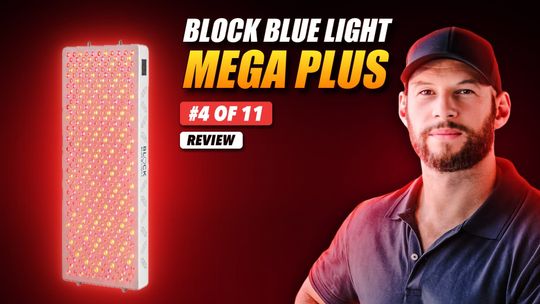
- Coverage: the MitoLight MitoHacker 5.0 covered 75.5% of a 24 × 30 in area with at least 30 mW/cm² at 12 inches, well ahead of the Block Blue Light Mega Plus (64.1%) and Rojo Switch M3 (60.8%).
- Average irradiance: the MitoLight MitoHacker 5.0 averaged 54.8 mW/cm² over that area, about 13% more than the PlatinumLED BioMax Pro Ultra (48.6 mW/cm²).
- Uniformity: the MitoLight MitoHacker 5.0 spread its light most evenly (68.0%). The Block Blue Light Mega Plus was next at 52.6%.
- Optical stability: the MitoRed Light MitoADAPT Max 4.0 changed by just 0.8% over 20 minutes, and the Sunlighten Red Light Therapy Panel by 1.6%. The MitoLight MitoHacker 5.0 dropped the most, by 13.4%.
- Red vs. near-infrared: the Lightpath Diesel XL Combo was closest to an even split (51.0% red). The Rouge G5 Panel was the most near-infrared heavy, with only 19.3% red light.
- Wavelengths: Seven of the 11 panels reached the 0.5 W/nm threshold at all five core wavelengths (630, 660, 810, 830 and 850 nm). None reached it at 590 nm or 1064 nm. The highest were the Block Blue Light Mega Plus at 590 nm (0.19 W/nm) and the Rojo Switch M3 at 1064 nm (0.33 W/nm).
- Total light output: the MitoLight MitoHacker 5.0 emitted the most light (325 W). The most efficient panel was the Lightpath Diesel XL Combo, turning 44.4% of the power it drew into light.
- Face irradiance: at 12 inches, the PlatinumLED BioMax Pro Ultra delivered the most intense light over a face-sized area (92.5 mW/cm²), followed by the Rojo Switch M3 (87.5 mW/cm²).
- Price: delivered prices at the time of filming ranged from $810 (BestQool Pro300) to $2,367 (Block Blue Light Mega Plus).
All the Lab Data in One Table
Here are the headline numbers for all 11 panels. Coverage, average irradiance and uniformity are for a 24 × 30 in area 12 inches from each panel. Output drop is the change in output over a 20-minute session.
| Place | Panel | Score | Price* | Coverage | Avg. irradiance | Uniformity | Output drop (20 min) | Red share | Core wavelengths | Light output | Efficiency | Deal |
|---|---|---|---|---|---|---|---|---|---|---|---|---|
| 1 | PlatinumLED BioMax Pro Ultra | 63.25 | $1,610 | 58.6% | 48.6 mW/cm² | 47.4% | 4.6% | 54.7% | 5 of 5 | 276 W | 37.3% | Check price |
| 2 | MitoLight MitoHacker 5.0 | 61.25 | $2,114 | 75.5% | 54.8 mW/cm² | 68.0% | 13.4% | 37.1% | 5 of 5 | 325 W | 28.9% | Check price |
| 3 | Rojo Switch M3 | 61 | $1,562 | 60.8% | 46.8 mW/cm² | 43.1% | 8.0% | 43.6% | 5 of 5 | 278 W | 38.4% | Check price |
| 4 | Block Blue Light Mega Plus | 55.25 | $2,367 | 64.1% | 47.2 mW/cm² | 52.6% | 5.5% | 36.8% | 5 of 5 | 260 W | 32.8% | Check price |
| 5 | Rouge G5 Panel | 44.75 | $1,564 | 43.8% | 30.5 mW/cm² | 40.6% | 5.7% | 19.3% | 4 of 5 | 168 W | 34.9% | Check price |
| 6 | MitoRed Light MitoPRO 1500+ v2 | 44.5 | $1,265 | 42.2% | 28.7 mW/cm² | 40.1% | 2.7% | 58.1% | 5 of 5 | 154 W | 41.8% | Check price |
| 7 | MitoRed Light MitoPRO 1500X | 43.5 | $1,335 | 39.1% | 25.6 mW/cm² | 39.8% | 5.7% | 41.8% | 5 of 5 | 161 W | 34.8% | Check price |
| 8 | MitoRed Light MitoADAPT Max 4.0 | 43 | $1,541 | 40.2% | 25.6 mW/cm² | 43.4% | 0.8% | 47.1% | 5 of 5 | 143 W | 31.2% | Check price |
| 9 | Lightpath Diesel XL Combo | 41.25 | $1,732 | 42.6% | 23.7 mW/cm² | 46.2% | 4.1% | 51.0% | 2 of 5 | 164 W | 44.4% | Check price |
| 10 | BestQool Pro300 | 40.75 | $810 | 41.0% | 23.4 mW/cm² | 43.9% | 9.4% | 54.9% | 3 of 5 | 133 W | 29.1% | Check price |
| 11 | Sunlighten Red Light Therapy Panel | 37.25 | $1,412 | 40.7% | 28.8 mW/cm² | 36.4% | 1.6% | 59.4% | 3 of 5 | 146 W | 44.1% | Check price |
*Prices were delivered to Austin, Texas, after my discount codes or links, including shipping and tax, at the time of filming. Prices change, so check the latest price.
Output at Each Key Wavelength (W/nm)
This is the lab's measured output at each key wavelength. Bold values reached the 0.5 W/nm a wavelength needed to count in my scoring.
| Panel | 590 nm | 630 nm | 660 nm | 810 nm | 830 nm | 850 nm | 1064 nm | Core counted |
|---|---|---|---|---|---|---|---|---|
| PlatinumLED BioMax Pro Ultra | 0.01 | 1.76 | 4.51 | 0.70 | 1.34 | 2.23 | 0.11 | 5 of 5 |
| MitoLight MitoHacker 5.0 | 0.00 | 0.97 | 1.89 | 2.02 | 2.85 | 2.67 | 0.00 | 5 of 5 |
| Rojo Switch M3 | 0.01 | 1.93 | 2.48 | 1.80 | 1.59 | 1.50 | 0.33 | 5 of 5 |
| Block Blue Light Mega Plus | 0.19 | 1.37 | 1.64 | 2.35 | 1.70 | 1.40 | 0.11 | 5 of 5 |
| Rouge G5 Panel | 0.00 | 0.35 | 0.59 | 1.61 | 1.71 | 1.61 | 0.07 | 4 of 5 |
| MitoRed Light MitoPRO 1500+ v2 | 0.00 | 1.78 | 2.27 | 0.54 | 1.31 | 1.04 | 0.00 | 5 of 5 |
| MitoRed Light MitoPRO 1500X | 0.03 | 1.14 | 1.32 | 1.25 | 1.48 | 0.92 | 0.00 | 5 of 5 |
| MitoRed Light MitoADAPT Max 4.0 | 0.14 | 0.94 | 1.21 | 0.81 | 0.81 | 0.61 | 0.00 | 5 of 5 |
| Lightpath Diesel XL Combo | 0.00 | 0.12 | 1.87 | 1.36 | 0.20 | 0.03 | 0.00 | 2 of 5 |
| BestQool Pro300 | 0.00 | 1.35 | 1.61 | 0.10 | 0.33 | 0.68 | 0.00 | 3 of 5 |
| Sunlighten Red Light Therapy Panel | 0.00 | 0.27 | 3.47 | 0.21 | 0.67 | 1.31 | 0.00 | 3 of 5 |
Want the raw numbers? Download the lab data as a CSV file. You're welcome to use it, as long as you credit and link to this page.
How the Lab Tested the Panels
All 11 panels were tested by LightLab International in Allentown, Pennsylvania, in September and October 2026. Every panel went through the same three tests:
- Total light output and spectrum: each panel was measured in a 2 m Labsphere integrating sphere with a spectroradiometer, following the applicable sections of LM-79-24 and related standards. That gives its total light output in watts, its efficiency and the spectrum you see in the overlay chart.
- Output over 20 minutes: spectral irradiance meters 12 inches above the centre of each panel recorded its output every minute for 20 minutes, split into red (600–780 nm) and near-infrared (780–1100 nm).
- Heat map: once each panel had stabilised, the lab measured its irradiance (570–1100 nm) at 403 points, every 2 inches over a 24 × 60 in grid, 12 inches away. The coverage, average irradiance and uniformity scores come from the 24 × 30 in area in the middle.
- Price: I priced every panel the same way, delivered to Austin, Texas, after my discount codes or links, with shipping and tax. You can see exactly how I scored each round in my 2026 panel comparison.
The spectra on this page come straight from the vector data in each lab report. I checked them against the lab's own figures: they're within 0.5% at every key wavelength, and their totals are within 0.2% of the lab's measured output.
Lab Data FAQ
Which red light therapy panel performed best in the lab?
The PlatinumLED BioMax Pro Ultra won my 2026 test overall with 63.25 points out of 100. The MitoLight MitoHacker 5.0 had the best raw light performance, winning coverage, average irradiance and uniformity, but it lost points on stability, red-light balance, warranty and price, and it's sold in the EU and UK only.
Which panel has the best coverage?
The MitoLight MitoHacker 5.0. At 12 inches, 75.5% of a 24 × 30 in area got at least 30 mW/cm². The Block Blue Light Mega Plus (64.1%) and Rojo Switch M3 (60.8%) were next.
Which panel has the most stable output?
The MitoRed Light MitoADAPT Max 4.0. Its output changed by only 0.8% over a 20-minute session. The MitoLight MitoHacker 5.0 changed the most, by 13.4%.
Do more wavelengths make a panel better?
Not necessarily. In my scoring, a wavelength only counted if it reached 0.5 W/nm. None of the 11 panels reached that at 590 nm or 1064 nm, even where brands list them. Seven of the 11 panels reached it at all five core wavelengths.
What's the best balance of red and near-infrared light?
I scored a close-to-even split highest, because red light is the most studied for skin and near-infrared reaches deeper tissue. The Lightpath Diesel XL Combo was closest (51.0% red). Several panels lean heavily towards near-infrared, so check the Red light share ranking above.
How long should a session be with these panels?
It depends on the dose you're aiming for and how far away you sit. Use the session-time calculator above. For example, at 12 inches the PlatinumLED BioMax Pro Ultra delivered 92.5 mW/cm² over a face-sized area, so 10 J/cm² takes about 1 minute 48 seconds. This isn't medical advice, so follow your panel's manual.
Who tested the panels, and who paid for the testing?
LightLab International in Allentown, Pennsylvania, tested all 11 panels. Each brand paid LightLab for its own panel's testing and provided its panel free of charge. Every panel went through the same tests, and I scored them all the same way.
Can I download the lab data?
Yes. There's a CSV file with the headline numbers for all 11 panels in the data table section above. Please credit and link to this page if you use it.
Final Thoughts
Lab data won't tell you everything about a panel. It doesn't cover the build quality, the controls, the warranty or how easy it is to live with, which is why my 2026 panel comparison also scored ease of use, extras and price. But it's the most reliable way I know to compare what these panels actually deliver.
If you want one panel that does everything well, the PlatinumLED BioMax Pro Ultra won my test. If you're in the EU or UK and want the most light over the biggest area, look at the MitoLight MitoHacker 5.0. And if your budget is tight, the BestQool Pro300 gives you the most for your money. Whichever you're considering, read its full review first:
⭐ My Lab-Tested Panel Reviews ⭐
Items Mentioned
🔥🔥 Check this blog daily for the latest Red Light Therapy Black Friday and Cyber Monday deals: https://aferg.co/black-friday-cyber-monday 🔥🔥
⭐ Sunlighten- Use code Fergus at https://aferg.co/sunlighten
⭐ Mito Light Europe - Use code ALEX at https://aferg.co/mitolight for 5% off!
⭐ MitoRed Light - use https://aferg.co/7d221 for 5% off sitewide.
⭐ Rojo Light Therapy - Use discount code ALEX at https://aferg.co/rojo-rlt for 10% off.
⭐ LightpathLED - Use discount code ALEX at https://aferg.co/lightpathled to get 5% off.
⭐ BestQool - use code ALEX at https://aferg.co/Bestqool to save 10%.
⭐ Block Blue Light - Use this link: https://aferg.co/BlockBlueLight to save 15% on Block Blue Light's products. The discount will automatically be applied at checkout.
⭐ PlatinumLED Therapy Lights- Use the discount link https://aferg.co/redled to save 5%
⭐ Rouge - Use discount code ALEX at https://aferg.co/rougecare for $50 off.
✨ Have you explored my website ✨
Discover guides, reviews, and insights to help you make the most of light therapy
Alex's Bio
Alex Fergus wrote this blog post. Alex is an ISSN Sports Nutrition Specialist, Fitness Professional, and certified Superhuman Coach who continues to expand his knowledge base and help people across the world with their health and wellness. Alex is recognized as the National Record Holder in Powerlifting and Indoor Rowing and has earned the title of the Australian National Natural Bodybuilding Champion. Having worked as a health coach and personal trainer for over a decade, Alex now researches all things health and wellness and shares his findings on this blog.