
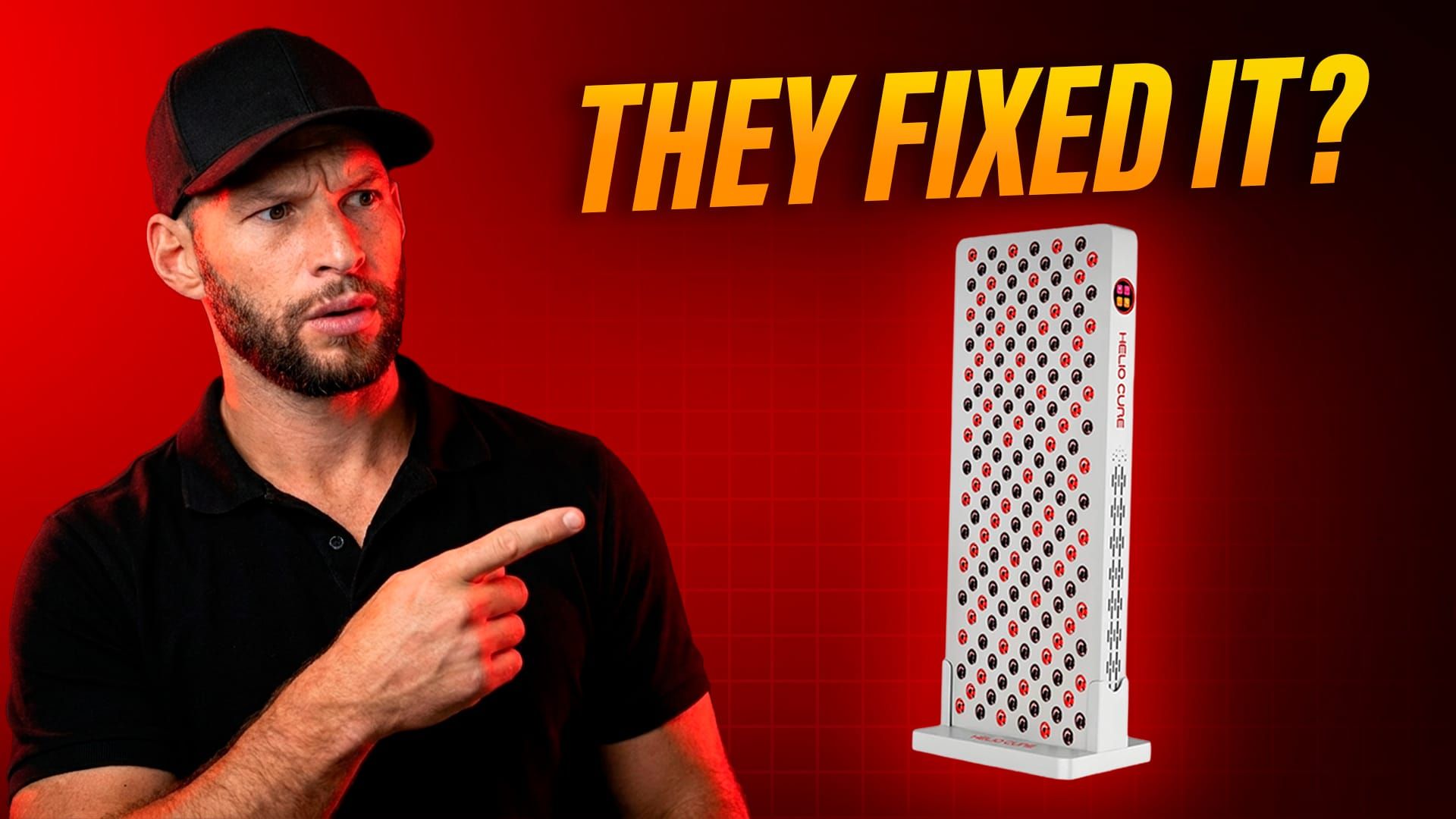
The Helio Cure Glow is back, and this time there are some meaningful changes.
I reviewed an earlier version of this red light therapy panel a few months ago, and while I liked some things, it also had several problems. It lacked a proper hanging setup, the price was relatively high, and most importantly, the wavelengths I measured didn't line up particularly well with what was being advertised.
To Helio Cure's credit, the company didn't simply ignore those criticisms. They changed the panel, lowered the price, added mounting options, and had Light Lab International independently test the updated device.
So, did those changes actually fix the Helio Cure Glow—and has my opinion of the panel changed?
Helio Cure Glow Specs and Features
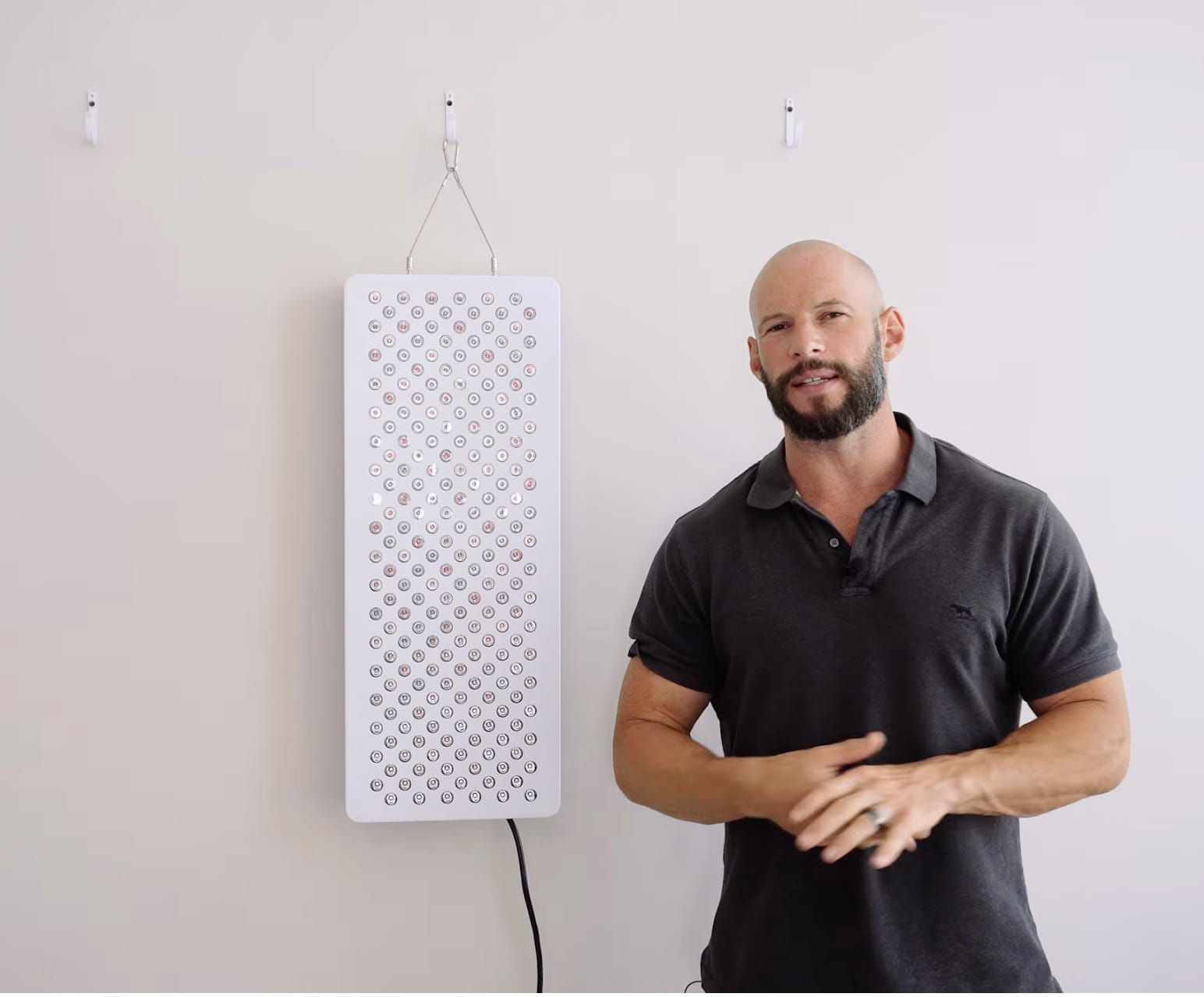
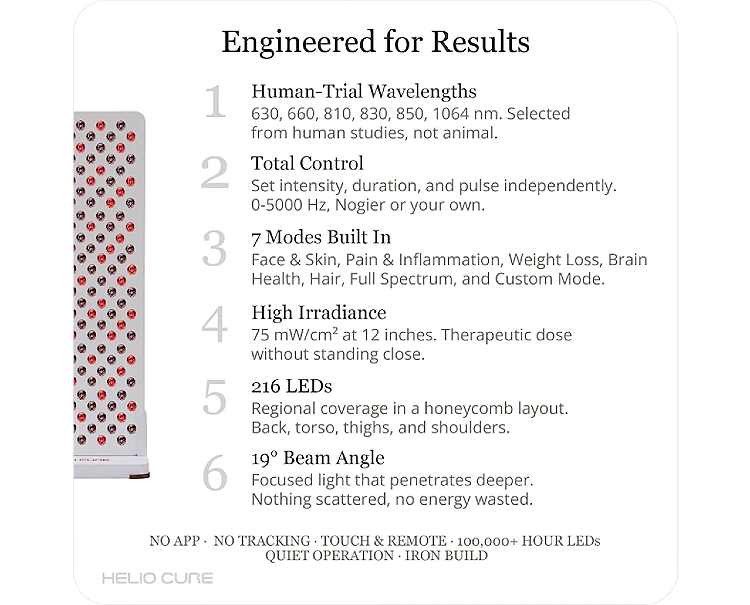
The updated Helio Cure Glow is a 216-LED red and near-infrared light therapy panel measuring approximately 30 inches tall by 12 inches wide and weighing around 20 pounds.
It uses six wavelengths: 630nm, 660nm, 810nm, 830nm, 850nm, and, most interestingly, 1064nm. It also offers pulsing, several preset treatment modes, touchscreen controls, and a remote.
Helio Cure also addresses one of my complaints about the original model by offering far more flexibility in mounting the panel. It now includes a basic floor stand, a wall-hanging hook, and a door-hanging hook. More substantial rolling and electric stand options are available separately if you want to build a larger setup.
But what really separates this panel from most of the competition is the amount of 1064nm near-infrared light it produces.
What's So Special About 1064nm?
We're starting to see more red light therapy products incorporate wavelengths around 1060–1070nm, but many panels dedicate only a small percentage of their LEDs or total output to these wavelengths.
The Helio Cure Glow takes a different approach.
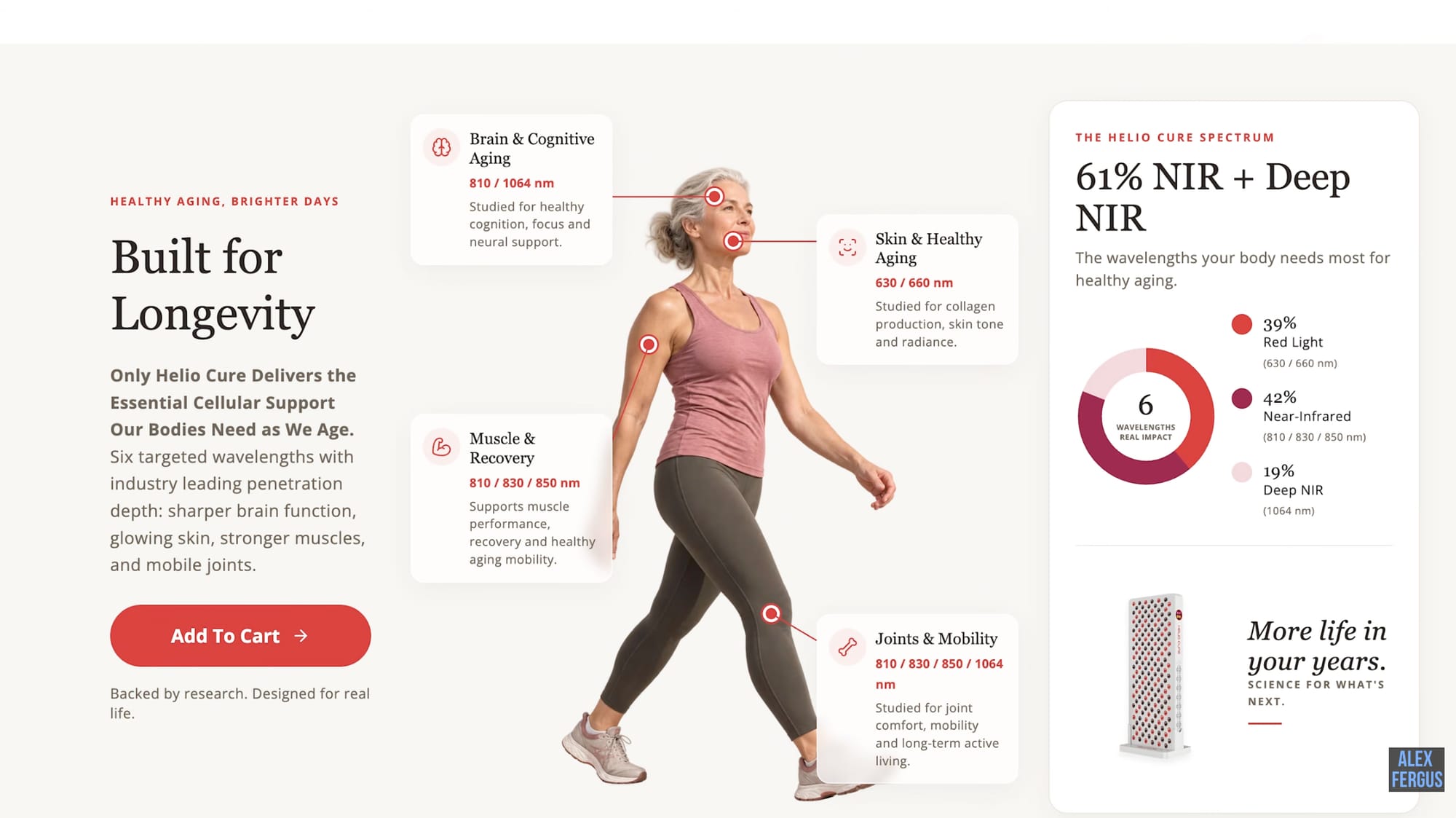
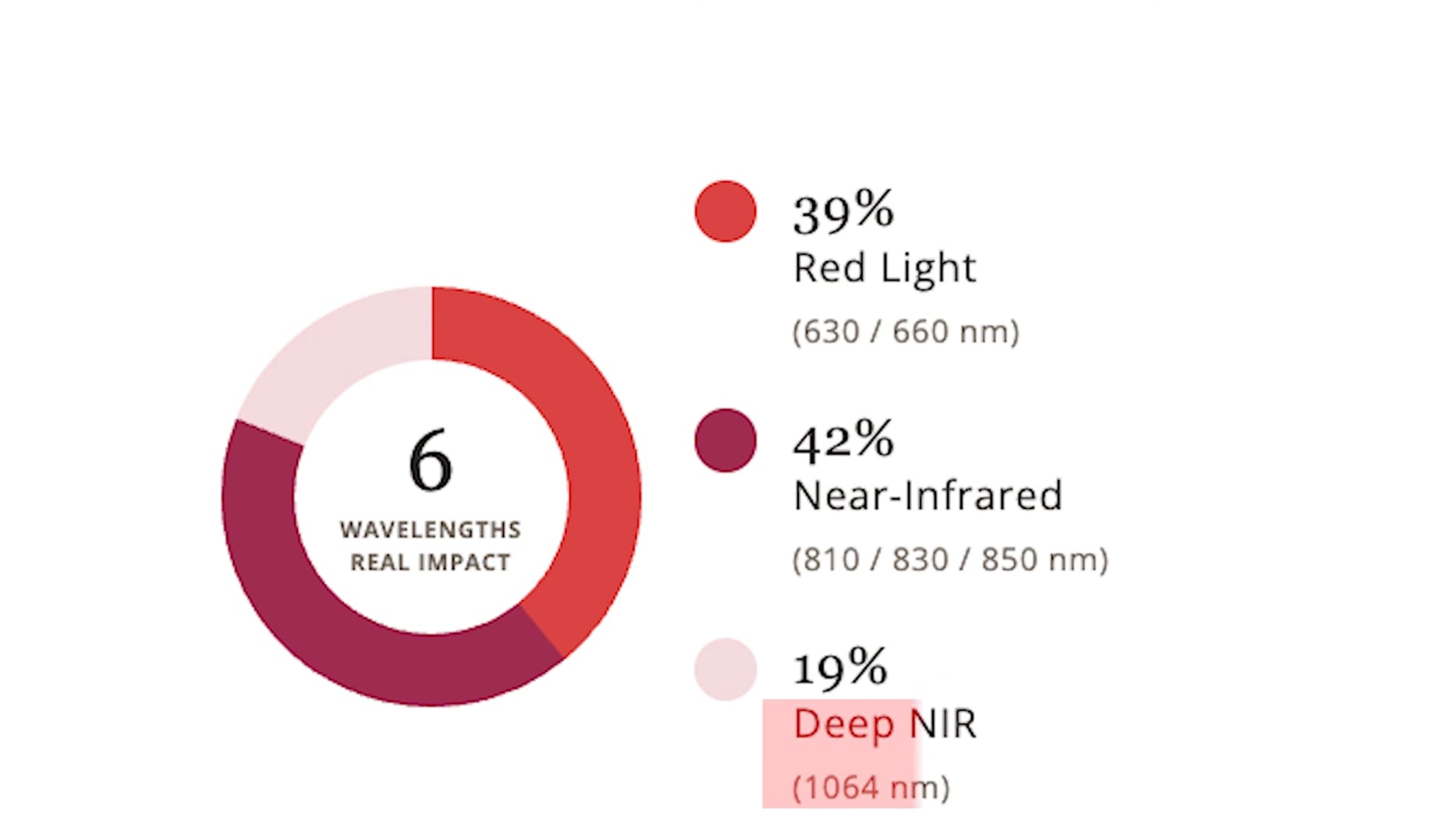
Approximately 20% of the panel's energy is dedicated to 1064nm. Another 20% goes to 810nm, while 830nm accounts for 14% and 850nm for 8%. The remaining output is distributed across the 630nm and 660nm red wavelengths.
That makes this a particularly near-infrared-heavy panel.
The interest in 1064nm comes partly from its ability to penetrate relatively deeply into tissue. Research involving wavelengths in this region has explored applications including cognitive function and transcranial photobiomodulation, as well as areas such as joints, tendons, dental health, and osteoarthritis.
This doesn't mean that simply adding 1064nm automatically makes a red light therapy panel better. However, if you're specifically looking for substantial output at this wavelength, the Helio Cure Glow offers considerably more emphasis on it than many conventional panels.
Independent Testing Makes a Big Difference
One of my biggest concerns with the previous Helio Cure panel was the discrepancy between the advertised wavelengths and what I measured.
That has now been addressed.
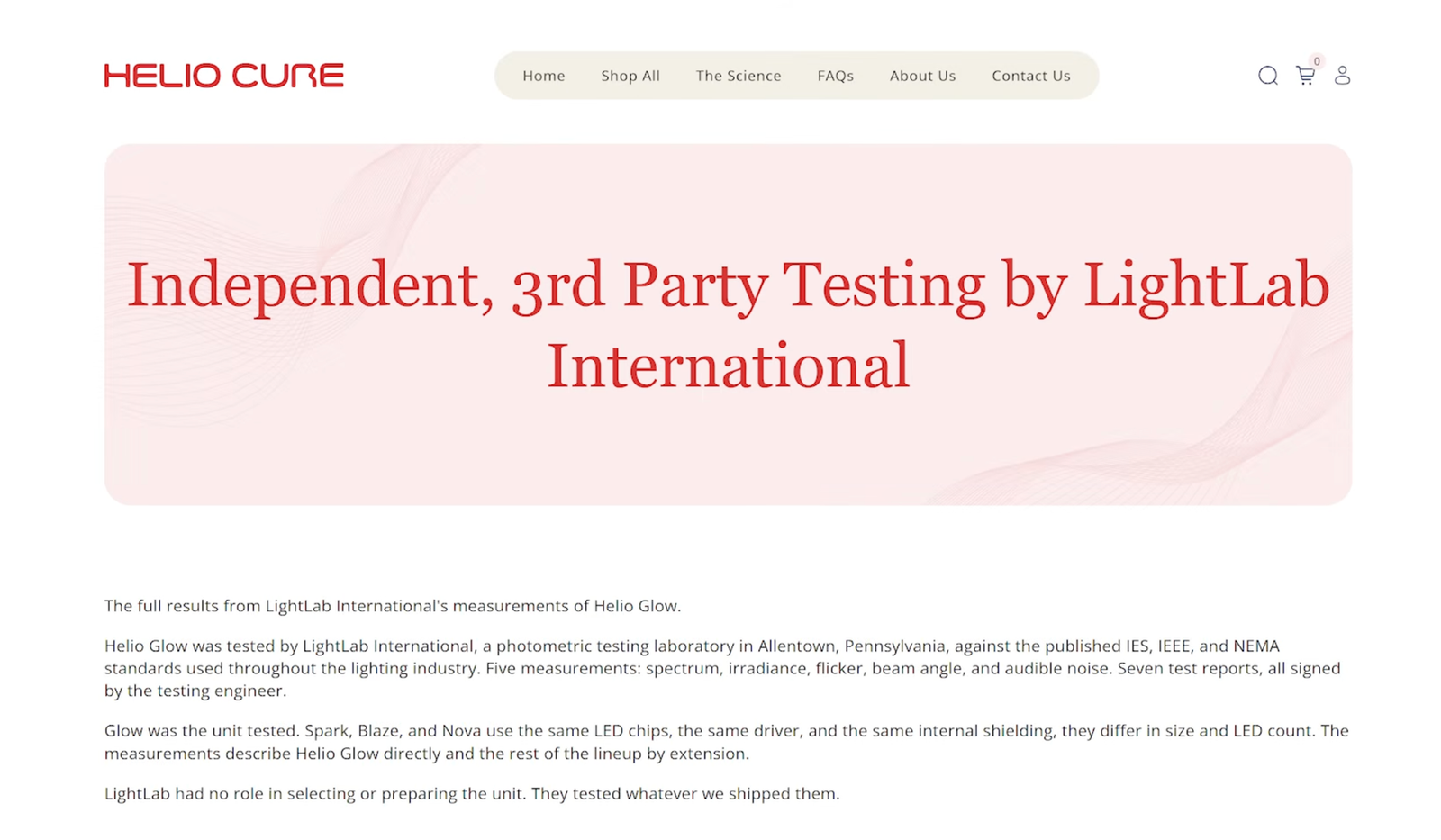
Helio Cure sent the updated panel to Light Lab International for independent testing and has made those testing reports available. This provides third-party measurements for wavelengths, irradiance, EMF, flicker, and other performance data.
That's something I want to see more manufacturers doing.
Independent testing makes it easier for reviewers to know what they're actually testing, but more importantly, it gives consumers access to information beyond the numbers printed on a manufacturer's product page.
In fact, independent laboratory data is becoming so important that, going forward, it will increasingly factor into which panels I choose to review.
Irradiance and Power Testing
At six inches, the Helio Cure Glow produced an irradiance figure of approximately 71 mW/cm².
What's particularly interesting is how that energy is distributed. Around 46.5 mW/cm² came from near-infrared wavelengths, while roughly 24.5 mW/cm² came from red light. In other words, about two-thirds of the measured output is in the near-infrared range.
Total radiant power was approximately 116 watts.
This reinforces the point that the Glow shouldn't necessarily be viewed as a typical balanced red/NIR panel. Its wavelength distribution clearly favors deeper-penetrating near-infrared light, particularly with its substantial 1064nm component.
Noise measured around 52.6 dB, which is somewhat louder than I would ideally like to see from a modern red light therapy panel.
Price and Value
Another major change is the price.
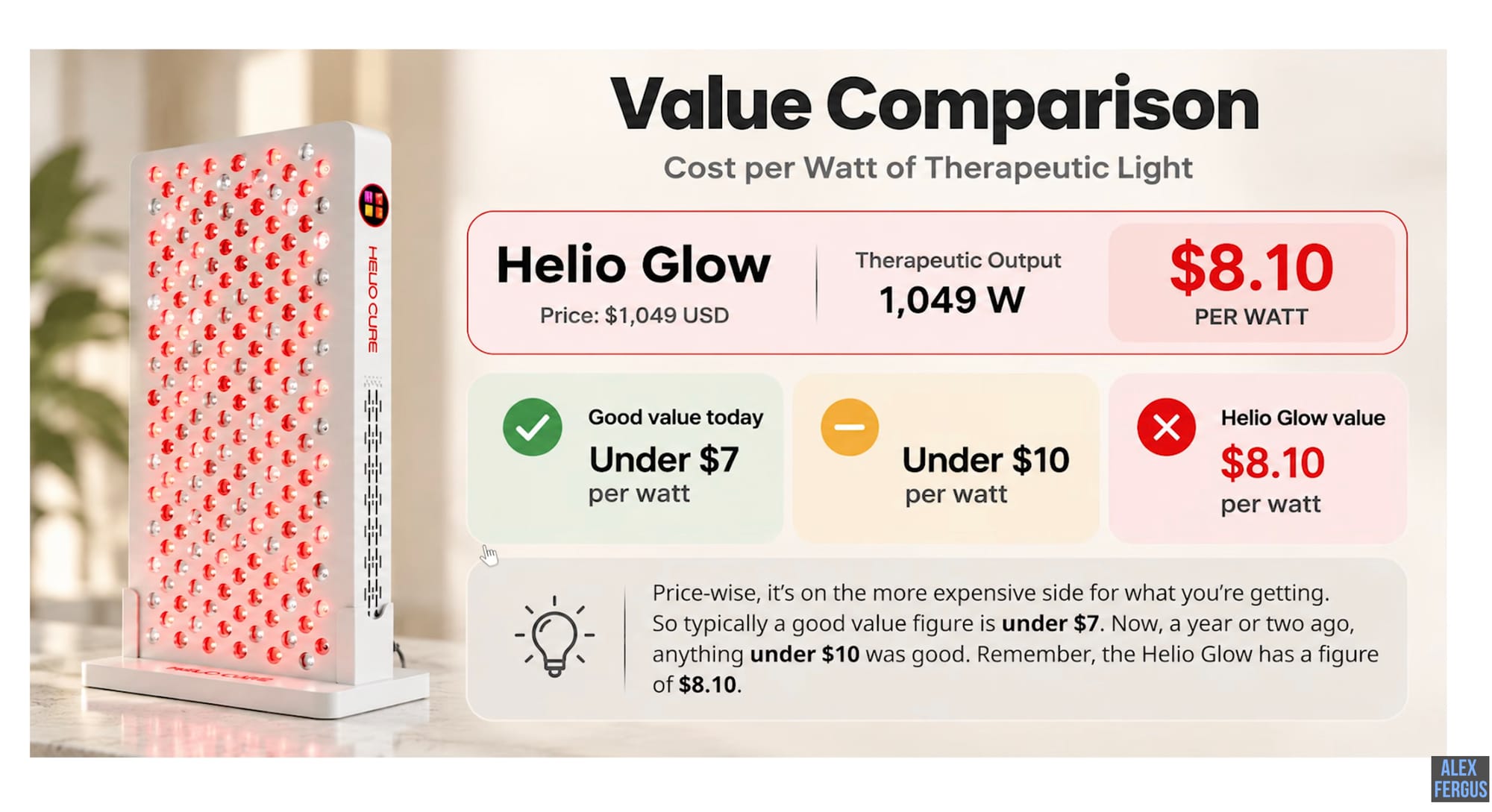
The Helio Cure Glow now retails for $1,049, and my discount brings that down to approximately $945, with free shipping in the United States.
Based on the therapeutic radiant output, my value calculation came out to approximately $8.10 per watt.
That's not terrible, but the market has become increasingly competitive. A couple of years ago, anything below roughly $10 per watt looked quite attractive. Today, I generally like to see good-value panels coming in below approximately $7 per watt.
There is an important caveat, though: 1064nm LEDs are more expensive to implement. You're not simply paying for the same wavelength configuration found in dozens of cheaper panels. A portion of that premium is likely tied to the unusually large amount of 1064nm output.
Whether that's worth paying for depends on how much you actually value that wavelength.
Accessories, Controls and Preset Modes
Helio Cure has significantly improved what comes with the panel. The included basic floor stand is particularly welcome. It's not comparable to the premium rolling or motorized stands available for larger setups, but considering it's included in the price, it's a useful addition.
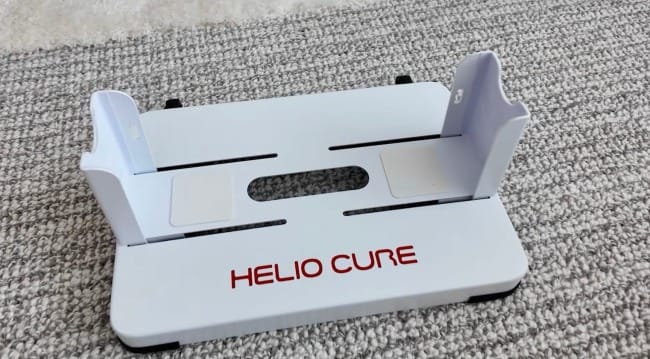
You also get wall and door-hanging hardware plus a remote control, although, strangely, the remote doesn't come with batteries.
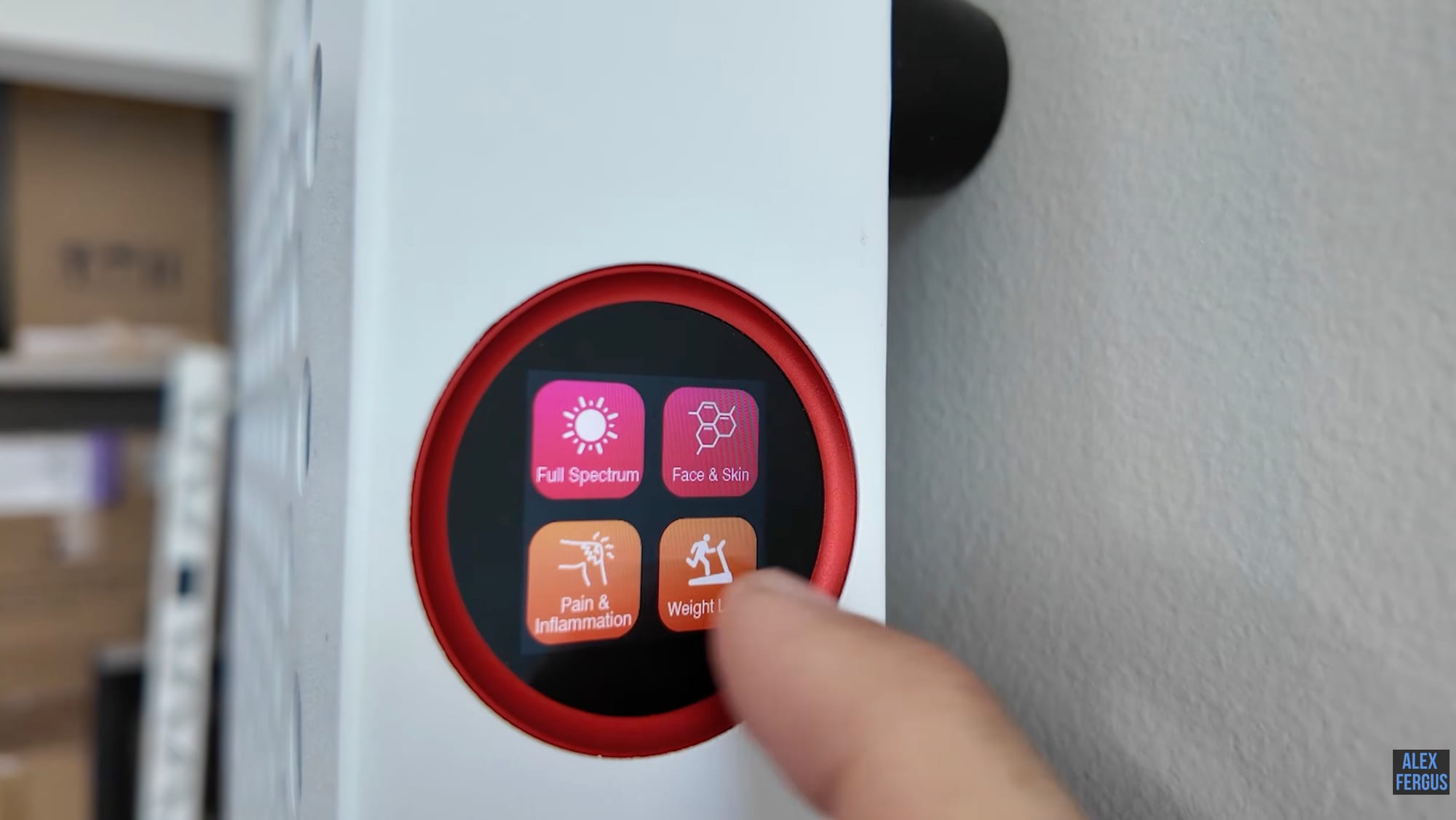
The panel includes several preset programs, including modes for full spectrum, face and skin, pain, inflammation, weight loss, and brain health.
I'm always cautious about preset treatment modes. Red light therapy dosing is more complicated than selecting a goal from a touchscreen. Treatment distance, irradiance, wavelength, treatment duration, skin characteristics, and the target tissue can all influence the dose.
Still, for someone completely new to red light therapy, presets can at least provide a convenient starting point.
What I Like About the Updated Helio Cure Glow
The biggest positive isn't actually a wavelength or performance figure. It's how Helio Cure responded to the problems with its previous panel.
The company received criticism, made changes, and then had the new product independently tested. That's exactly what I want to see manufacturers doing.
I also like the wavelength configuration. With such a large percentage of its energy dedicated to near-infrared light—and particularly 1064nm—the Glow offers something genuinely different from many standard red light therapy panels.
The improved mounting options are another welcome change. Being able to use the included floor stand, hang the panel on a wall or use the door hook gives buyers far more flexibility than before.
Finally, Helio Cure offers a three-year warranty and a 60-day return period with no restocking fee. That's a solid return policy, especially if you're unsure whether this particular wavelength configuration is right for you.
What I Still Don't Like
Despite the improvements, I'd still change a few things.
First, this isn't a particularly large panel. With 216 LEDs, it's on the smaller side compared with some wall panels available today. If you're primarily interested in maximizing treatment area, there are larger options on the market.
My biggest usability complaint is the screen. It works, but it's small, and navigating the custom settings is more frustrating than it needs to be. I'd happily trade some of the colorful icons and graphical elements for a larger, simpler interface that's easier to operate.
Price is another consideration. Even after the reduction, the Glow isn't one of the cheapest options for the amount of therapeutic output you're getting. Again, some of that premium can be explained by the 1064nm LEDs, but buyers who don't specifically care about 1064nm may find better value elsewhere.
There are also a few smaller annoyances. At around 52.6 dB, it's louder than I'd like. The remote doesn't include batteries, and there's no app for people who prefer controlling their devices from a phone.
None of these issues are deal-breakers, but they're worth knowing about.
Should You Buy the Helio Cure Glow?
The Helio Cure Glow makes the most sense for someone specifically interested in near-infrared light and 1064nm.
If your priority is deeper-penetrating wavelengths or you're particularly interested in the research surrounding 1064nm and cognitive applications, this panel stands out because a meaningful percentage of its energy is actually dedicated to that wavelength.
If, however, you simply want a versatile red light therapy panel for general skin health, muscle recovery, joint support, and overall wellness, the decision becomes more complicated. The Glow can certainly be used for those goals, but there are competing panels offering larger treatment areas, better interfaces, or stronger value for the money.
There's also another option if 1064nm is your main interest. If you primarily want to target the head or brain, you may not need a panel this large at all. One of Helio Cure's smaller tabletop devices could potentially give you the wavelength you're looking for without requiring you to spend more than $1,000 on a larger panel.
Ultimately, the updated Helio Cure Glow is a much more compelling product than the version I originally reviewed. Helio Cure fixed several legitimate problems, backed up its new specifications with independent testing, lowered the price, and added useful accessories.
It's still not perfect, and it won't be the best fit for everyone. But if you're specifically shopping for a panel with an unusually high amount of 1064nm and near-infrared output, the Helio Cure Glow now has a much clearer reason to be on your shortlist.
Items Mentioned
⭐ Heli0 Cure - use code ALEX to save 10%.
👉 https://aferg.com/Helio
⭐ My Chat Recommendation Free Tool: 👉 http://aferg.co/help
⭐ Verified Deals & Active Discounts: 👉 https://aferg.co/deals
You May Like These Reviews:
🔴 Mito Red Light Review: Are They Still Worth It?
🔴 Inside Vielight's Red Light Therapy Brain & Body Impact
🔴 Pulse Light vs Continuous: What Actually Matters in Red Light Therapy
🔴 Red Light Therapy For Hair Regrowth: HUGE 6-Month Test!
Found This Interesting? Look At These Articles:
🔴 Red Light Therapy And Cancer: What You Need To Know From The Most Important Studies
🔴 Sun Exposure & Melanoma Risk: The Huge Light Therapy Implications
🔴 Gut Health & Red Light: A Surprising Connection
🔴 Red Light Therapy For Migraines 101: Why The Research Is Super Promising!
Alex's Bio
This blog post was written by Alex Fergus. Alex is a ISSN Sports Nutrition Specialist, Fitness Professional and certified Superhuman Coach who continues to expand his knowledge base and help people across the world with their health and wellness. Alex is recognized as the National Record Holder in Powerlifting and Indoor Rowing and has earned the title of the Australian National Natural Bodybuilding Champion. Having worked as a health coach and personal trainer for over a decade, Alex now researches all things health and wellness and shares his findings on this blog.