

🔥🔥 Check this blog daily for the latest 2026 Red Light Therapy Black Friday and Cyber Monday deals: https://aferg.co/black-friday-cyber-monday 🔥🔥
The INIA Glow 4D red light therapy mask is one of the newer masks on the market, and it comes packed with features that caught my attention. With 460 light chips, multiple wavelengths, built-in controls, and a completely cordless design, there's a lot to like about this device. However, after putting it through my independent testing process, I discovered one significant drawback that could affect whether it's the right mask for you.
I've tested about 35 red light therapy masks over the years, so I've developed a solid understanding of what makes a mask worth buying. For this review, I evaluated the INIA Glow 4D across my usual categories, including comfort, operation, wavelengths, therapeutic dose, facial coverage, price, and warranty. It scored an impressive 77.5 out of 100, making it one of the higher-scoring masks I've tested, but that doesn't necessarily mean it's perfect.
INIA Glow 4D: Key Features and Specifications
Before getting into my testing results, here's a breakdown of what the INIA Glow 4D offers.
| Feature | INIA Glow 4D |
|---|---|
| Light chips | 460 |
| LED clusters | 92 |
| Light technology | LEDs and laser diodes |
| Wavelengths | 460, 610, 630, 660, 850, 940 nm; 1060 nm claimed |
| Treatment modes | Red, blue, purple, red/amber |
| Session durations | 5, 10, or 15 minutes |
| Default session | 10 minutes |
| Measured calculated dose | 10.8 J/cm² |
| Controls | Built into the mask |
| Charging | USB-C |
| Retail price | $360 |
| Warranty | 2 years |
| Return period | 90 days |
| Overall score | 77.5/100 |
On paper, this is a feature-rich mask, especially considering its relatively affordable price when discounts are available. But as I've learned from testing dozens of devices, specifications only tell part of the story. How those features perform in real-world use is what matters.
Round 1: Comfort and Operation
Comfort and Fit: My Biggest Complaint
Comfort is always one of the first things I evaluate because even the best-performing red light therapy mask isn't particularly useful if you don't enjoy wearing it. Unfortunately, this is where the INIA Glow 4D disappointed me.
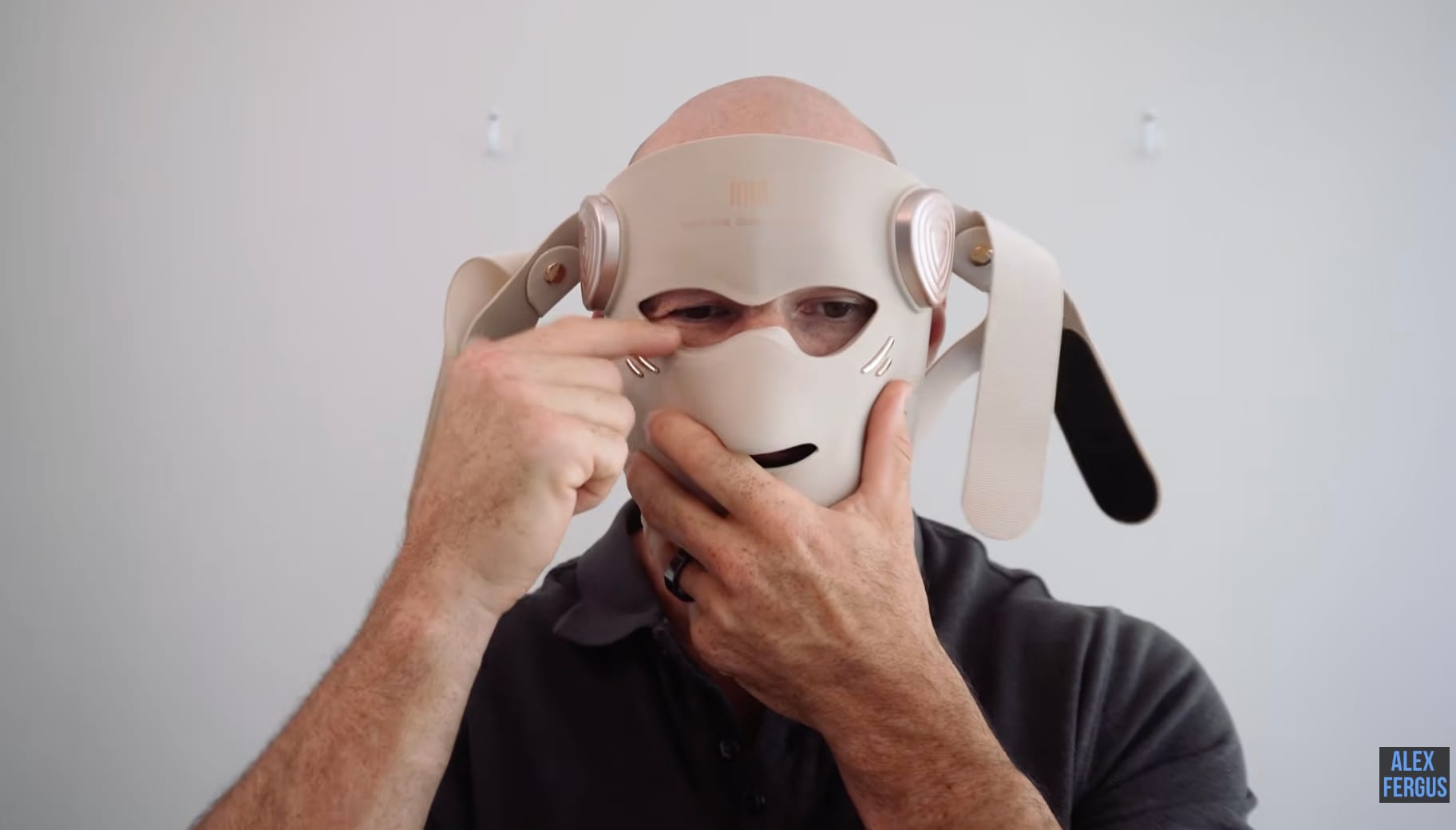
The mask comes with a rear strap and an additional overhead strap that can be removed. Putting it on is straightforward, but getting it to sit comfortably is another story. I found the mask heavier than a typical lightweight silicone mask, and without the overhead strap, it tended to slump forward on my face.
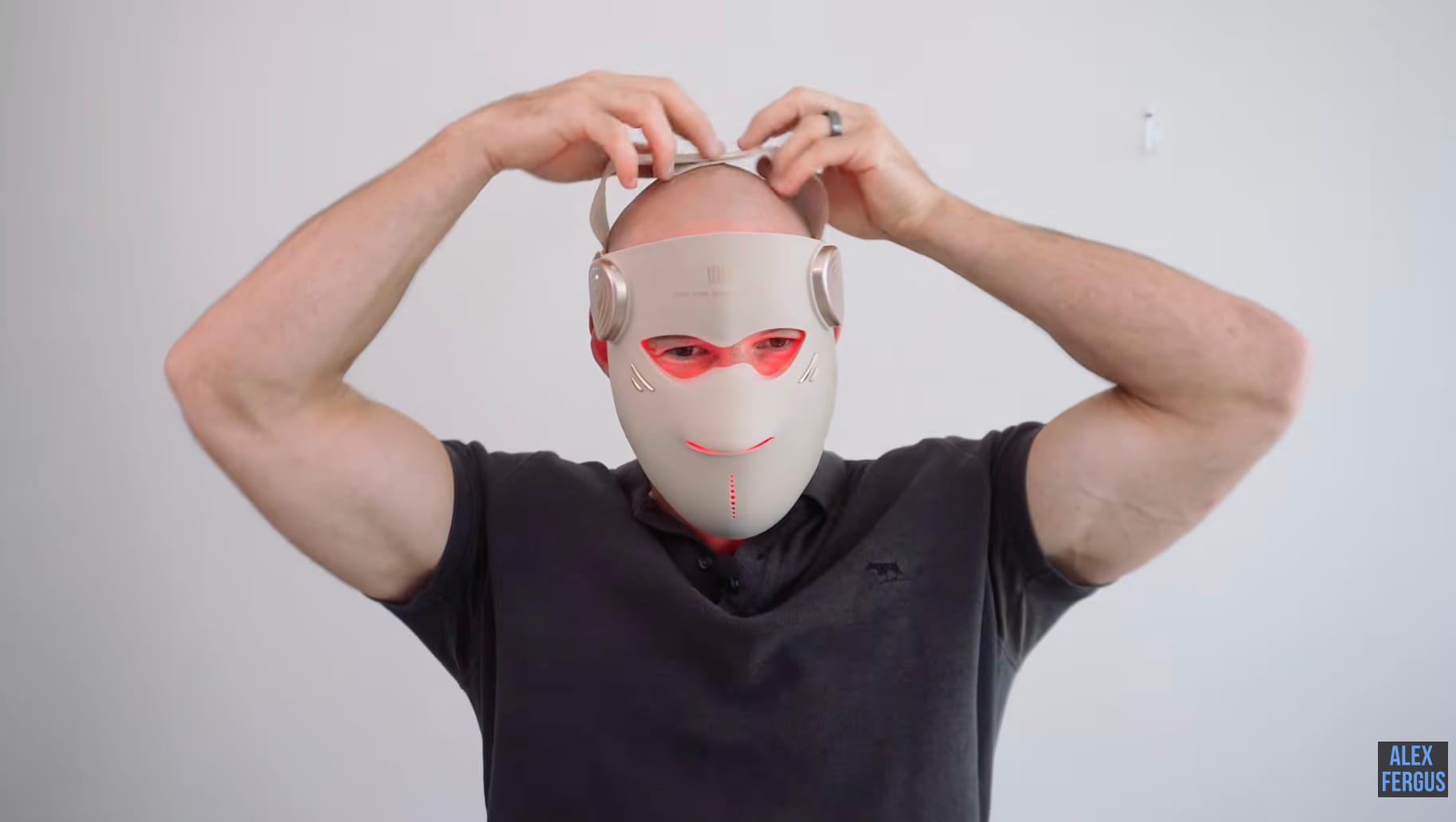
To prevent that movement, I had to tighten the rear strap considerably. That created pressure around my forehead and the back of my head, which became uncomfortable during longer sessions. Adding the overhead strap helped stabilize the mask, but I still noticed discomfort after approximately five to ten minutes.
There are some positives. I could breathe and speak comfortably while wearing it, and visibility through the eye openings was good. There was also plenty of space around my nose and mouth, although I experienced a little pressure on the bridge of my nose.
My biggest concern is the overall weight distribution. The mask seems to pull forward, and tightening the straps enough to prevent that movement creates additional pressure. I experienced this consistently across several uses, not just during the review.
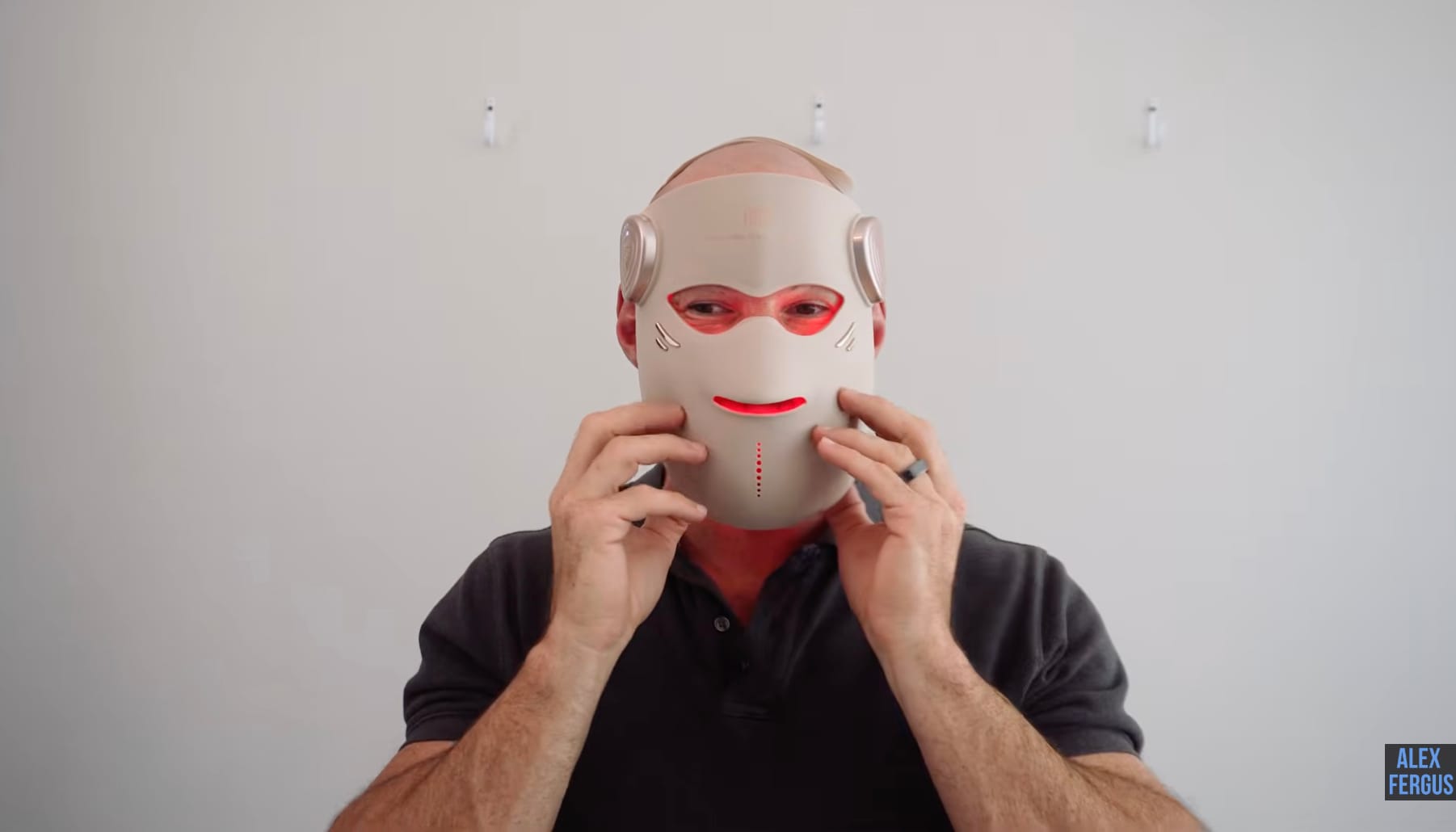
It's worth mentioning that facial structure makes a difference. My face may be shaped differently from yours, and someone with smaller features might find the fit more comfortable. If you plan to lie down during treatments, the weight may also be less noticeable.
Nevertheless, comfort is an important consideration, especially if you want to wear your mask while walking around or completing everyday tasks.
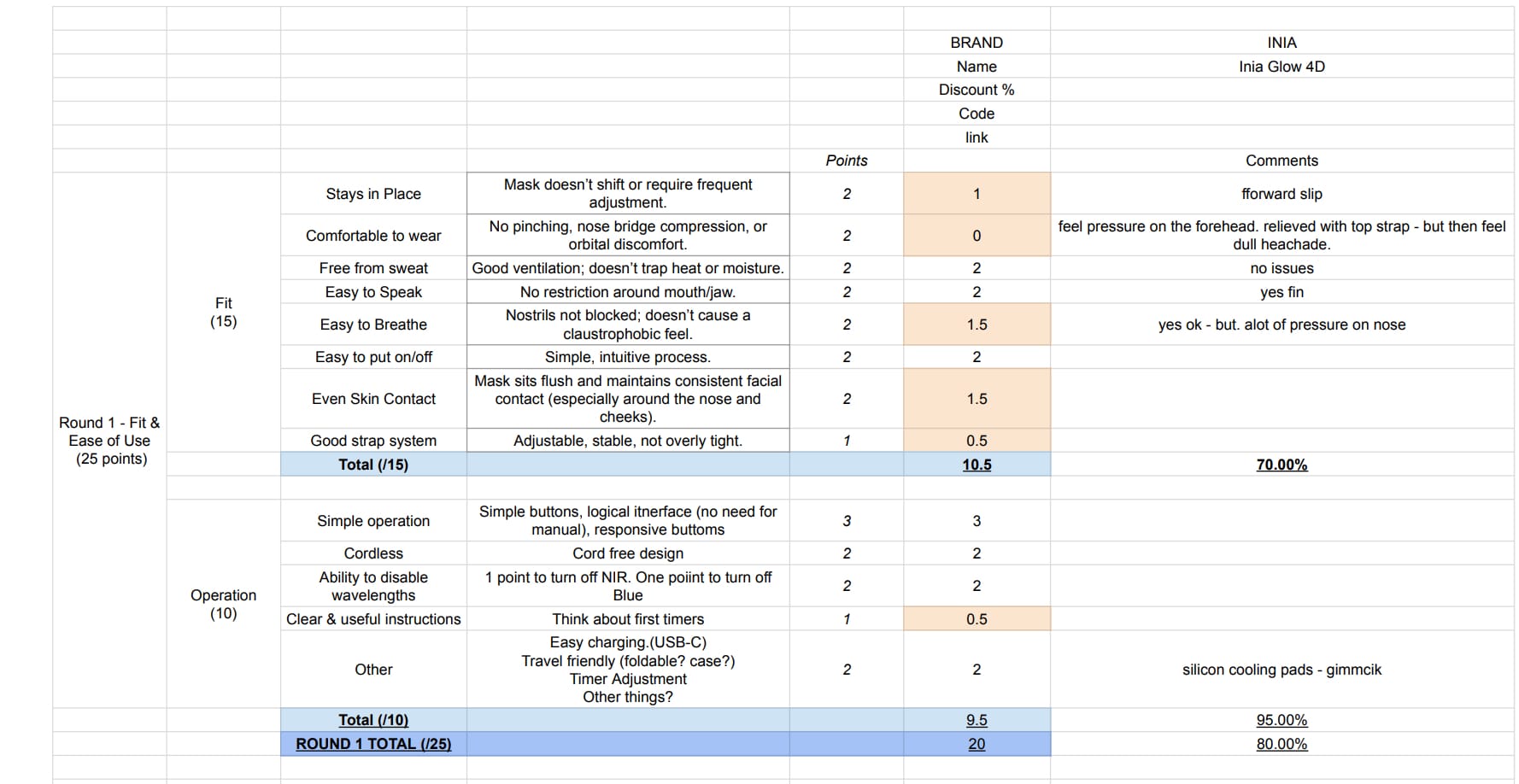
Comfort and Fit Score: 10.5/15
Operation and Ease of Use: Almost Perfect
While the comfort disappointed me, the INIA Glow 4D's operation is one of its strongest features. In fact, I think the overall control design is close to ideal for a red light therapy mask.
One of my favorite features is that everything is built directly into the mask. There are no external controllers, dangling cords, or separate battery packs to carry around. The controls sit on the sides of the device, making the entire setup compact and convenient.
I've tested plenty of masks with external controllers, and while they certainly have advantages, the cords can sometimes get in the way. With the INIA Glow 4D, you simply put the mask on, select your settings, and begin your treatment.
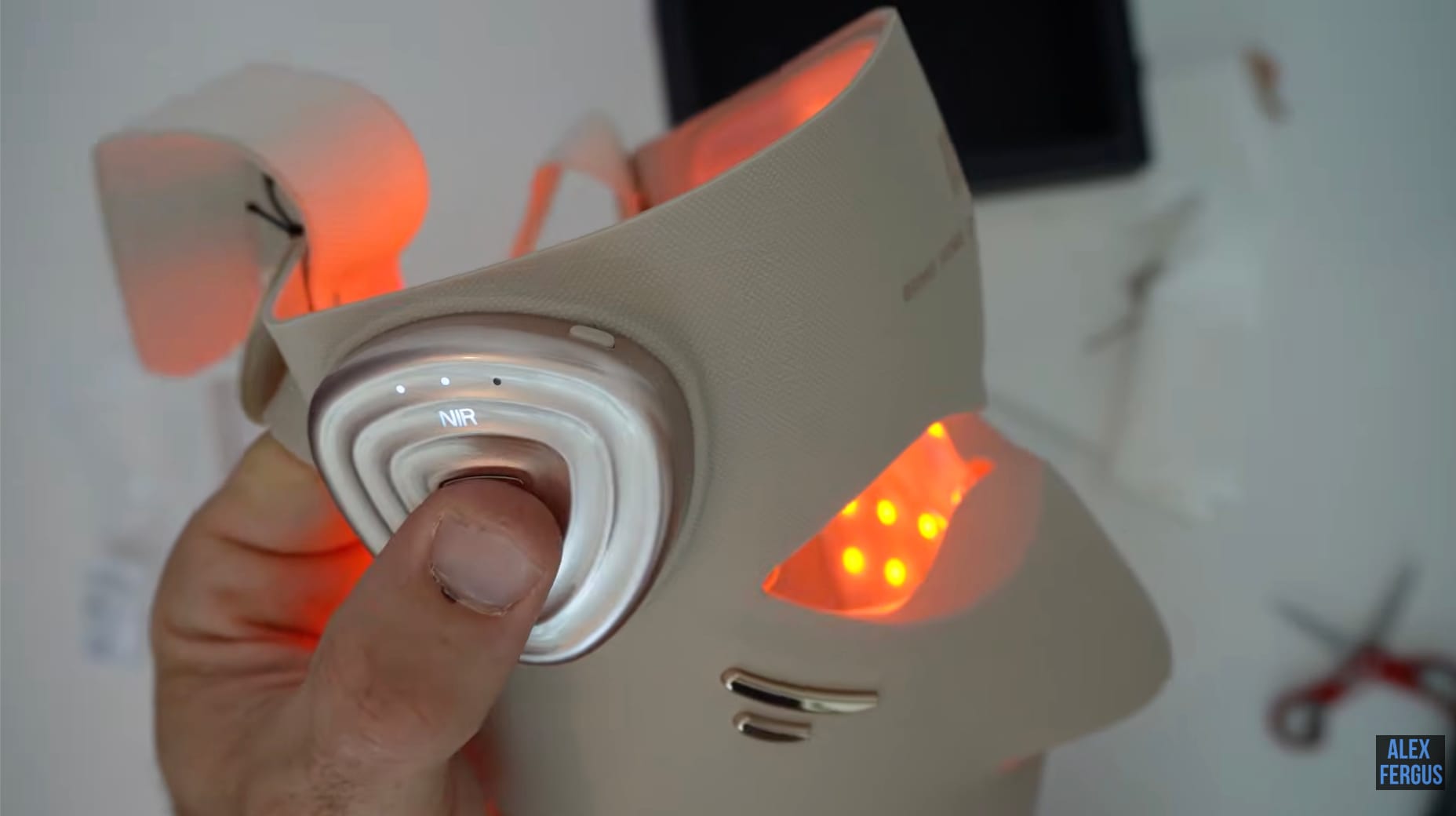
Built-In Voice Announcements
One interesting feature is the small built-in speaker that announces the selected treatment mode. When you change settings, the mask provides an audio announcement, so you know which mode you've selected without needing to remove it.
I really like this approach, although there's room for improvement. For example, it would be helpful if pressing a button during treatment could announce how much time remains in your session. That would make the system even more convenient.
Multiple Treatment Modes
The mask offers several light combinations, including red, blue, purple, and red/amber modes. You can also choose between five-, ten-, and fifteen-minute treatment sessions, giving you flexibility depending on your preferences.
Charging is handled through USB-C, and the flexible design allows the mask to fold for travel. It also includes a printed instruction manual, which provides the essential information needed to operate the device.
Are the Cooling Eye Inserts Worth Using?
The INIA Glow 4D also comes with removable inserts that attach magnetically beneath the eyes. They're marketed as cooling accessories, but I wasn't particularly impressed.
The inserts are made from a transparent material, and I didn't notice any meaningful cooling sensation when using them. They essentially felt like additional plastic padding against my face.
More importantly, they introduce two potential disadvantages. First, they push the mask farther away from the skin, increasing the distance between the LEDs and the treatment area. Second, the material itself can reduce the amount of light reaching the skin.
I haven't specifically tested the light transmission through these inserts, so I can't provide an exact percentage of light loss. However, based on my previous testing of light passing through other materials, I wouldn't expect them to improve treatment performance.
Personally, I would leave these accessories off. Overall, I was very impressed with the operation, and the cordless design, integrated controls, and audio announcements make this one of the more convenient masks I've tested.
Operation Score: 9.5/10
Round 1 Results:
- Comfort and Fit: 10.5/15
- Operation: 9.5/10
- Total Round 1 Score: 20/25
Need Help Finding Something?
Light Therapy Insiders has hundreds of guides, reviews, interviews, and science articles. Our AI assistant can help you quickly find the most relevant information from across the site.
Ask the LTI AI Assistant →Round 2: Wavelengths and Therapeutic Dose
Wavelength Testing: Lots of Options, But Are They All Useful?
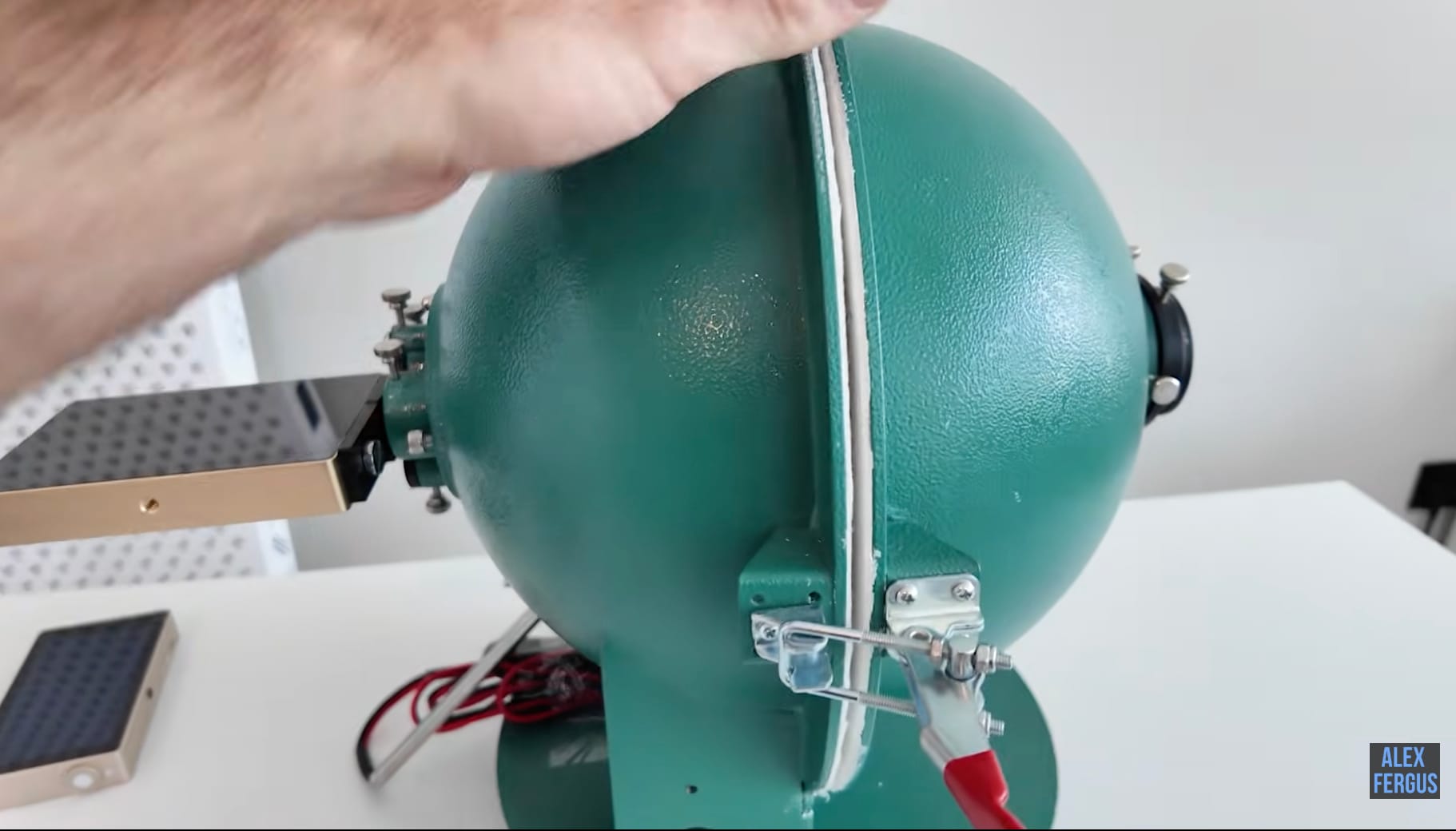
One of the biggest selling points of the INIA Glow 4D is its extensive selection of wavelengths. I tested the device using my integrating sphere to examine its light output and determine which wavelengths were present.
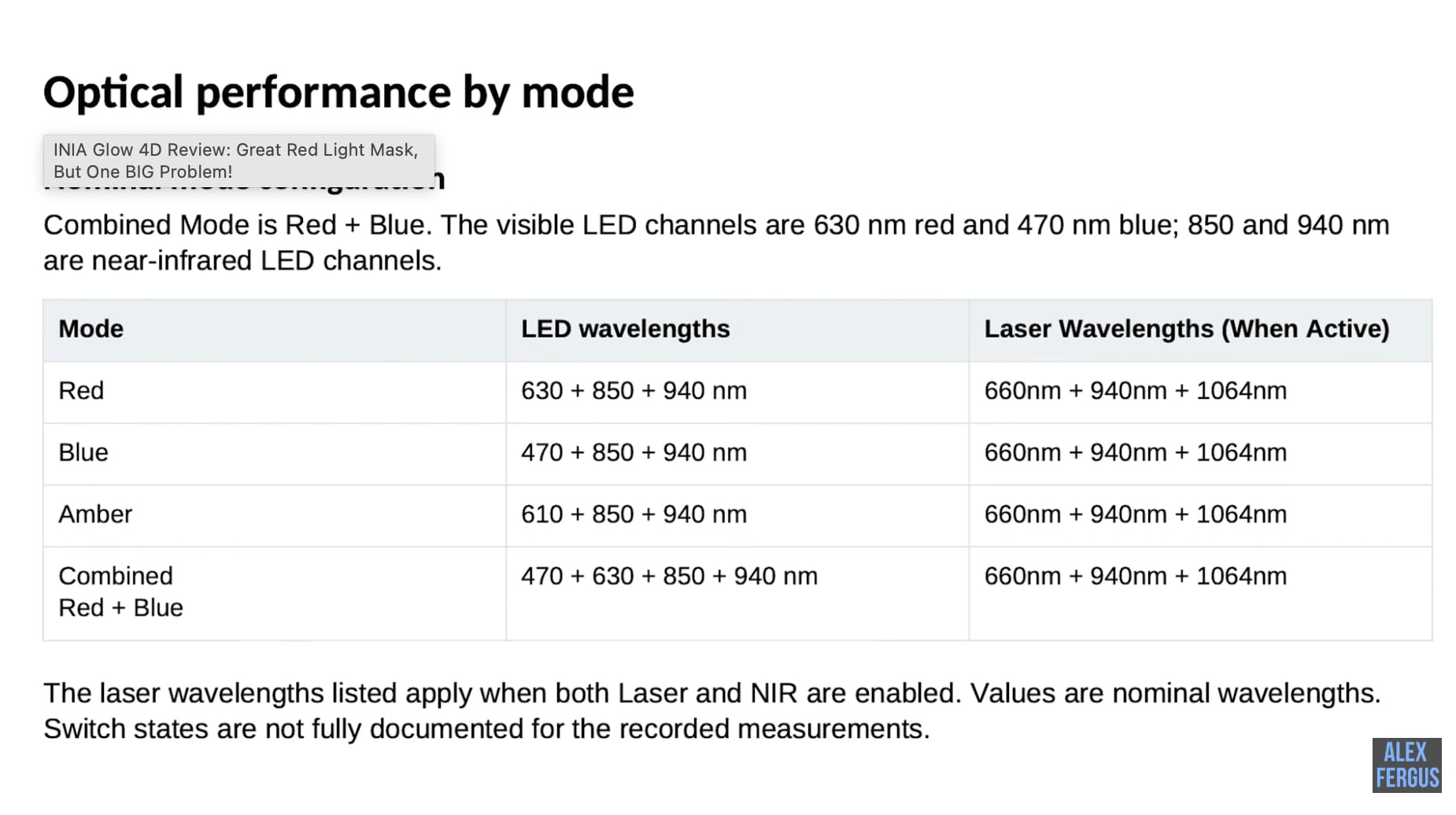
My testing identified several wavelengths across the visible and near-infrared spectrum, including:
- 460 nm: Blue light
- 610 nm: Orange/red light
- 630 nm: Red light
- 660 nm: Red light
- 850 nm: Near-infrared light
- 940 nm: Near-infrared light
- 1060 nm: An additional near-infrared wavelength claimed for the device
That's an impressive selection, but more wavelengths don't automatically mean better results. What matters is whether those wavelengths are appropriate for your intended treatment goals.
Red and Near-Infrared Light
The inclusion of 630 nm and 660 nm red light is a positive, as these are commonly used wavelengths in red light therapy research. The mask also includes 850 nm and 940 nm near-infrared light, giving it a broader range of wavelengths than many simpler devices.
These wavelengths make the mask interesting for people primarily focused on skin appearance and cosmetic light therapy. However, the presence of multiple wavelengths alone doesn't establish how effective a device will be. Power output, treatment duration, and coverage also play important roles.
Is the Blue Light Good for Acne?
The INIA Glow 4D uses blue light at approximately 460 nm, but for acne treatment, I prefer wavelengths closer to 400–420 nm, which are better supported by research. If acne is your main concern, I'd consider alternatives like the CurrentBody acne mask.
What About the Amber Light?
The mask also includes an amber light mode, but my testing measured approximately 607–610 nm, placing it closer to orange-red light. That's not necessarily bad, but it's worth knowing that the wavelength differs from what you might expect from amber light.
LEDs vs. Lasers: Does the INIA Glow 4D Need Both?
The INIA Glow 4D combines traditional LEDs with approximately 60 laser diodes among its 460 light chips. While lasers produce a narrow, concentrated beam, LEDs spread light over a wider area, making them particularly useful for full-face treatments.
Although lasers can be beneficial for targeting specific areas, I'm not convinced they offer a meaningful advantage in a facial mask where even coverage is the priority. Their inclusion doesn't make the INIA Glow 4D a bad device, but I wouldn't consider the lasers a major selling point or a reason to choose this mask over another.
Wavelength Score: 9/10
Therapeutic Dose: Very Close to My Ideal Range
Power output is another important part of my testing process. Rather than simply accepting the manufacturer's advertised specifications, I measure light output across different areas of the mask and calculate the dose delivered during a typical treatment session.
The INIA Glow 4D offers treatment durations of five, ten, and fifteen minutes. Its default session is ten minutes, so that's the duration I used for my calculations.
My testing produced a calculated dose of 10.8 joules per square centimeter (J/cm²) during the default ten-minute session.
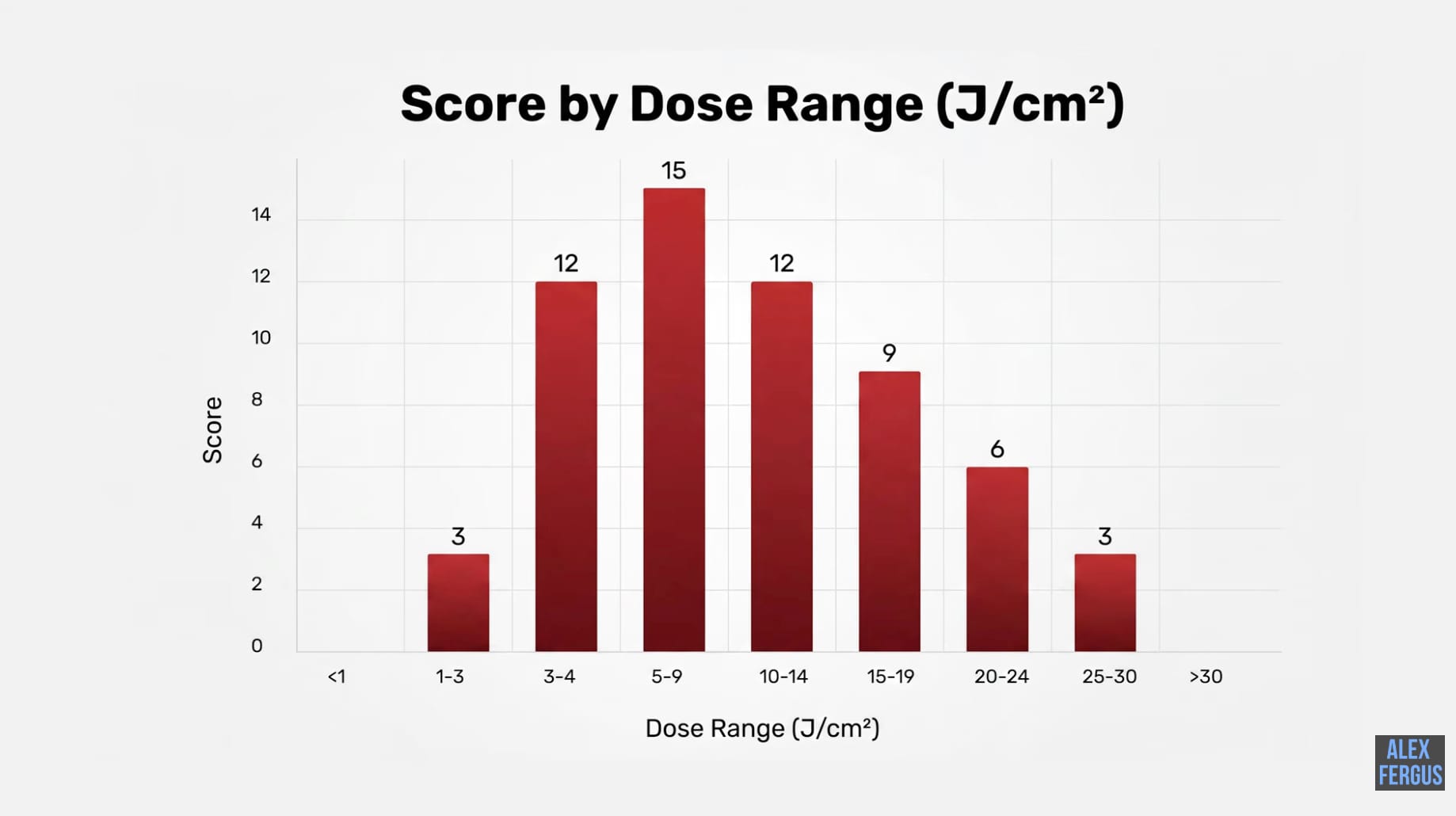
Based on the scientific literature my team and I have reviewed regarding red light therapy and cosmetic applications, this is very close to the dose range we consider desirable. It's slightly toward the higher end of our preferred range, but not something I consider problematic.
This is a strong result for the INIA Glow 4D. Despite some of my concerns about its design, the mask delivers a respectable amount of light during a standard session.
Combined with the wavelength selection, the therapeutic dose is one of the reasons this mask scored well in my testing.
Therapeutic Dose Score: 12/15
Round 2 Results:
- Wavelengths: 9/10
- Therapeutic Dose: 12/15
- Total Round 2 Score: 21/25
Round 3: Chip Count and Facial Coverage
LED Chip Count: 460 Chips Is Impressive
The INIA Glow 4D contains 92 LED clusters, with five light chips in each cluster, giving it a total of 460 chips.
That's a relatively high number compared with many red light therapy masks I've tested. Some masks contain approximately 200–300 chips, while others have significantly more, sometimes reaching 700–900.
Having more chips can help distribute light across the treatment area, although the number alone doesn't guarantee good coverage. Their positioning and the way light spreads across the face are equally important.
I didn't deduct points simply because some of the chips are lasers. Overall, 460 chips is a strong specification, and the mask performed well in this category.
Chip Count Score: 9/10
Facial Coverage: Good on the Chin, Weak Around the Eyes and Nose
Facial coverage is one of the most important factors I consider when evaluating a red light therapy mask. After all, if certain areas of your face receive very little light, they may not benefit from the treatment in the same way as better-covered areas.
For my testing, I divide the face into ten regions and evaluate how effectively the mask illuminates each one. This gives me a more practical understanding of coverage than simply looking at the number of LEDs.
The INIA Glow 4D performs well across several areas, including the forehead, temples, and cheeks. These regions receive relatively good coverage, which is what I would expect from a modern mask.
However, I found noticeable gaps around the eyes and nose.
Poor Coverage Around the Nose and Eyes
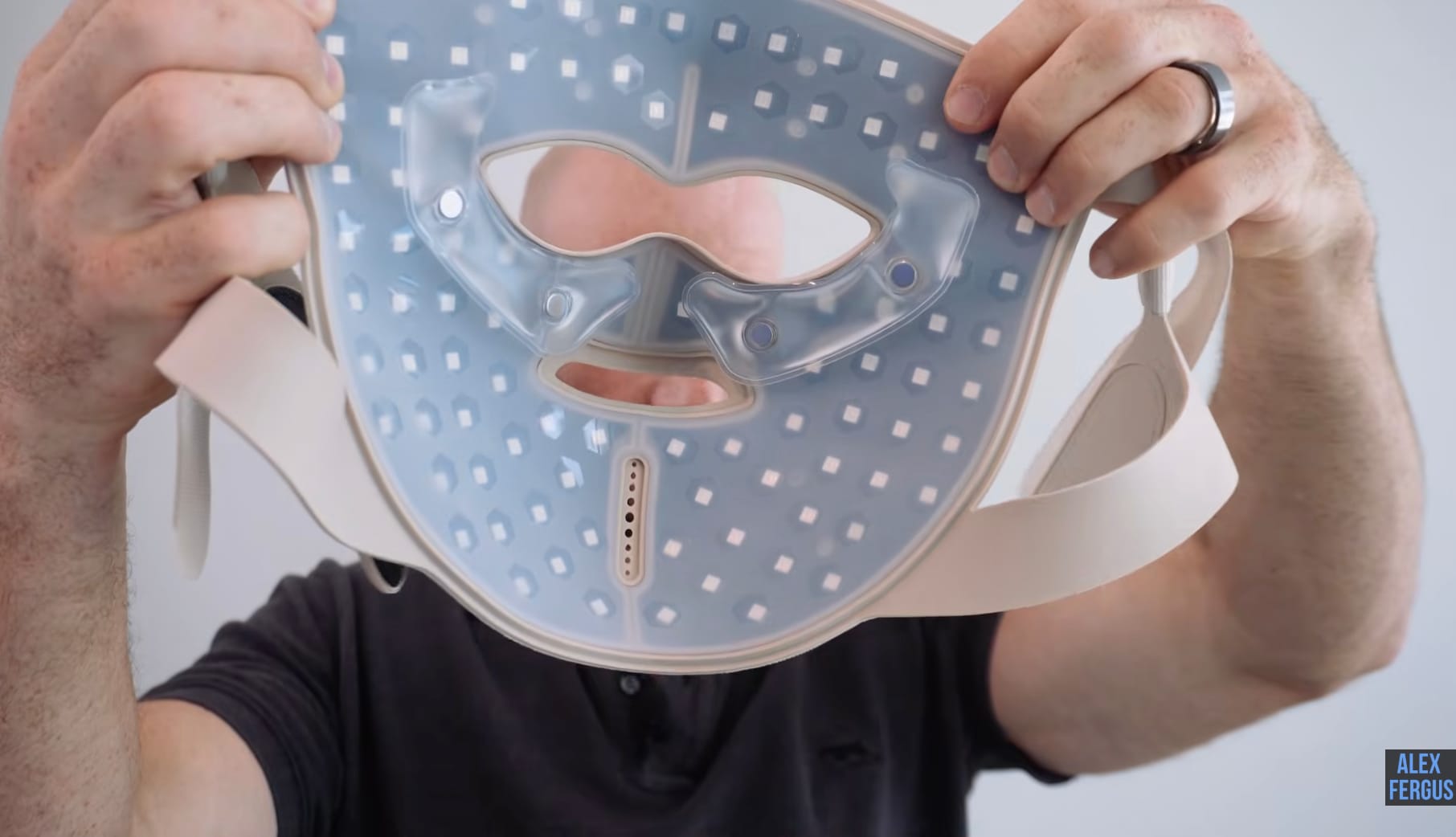
The INIA Glow 4D has noticeable coverage gaps around the bridge of the nose and beneath the eyes, where there are fewer nearby LED clusters. This means these areas receive less light, which is worth considering if you're specifically targeting the skin around your eyes and nose.
When I turn the INIA Glow 4D around, you can see that the white squares are the LED clusters. Looking at their placement, there are noticeable gaps around the eyes and bridge of the nose, where there are few or no LEDs. This means those areas receive less light, making coverage a weakness of this mask.
Better Coverage Around the Jaw and Chin
The INIA Glow 4D provides good coverage across the forehead, cheeks, chin, and jawline, with its extended design reaching farther down the lower face than some competing masks. Coverage around the lips is also reasonable, but the gaps around the eyes and nose prevent it from delivering consistently even coverage across the entire face.
Facial Coverage Score: 9.5/15
Round 3 Results:
- Chip Count: 9/10
- Facial Coverage: 9.5/15
- Total Round 3 Score: 18.5/25
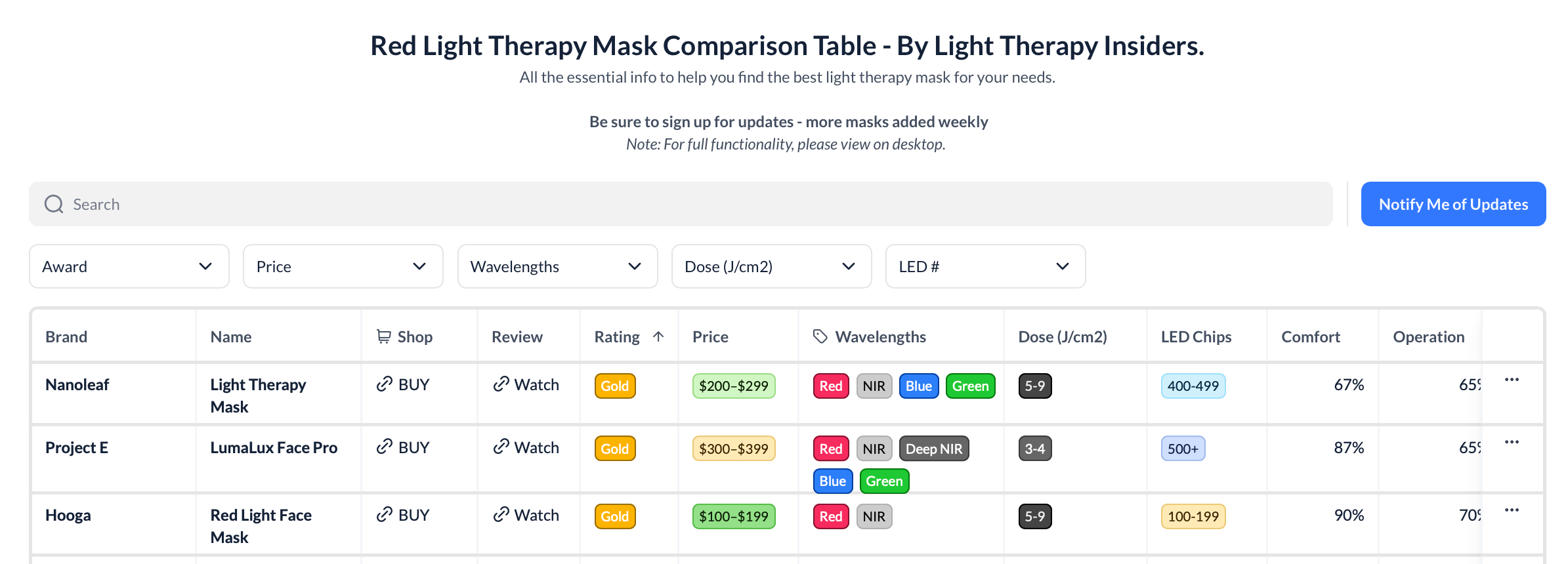
☝️ Use My Mask Comparison Table ☝️
Round 4: Price and Peace of Mind
Price and Value: Is the INIA Glow 4D Worth the Money?
The INIA Glow 4D retails for approximately $360, although discounts could bring the price below $300 or even into the low-$200 range during sales like Black Friday. At those prices, I think it offers excellent value, especially considering its cordless design, built-in controls, multiple wavelengths, and strong therapeutic dose.
However, comfort and facial coverage are its biggest weaknesses. At a discounted price, these drawbacks are easier to overlook, but at full retail price, I'd recommend comparing it with other masks before making a decision.
Price Score: 14/20
Peace of Mind: Warranty and Returns
One thing I really like about the INIA Glow 4D is its warranty and return policy.
The mask comes with a two-year warranty and a 90-day return period, which are attractive terms for someone purchasing a device they haven't had the opportunity to try in person.
That return window is especially important because comfort is my biggest complaint about this mask. What feels uncomfortable on my face might fit someone else perfectly, and having the opportunity to test it for yourself reduces some of the purchasing risk.
INIA has also been around for some time, which contributed positively to my assessment of the company's reliability.
Peace of Mind Score: 4/5
Round 4 Results:
- Price: 14/20
- Peace of Mind: 4/5
- Total Round 4 Score: 18/25
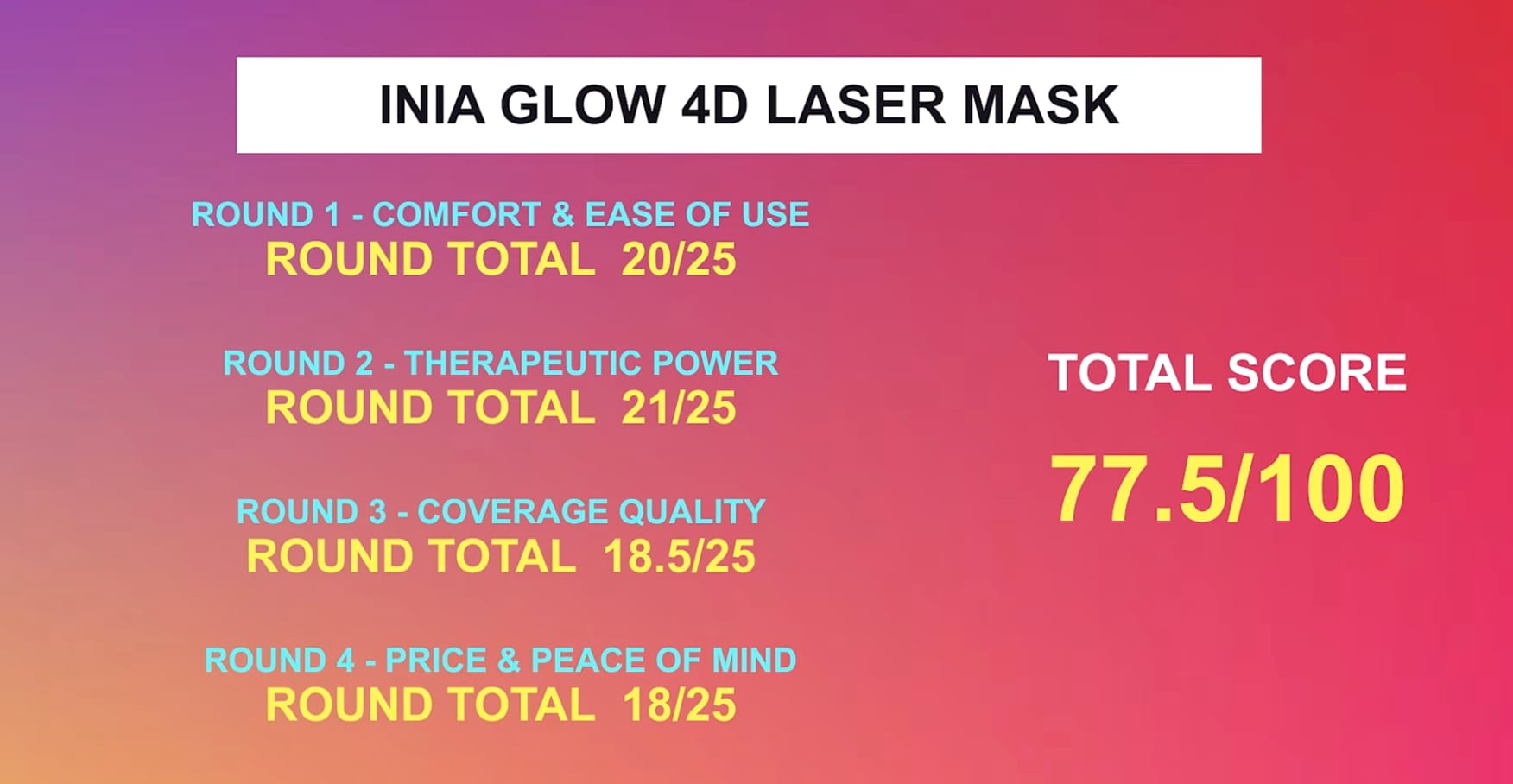
INIA Glow 4D: My Final Test Scores
After completing all four rounds of testing, the INIA Glow 4D achieved an overall score of 77.5 out of 100.
Here's how the results break down:
| Testing Category | Score |
|---|---|
| Round 1: Comfort and Operation | 20/25 |
| Round 2: Wavelengths and Therapeutic Dose | 21/25 |
| Round 3: Chip Count and Facial Coverage | 18.5/25 |
| Round 4: Price and Peace of Mind | 18/25 |
| Final Score | 77.5/100 |
That's an excellent overall result, particularly for a mask that isn't positioned at the very top of the premium price range.
The INIA Glow 4D scores especially well for operation, wavelength selection, chip count, and therapeutic dose. Its weakest areas are comfort and facial coverage, which are worth considering before purchasing.
⭐ Looking to Purchase a Mask? ⭐
Find your go-to red light therapy resources here:
My Final Verdict: Would I Recommend the INIA Glow 4D?
After testing the INIA Glow 4D, I have mixed feelings, although my overall impression is positive.
On one hand, this mask has a lot going for it. I love the cordless design, the built-in controls, and the voice announcements. It offers plenty of wavelengths, a respectable therapeutic dose, and a relatively high chip count. Its overall score of 77.5 out of 100 reflects those strengths.
On the other hand, I can't ignore the comfort issues. I found the mask heavier than I would like, and getting the straps adjusted properly was frustrating. Even after experimenting with different configurations, I experienced discomfort during treatment sessions.
The facial coverage also isn't perfect, particularly around the eyes and nose. And while the combination of LEDs and lasers sounds impressive, I don't think the lasers offer a clear advantage for full-face cosmetic treatments.
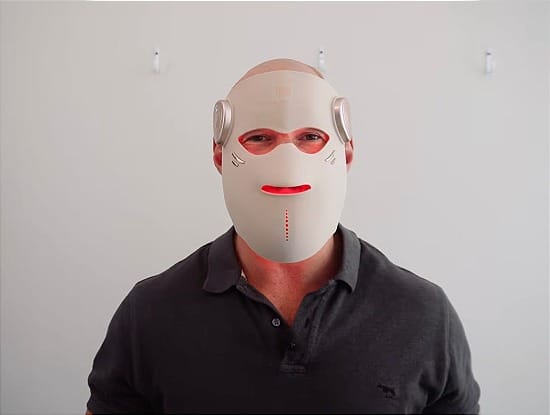
So, Who Should Consider Buying It?
The INIA Glow 4D is worth considering if you want a cordless red light therapy mask with good light output, multiple treatment modes, and plenty of features at a reasonable price. However, comfort is its biggest drawback, and coverage around the eyes and nose could be better.
With a final score of 77.5/100, it's a solid option, especially at a discounted price. The 90-day return period also gives you time to see whether the fit works for you, since you may find it more comfortable than I did.
Items Mentioned
⭐ Use discount code AlexINIA at https://aferg.co/inia
Have You Seen These Reviews?
🔴 Best Red Light Therapy Panels of 2026: 11 Panels Put to the Test
🔴 Red Light Therapy Panel Comparison: Interactive Lab Data for 11 Panels (2026)
🔴 Red Light Mask Buyer's Guide - Avoid These Mistakes!
🔴 PlatinumLED BioMax Go: They Finally Made a Handheld. Is It Any Good?
Alex's Bio
Alex Fergus wrote this article. Alex is the founder and head reviewer of Light Therapy Insiders and has tested and reviewed red light therapy devices since 2017. He measures the devices he reviews with a calibrated spectroradiometer, and in 2026 he had 11 popular panels independently measured at LightLab International (see how we test). He shares his testing with more than 90,000 subscribers on YouTube. Alex is also an ISSN Sports Nutrition Specialist, fitness professional and certified Superhuman Coach, and worked as a health coach and personal trainer for over a decade.